


Asset Based Lending for Trucking Companies (2026 Guide)
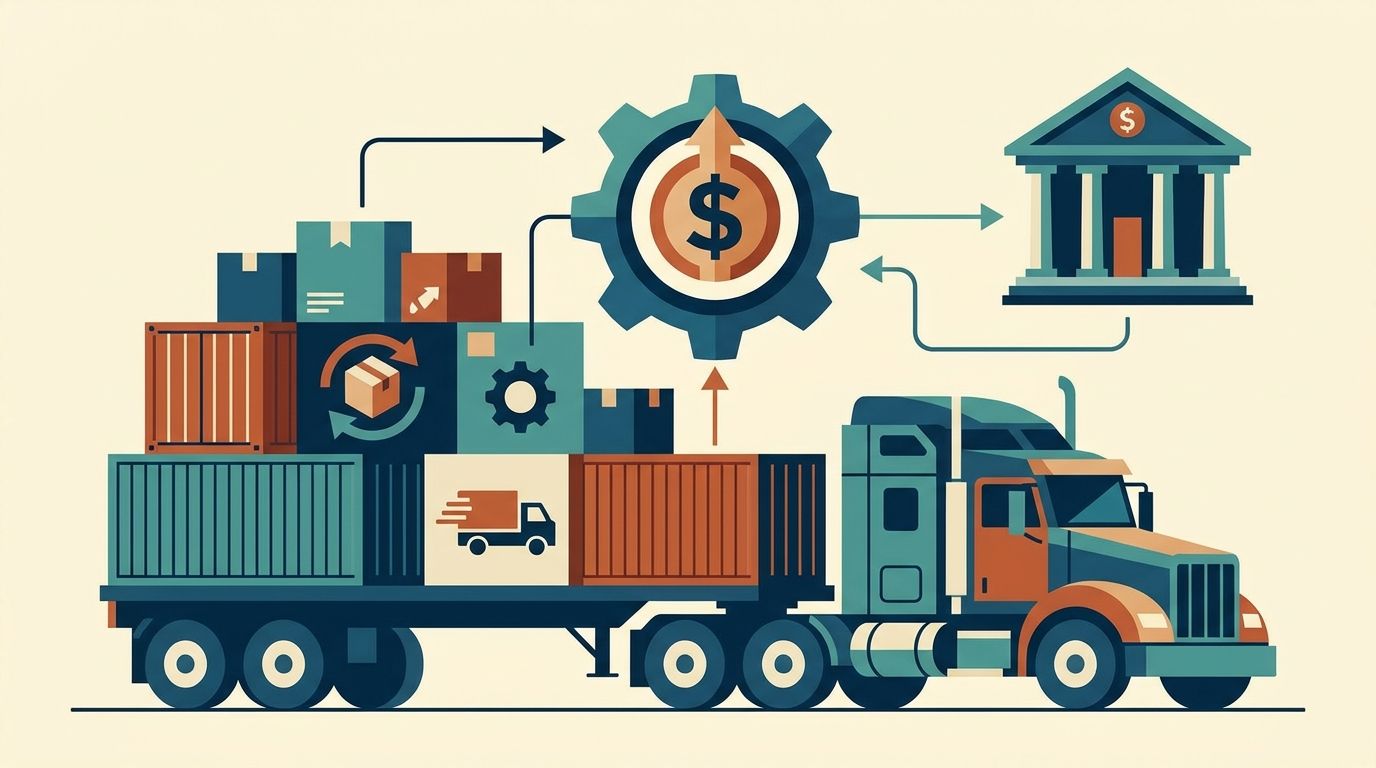
Trucking and logistics companies use asset based lending for trucking companies to turn owned real estate, equipment, and receivables into usable capital instead of relying on tax returns that make thin freight margins look worse than they are. A carrier that owns its terminal, a brokerage sitting on a warehouse, or an owner-operator with a paid-off truck yard all have collateral a bank rarely credits properly. Asset based lending for trucking companies works because it qualifies the asset, not the write-offs on your Schedule C.
TL;DR
- Asset based lending for trucking companies uses owned real estate, equipment, or receivables as collateral instead of tax return income.
- DSCR loans qualify trucking-owned terminals and warehouses off the property's cash flow, not the company's P&L.
- Bank statement loans fit owner-operators whose tax returns understate income after depreciation write-offs.
- Bridge loans close fast for time-sensitive terminal or yard purchases but need a clear exit plan.
- Pre-approval before bidding beats scrambling for financing after a freight downturn hits cash reserves.
Why asset based lending matters for trucking and logistics companies
Trucking is a depreciation-heavy business. Trucks, trailers, and reefer units get written off aggressively, which shrinks taxable income on paper even in a profitable year. Traditional banks read those tax returns literally and decline loans that a company can clearly afford to carry.
Freight rates swing hard by season and by lane, so a bank underwriter looking at trailing twelve months sees volatility instead of a pattern. Asset based lending for trucking companies sidesteps that entirely by pricing the loan against a hard asset or verified cash flow instead of a fluctuating income statement.
Owner-operators face the same wall from a different angle. A driver running under an LLC with strong bank deposits but a tax return full of fuel, maintenance, and lease deductions looks unqualified to a conventional lender even with six figures moving through the account. Bank statement loans for truck drivers and owner-operators exist specifically for that mismatch between real cash flow and reported income.
Audit every asset you can pledge
Before approaching any lender, list what the business actually owns free and clear or with meaningful equity. Most trucking and logistics operators undervalue what they're sitting on.
- Owned terminals, truck yards, or distribution warehouses
- Titled tractors, trailers, and reefer units with no lien or low remaining balance
- Outstanding freight invoices and factored receivables
- Fuel and maintenance equipment purchased outright
- Any residential or investment property held personally that could support a separate loan
A company that owns even one piece of commercial real estate has more leverage than it realizes in 2026's lending environment, where cash-flow-based underwriting has become the norm for non-bank lenders.
Pull bank statements instead of amended tax returns
Stop leading with tax returns if your write-offs distort the real picture. Twelve to twenty-four months of business bank statements tell a lender what actually moved through the company.
- Separate personal and business accounts if they're currently mixed
- Pull statements from every account tied to freight income, not just the primary operating account
- Flag large one-time deposits (equipment sale, insurance payout) so underwriting doesn't miscount them as recurring revenue
- Keep at least 12 months of consistent deposit history before applying
- Have a CPA or bookkeeper reconcile any gaps between reported revenue and bank deposits
No-doc business loans for contractors and tradespeople follow the same underwriting logic and are worth reviewing if your logistics operation runs closer to a service business than a fleet.
Check if your terminal or warehouse qualifies for a DSCR loan
DSCR stands for debt service coverage ratio — it measures whether a property's income covers its own debt payment, independent of the borrower's personal or business income. If your trucking company owns a terminal, cross-dock facility, or warehouse that generates lease income or supports operations, that property can carry its own loan.
- Calculate the property's net operating income against the proposed monthly payment
- A DSCR above 1.0 means the property covers its debt on its own
- Lenders commonly cap DSCR loans at 75-80% loan-to-value depending on property type
- No personal tax returns are required when the property qualifies on its own numbers
- Refinancing an owned warehouse can free up cash for fleet expansion without touching operating capital
Commercial real estate loans for cold storage warehouses covers the same DSCR mechanics for temperature-controlled logistics facilities, a common asset class for freight and distribution companies.
Compare bridge loan terms before you commit
Bridge loans close faster than conventional commercial mortgages, typically in weeks rather than months, which matters when a terminal or yard hits the market and a competitor is bidding against you.
- Confirm the term length (usually 12-24 months) fits your refinance or sale timeline
- Ask what the exit strategy needs to look like — refinance into a DSCR loan, sale, or payoff from operating cash
- Compare interest-only versus amortizing structures
- Check prepayment penalties if you expect to refinance early
- Get a clear breakdown of origination fees before signing a term sheet
How to get a bridge loan for a commercial property purchase walks through the mechanics step by step, including how to line up the refinance before the bridge term expires.
Structure a blanket loan across multiple properties
Companies running more than one terminal, warehouse, or yard don't need a separate loan for each. A blanket loan consolidates multiple properties into a single note with one payment and one closing.
- Fewer closing costs than financing each property separately
- Simpler debt management for accounting and covenant tracking
- Cross-collateralization can improve terms on a weaker-performing property
- Releasing one property from the blanket usually requires lender approval
- Best suited to companies with three or more owned facilities
Get pre-approved before you bid on a new yard or terminal
A pre-approval letter turns a trucking company into a serious buyer in a competitive commercial real estate market. Sellers of industrial and logistics property routinely favor buyers who can close fast over ones still shopping for financing.
- Pull recent bank statements and, if applicable, DSCR numbers on the target property
- Line up a lender familiar with logistics and trucking assets, not just general commercial real estate
- Know your loan-to-value ceiling before you make an offer
- Confirm timeline expectations match the seller's closing window
See what your assets qualify for
Get a read on DSCR, bridge, or bank statement options for your fleet or terminal.
Financing options compared for trucking and logistics companies
Bank statement loan
- Best for: Owner-operators and small carriers with depreciation-heavy tax returns
- Key limitation: Needs 12-24 months of clean, verifiable deposit history
DSCR loan
- Best for: Companies owning a terminal, warehouse, or cross-dock that generates income
- Key limitation: Qualifies off the property, not the trucking operation itself
Bridge loan
- Best for: Time-sensitive terminal, yard, or warehouse acquisitions
- Key limitation: Short term (12-24 months) requires a defined exit plan
Traditional bank term loan
- Best for: Established fleets with strong, consistent reported income
- Key limitation: Slow underwriting; tax-return depreciation often disqualifies applicants
Equipment or receivables-based line of credit
- Best for: Working capital against titled trucks, trailers, or open invoices
- Key limitation: Advance rates drop as equipment ages or receivables age past 90 days
Verdict: for trucking and logistics companies with owned real estate, a DSCR or bridge loan structured against the property outperforms a traditional bank loan on speed and qualification — for owner-operators without commercial property, a bank statement loan is the more realistic path in 2026.
Common mistakes trucking and logistics companies make
- Ignoring real estate as collateral. Many carriers focus only on trucks and trailers as pledgeable assets and never check whether an owned terminal or warehouse could carry its own DSCR loan.
- Applying only after a freight downturn hits. Waiting until cash is tight to seek financing means underwriting a weaker bank statement history right when you need speed most.
- Mixing personal and business accounts. Bank statement underwriting gets slower and messier when freight income, personal draws, and equipment purchases all run through one account.
- Missing the DSCR refinance opportunity. Companies sitting on equity in an owned facility often don't realize that equity can be pulled out without touching operating capital.
- Skipping pre-approval on competitive properties. Logistics real estate in strong freight corridors moves fast, and sellers favor buyers who already have financing lined up.
FAQ
What is asset based lending for trucking companies?
Asset based lending for trucking companies is financing secured by owned assets such as real estate, equipment, or receivables instead of the company's tax return income. It fits carriers and owner-operators whose depreciation write-offs make taxable income look weaker than actual cash flow.
Is a DSCR loan the same as asset based lending?
A DSCR loan is one type of asset based lending that qualifies a property off its own income rather than the borrower's tax returns. It works for trucking companies that own an income-producing terminal, warehouse, or cross-dock facility.
Can owner-operators qualify for asset based lending with bad personal credit?
Qualification depends on the specific program and the strength of the collateral or bank deposit history, not personal credit alone. A property with strong DSCR or a business with consistent bank deposits can offset a lower credit score.
How much can a trucking company borrow against a warehouse or terminal?
DSCR loans on commercial and industrial property commonly go up to 75-80% loan-to-value depending on the property type and lender. The exact ceiling depends on the property's income and the loan structure.
What assets can owner-operators use for asset based lending?
Owner-operators can typically use titled trucks and trailers, business bank deposits, or personally held real estate as collateral. Bank statement loans specifically use verified deposit history in place of tax returns.
How long does it take to close a bridge loan for a trucking terminal?
Bridge loans commonly close in a matter of weeks rather than the months a conventional commercial mortgage takes. Speed depends on how quickly the borrower supplies documentation and how the exit strategy is structured.
Is asset based lending better than a traditional bank loan for a trucking company?
For companies with owned real estate or strong bank deposit history but weak tax-return income, asset based lending qualifies faster and more accurately than a traditional bank loan. Traditional bank loans still work for fleets with clean, consistently reported income.
Can bank statement loans work for truck drivers who write off a lot of expenses?
Yes, bank statement loans are built for exactly that situation because they use deposit history instead of net income after write-offs. Twelve to twenty-four months of consistent business bank statements typically qualifies.
One last thing
The detail most trucking companies miss in 2026: an owned terminal or warehouse doesn't have to sit as a dead asset on the balance sheet. If it generates any lease or operational income, it can qualify for its own DSCR loan completely separate from how the trucking side of the business reports income — which means the property can fund fleet growth even in a year the P&L looks rough.


