


Bank Statement Loans for Accountants 2026: Full Guide
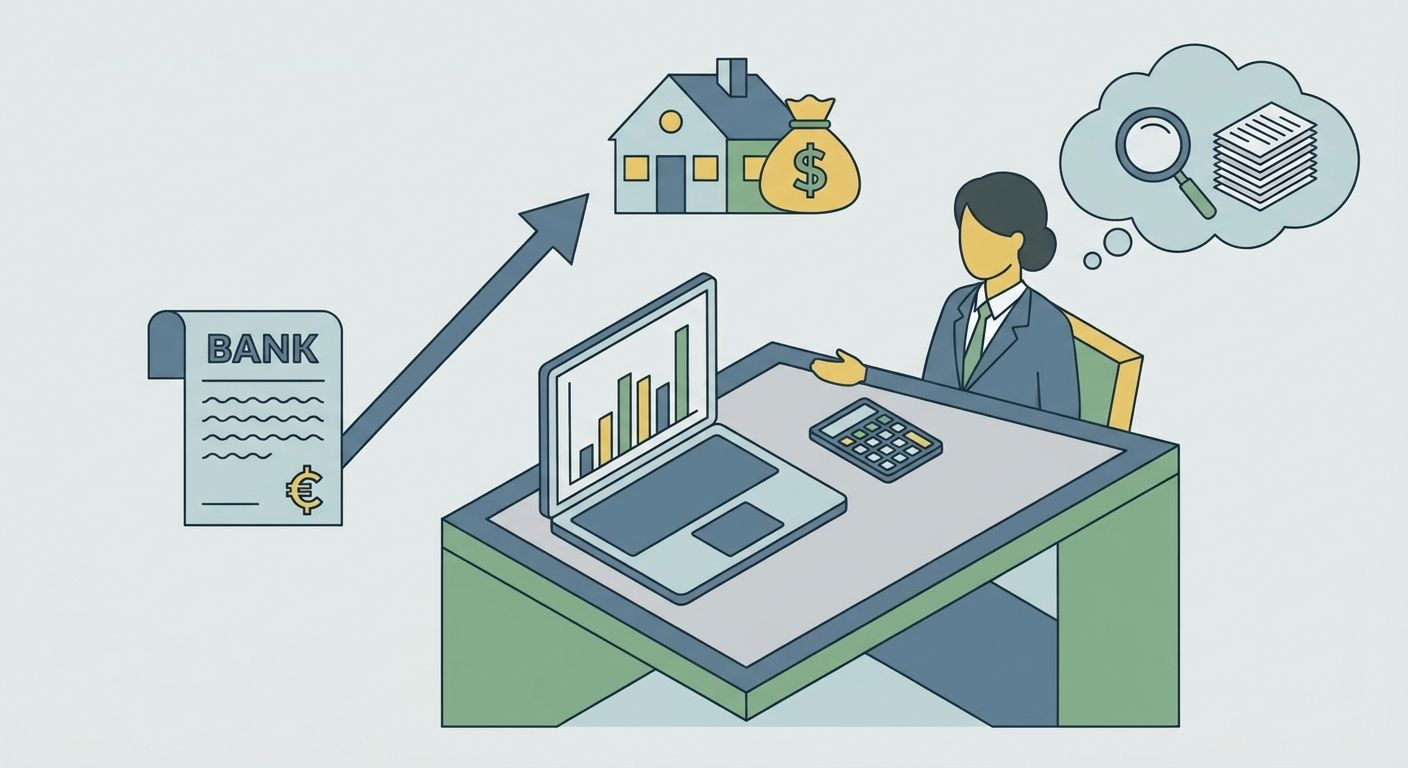
Bank statement loans for accountants and financial consultants let self-employed practitioners qualify for a mortgage using 12 or 24 months of business or personal deposits instead of tax returns, with the goal of closing on a home or investment property despite a return that's loaded with deductions. Accountants and financial consultants write off more than almost any other self-employed group — home office, software subscriptions, CE credits, retirement contributions — and that's exactly what tanks a debt-to-income ratio on a conventional file.
TL;DR
- Bank statement loans for accountants qualify income from deposits, not net income after write-offs, on 12 or 24 month programs.
- Loan Guys underwrites CPAs, EAs, bookkeepers, and financial consultants using average monthly deposits rather than Schedule C profit.
- Expect a credit profile review, a 12-24 month statement pull, and a P&L that a CPA (often a third party, not you) can sign off on.
- Traditional bank underwriting rejects most high-write-off accountants; bank statement and DSCR programs exist specifically to fix that gap.
Why bank statement loans matter for accountants and financial consultants
An accountant with $18,000 a month in gross deposits can show $4,200 in net profit after deductions on a tax return. A conventional underwriter reads that $4,200 as the entire qualifying income. A bank statement loan reads the $18,000.
That gap is the whole reason this loan category exists, and it's worse for financial consultants running an S-corp or LLC where retirement contributions, health insurance premiums, and equipment depreciation all stack on top of standard business deductions. Traditional banks weren't built to underwrite deposits — they were built to underwrite W-2s and 1040s, and a Schedule C or K-1 heavy return doesn't fit that model no matter how strong the actual cash flow is.
The practical effect: accountants get declined or downsized on conventional loans at a rate their income doesn't justify. Bank statement programs correct for that by qualifying on what actually hits the account.
Update your statement history before you apply
Lenders pull either 12 or 24 consecutive months of statements, and gaps or irregular deposits slow underwriting fast. Clean this up before you submit a file.
- Consolidate business deposits into one primary operating account if you're currently splitting across two or three
- Flag and document any large one-time deposits (a settlement, a sold asset) so they don't get misread as recurring income
- Stop moving personal funds through the business account — commingling is the single biggest slowdown in bank statement underwriting
- Pull your own 12-24 month statement PDFs early and scan for months with unusually low deposits that need an explanation
- If you run payroll to yourself, keep that consistent month to month rather than variable draws
Separate business and personal accounts
Mixed accounts force underwriters to manually strip out non-business deposits, which adds review time and increases the chance of a lower qualifying number.
- Open a dedicated business checking account if you're still running everything through personal
- Route client payments, retainers, and consulting fees exclusively through the business account
- Keep personal bill pay, mortgage payments, and discretionary spending on a separate personal account
- Ask your bookkeeper (or set a calendar reminder) to reconcile the split monthly, not annually
Get a CPA letter or P&L ready
Most 12-month bank statement programs and nearly all 24-month programs ask for a profit and loss statement or a CPA-prepared letter confirming the business is active and the expense ratio is reasonable.
- Have your CPA (or a third-party CPA if you self-prepare returns) draft a one-page P&L covering the statement period
- Confirm the expense ratio the lender will apply — many bank statement programs default to a flat percentage unless a CPA letter states otherwise
- Keep the P&L consistent with what the bank statements actually show; mismatches trigger a second review round
- If you're a solo consultant with no formal bookkeeping, this is the step where a bookkeeping service pays for itself in approval speed
Measure your qualifying income before you shop rates
Don't wait for a lender to tell you your number — calculate it yourself first so you know what property price range is realistic.
- Add up 12 or 24 months of gross business deposits and divide by the number of months
- Apply the expense ratio your target program uses (this varies by lender, so get a range from two or three)
- Subtract existing debt payments to estimate your usable DTI room
- Run the number against target purchase prices before you fall in love with a listing
Compare bank statement loans against DSCR and conventional options
Accountants who also hold rental property have a second path worth checking: a DSCR loan qualifies purely on the property's rental income and skips personal income documentation entirely. That's a different tool for a different purpose — bank statement loans work for the property you live in or a purchase tied to your personal income; DSCR works when the property itself cash flows.
- If buying a primary residence: bank statement loan is usually the correct tool
- If buying a rental with strong rent-to-mortgage coverage: a DSCR loan may qualify faster since it ignores your tax return entirely
- If your credit and reserves are strong but write-offs are the only issue: bank statement programs solve exactly that problem
Build reserves before you lock a rate
Non-QM underwriting, including bank statement programs, tends to ask for more reserve months than a conventional file, since the income model carries more variability by design.
- Target 6-12 months of PITI in liquid reserves before applying
- Keep reserve funds in an account with a clean paper trail — freshly deposited large sums get flagged and require sourcing
- Don't liquidate retirement accounts to hit a reserve number; lenders want seasoned, sourced funds
Get pre-qualified with your bank statements
Talk to a specialist about 12 or 24 month programs before you shop for a property.
Bank statement loan options for accountants and financial consultants
12-month bank statement loan
- Best for: Accountants with a shorter but strong recent deposit history
- Key limitation: Higher scrutiny on any single low-deposit month
24-month bank statement loan
- Best for: Established practices with consistent multi-year deposits
- Key limitation: Requires a longer, cleaner statement history
DSCR loan
- Best for: Financial consultants also buying rental property
- Key limitation: Doesn't apply to primary residence purchases
Conventional mortgage
- Best for: Accountants with modest write-offs and strong net Schedule C income
- Key limitation: Net income after deductions caps the qualifying number
Verdict: a 24-month bank statement loan is the strongest fit for a licensed CPA or established financial consultant with two-plus years of consistent deposits and heavy legitimate write-offs — it qualifies the real cash flow the tax return hides.
Common mistakes accountants and financial consultants make
- Over-optimizing the tax return for deductions the same year they apply for a mortgage. Every write-off that lowers your tax bill also lowers what a conventional lender sees, and even bank statement programs still review the return for red flags.
- Running client retainers through a personal account out of habit. This is the single fastest way to turn a clean 12-month file into a manual, delayed underwrite.
- Assuming a CPA license substitutes for documentation. Underwriters need the P&L and statement history regardless of professional credentials.
- Applying with an incomplete 24 months when a 12-month program would have worked. Some consultants stretch for the longer program and expose messier older statements unnecessarily.
- Ignoring reserve requirements until the final underwriting stage. Bank statement and non-QM files generally carry higher reserve asks than a conventional file, and finding out at the last stage stalls closing.
FAQ
What is a bank statement loan for accountants?
A bank statement loan for accountants qualifies income from 12 or 24 months of business or personal deposits instead of a tax return. It's built for self-employed CPAs, EAs, and financial consultants whose net income looks small after legitimate write-offs.
Can a financial consultant qualify for a bank statement loan with an S-corp?
Yes, S-corp financial consultants qualify using business account deposits, though the lender typically also reviews K-1 income and may request a CPA letter. Mixed personal and business accounts slow this process down.
Is a bank statement loan better than a conventional mortgage for a CPA?
For a CPA with heavy deductions, a bank statement loan usually qualifies a higher amount than a conventional loan, since it uses gross deposits rather than post-write-off net income. A CPA with modest deductions and strong net Schedule C income may still qualify better conventionally.
How many months of bank statements do lenders require?
Most programs use either 12 or 24 consecutive months of statements. Shorter 12-month programs are common for accountants with a strong, recent deposit history; 24-month programs suit longer-established practices.
Do bank statement loans require tax returns at all?
Bank statement programs generally don't require tax returns for income qualification, though the lender may still pull a return to check for inconsistencies or red flags. This differs from a full doc conventional mortgage that requires two years of returns.
Can a solo financial consultant with no employees qualify?
Yes, solo consultants qualify the same way as larger practices, using their own deposit history and a P&L or CPA letter confirming the business is active. A dedicated business account makes this faster.
What credit score do accountants need for a bank statement loan?
Bank statement and non-QM programs generally require stronger credit than government-backed loans since the income model carries more underwriting risk. Check current requirements directly, since minimums vary by program and lender.
Are bank statement loans only for primary residences?
No, bank statement loans work for primary residences, second homes, and investment property purchases. Accountants buying a rental property specifically for its income may find a DSCR loan a faster fit since it skips personal income review entirely.
One last thing
The practices with the cleanest bank statement approvals in 2026 aren't the ones with the highest income — they're the ones with the most boring, consistent deposit pattern. A financial consultant depositing $22,000 a month with zero variance beats one depositing $40,000 with three erratic months every time, because underwriting rewards predictability over size. Fix the pattern before you fix the number.


