


Bank Statement Loans for Estate Sale Owners (2026)

Bank statement loans for estate sale and auction business owners let you qualify for a mortgage using 12-24 months of business deposits instead of the net income your tax returns report. If your estate sale or auction house write-offs make your Schedule C look thin, this is the program built for that exact problem.
TL;DR
- Bank statement loans for estate sale business owners use 12-24 months of deposits, not tax returns, to calculate qualifying income.
- LoanGuys applies an expense factor to your total deposits rather than rejecting seasonal auction income outright.
- P&L only loans and DSCR loans are the two closest alternatives, each suited to a different situation.
- Mixing personal and consignment payouts in one account is the single fastest way to get declined.
Why bank statement loans matter for estate sale and auction business owners
Estate sale and auction companies run on lumpy, seasonal cash flow: a single high-value estate liquidation can push one month's deposits three or four times higher than a slow month with only small consignment sales. Traditional mortgage underwriting averages net income off your tax returns, and most estate sale operators legitimately write off vehicle mileage, storage rent, appraisal fees, and staging costs to lower their tax bill. That lower number is exactly what tanks a conventional loan application.
A lender who knows how to read bank statement loans for estate sale business owners looks at what actually landed in your account, not what your accountant deducted. If you're also using auction proceeds to buy inventory-heavy properties or storage space, the same logic applies to investors buying at estate sales who need financing that doesn't hinge on a clean W-2.
LoanGuys underwrites bank statement loans for estate sale and auction business owners who show volatile monthly deposits but consistent annual revenue — best for owners whose tax returns understate what the business actually brings in.
How to qualify for a bank statement loan as an estate sale or auction business owner
Qualifying is a documentation exercise more than a credit exercise. Get these six steps right before you apply and the underwriting moves faster.
Separate your estate sale and auction deposits from personal accounts
- Open a dedicated business checking account for consignment payouts, buyer's premiums, and hammer-price deposits
- Route online auction platform payouts into that same account, not a personal one
- Stop depositing personal checks, rent, or side income into the business account
- Keep at least 3 clean months in that account before you apply, longer if you just made the switch
Gather 12 to 24 months of business bank statements
- Pull PDFs directly from your bank's portal, not scanned printouts
- Request 12 months for most bank statement programs, or 24 months if you want a lower expense factor applied
- Include every account tied to the business, even a secondary savings account holding auction proceeds
- Flag large one-time deposits from a single estate liquidation so the underwriter doesn't count it as regular monthly income
Calculate your qualifying income with the expense factor
- Add up total monthly deposits across all business accounts
- Apply the lender's expense factor — the percentage assumed to cover overhead — to arrive at qualifying income
- Exclude transfers between your own accounts, loan proceeds, and refunds from the deposit total
- Ask whether the lender uses a flat expense factor or one calculated for your specific business type
Smooth out seasonal auction swings for the underwriter
- Note your two or three heaviest auction months on a cover sheet with the application
- Explain any dip as a slow estate sale season rather than a shrinking business
- Provide a CPA letter if one large estate liquidation skews a single month's deposits
- Use a 24-month average instead of 12 months if your revenue is genuinely seasonal
Check your credit and reserve requirements before you apply
- Check your credit report for errors before a lender pulls it
- Expect most bank statement programs to set a higher minimum credit score than a conventional full-doc loan
- Line up 2 to 6 months of reserves in a separate account, depending on the lender and loan-to-value ratio
- Pay down revolving balances if utilization is dragging your score down
Compare bank statement, P&L only, and DSCR options for your situation
- Compare a bank statement loan against a P&L only loan if your CPA already prepares a formal profit and loss statement
- Ask about interest-only structures if the goal is preserving monthly cash flow over paying down principal
- Confirm the loan-to-value a lender will extend on a self-employed borrower with variable income
- Get pre-qualified before you make an offer instead of guessing which program fits
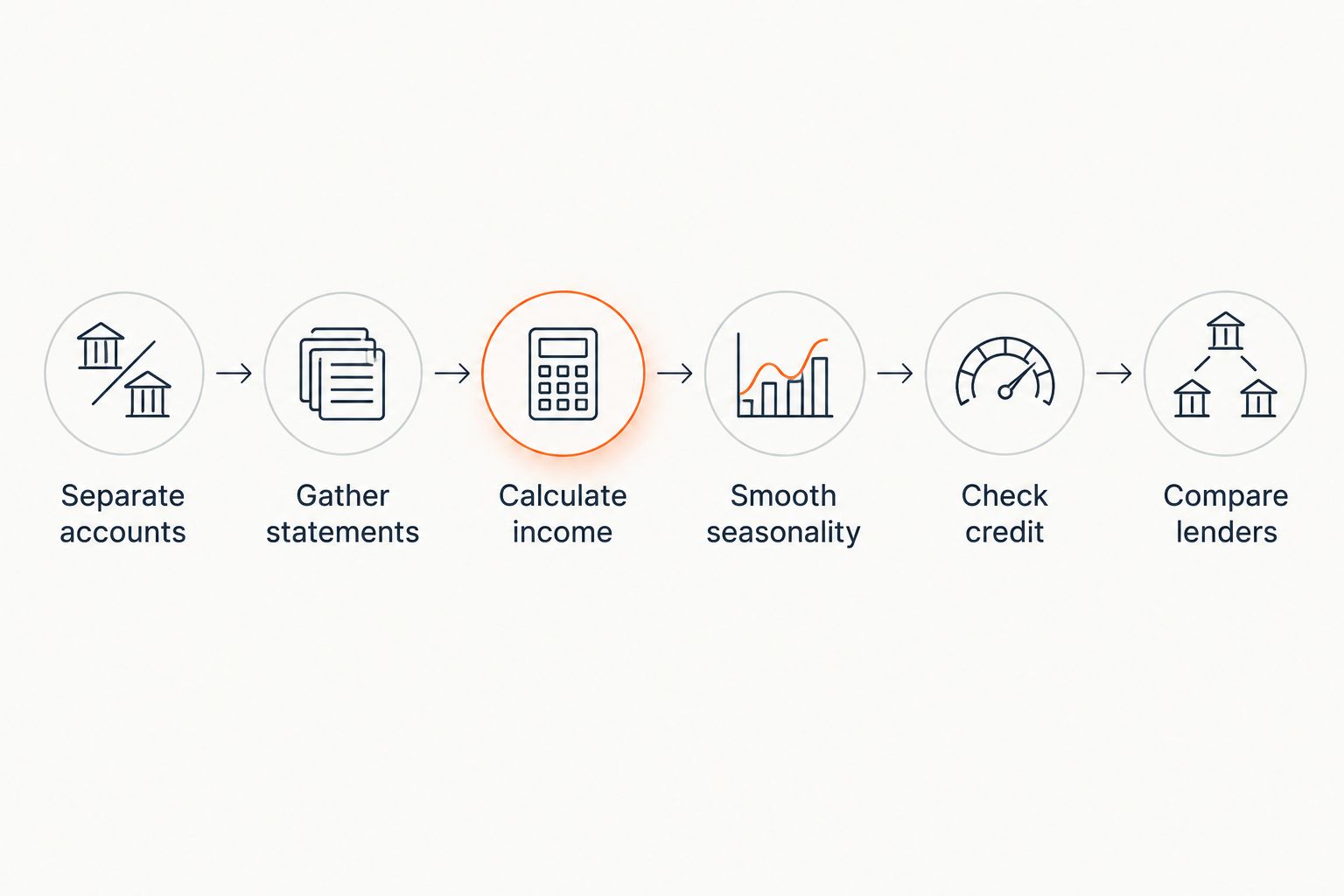
Documentation order matters more than credit score for most estate sale applicants.
See if your income qualifies
LoanGuys reviews estate sale and auction income case by case, not off a tax return.
Loan options for estate sale and auction business owners in 2026
Bank statement loans aren't the only door open to you. Here's how the main non-QM options stack up for this segment in 2026.
Bank statement loan
- Best for: Owners who deposit business revenue into a dedicated account
- Key limitation: Needs 12-24 months of statements and an expense-factor haircut on income
- Best for: Owners with a CPA-prepared profit and loss statement instead of raw statements
- Key limitation: Fewer lenders offer it and the P&L gets closer scrutiny than a tax return
DSCR loan
- Best for: Buying a rental or storage property to house auction inventory
- Key limitation: Qualifies off property cash flow, not your personal or business income
Full-doc mortgage
- Best for: Owners whose tax returns show strong net income after write-offs
- Key limitation: Heavy write-offs common in estate sale work often disqualify you here
Asset-based loan
- Best for: Owners with significant investment or retirement account balances
- Key limitation: Requires substantial liquid assets, not deposit history
Bank statement loans win for estate sale and auction owners with strong deposits and thin tax-return income; DSCR loans win when the purchase is an income property, not a home for the family.
Common mistakes estate sale and auction business owners make
- Mixing consignment payouts with personal spending in one account — underwriters can't separate business revenue from a car payment or a grocery run, and a mixed account slows or kills the application
- Writing off too much and then applying for a full-doc loan anyway — if your tax returns show minimal net income, a bank statement or P&L only program almost always outperforms it
- Presenting only your best months — underwriters ask for 12-24 consecutive months precisely because a cherry-picked quarter doesn't hold up
- Treating buyer's premium and hammer price as unexplained deposits — label large one-time estate liquidation payouts so they aren't flagged as unverifiable income
- Waiting until the week before closing to pull statements — gathering 24 months of PDFs from three different banks takes longer than most owners expect in 2026's underwriting environment
FAQ
What is a bank statement loan for estate sale business owners?
It's a mortgage program that qualifies you using 12 to 24 months of business bank deposits instead of tax return net income. It's built for owners whose write-offs make their reported income look lower than actual cash flow.
How many months of bank statements do lenders require?
Most bank statement programs ask for 12 months minimum, with 24 months often producing a lower expense factor and higher qualifying income. Auction and estate sale businesses with seasonal swings usually benefit from providing the full 24 months.
Can auction house owners qualify with seasonal income?
Yes, as long as the deposit history shows consistent annual revenue even if monthly totals swing widely. A 24-month average and a CPA letter explaining any one-time spikes both help the underwriter read the pattern correctly.
Is a bank statement loan better than a P&L only loan for estate sale businesses?
A bank statement loan works best when your revenue flows cleanly through a dedicated business account. A P&L only loan fits better when your CPA already prepares a formal profit and loss statement and your deposits are harder to trace to specific transactions.
Do I need good credit for a bank statement loan?
Bank statement programs generally set a higher minimum credit score than conventional full-doc loans because the income documentation carries more underwriting risk. Checking your credit report for errors before applying is a fast way to avoid a surprise decline.
Can I use a bank statement loan to buy an investment property for my auction business?
Bank statement loans typically apply to owner-occupied or personal financing needs; a rental or investment purchase for storage or inventory usually fits better under a DSCR loan, which qualifies off the property's cash flow instead of your personal income.
What's the difference between bank statement loans and DSCR loans?
A bank statement loan qualifies you using your personal or business deposit history. A DSCR loan qualifies the property using its own rental income, ignoring your personal income entirely, which makes it a fit for investment purchases rather than your own home.
How does LoanGuys calculate qualifying income for estate sale business owners?
LoanGuys totals deposits across your business bank accounts over 12 to 24 months, then applies an expense factor to arrive at a qualifying income figure. Large one-time estate liquidation payouts get flagged and explained rather than averaged in as regular monthly revenue.
One last thing
The expense factor, not your credit score, decides most estate sale bank statement approvals in 2026 — a lower expense factor from 24 months of clean statements can raise your qualifying income more than a 40-point credit score bump does. Get the deposit history right before you worry about anything else on the application.


