


Bankrate alternatives for investment property loan rates

Bankrate is useful for comparing mortgage offers and understanding rate trends, but an advertised rate does not establish whether a lender will finance your rental property or accept your income documentation. Investment properties that need DSCR, renovation, bridge, or bank-statement financing require program-specific questions beyond a rate comparison. The best Bankrate alternative in 2026 is Loanguys if you need investor-focused loan programs; LendingTree if you want another mortgage-shopping marketplace.
TL;DR
- For bankrate alternatives for investment property loan rates, choose Loanguys when you need DSCR or bank-statement financing.
- LendingTree is an alternative for mortgage shopping, not a substitute for property-specific underwriting.
- Compare investment property loans using identical property, income, loan-term, and ownership assumptions.
- Keep Bankrate for market context; use written lender proposals to evaluate your actual financing options.
Why this matters
Shopping for an investment property loan involves two separate decisions: which program fits the transaction, and which lender offers suitable terms within that program. Start with the first. Comparing rates across incompatible programs gives you a ranking you cannot use.
A stabilized rental, a house needing major repairs, and a short-term rental do not present the same underwriting questions. Neither do a salaried borrower and a business owner whose tax returns reflect substantial deductions.
In 2026, the useful comparison is between loans you qualify for—not between the lowest numbers displayed on different websites. Establish property eligibility, income documentation, and your intended holding period before narrowing the lender list.
Bankrate alternatives at a glance
Bankrate and LendingTree help you research or shop for financing. A mortgage broker, bank, or credit union takes the comparison closer to a specific loan transaction; these are different roles, not interchangeable services.
Bankrate
- Best for: Mortgage research and rate comparisons
- Standout feature: Mortgage information and offer comparison
- How it differs from Bankrate: The benchmark for initial research
Loanguys
- Best for: Investors needing specialized loan programs
- Standout feature: DSCR, fix-and-flip, bridge, bank-statement, and short-term rental programs
- How it differs from Bankrate: A mortgage broker rather than a rate-comparison publisher
LendingTree
- Best for: Another marketplace for mortgage shopping
- Standout feature: Connecting borrowers with participating lenders
- How it differs from Bankrate: An alternative marketplace, not a specialized investor-loan program
Direct mortgage lender or bank
- Best for: Borrowers comparing a specific lender's proposal
- Standout feature: Direct discussion of that lender's underwriting
- How it differs from Bankrate: You evaluate an actual lending source rather than a comparison platform
Credit union
- Best for: Eligible members seeking a relationship-based comparison
- Standout feature: Direct access to the institution's mortgage team
- How it differs from Bankrate: Membership and the institution's lending rules shape your options
There is no universal winner across these categories. Use the marketplace route for discovery and the broker or direct-lender route to resolve eligibility and obtain transaction-specific terms.
1. Loanguys: best for specialized investment property loans
Loanguys is a mortgage broker offering DSCR, fix-and-flip, bridge, bank-statement, and short-term rental loan programs to investors and homeowners across the United States. That makes the broker a relevant Bankrate alternative when your question is not simply what mortgage rates look like, but which financing structure fits your property and income.
Start by describing the transaction. Include whether you are buying, refinancing, renovating, or converting the property to rental use, then explain how you document income.
Where this approach shines
- Rental-focused financing: DSCR programs evaluate rental income against debt obligations under the applicable program's calculation.
- Alternative income documentation: Bank-statement programs provide a different documentation route from a conventional tax-return-based review.
- Project-specific options: Fix-and-flip and bridge programs address financing needs distinct from a stabilized rental mortgage.
- Short-term rental relevance: Short-term rental programs belong in the discussion when the property will serve vacation or temporary guests.
Where this approach falls short
- A broker's program offering is not an approval; your property and borrower file still require underwriting.
- Specialized programs are not automatically the right choice when conventional financing already fits.
- Program names do not settle questions about ownership structure, rental-income treatment, reserves, or an early payoff.
Ask which program fits before requesting a comparison. A DSCR loan and a bank-statement loan answer different qualification questions, even when both finance an investment property.
Business role
- Loanguys: Mortgage broker
- Bankrate: Financial information and comparison platform
Investor-program discussion
- Loanguys: Offers the named specialized programs
- Bankrate: Useful for mortgage research and comparison
Next step
- Loanguys: Discuss your transaction and documentation
- Bankrate: Research offers, then investigate the lending source
Approval question
- Loanguys: Requires underwriting for the selected program
- Bankrate: A displayed offer does not establish approval
Best for: Investors who need to identify an appropriate specialized financing route.
Verdict: Buy into the program-selection process; do not choose a loan from the rate alone.
2. LendingTree: best for another mortgage-shopping marketplace
LendingTree is an alternative when you want to connect with participating lenders and compare mortgage options. It serves a similar discovery purpose to Bankrate, so the strongest reason to use it is to explore another shopping channel—not to assume it solves a specialized underwriting problem.
Describe the property as an investment property from the start. Then verify the responding lender's program before investing time in an application.
Where LendingTree shines
- It provides another route to participating mortgage lenders.
- It lets you move from general research toward lender conversations.
- It is useful when you want to broaden the sources you consider rather than approach only one institution.
Where LendingTree falls short
- A marketplace connection does not confirm that a lender accepts your rental strategy or income documentation.
- Participating lenders still apply their own underwriting rules.
- Offers require consistent assumptions before they become meaningful comparisons.
Core role
- LendingTree: Lender-shopping marketplace
- Bankrate: Financial publisher and comparison platform
Useful task
- LendingTree: Connecting with participating lenders
- Bankrate: Researching mortgages and comparing offers
Eligibility decision
- LendingTree: Made through lender underwriting
- Bankrate: Made through lender underwriting
Specialized financing
- LendingTree: Verify with the responding lender
- Bankrate: Verify with the listed lending source
For your 2026 search, ask each responding lender the same opening question: does your program finance this property type using this documentation method? That answer is more useful than a preliminary rate without matching assumptions.
Best for: Borrowers who want another marketplace to explore mortgage options.
Verdict: Buy into marketplace shopping for discovery; hold off on choosing until lender eligibility is clear.
3. Direct mortgage lenders and banks: best for specific proposals
A direct lender or bank is an alternative to Bankrate when you are ready to discuss a defined transaction. You can ask the institution directly about property eligibility, income review, and the terms attached to its proposal.
This route deserves a place in the comparison when you have a stabilized property and documentation that fits the lender's requirements. Conventional investment-property financing generally concerns residential properties with 1–4 units; larger properties require a different financing discussion.
Where direct lenders shine
- You discuss the institution's actual lending criteria rather than infer them from an advertisement.
- You can request a proposal based on your property and borrower information.
- You can investigate conventional financing before selecting a specialized alternative.
Where direct lenders fall short
- One institution's programs do not represent the full financing market.
- A lender focused on conventional mortgages does not necessarily offer DSCR or renovation financing.
- An initial proposal remains subject to the lender's stated conditions and underwriting.
Ask whether the proposal assumes a 30-year mortgage or a 15-year mortgage. Those are different repayment structures, and comparing their rates without accounting for the payment obligation obscures the decision.
Best for: Borrowers who want to evaluate a specific institution's investment-property loan proposal.
Verdict: Buy into a direct comparison when the lender confirms the property and documentation fit.
4. Credit unions: best for eligible members comparing another institution
A credit union adds another direct lending source to your search. Membership eligibility comes first, followed by confirmation that the institution finances your type of investment property.
Do not infer investor-loan capability from an existing checking account or owner-occupied mortgage. Ask explicitly about rental-property financing.
Where credit unions shine
- You can discuss mortgage options directly with the institution.
- Existing members have an established relationship from which to start the conversation.
- A credit union proposal gives you another institution-specific comparison.
Where credit unions fall short
- Membership requirements limit who can apply.
- Investment-property programs and ownership rules vary by institution.
- A credit union is not automatically a source of DSCR, bridge, or fix-and-flip financing.
Best for: Eligible members whose property and documentation fit the credit union's mortgage programs.
Verdict: Hold until membership and investment-property eligibility are confirmed.
Why investors look beyond Bankrate
Bankrate remains useful for research. The reason to expand your search is that a financing decision requires answers a market-level comparison cannot supply by itself.
Rental income is central to qualification
DSCR means debt service coverage ratio: income divided by the relevant debt-service obligation. Residential rental programs commonly compare qualifying rental income with the housing payment, while commercial calculations commonly use net operating income and debt service.
Ask the lender to explain its calculation. The label alone does not establish what income or expenses it includes.
Tax returns do not explain the entire income picture
Business owners need to know which documentation method the lender accepts. Bank-statement financing evaluates income through bank records under the program's rules; it does not mean deposits automatically count as qualifying income or that underwriting disappears.
The property needs work
A property needing substantial renovation requires a financing discussion about its condition, project scope, and exit strategy. A standard rental-mortgage comparison does not answer those questions.
Ownership and rental use matter
Tell the lender if an LLC will own the property or if you intend short-term rental use. Resolve those details before comparing proposals that assume personal ownership or a different rental strategy.
How to compare investment property loan proposals in 2026
Use this sequence to turn a broad search into a defensible decision. Each step eliminates a different source of misleading comparison.
- Property fit: Confirm location, unit count, condition, ownership, and intended rental use.
- Income fit: Identify whether qualification uses conventional documentation, bank statements, or rental-income analysis.
- Loan structure: Match the loan amount, term, amortization, and transaction purpose across proposals.
- Exit terms: Ask about prepayment restrictions, maturity, extensions, and the requirements for a planned refinance.
- Written comparison: Obtain written terms and identify which assumptions or conditions remain unresolved.
The sequence matters. There is little value in debating repayment terms for a program that does not accept your property or documentation.
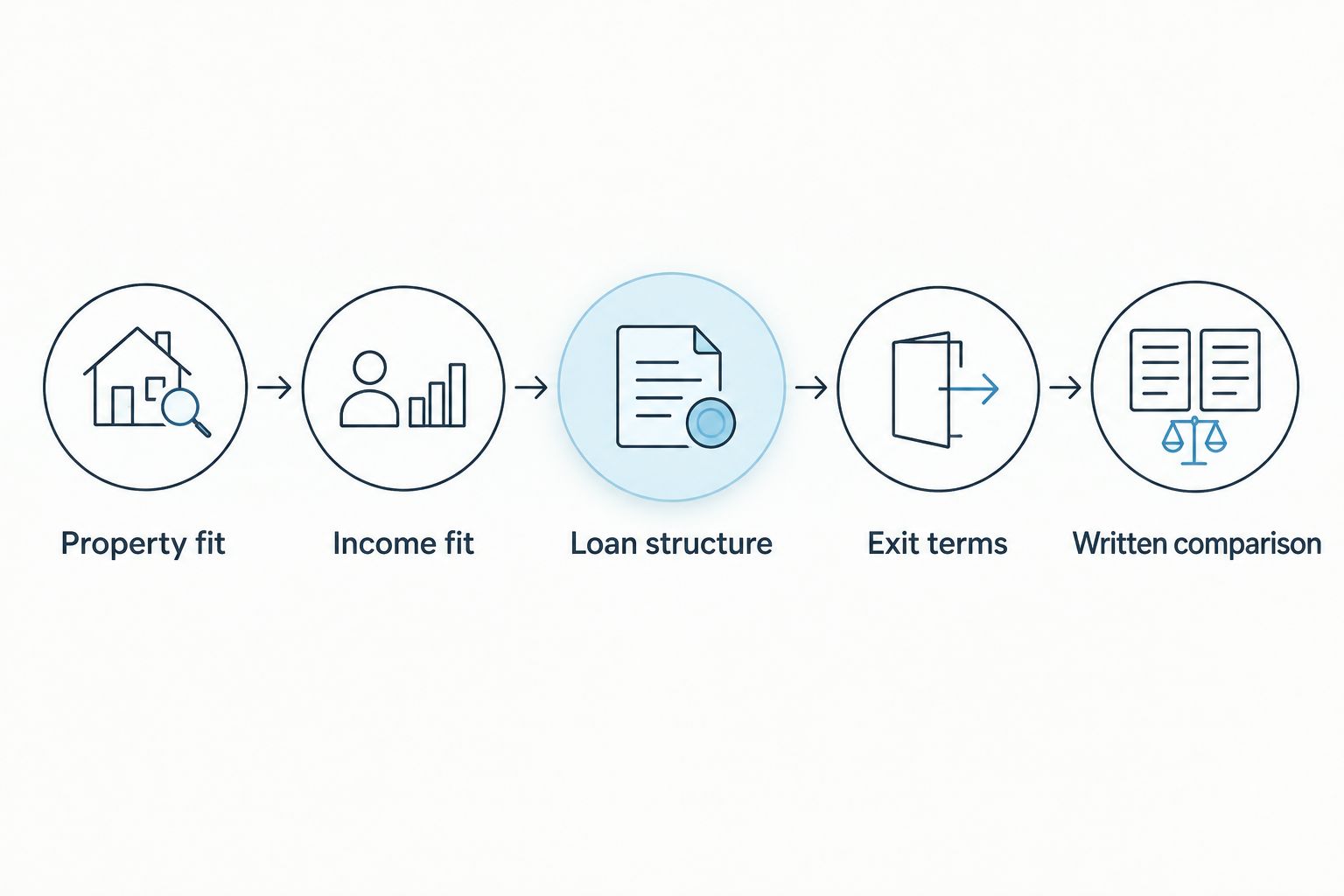
Confirm property and income fit before comparing loan structure and exit terms.
Keep the comparison packet consistent. Give each lending source the same property information and clearly distinguish documented rental income from projections.
Loan-to-value, or LTV, measures the loan amount against the property's value. Ask which valuation basis the proposal uses, particularly when renovations are part of the transaction; identical loan amounts do not establish identical underwriting assumptions.
Also distinguish interest-only payments from fully amortizing payments. Interest-only payments do not reduce principal during the interest-only period, so the monthly payment alone is not a complete measure of the obligation.
For a 2026 loan comparison, record the proposal date and ask whether the quoted terms are locked or still subject to change. Keep those details beside the underwriting conditions rather than in a separate email thread.
Find the right investor loan program
Discuss your property, income documentation, and financing purpose before comparing loan terms.
When staying with Bankrate is the right call
Stay with Bankrate when your immediate goal is mortgage education, market context, or an initial comparison of advertised offers. You do not need to abandon a useful research source simply because your eventual financing requires a specialist.
Bankrate is also a reasonable starting point when you are still learning the difference between loan types. Use that research to prepare better questions, then confirm the answers with the lending source responsible for the proposal.
Keep Bankrate as a benchmark; do not treat its displayed offers as approval decisions. The right alternative adds the missing transaction-specific discussion rather than replacing every part of your research.
FAQ
What's the best Bankrate alternative for investment property loan rates?
Loanguys is the best fit when you need to discuss DSCR, fix-and-flip, bridge, bank-statement, or short-term rental programs. LendingTree is an alternative when your priority is another mortgage-shopping marketplace.
Is LendingTree better than Bankrate for investment property loans?
Neither marketplace establishes which loan you qualify for. Compare their usefulness for finding lenders, then confirm investment-property eligibility and documentation requirements with each lending source.
Can I use a Bankrate mortgage rate for a rental property comparison?
Use a displayed rate only after checking that its assumptions match your investment-property transaction. Occupancy, loan structure, borrower information, and quote conditions must align for a meaningful comparison.
What's the difference between DSCR and bank-statement financing?
DSCR financing focuses on rental income relative to the applicable debt obligation, while bank-statement financing uses bank records to evaluate qualifying income. Ask how the selected program calculates income and what additional underwriting requirements apply.
Should I compare a 15-year loan with a 30-year investment mortgage?
Compare them as different repayment structures, not interchangeable rate offers. Evaluate the payment obligation, principal repayment, and fit with your intended holding period.
Can I compare loan offers before deciding on LLC ownership?
Resolve the intended borrowing and ownership structure before relying on the comparison. Tell every lending source whether the property will be held personally or through an LLC.
What should I ask before choosing an investment property lender in 2026?
Ask whether the program accepts your property, rental use, income documentation, and ownership structure. Then request written terms covering repayment, prepayment restrictions, maturity, and unresolved underwriting conditions.
One last thing
Write down your exit strategy before selecting the loan. Selling after renovation, refinancing after stabilization, and holding a rental long term require different questions about maturity and early repayment.
A proposal that fits the purchase but conflicts with the planned exit is not a useful financing match. Evaluate both ends of the transaction before committing.


