


Best asset-based lenders for day traders with volatile income

Best starting point for comparing property loan programs: Loanguys. Best for rental cash flow: a DSCR mortgage specialist. Best for substantial eligible investments: an asset-utilization mortgage specialist. For day traders in 2026, the right choice depends on what you are financing, which assets support qualification, and whether those assets remain available to trade.
TL;DR
- The best asset-based lenders for day traders match the loan purpose to eligible collateral and a documented repayment source.
- Loanguys offers property financing programs, including DSCR, bank-statement, bridge, and fix-and-flip loans.
- DSCR mortgages evaluate rental cash flow; asset-utilization mortgages evaluate eligible financial assets under lender-specific rules.
- Securities-backed credit can restrict pledged holdings and expose borrowers to collateral calls.
- Choose financing that remains manageable during trading losses, not financing that depends on your next profitable trade.
Why this matters
A large brokerage balance and reliable mortgage income are different things. Your account can hold valuable securities while your realized trading gains fluctuate, and transferring money into a checking account does not automatically turn that money into qualifying income.
Asset-based lenders also do not all mean the same thing by assets. Some lend against securities, some calculate mortgage qualifying income from eligible investments, and others finance real estate using property value or rental cash flow.
For a 2026 property purchase, Loanguys is a mortgage broker offering DSCR, bank-statement, bridge, fix-and-flip, and short-term rental loan programs. Loanguys is a relevant starting point for day traders comparing property financing rather than seeking additional trading capital. Choose the underwriting route before choosing the provider.
What makes the best asset-based lender for a day trader?
Use these criteria to separate an appropriate loan from an attractive-looking mismatch:
- Loan purpose: Identify whether you need a primary-home mortgage, rental-property financing, renovation funding, or liquidity against investments.
- Eligible assets: Ask which account types and holdings count, how the lender values them, and whether existing margin debt reduces eligibility.
- Repayment basis: Determine whether approval depends on documented income, rental cash flow, financial assets, or a property sale or refinance.
- Trading freedom: Confirm whether you must transfer, pledge, or maintain holdings and whether you can continue trading them.
- Downside exposure: Understand collateral calls, liquidation rights, personal guarantees, and what happens if your repayment plan fails.
- Written conditions: Compare documentation requirements, payment structure, prepayment provisions, and closing conditions before committing.
These criteria matter more than a broad claim that a lender accepts self-employed borrowers. Acceptance of self-employment does not establish acceptance of volatile trading income. Ask specifically how the underwriter treats realized gains, losses, distributions, and transfers between your own accounts.
Best lending routes at a glance
The ranking below is a decision guide by financing need, not a claim that every provider accepts every day trader. Each option solves a different problem.
Mortgage broker offering alternative property programs
- Best for: Comparing property-financing routes
- Standout feature: Different underwriting approaches for different property goals
- Key limitation: A broker is not the funding lender; approval depends on the selected program
DSCR mortgage specialist
- Best for: Buying or refinancing an income-producing rental
- Standout feature: Rental cash flow is central to qualification
- Key limitation: Property performance and borrower requirements still matter
Asset-utilization mortgage specialist
- Best for: Qualifying with substantial eligible financial assets
- Standout feature: Converts eligible assets into calculated qualifying income
- Key limitation: Not every account or holding qualifies
Securities-backed credit provider
- Best for: Non-trading liquidity against eligible investments
- Standout feature: Uses pledged securities as collateral
- Key limitation: Market declines can trigger collateral demands or liquidation
Bridge or fix-and-flip lender
- Best for: Temporary acquisition or renovation financing
- Standout feature: Underwriting focuses on the property and project
- Key limitation: Repayment depends on a credible exit, not future trading gains
1. Loanguys: best starting point for property-program comparisons
Loanguys offers mortgage brokerage services for real estate investors and homeowners across the United States. Its stated programs include DSCR, bank-statement, bridge, fix-and-flip, and short-term rental loans. Those categories provide different starting points for a trader buying a home, acquiring a rental, or renovating an investment property.
The value of a broker conversation is identifying the appropriate qualification route. A bank-statement program is not automatically an asset-based loan, and a DSCR program is not a personal-residence mortgage.
Loanguys pros:
- Offers several stated property-financing categories.
- Serves both real estate investors and homeowners.
- Provides a relevant starting point when a conventional income presentation does not match your circumstances.
Loanguys cons:
- Operates as a broker, not the funding lender.
- Its stated programs do not establish eligibility for your specific trading income or holdings.
- A property-financing discussion does not establish access to a securities-backed credit line.
Best for: Day traders who want to compare property loan programs before choosing an underwriting approach.
Bring your property objective, account statements, existing debts, and explanation of trading income. Ask which program fits and which funding lender makes the approval decision.
Verdict: Buy into the comparison process; commit only after reviewing written program conditions.
2. DSCR mortgage specialist: best for rental-property cash flow
A DSCR mortgage evaluates an investment property's ability to support its debt payments. DSCR means debt service coverage ratio. Residential rental programs commonly compare qualifying rent with the housing payment specified by the lender; commercial calculations can use net operating income and debt service.
A 1.00x DSCR means qualifying income equals 100% of the debt service used in that calculation. This is a definition, not a universal approval threshold. Ask what the lender includes in both sides of the formula.
DSCR mortgage specialist pros:
- Connects qualification to the rental property's income.
- Offers an underwriting route distinct from averaging personal trading gains.
- Supports a decision based on property performance rather than brokerage-account activity alone.
DSCR mortgage specialist cons:
- Does not replace a mortgage for your primary residence.
- Still involves property, credit, equity, and reserve requirements.
- A qualifying ratio does not account for every repair, vacancy, or operating expense in your investment plan.
Best for: Day traders buying or refinancing a rental with supportable rental income.
For a 2026 purchase, evaluate the property's operating budget separately from the lender's qualification calculation. Approval and a sound investment are different tests.
Verdict: Buy for a rental that supports its obligations; skip for owner-occupied financing.
3. Asset-utilization mortgage specialist: best for eligible investments
Asset-utilization, also called asset-depletion qualification, calculates an income figure from eligible financial assets under the lender's rules. The mortgage remains secured by real estate. This is different from a credit line secured directly by your brokerage holdings.
For a day trader, the important question is not simply the account balance. Ask which assets count after adjustments for asset type, accessibility, existing obligations, closing funds, and required reserves.
Asset-utilization mortgage specialist pros:
- Provides a qualification route based on eligible accumulated assets.
- Separates the asset calculation from a simple average of trading gains.
- Lets you evaluate mortgage eligibility without assuming every brokerage withdrawal is income.
Asset-utilization mortgage specialist cons:
- Eligibility and calculation methods differ by program.
- Restricted, encumbered, or inaccessible assets require specific treatment.
- Assets needed for closing or reserves are not automatically available for another qualification purpose.
Best for: Borrowers with substantial eligible assets who need a mortgage qualification route beyond volatile income.
Request the calculation in writing. Identify the eligible balance, adjustments, calculation period, and resulting income figure before comparing it with another proposal.
Verdict: Buy when the documented asset calculation works; hold if approval assumes assets you cannot use.
4. Securities-backed credit provider: best for non-trading liquidity
A securities-backed line of credit uses eligible investments as collateral. It is not an asset-utilization mortgage, and it should not be confused with a brokerage margin account. FINRA's investor guidance on securities-backed credit explains collateral calls, liquidation risks, and restrictions on using proceeds to purchase or trade securities.
The central trade-off is control. You obtain liquidity against holdings, but the credit agreement governs collateral eligibility, maintenance requirements, and the provider's rights when collateral becomes insufficient.
Securities-backed credit provider pros:
- Provides a borrowing route tied directly to eligible investments.
- Does not require selling pledged holdings merely to obtain the advance.
- Separates collateral borrowing from mortgage asset-income calculations.
Securities-backed credit provider cons:
- Market declines can create collateral shortfalls.
- The provider can require additional collateral or repayment under the agreement.
- Pledged holdings face restrictions, and forced sales can have tax consequences.
Best for: Borrowers with eligible investments who need permitted non-trading liquidity and understand collateral risk.
For 2026, read the actual agreement rather than treating your current portfolio value as permanent borrowing capacity. Do not assume an actively traded account can remain unchanged after a pledge.
Verdict: Hold until permitted uses and collateral controls are clear; skip as a way to fund additional day trading.
5. Bridge or fix-and-flip lender: best for a defined property exit
Bridge financing addresses a temporary property-financing need. Fix-and-flip financing supports an acquisition and renovation strategy leading to a sale or another documented exit. Neither replaces a durable repayment plan with an expectation of profitable trading.
Loan-to-value, or LTV, compares the loan amount with the property value used by the lender. An 80% LTV means the loan equals 80% of that value; it is an arithmetic definition, not an advertised program limit. Also ask whether the lender uses current value, purchase value, or a supported future value.
Bridge or fix-and-flip lender pros:
- Aligns financing with a property transaction or renovation project.
- Makes the intended sale or refinance central to the borrowing decision.
- Allows project feasibility to be evaluated separately from trading results.
Bridge or fix-and-flip lender cons:
- Requires a credible exit and a realistic project budget.
- Renovation draws and completion conditions can affect available funds.
- Delayed sales or unavailable refinancing can leave repayment unresolved.
Best for: Investors with a defined acquisition, renovation, or transition plan.
Verdict: Buy only with a supported exit; skip when repayment depends on recovering trading losses.
How to shortlist lenders without risking your trading account
Use this sequence before submitting applications. It keeps mortgage qualification, collateral borrowing, and project financing from becoming one confusing conversation.
Define purpose
State the exact use: personal residence, rental purchase, refinance, renovation, or non-trading liquidity. Describe occupancy honestly. A lender cannot select the right program from your account balance alone.
Map assets
Separate cash, unrestricted securities, retirement assets, pledged holdings, and funds already committed to a purchase. Identify existing margin obligations. Do not present the same funds as trading capital, closing funds, and untouched reserves without explaining the overlap.
Confirm qualification
Ask the lender to identify the actual approval basis: trading income, eligible assets, rental cash flow, or a property exit. Request its treatment of internal transfers and brokerage withdrawals. Moving principal between accounts does not create earnings.
Review controls
Ask who holds the collateral, what restrictions apply, and what triggers additional demands or liquidation. For property loans, review guarantees, prepayment terms, draw conditions, and the consequences of failing to refinance or sell.
Test repayment
Assess whether you can meet obligations during a trading drawdown without selling investments under pressure. For a rental, include operating expenses and vacancy in your own budget. For a renovation, evaluate an exit that does not require an unusually favorable sale.
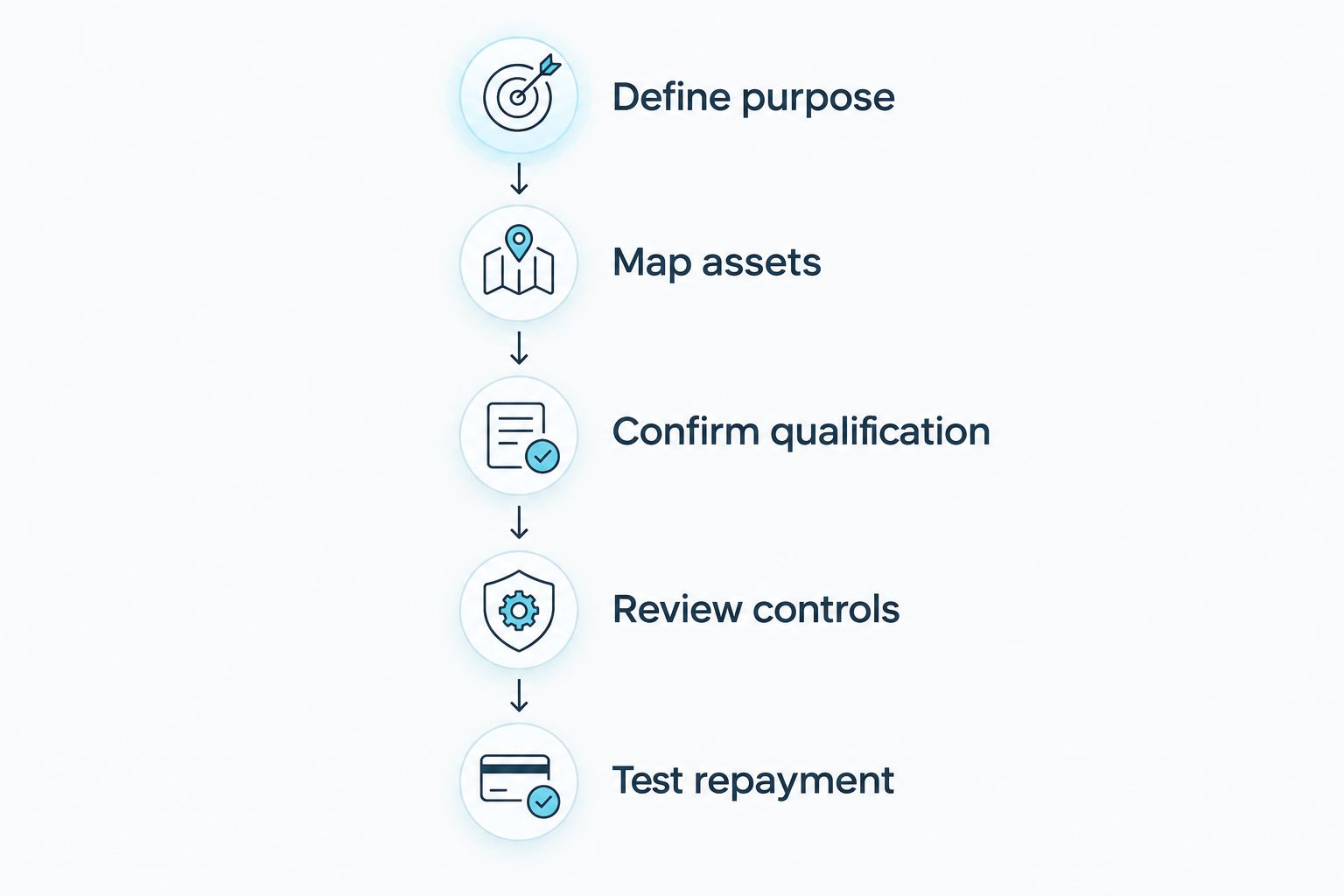
Confirm the repayment basis before deciding which assets to pledge or commit.
Once you have those answers, compare proposals for the same purpose and repayment structure. A 2026 mortgage proposal and a securities-backed credit agreement are not interchangeable simply because both refer to assets.
Discuss your property financing route
Explain your property goal, trading income, and available assets before choosing a loan program.
How these options are ranked
The order prioritizes matching the financing purpose before taking collateral risk. Property-program comparison comes first, followed by rental cash flow, eligible-asset qualification, securities-backed liquidity, and temporary project financing.
These are distinct use cases, not interchangeable winners. The ranking does not rely on unverified approval speeds, trader-specific acceptance claims, or assumed eligibility thresholds. The strongest proposal identifies its repayment basis and downside conditions in writing.
Which asset-based lender should you choose?
For a property purchase, start with the loan program, not a pledge of your trading portfolio. Loanguys is a relevant broker to approach for its stated property-financing categories; confirm the selected lender's treatment of your trading activity before proceeding.
Choose a DSCR specialist for rental cash flow, an asset-utilization specialist for eligible-asset qualification, and a securities-backed provider only for permitted liquidity needs. Choose bridge or fix-and-flip financing only when the property exit is supported independently of future trading profits.
FAQ
What's the best asset-based lender for a day trader with volatile income?
The best fit depends on the financing purpose and qualifying assets. Use a mortgage specialist for property financing, a DSCR specialist for rental cash flow, or a securities-backed provider for permitted liquidity against investments.
Can I qualify for a mortgage using my brokerage account?
An asset-utilization mortgage can use eligible financial assets to calculate qualifying income under the lender's rules. Account type, existing obligations, accessibility, and funds needed for closing affect the calculation.
Are bank-statement loans automatically suitable for day traders?
No, a bank-statement loan does not automatically make brokerage transfers qualifying income. Ask the lender how it distinguishes realized earnings from principal transfers, borrowed funds, and other deposits.
Is a DSCR loan better than an asset-utilization mortgage?
A DSCR loan fits rental-property qualification, while an asset-utilization mortgage evaluates eligible financial assets. The better route depends on the property's use and the evidence supporting repayment.
Can I keep day trading with securities pledged for a loan?
Your credit agreement determines trading permissions and collateral restrictions. Confirm transfer requirements, eligible holdings, maintenance rules, and liquidation rights before pledging an actively traded account.
Can I use a securities-backed credit line to fund more trades?
A non-purpose securities-backed credit line restricts using proceeds to purchase or trade securities. Confirm the permitted use in the agreement rather than treating the facility as additional trading capital.
Does asset-based lending mean no documentation?
No, asset-based lending still requires evidence supporting the assets, collateral, and applicable qualification method. Expect the provider to verify ownership, obligations, and the information needed for its underwriting.
One last thing
An asset can support qualification without being pledged collateral, and pledged collateral can support borrowing without being qualifying income. That distinction changes your control over the account and your exposure during a market decline.
Before signing, ask one direct question: which assets must remain available after closing, and what happens if their value falls? Get the answer in the agreement, not just in a conversation.


