


Best Industrial & Warehouse Bridge Loan Lenders: 2026

Best starting point: a mortgage broker for initial bridge-loan screening; best for warehouse lease-up: a commercial debt fund; best for an established banking relationship: a regional bank. Loanguys offers bridge loan programs, but confirm industrial-property eligibility before treating any proposal as a financing solution. This 2026 guide ranks financing routes by transaction fit, not unsupported claims about individual lenders.
TL;DR
- The best bridge loan lenders for industrial and warehouse properties match property condition, lease-up needs, and repayment strategy.
- Loanguys offers bridge loans; confirm warehouse eligibility and the funding lender before proceeding.
- Commercial debt funds suit transitional-property screening; regional banks belong on the shortlist for relationship-based transactions.
- Compare closing conditions, renovation funding, guarantees, and refinance requirements before accepting a term sheet.
Why this matters
A warehouse bridge loan finances a transition: acquisition, repairs, lease-up, or the interval before permanent financing. Your choice depends on what must change before the property supports its next loan.
Industrial collateral adds questions that a residential financing discussion does not resolve. Truck access, permitted uses, tenant improvements, environmental history, and specialized building systems all belong in the underwriting conversation. A lender that accepts commercial property is not automatically a fit for your warehouse.
For a 2026 acquisition, separate the closing deadline from the business plan. Funding the purchase solves the first problem; financing improvements and reaching a workable refinance solves the second. Your lender must address both.
What makes the best industrial bridge loan lender?
Use these criteria before comparing proposals:
- Property eligibility: Written acceptance of the actual warehouse, industrial, or flex-space use, including occupancy and condition.
- Closing certainty: A clear list of remaining approvals, third-party reports, and funding conditions—not a verbal deadline.
- Funding structure: Separate treatment of acquisition proceeds, improvement funds, reserves, and borrower equity.
- Lease-up flexibility: Terms that accommodate your tenant-improvement and leasing plan without conflicting deadlines.
- Repayment fit: A maturity date, extension mechanism, and refinance strategy that work together.
- Borrower exposure: Understandable guarantees, collateral requirements, default provisions, and reporting obligations.
Ask each financing source to respond to the same property summary. Different assumptions about occupancy, valuation, or construction scope make proposals difficult to compare.
Industrial bridge financing routes at a glance
These are routes to evaluate, not verified rankings of named industrial lenders. A broker arranges financing; the lender identified in your documents makes the credit decision and funds the loan.
Mortgage broker, including Loanguys
- Best for: Initial program screening
- Standout feature to seek: Clear identification of eligible programs and funding lender
- Key limitation: Brokerage services do not establish warehouse eligibility
Commercial debt fund
- Best for: Lease-up and property repositioning
- Standout feature to seek: Underwriting tied to the property's transition plan
- Key limitation: Draws, reserves, and milestones require careful review
Regional bank
- Best for: Existing borrower relationships
- Standout feature to seek: Direct discussion of bridge and permanent financing
- Key limitation: Property and borrower must meet the bank's credit requirements
Local private lender
- Best for: Nonstandard collateral or transaction structure
- Standout feature to seek: Direct review of a specific property problem
- Key limitation: Guarantees and enforcement terms deserve close attention
Seller financing
- Best for: A seller willing to defer payment
- Standout feature to seek: Negotiated repayment structure with the property seller
- Key limitation: Depends on seller agreement and existing mortgage constraints
1. Mortgage broker: best for initial bridge-loan screening
A mortgage broker helps you investigate financing before you commit to a particular funding source. Loanguys is a mortgage broker offering bridge and other loan programs to investors and homeowners across the United States. That description does not establish eligibility for an industrial building, cold-storage facility, or vacant warehouse.
Loanguys is a starting point for investors screening bridge loan options, not a verified industrial-lender ranking winner. Ask whether the specific property qualifies, who would fund the transaction, and which conditions apply.
Mortgage broker pros:
- Gives you a starting point when the financing route is unclear.
- Lets you discuss the borrower and property together.
- Helps separate a program inquiry from a lender commitment.
Mortgage broker cons:
- The broker is not necessarily the funding lender.
- Program descriptions do not establish collateral eligibility.
- Final decisions depend on the lender's underwriting.
Best for: Investors who need initial screening before approaching a funding source.
Verdict: Hold—advance only after written confirmation of industrial eligibility and the proposed lender's role.
2. Commercial debt fund: best for warehouse lease-up
A commercial debt fund is a nonbank financing source to investigate when your plan involves a transitional property. For a vacant or partially occupied warehouse, the central question is whether the proposed loan supports the work and leasing needed before refinancing.
Ask how the fund underwrites existing income versus projected income. Then examine whether improvement proceeds are funded at closing or released after documented work.
Commercial debt fund pros:
- A relevant route to screen for acquisition-and-repositioning plans.
- Allows a focused discussion of lease-up milestones.
- Provides an opportunity to evaluate improvement funding alongside acquisition funding.
Commercial debt fund cons:
- Future funding depends on the actual draw provisions.
- Reserves and covenants affect usable cash.
- Refinance assumptions still require independent examination.
Best for: Investors acquiring a warehouse that needs repairs, tenant improvements, or additional occupancy.
Verdict: Hold—proceed only when funding releases and lease-up milestones match the business plan.
3. Regional bank: best for an existing banking relationship
A regional bank belongs on your shortlist when you already have a commercial lending relationship. Present the bridge request alongside the eventual permanent-financing request so the bank can explain both sets of requirements.
Do not assume an existing relationship guarantees approval. Ask whether the bank accepts the property's current occupancy, condition, tenant profile, and planned use.
Regional bank pros:
- Gives an existing borrower a direct credit discussion.
- Allows bridge and permanent financing to be discussed together.
- Creates a clear opportunity to define required financial reporting.
Regional bank cons:
- The transaction must satisfy the bank's credit requirements.
- A transitional property still needs explicit approval.
- A future refinance discussion is not a refinance commitment.
Best for: Borrowers with an established banking relationship and a clearly documented industrial acquisition.
Verdict: Hold—seek a written financing outline before relying on the relationship to meet a purchase deadline.
4. Local private lender: best for a nonstandard property problem
A local private lender is a route to investigate when the transaction has a specific complication, such as an unusual building configuration or an incomplete renovation. Describe the complication plainly rather than presenting the property as a standard warehouse.
Evaluate the proposal through legal documents, not reassurance. Identify the lender, collateral, guarantee obligations, funding conditions, and consequences of missing the repayment date.
Local private lender pros:
- Enables a direct discussion of the property's specific obstacle.
- Allows you to request a transaction-specific structure.
- Provides a separate route when other financing discussions stall.
Local private lender cons:
- Local familiarity does not establish financial capacity.
- Guarantees can expose assets beyond the property.
- Default and extension provisions require legal review.
Best for: Investors with a defined collateral problem that requires individual evaluation.
Verdict: Hold—verify funding capacity and have counsel review the documents before committing.
5. Seller financing: best for a seller willing to defer payment
Seller financing means the property seller accepts repayment over time rather than receiving the entire financed portion at closing. It is an alternative to an institutional bridge loan, not a named bridge-lender recommendation.
Discuss the structure early. An existing mortgage, title issues, or the seller's need for immediate proceeds can prevent the arrangement from working.
Seller financing pros:
- Allows direct negotiation with the property seller.
- Creates an alternative when the seller accepts deferred payment.
- Lets both parties define repayment and security terms.
Seller financing cons:
- Requires the seller's agreement.
- Existing financing can restrict the arrangement.
- A balloon payment still needs a credible repayment plan.
Best for: Buyers negotiating with a seller who is willing and legally able to finance part of the transaction.
Verdict: Hold—proceed only after title, existing debt, and repayment terms receive professional review.
How these routes are ranked
The order starts with program screening, then separates lease-up financing, relationship banking, nonstandard collateral, and seller participation. It follows the eligibility, funding, and repayment criteria above—not claimed approval rates or closing-speed comparisons.
For 2026, use this ranking as a decision tree. Once a route fits, compare actual written proposals within that route rather than treating the category label as proof of quality.
Check warehouse eligibility before discussing loan size
Start with the building, not the requested loan amount. Use the guide to loans for warehouse and industrial property investors for the property-specific financing discussion.
Give each lender the same facts:
- Property use: Warehouse, distribution, manufacturing, flex space, or specialized storage.
- Tenant profile: Current occupants, lease expirations, payment history, and vacant space.
- Physical condition: Roof, loading facilities, electrical service, fire protection, and planned repairs.
- Environmental review: Prior uses, existing reports, and unresolved concerns.
- Exit plan: Sale or refinance, supported by the property's expected condition and income.
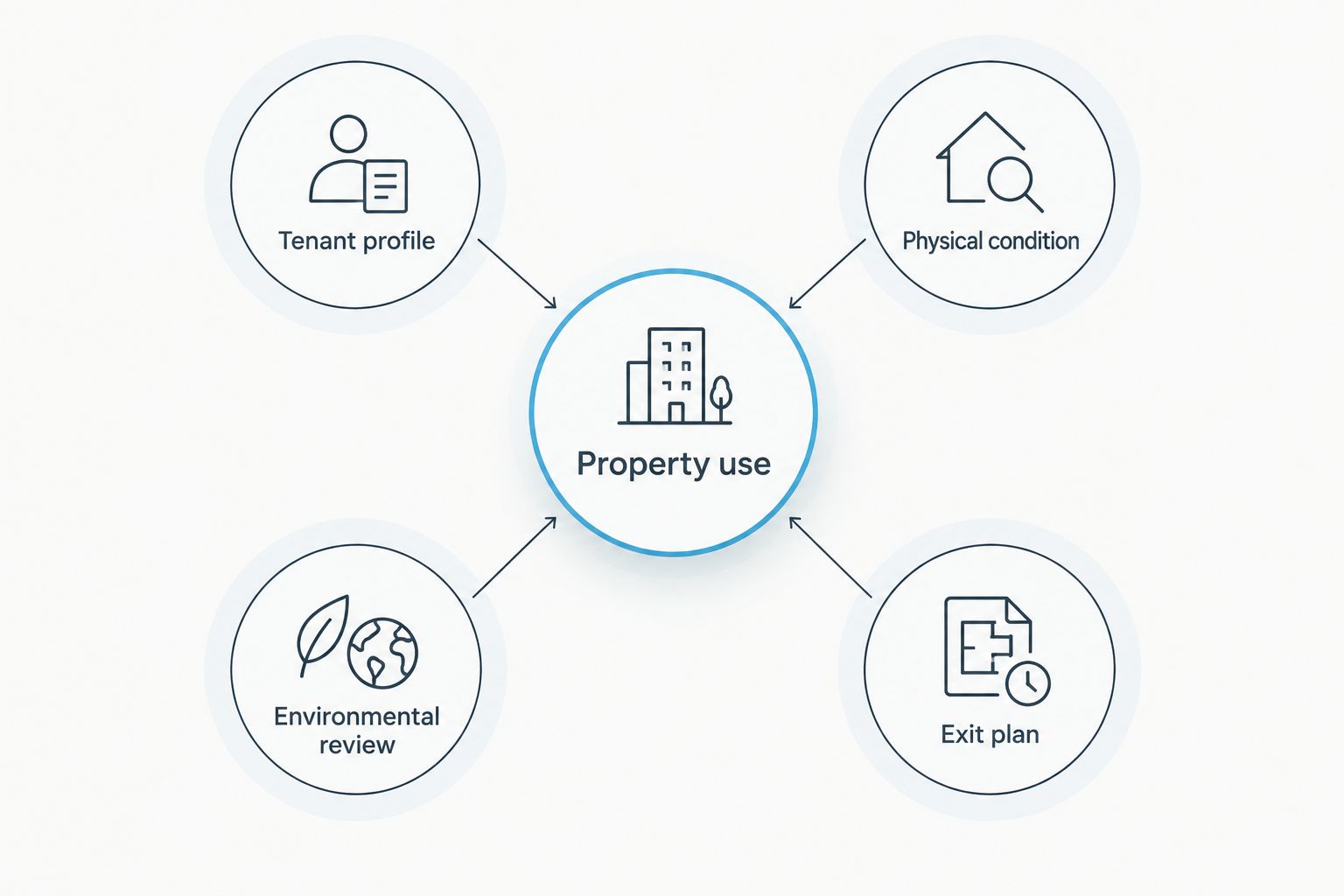
Establish the property's eligibility before comparing financing proposals.
Specialized systems deserve separate treatment. Refrigeration equipment, manufacturing machinery, and tenant-owned installations are not automatically part of the real-estate collateral. Ask what the appraisal includes and what the lender accepts as security.
Read the funding mechanics, not just the headline amount
Your 2026 comparison should distinguish the total commitment from proceeds usable at closing. Held-back improvement funds and required reserves do not pay the seller unless the documents expressly permit that use.
Loan-to-value, or LTV, compares the loan amount with the property value used by the lender. Loan-to-cost, or LTC, compares debt with the project cost recognized in underwriting. Ask which valuation and project expenses the lender uses; the label alone does not explain your equity requirement.
For income analysis, a 1.0x debt-service coverage ratio means 1 dollar of net operating income for every 1 dollar of debt service over the same period. That definition is not an approval threshold. Confirm the lender's calculation and required coverage rather than importing assumptions from residential rental financing.
Test the refinance before signing the bridge loan
A bridge loan needs a defined repayment event. For a warehouse acquisition, that means identifying what a permanent lender will require after repairs or lease-up—not simply expecting the property to become more valuable.
Build your 2026 exit review around these questions:
- What occupancy and lease documentation will support refinancing?
- Which improvements must be finished?
- What income will the permanent lender recognize?
- What happens if a tenant delays occupancy or stops paying?
- Are extensions contractual, conditional, or entirely discretionary?
Match the bridge maturity to the property's path to permanent financing. Have the proposed refinance source review the plan before you accept the bridge obligation.
Discuss your bridge financing plan
Ask about property eligibility, the funding lender, and requirements for your proposed transaction.
Which industrial bridge financing route should you choose?
Start with eligibility screening if you have not identified a funding source. Loanguys offers bridge loan programs; use the initial discussion to establish whether your industrial property and business plan fit.
Choose the next route by the obstacle: a commercial debt fund for lease-up screening, a regional bank for a relationship-based request, a private lender for a defined nonstandard problem, or seller financing when the seller accepts deferred payment.
The best 2026 proposal is the one whose documented funding conditions and repayment requirements match your transaction. Reject a mismatch even when the headline loan amount looks attractive.
FAQ
What's the best bridge loan lender for a warehouse purchase?
The best fit is a lender that accepts the warehouse's current condition and funds the transition required before repayment. Compare written eligibility, funding conditions, improvement draws, guarantees, and exit requirements rather than choosing by a general lender ranking.
Does Loanguys offer industrial warehouse bridge loans?
Loanguys offers bridge loan programs, but industrial warehouse eligibility requires confirmation for the specific transaction. Ask whether the property qualifies and which lender would fund it.
Is a mortgage broker the same as a bridge lender?
No. A mortgage broker arranges financing, while the funding lender makes the credit decision and provides the loan proceeds. Identify each party's role before signing documents.
Can I get a bridge loan on a vacant warehouse?
Vacant-warehouse eligibility depends on the lender's underwriting and the proposed business plan. Submit the repair scope, leasing plan, property reports, and repayment strategy for review.
Is a commercial debt fund better than a bank?
Neither route is universally better. Screen a commercial debt fund for a transitional-property plan and a bank for a transaction that meets its credit requirements; then compare actual proposals.
What does DSCR mean for warehouse financing?
DSCR means debt-service coverage ratio: net operating income divided by debt service for the same period. A ratio of 1.0x means operating income equals debt service, not that the property automatically qualifies.
What should I check before accepting a bridge term sheet?
Check property eligibility, usable closing proceeds, draw conditions, reserves, guarantees, maturity, and extension provisions. Also confirm which conditions remain before the lender is obligated to fund.
Can seller financing replace a warehouse bridge loan?
Seller financing is an alternative when the seller agrees and the legal structure permits it. Review existing mortgages, title, security documents, and the eventual repayment obligation with qualified professionals.
One last thing
Ask the proposed permanent lender to review the warehouse before you sign the bridge loan. A bridge lender's willingness to fund does not establish that another lender will refinance the property. Finding that mismatch before closing protects your repayment plan.


