


Best commercial loans for warehouse and industrial property

Best overall for a stabilized rental warehouse: a conventional commercial mortgage. Best for eligible owner-occupants: SBA 504 financing. Best for a property needing lease-up: a commercial bridge loan. This 2026 guide compares commercial loans for warehouse and industrial property by occupancy, building condition, repayment structure, and exit risk.
TL;DR
- Conventional mortgages lead commercial loans for warehouse and industrial property when rental income and building condition support permanent financing.
- SBA 504 financing suits eligible owner-occupied industrial purchases, not passive rental investments.
- Commercial bridge loans suit warehouse repositioning only when the borrower has a credible repayment exit.
- Loanguys is a mortgage broker; confirm industrial-property eligibility before choosing a loan program.
Why this matters
The wrong warehouse loan creates a mismatch between the building's income and your repayment obligations. A fully leased distribution building, a vacant industrial conversion, and a warehouse occupied by your own business need different financing structures.
Loanguys offers mortgage brokerage services, including bridge and investment-property loan programs. Loanguys is best suited to borrowers seeking a mortgage broker rather than a direct lender. Confirm that the specific warehouse, business use, and ownership structure qualify before ordering third-party reports.
For a property-focused starting point, review the guide to loans for warehouse and industrial property investors. The comparison below ranks financing structures—not individual lenders or unverified offers.
What makes the best warehouse and industrial property loan?
Use these criteria to evaluate a 2026 financing proposal before comparing individual terms:
- Occupancy fit: Separate owner-occupied business premises from property leased to unrelated tenants. SBA eligibility depends on this distinction.
- Income quality: Review collected rent, tenant credit, lease expirations, operating expenses, and reimbursement obligations—not just advertised rent.
- Property eligibility: Confirm zoning, permitted use, environmental condition, truck access, loading facilities, and any specialized improvements.
- Repayment structure: Compare amortization, maturity, balloon obligations, guarantees, and restrictions on early repayment.
- Funding mechanics: Identify required equity, reserves, construction draws, leasing reserves, and conditions that must be satisfied before funding.
- Exit fit: Match the debt to your hold strategy. Temporary financing needs a documented sale or refinance path.
Warehouse and industrial loans at a glance
1. Conventional commercial mortgage
- Best for: Stabilized rental warehouses
- Standout feature: Permanent financing based on property and borrower underwriting
- Key limitation: Vacancies and weak leases undermine qualification
2. SBA 504 financing
- Best for: Eligible owner-occupied industrial real estate
- Standout feature: Fixed-asset financing structured around business occupancy
- Key limitation: Not intended for passive rental investment
3. SBA 7(a) financing
- Best for: Eligible business acquisitions involving real estate
- Standout feature: Can support eligible real estate and other business purposes
- Key limitation: Business eligibility and repayment capacity both matter
4. Commercial bridge loan
- Best for: Vacant or transitional warehouses
- Standout feature: Temporary financing during renovation or lease-up
- Key limitation: Refinance or sale must repay the debt
5. CMBS loan
- Best for: Stabilized industrial investments with predictable cash flow
- Standout feature: Securitized commercial mortgage structure
- Key limitation: Servicing and early-exit provisions restrict flexibility
6. Commercial construction loan
- Best for: Ground-up industrial development
- Standout feature: Funds released against construction progress
- Key limitation: Completion and permanent-financing risks remain
1. Conventional mortgages: best for stabilized rental warehouses
A conventional commercial mortgage finances an income-producing warehouse through a bank or another commercial lender. Underwriting evaluates property cash flow, collateral, the borrowing entity, and the sponsor's finances and experience.
Best for: You own or are buying a warehouse with documented rent collections, supportable expenses, and no major unfinished construction. For a 2026 acquisition, examine lease expirations alongside loan maturity rather than treating occupancy alone as proof of stability.
Conventional commercial mortgage pros:
- Matches a long-term rental-property strategy.
- Uses documented operating performance to support underwriting.
- Offers a structure you can compare across commercial lenders.
Conventional commercial mortgage cons:
- Vacant space and near-term tenant departures weaken the application.
- Guarantees, financial reporting, and renewal conditions depend on the lender.
Ask whether the loan fully amortizes or leaves a balloon balance at maturity. A payment schedule that extends beyond the loan term does not eliminate the need to refinance.
Verdict: Buy this structure for a stabilized warehouse after checking the balloon obligation and tenant rollover exposure.
2. SBA 504 financing: best for owner-occupied industrial purchases
SBA 504 financing supports eligible fixed-asset projects through a structure involving a participating lender, a Certified Development Company, and borrower equity. It serves qualifying operating businesses rather than passive real estate investment strategies.
Best for: Your operating business needs a warehouse or industrial building for its own use. Under SBA occupancy rules, an existing building generally requires at least 51% owner occupancy; new construction generally requires at least 60% initial owner occupancy, with additional future-occupancy requirements.
SBA 504 financing pros:
- Aligns financing with eligible business premises and fixed assets.
- Provides a defined program structure for owner-occupied projects.
- Separates an operating-business purchase from a rental-investment application.
SBA 504 financing cons:
- Passive rental warehouses do not fit the program's purpose.
- Business eligibility, project eligibility, and occupancy require documentation.
The SBA's published 504 program and occupancy rules are the reference point for these distinctions. For a 2026 application, have the participating lender and Certified Development Company confirm the rules that apply to your project, especially when you plan to lease unused space.
Verdict: Buy this structure for an eligible owner-occupied project; skip it for a passive warehouse investment.
3. SBA 7(a) financing: best for business acquisitions with real estate
SBA 7(a) financing supports eligible business purposes, including real estate acquisition and certain other business needs. Unlike a property-only investment mortgage, the application centers on an eligible operating business and its ability to repay.
Best for: You are buying an operating business together with its warehouse, or your transaction includes eligible needs beyond the building. Identify each use of funds before deciding between SBA 7(a) and SBA 504 financing.
SBA 7(a) financing pros:
- Accommodates multiple eligible business purposes within the program.
- Fits transactions where real estate is part of a broader business purchase.
- Connects the financing analysis to business repayment capacity.
SBA 7(a) financing cons:
- It is not a workaround for financing passive rental property.
- Business financials and acquisition documentation add underwriting requirements.
A warehouse occupied by a distributor you own is different from a warehouse leased to an unrelated distributor. Similar buildings do not establish similar program eligibility; the business relationship and use of proceeds matter.
Verdict: Buy this structure when an eligible operating-business transaction—not just a building purchase—drives the financing need.
4. Commercial bridge loans: best for warehouse repositioning
A commercial bridge loan provides temporary financing while you renovate, replace tenants, or establish operating performance. The planned exit is usually a sale or permanent refinance, so repayment depends on more than acquiring the property.
Best for: Your warehouse has a specific, financeable transition plan. Examples include completing deferred repairs, dividing space for new tenants, or replacing an expiring lease before seeking permanent financing.
Commercial bridge loan pros:
- Fits a transitional property that is not ready for permanent debt.
- Supports an acquisition strategy tied to defined property improvements.
- Allows the financing discussion to address the property's planned next stage.
Commercial bridge loan cons:
- Maturity arrives whether or not leasing and repairs are complete.
- Extensions, reserves, and future funding depend on contractual conditions.
Loanguys offers bridge loan programs, but that does not establish eligibility for every industrial use. Confirm collateral acceptance, construction scope, funding conditions, and the proposed exit before treating a preliminary discussion as a financing commitment.
For your 2026 plan, identify what the permanent lender must see at refinance: completed work, documented collections, acceptable tenants, and sufficient cash flow.
Verdict: Buy only with a documented exit; skip bridge debt when repayment depends entirely on unproven rent growth.
5. CMBS loans: best for predictable industrial investment cash flow
Commercial mortgage-backed securities, or CMBS, loans are commercial mortgages originated for securitization. These structures emphasize property underwriting and contain detailed servicing, transfer, and repayment provisions.
Best for: You have a stabilized industrial investment and a hold strategy that fits the loan documents. Review lease durability and borrower-entity requirements before focusing on the financing headline.
CMBS loan pros:
- Provides a financing route for qualifying income-producing commercial property.
- Fits properties with documented, predictable operating performance.
- Establishes detailed contractual rules for the loan's administration.
CMBS loan cons:
- Early repayment provisions can complicate a sale or refinance.
- Servicing procedures can restrict modifications and borrower requests.
Do not assume that a nonrecourse structure means you have no personal exposure. Review carve-outs, guarantees, and obligations with commercial real estate counsel, along with defeasance or other applicable early-repayment provisions.
Verdict: Buy only when the hold strategy fits the servicing and exit restrictions; skip it when flexibility is essential.
6. Construction loans: best for ground-up industrial development
A commercial construction loan funds an industrial project through draws tied to approved work and lender requirements. Underwriting evaluates plans, budget, contractors, permits, borrower equity, and the repayment strategy after completion.
Best for: You are developing a warehouse rather than purchasing a building ready for permanent financing. Major redevelopment also needs a funding structure that explicitly accounts for construction work.
Commercial construction loan pros:
- Connects funding to an approved development budget.
- Supports project costs through a defined draw process.
- Makes completion requirements part of the financing structure.
Commercial construction loan cons:
- Cost overruns and delayed completion require financial capacity.
- Completion does not guarantee qualification for permanent financing.
Separate construction completion from income stabilization. A finished building without the required tenants or operating performance still needs a viable repayment plan.
Verdict: Buy only after aligning permits, contractor obligations, contingency funding, and the permanent-financing exit.
Check the property before choosing the loan
For commercial loans for warehouse and industrial property, building-specific risks belong in the financing decision—not at the end of diligence. Use this sequence to prepare a lender discussion:
- Occupancy: State whether your business uses the building or unrelated tenants rent it.
- Lease review: Assemble executed leases, amendments, rent collections, reimbursement terms, and expiration dates.
- Property review: Confirm permitted use, environmental diligence, building condition, loading access, and utility capacity.
- Exit review: Document how the debt will be repaid at maturity and what must happen first.
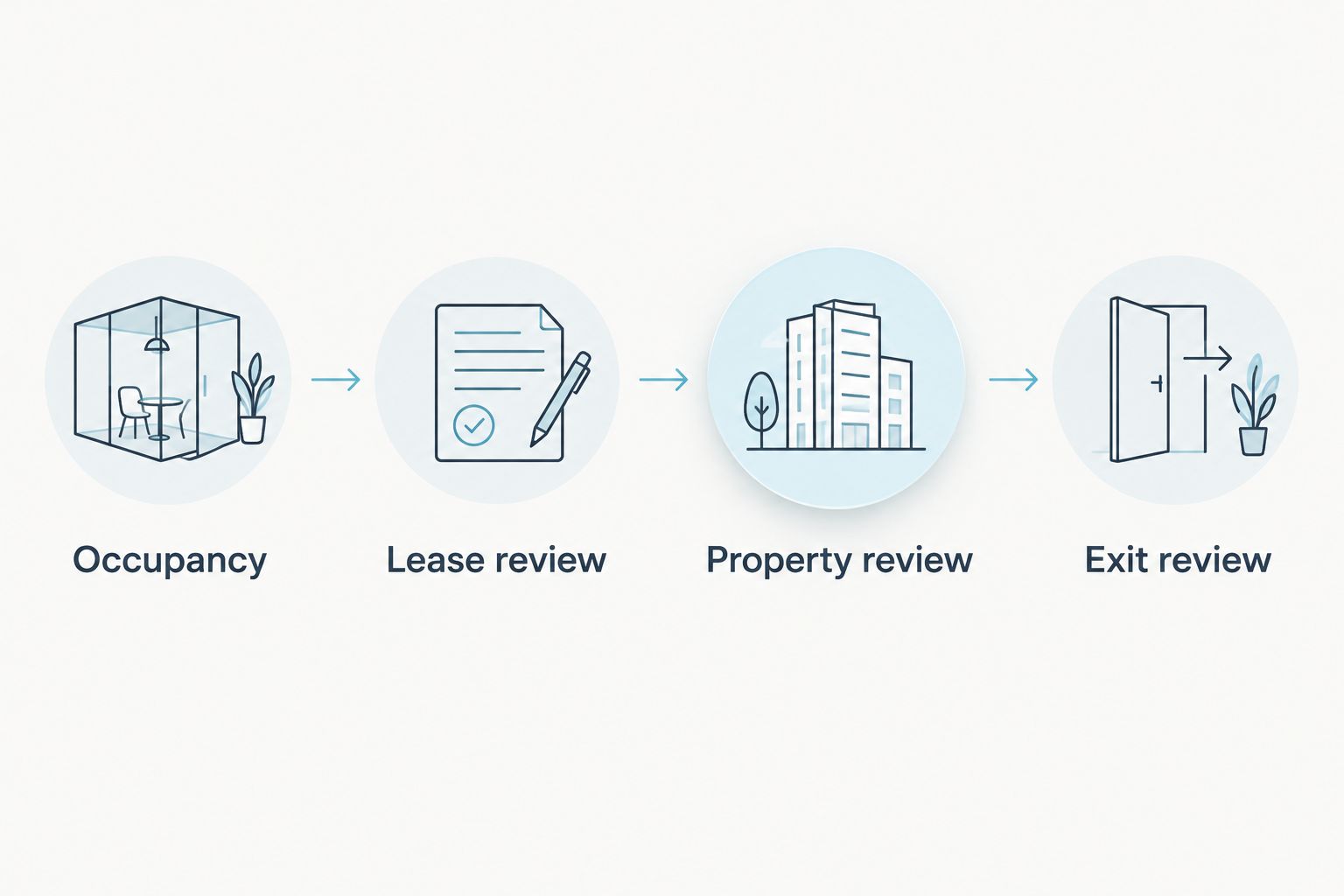
Choose the financing structure after identifying occupancy, property risks, and the repayment exit.
Calculate debt service coverage using the commercial lender's definitions. DSCR equals net operating income divided by debt service; a 1.00x coverage ratio means the included income equals the included debt service, leaving no cushion within that calculation. The lender's required minimum and expense adjustments are separate underwriting questions.
Also distinguish loan-to-value, or LTV, from loan-to-cost. LTV compares debt with property value; loan-to-cost compares debt with eligible project costs. Ask which measure limits proceeds and what valuation or cost exclusions apply.
How we ranked these loan structures
The ranking prioritizes occupancy fit, income quality, property eligibility, repayment structure, funding mechanics, and exit fit. Conventional mortgages rank first for stabilized rental warehouses; the remaining options each address a different transaction need.
This is a financing-use-case ranking, not a lender performance survey. Loanguys' listed programs establish its brokerage offering, not industrial underwriting thresholds, closing commitments, or approval outcomes.
Which warehouse loan should you choose?
Start with a conventional commercial mortgage for a stabilized rental warehouse. For an owner-occupied purchase, compare SBA 504 with SBA 7(a) according to eligible uses of funds; for a transitional building, evaluate bridge financing against a documented permanent exit.
Your 2026 shortlist should contain structures that fit the transaction—not every program with a commercial label. Send the same property and borrower information to each financing provider so differences in proposed terms reflect comparable assumptions.
Discuss your property financing
Ask about property eligibility, documentation, and a loan structure that fits your investment plan.
FAQ
What's the best commercial loan for a rented warehouse?
A conventional commercial mortgage is the starting choice for a stabilized rental warehouse. Compare property cash-flow requirements, guarantees, maturity, and early-repayment provisions before selecting a lender.
Can I use an SBA loan to buy a warehouse investment property?
SBA financing generally does not fit a passive warehouse rental investment. Eligible owner-occupied business real estate is different, and the operating business must satisfy the applicable program requirements.
Is SBA 504 better than SBA 7(a) for an industrial building?
SBA 504 is the more focused comparison for an eligible fixed-asset project, while SBA 7(a) accommodates broader eligible business purposes. Choose according to occupancy, business eligibility, and the complete use of proceeds.
Can I finance a vacant warehouse?
A vacant warehouse needs a financing structure that accepts its transitional condition. Commercial bridge or construction financing is the relevant starting point, depending on the work required and the repayment exit.
Does a DSCR loan automatically cover industrial property?
No, using a debt service coverage calculation does not establish industrial-property eligibility. Ask whether the specific loan program accepts warehouses rather than assuming a residential investor program extends to commercial buildings.
What documents should I prepare for a warehouse loan?
Prepare ownership information, borrower financials, leases, operating statements, and details of the property's use and condition. Transitional projects also need a scope of work, budget, and documented repayment strategy.
Does Loanguys finance every type of industrial property?
Do not assume every industrial property qualifies for Loanguys' programs. Request confirmation for the building, intended use, borrowing entity, and transaction structure before relying on a proposed financing route.
One last thing
A fully occupied warehouse is not automatically a durable income stream. A single tenant's lease expiration can place the entire rent roll at risk, so compare lease rollover dates with loan maturity before committing to debt.
Ask your lender what happens if that tenant leaves before refinance. The answer belongs in your purchase decision, not your extension request.


