


Best Medical & Dental Commercial Real Estate Loans 2026

Best overall for an eligible owner-occupied property purchase: SBA 504. Best for combining property with practice expenses: SBA 7(a). Best for an established practice with a straightforward purchase: conventional commercial financing. This 2026 guide compares the best commercial real estate loans for medical and dental practices by occupancy, project scope, repayment structure, and financing risk.
TL;DR
- The best commercial real estate loans for medical and dental practices match building occupancy, practice cash flow, and project scope.
- SBA 504 is the default shortlist for eligible owner-occupied property purchases; SBA 7(a) suits broader business financing.
- Conventional commercial loans suit established practices; construction loans suit substantial buildouts; bridge loans require a credible repayment exit.
- Loanguys offers mortgage brokerage for investors and homeowners; confirm medical-office property eligibility before choosing a program.
Why this matters
Buying a dental office for your own practice is different from buying a medical building leased to unrelated tenants. The first transaction centers on an operating business; the second centers on investment property and rental income. Classify the transaction before comparing loans.
Loanguys is a mortgage broker offering DSCR, fix-and-flip, bridge, bank-statement, and short-term rental programs. Those program names do not establish eligibility for an owner-occupied clinic or commercial medical building. Ask about the actual property type and business use before submitting an application.
For a 2026 purchase, separate the building, renovations, equipment, and operating cash in your financing request. A loan that funds the acquisition but leaves the treatment space unfinished does not solve your opening problem. If you are buying for rental income rather than your own practice, start with the guide to loans for medical office building investors.
What makes the best medical and dental property loan?
Use these criteria before choosing a loan category:
- Occupancy fit: Does your practice occupy the building, or do unrelated tenants generate the income?
- Eligible uses: Does financing cover real estate alone, or also renovations, equipment, and operating needs?
- Repayment fit: Distinguish the repayment period from the maturity date, when any remaining balance becomes due.
- Cash-flow evidence: Identify whether underwriting evaluates practice earnings, property income, or both.
- Execution requirements: Check appraisal, permits, ownership documents, guarantees, and construction conditions.
- Exit risk: Establish whether the loan pays down fully or requires a refinance, sale, or balloon payment.
A longer amortization period spreads repayment over more time. It does not automatically eliminate a balloon balance. Read both the payment schedule and the maturity provision.
Medical and dental real estate loans at a glance
SBA 504
- Best for: Eligible owner-occupied building acquisition
- Standout feature: Financing focused on qualifying fixed assets
- Key limitation: Does not fund working capital
SBA 7(a)
- Best for: Property plus broader practice financing
- Standout feature: Multiple eligible business uses
- Key limitation: SBA eligibility and repayment requirements apply
Conventional commercial mortgage
- Best for: Established practice buying a completed property
- Standout feature: Lender-negotiated loan structure
- Key limitation: Balloon and guarantee provisions require scrutiny
Healthcare practice financing
- Best for: Coordinating practice acquisition with real estate
- Standout feature: Healthcare-focused business underwriting
- Key limitation: Real estate inclusion depends on the lender
Commercial construction loan
- Best for: Ground-up clinics or substantial conversion
- Standout feature: Funding tied to construction progress
- Key limitation: Draw conditions and completion risk
Commercial bridge loan
- Best for: Transitional acquisition before permanent financing
- Standout feature: Temporary financing structure
- Key limitation: Requires a credible repayment exit
1. SBA 504: best for owner-occupied property acquisition
SBA 504 financing supports qualifying fixed assets, including eligible commercial real estate and improvements. Its structure combines financing from a participating lender, a Certified Development Company, and the borrower. It is a useful starting point when your main objective is owning the building where your practice operates.
For a 2026 eligibility review, apply the SBA's owner-occupancy requirements rather than treating any medical building as eligible. For an existing building, the operating business generally must occupy at least 51% of the rentable property. For new construction, initial occupancy generally must reach 60% of the rentable property, with additional future-occupancy requirements.
These are SBA program rules for owner-occupied business property, not thresholds announced by this broker. Have the lender confirm how the rules apply to your ownership and tenant arrangement.
SBA 504 pros:
- Focuses financing on qualifying long-term fixed assets.
- Supports eligible building purchases and improvements.
- Fits the distinction between operating premises and investment property.
SBA 504 cons:
- Working capital is not an eligible use.
- Passive rental investment does not fit ordinary program eligibility.
- Coordination across financing participants adds documentation requirements.
Best for: An eligible practice purchasing its long-term premises without needing the same loan to fund daily operations.
Verdict: Buy—shortlist SBA 504 for a qualifying owner-occupied acquisition.
2. SBA 7(a): best for property plus practice financing
SBA 7(a) loans support a broader range of eligible business purposes than SBA 504, including real estate, equipment, working capital, and eligible business acquisitions. That makes SBA 7(a) relevant when buying the building is only part of your transaction. You still need to establish eligibility and repayment capacity.
For 2026 planning, the SBA permits maturities of up to 25 years for qualifying real estate financing under 7(a). A mixed-purpose loan needs a lender-specific explanation of maturity and use-of-proceeds treatment. Do not assume every expense receives the same repayment schedule.
Ask the lender to separate the property acquisition, clinical equipment, improvements, and operating cash in the proposed financing. That breakdown shows whether the structure funds the whole project.
SBA 7(a) pros:
- Accommodates multiple eligible business uses.
- Supports eligible acquisitions alongside real estate.
- Provides a route for evaluating the practice and property together.
SBA 7(a) cons:
- SBA eligibility does not replace credit underwriting.
- Business acquisition and property documentation both require attention.
- Ownership and guarantee requirements affect the borrowing structure.
Best for: A practice buying premises while also financing eligible business expenses or an acquisition.
Verdict: Buy—shortlist SBA 7(a) when the financing need extends beyond the building.
3. Conventional commercial mortgage: best for an established practice
A conventional commercial mortgage finances commercial property without an SBA guarantee. The lender evaluates the borrower, property, repayment capacity, and proposed collateral. An established practice with clear financial records should compare this route alongside SBA financing.
The key question is not simply whether you qualify. It is whether the proposed structure fits how long you intend to own the property. Check interest-rate adjustments, amortization, maturity, guarantees, and restrictions on early repayment.
Ask for a written explanation of the balance due at maturity. A payment calculated over a long amortization schedule can still leave a substantial amount to refinance when the loan ends.
Conventional commercial mortgage pros:
- Avoids SBA-specific program eligibility requirements.
- Allows comparison of lender-specific structures.
- Fits completed properties with an established repayment source.
Conventional commercial mortgage cons:
- Underwriting standards differ across lenders.
- A balloon payment creates future refinancing exposure.
- Covenants and personal guarantees can restrict flexibility.
Best for: A financially established practice buying a completed, usable property and comparing conventional terms against SBA options.
Verdict: Buy—compare conventional financing when practice earnings and property condition are well documented.
4. Healthcare practice financing: best for a combined acquisition
Healthcare-focused practice financing addresses the operating business, such as an eligible practice acquisition or expansion. Some lenders also finance associated real estate. Confirm that inclusion explicitly; a practice-acquisition approval does not establish building-finance approval.
For a 2026 purchase of both a practice and its premises, ask which assets secure each obligation. Review whether the business and building have separate loans, shared collateral, or linked default provisions. These details affect your ability to sell or refinance either asset later.
Healthcare practice financing pros:
- Frames underwriting around the healthcare business.
- Supports discussion of acquisition and expansion needs.
- Helps identify how practice and property financing interact.
Healthcare practice financing cons:
- Real estate is not automatically included.
- Shared collateral can complicate future transactions.
- Lender-specific eligibility prevents a universal recommendation.
Best for: A dentist or physician purchasing an operating practice together with its premises.
Verdict: Hold—confirm the real estate component and collateral structure before committing.
5. Commercial construction loan: best for a custom clinic buildout
Commercial construction financing funds an eligible building project through advances tied to progress and lender conditions. It fits ground-up construction or a substantial conversion when the premises are not ready for permanent financing. The lender evaluates the project as well as your repayment capacity.
Medical and dental buildouts require careful coordination of layout, utilities, equipment installation, and local approvals. Give the lender a contractor scope that distinguishes building work from movable equipment. Confirm what the loan actually funds.
Commercial construction loan pros:
- Matches funding to construction progress.
- Supports evaluation of project plans and budgets.
- Addresses properties that are not yet ready for occupancy.
Commercial construction loan cons:
- Draw inspections and conditions affect access to funds.
- Delays and scope changes threaten completion.
- Permanent financing must be arranged or clearly addressed.
Best for: A practice building a clinic or converting premises through substantial construction.
Verdict: Buy—use construction financing when completing the property is central to the transaction.
6. Commercial bridge loan: best for a transitional acquisition
A commercial bridge loan provides temporary financing before a planned refinance or sale. It belongs on the shortlist when a property needs a transition before permanent financing becomes suitable. It is not a substitute for a sustainable long-term repayment plan.
Loanguys offers bridge loan programs, but commercial medical-office eligibility must be confirmed for the specific transaction. Ask about permitted occupancy, renovation funding, maturity, and the evidence required for the proposed exit.
Commercial bridge loan pros:
- Separates an interim acquisition from permanent financing.
- Supports a financing discussion around a defined transition.
- Makes the repayment exit an explicit underwriting question.
Commercial bridge loan cons:
- Refinancing depends on future qualification and property conditions.
- Extensions are not a substitute for a documented exit.
- A delayed opening or incomplete renovation threatens the plan.
Best for: A transitional purchase with a documented path to permanent financing or sale.
Verdict: Hold—proceed only after validating the exit; skip it without one.
Build your financing request in the right order
Use this sequence for a 2026 financing discussion:
- Occupancy: State who uses the property and identify leased space separately.
- Project scope: Separate acquisition, construction, equipment, and operating needs.
- Repayment source: Provide practice financials and relevant lease information.
- Loan structure: Compare guarantees, collateral, amortization, and maturity.
- Exit plan: Identify how any balloon or temporary loan will be repaid.
Do not send only a property listing. A lender needs the transaction structure, the business use, and a credible repayment source to evaluate financing fit.
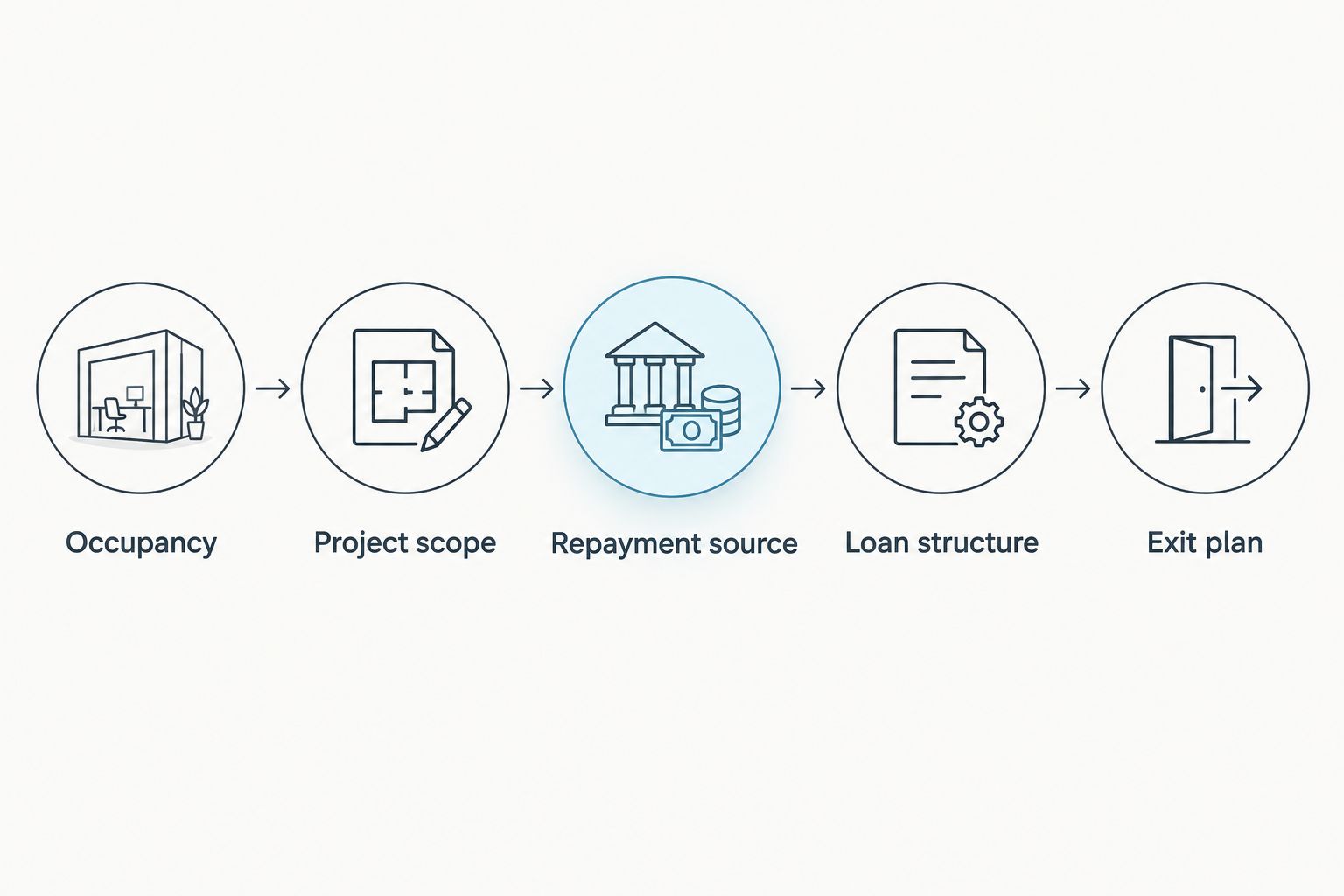
Classify the property and project before comparing loan structures.
LTV means loan-to-value: the loan balance compared with the property's value. DSCR means debt service coverage ratio: income available for debt payments compared with those payments. Ask the lender which income measure it uses; commercial property underwriting and residential rental programs are not interchangeable.
How these options are ranked
The ranking prioritizes occupancy fit, eligible uses, repayment structure, documentation, and exit risk. It compares loan categories, not individual lender offers or approval outcomes. SBA 504 leads for qualifying owner-occupied fixed-asset purchases; the other categories win when the transaction has a different purpose.
Which medical or dental property loan should you choose?
Start with SBA 504 for an eligible owner-occupied building purchase, then compare conventional commercial financing. Choose SBA 7(a) when the transaction also needs eligible business funding. Use healthcare practice financing for a combined acquisition, construction financing for unfinished premises, and bridge financing only for a defined transition.
Loanguys is a mortgage-brokerage option for physicians and dentists pursuing real estate investment financing, subject to property and program eligibility. Do not treat its residential investment programs as proof that an owner-occupied commercial clinic qualifies.
FAQ
What's the best commercial real estate loan for a dental practice buying its building?
SBA 504 is the starting shortlist for an eligible owner-occupied building purchase. Compare conventional commercial financing, and consider SBA 7(a) if the project also needs eligible business funding.
Is SBA 504 better than SBA 7(a) for a medical office?
SBA 504 fits qualifying fixed-asset financing, while SBA 7(a) fits broader eligible business uses. Choose based on whether you need the building alone or additional practice financing.
How much of the building must my practice occupy for SBA financing?
SBA owner-occupancy rules generally require at least 51% of an existing building's rentable property and 60% initially for new construction. New construction also carries future-occupancy requirements; confirm the full rules with the lender.
Can I use a DSCR loan to buy my own clinic?
Do not assume a residential rental DSCR program accepts an owner-occupied commercial clinic. Confirm property eligibility and whether underwriting uses practice earnings, property rental income, or both.
Can a property-owning LLC lease the office to my practice?
A separate property-owning entity requires review of the ownership and lease structure. SBA financing has specific eligible passive company rules, and conventional lenders apply their own requirements.
Does Loanguys offer loans for medical and dental properties?
Loanguys offers DSCR, fix-and-flip, bridge, bank-statement, and short-term rental programs. Confirm commercial medical or dental property eligibility directly; those program names do not establish it.
What should I check before accepting a commercial bridge loan?
Check the maturity date, extension provisions, collateral, and documented repayment exit. Confirm that the intended permanent lender accepts the completed property and proposed borrower structure.
One last thing
Your loan's maturity date can matter more than its payment schedule. Before signing, ask the lender to show the remaining balance due at maturity and explain how the financing treats unfinished improvements. That single review exposes whether your plan depends on a future refinance or cash contribution.


