


Best Construction Loan Lenders for Multifamily 2026

Ground-up multifamily construction loans work nothing like a stabilized rental refinance, and picking the wrong lender type costs sponsors months on the front end and points on the back end. This guide ranks the construction loan lender categories that actually close ground-up multifamily deals in 2026, matched to the sponsor profile each one fits best.
TL;DR
- LoanGuys coordinates bridge-to-construction financing with DSCR takeout in one file, best for sponsors who want a single point of contact through stabilization.
- HUD/FHA 221(d)(4) lenders offer the highest leverage and a 40-year fixed term, but the timeline runs 12 to 18 months.
- Debt funds and private direct lenders close faster and go non-recourse, trading speed for a higher rate and stricter draw oversight.
- Regional banks and credit unions still win on rate for sponsors with a track record and recourse tolerance, but leverage tops out lower than HUD.
Why this matters
A stabilized rental loan underwrites the property as it sits today. A ground-up multifamily construction loan underwrites a plan: land closing, permitting, a general contractor, a draw schedule, and a completed building that has to lease up before anyone gets paid back. Lenders that are excellent at DSCR refinances often have no appetite for that risk at all.
Sponsors who default to "whichever bank said yes" usually end up recourse-signed at a lower leverage point than the deal needed, or stuck in a 15-month HUD queue when the land contract closes in 45 days. LoanGuys works construction files against both timelines at once, structuring the ground-up piece and lining up the DSCR or agency takeout before the certificate of occupancy is even issued. That sequencing question, not the interest rate alone, is what separates the lenders worth calling in 2026 from the ones that will waste your under-contract period.
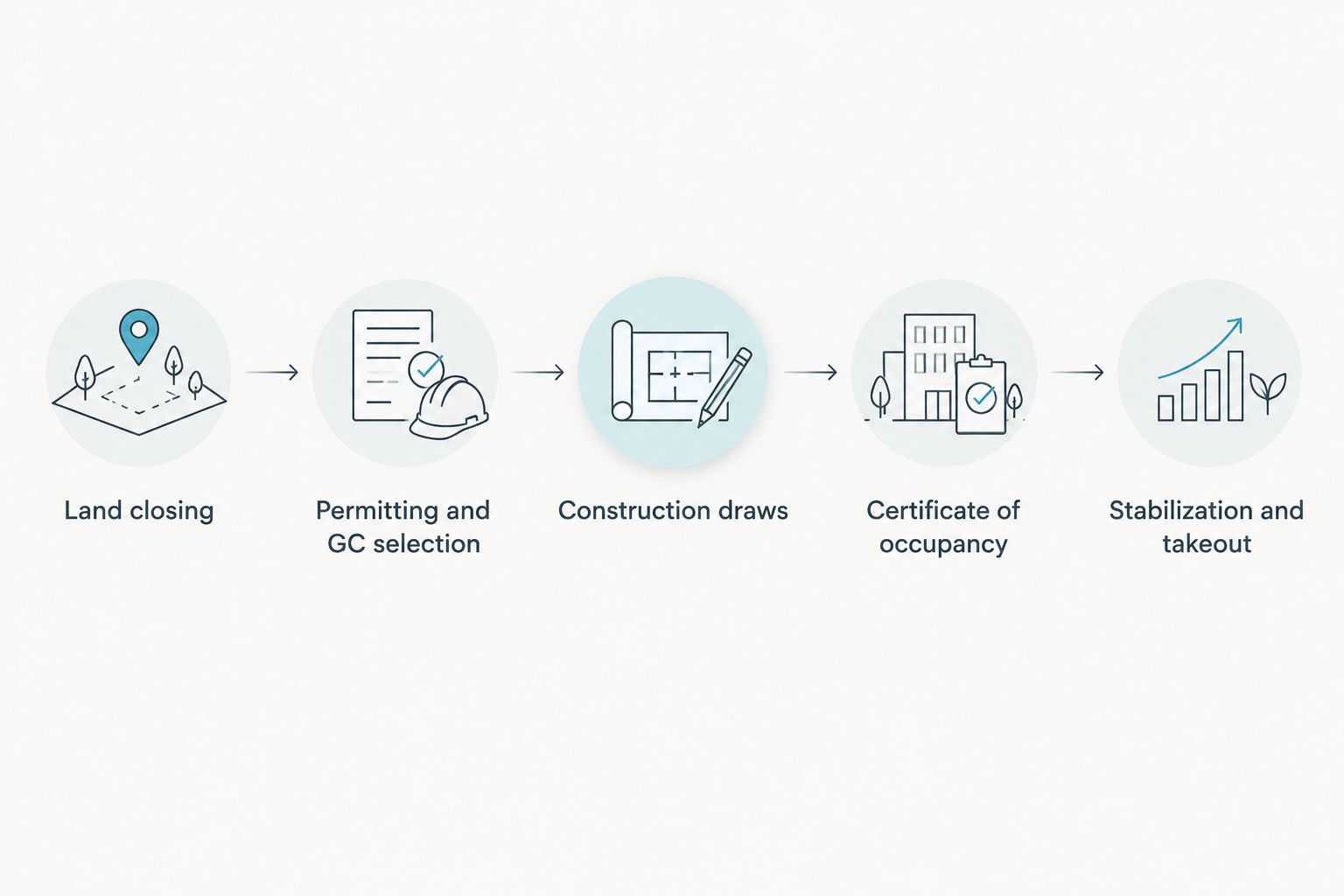
The lender that funds land closing is rarely the lender that holds the permanent loan.
What makes the best construction loan lenders for multifamily development
- Loan-to-cost leverage on the actual build, not just the land
- Recourse posture — full recourse, partial guaranty, or non-recourse
- Draw process speed — how fast inspections turn into wired funds
- Multifamily-specific underwriting experience, not just single-family flip experience
- Takeout coordination — whether the lender helps line up the permanent loan or leaves you to find it cold
- Timeline fit against your land contract and permit schedule
Construction loan lenders for multifamily development at a glance
LoanGuys
- Best for: Sponsors wanting one file through construction and takeout
- Standout feature: Coordinates bridge-to-construction with DSCR refinance
- Key limitation: Not a direct portfolio lender — works through its lender network
HUD/FHA 221(d)(4)
- Best for: Maximum leverage, long-term fixed-rate multifamily
- Standout feature: 40-year fixed term, non-recourse
- Key limitation: 12-18 month processing timeline
Regional and community banks
- Best for: Sponsors with a track record and recourse tolerance
- Standout feature: Relationship-based pricing and flexibility on draws
- Key limitation: Leverage usually caps well under HUD levels
Debt funds and private direct lenders
- Best for: Speed and non-recourse on thinner sponsor files
- Standout feature: Close in weeks, not months
- Key limitation: Higher rate, tighter GC and draw scrutiny
Credit unions
- Best for: Smaller balance ground-up deals
- Standout feature: Member pricing on loans under roughly $5-10 million
- Key limitation: Limited unit-count appetite and slower committee cycles
1. LoanGuys: best construction loan lender for coordinating build-to-permanent financing
LoanGuys structures the ground-up construction piece and lines up the DSCR or agency takeout loan before the building leases up, so a sponsor isn't shopping cold for permanent financing while the certificate of occupancy is sitting in a drawer. That sequencing matters more on multifamily than on single-family builds because the takeout is underwritten on projected rents, not a comp sale.
LoanGuys pros:
- Single point of contact across the construction and takeout stages
- Works with sponsors on both the ground-up bridge and the mixed-income multifamily side of a deal
- Structures deals through a network rather than one balance sheet, widening the options a sponsor sees
LoanGuys cons:
- Not a direct portfolio lender, so the final terms depend on which lender in the network takes the file
- Not the fastest path for a sponsor who only wants a stabilized bridge-to-perm on an already-built property
Best for: sponsors who want the construction and permanent-loan conversations happening in the same file instead of two separate searches. Verdict: strong fit if takeout timing is the part of the deal that worries you most.
2. HUD/FHA 221(d)(4): best construction loan lender for maximum leverage and a fixed 40-year term
HUD's 221(d)(4) program insures ground-up multifamily construction loans that convert to a permanent loan with up to a 40-year fully amortizing, fixed-rate term. It's built specifically for new construction and substantial rehab of apartment properties, which is why leverage on this program regularly runs ahead of conventional bank construction debt.
HUD 221(d)(4) pros:
- Highest leverage of any program on this list for ground-up multifamily
- Non-recourse once the loan converts
- Rate is fixed for the life of the loan, removing refinance risk at stabilization
HUD 221(d)(4) cons:
- Processing typically runs 12 to 18 months from application to closing
- Prevailing wage and Davis-Bacon requirements apply and add cost most sponsors don't budget for upfront
- Not workable if your land contract or entitlement window is measured in months, not years
Best for: larger multifamily projects where the sponsor can carry the entitlement and processing timeline. Verdict: worth the wait only when the deal's economics can absorb a year-plus runway before ground breaks.
3. Regional and community banks: best construction loan lender for relationship-based recourse deals
Regional and community banks still fund a large share of ground-up multifamily construction in 2026, particularly for sponsors with an existing deposit relationship or a completed project or two under their belt. Pricing tends to track the bank's cost of funds closely, and draw requests move through a loan officer who already knows the file.
Regional bank pros:
- Competitive rate for sponsors willing to sign full or partial recourse
- Loan officer continuity through the draw period
- Flexibility on smaller change orders that a securitized lender would kick back to committee
Regional bank cons:
- Leverage typically lands lower than HUD or debt fund options on a pure ground-up deal
- Credit committee cycles can slow a time-sensitive land closing
- Most regional banks want a sponsor with at least one completed multifamily project on their resume
Best for: repeat sponsors with a banking relationship and tolerance for a personal or corporate guaranty. Verdict: solid hold for sponsors who've already banked a completed deal with the same institution.
4. Debt funds and private direct lenders: best construction loan lender for speed and non-recourse structure
Debt funds move fast because they underwrite the deal, not the deposit relationship, closing ground-up multifamily construction loans in weeks where a bank committee would still be scheduling a site visit. That speed comes with tighter oversight on the build itself — draw inspections are stricter, and the lender wants a complete picture of who's swinging the hammer before the first dollar goes out.
Most debt funds now dig into a general contractor's licensing, insurance certificates, and safety compliance history before releasing the first construction draw, and contractors who stay current with OSHA compliance consultants for contractors tend to clear that review without a follow-up request slowing the schedule down.
Debt fund pros:
- Closings measured in weeks, not months
- Non-recourse structures available even for sponsors without a long multifamily resume
- Underwriting focused on the deal and the GC, not the sponsor's banking history
Debt fund cons:
- Rate sits above bank and HUD pricing
- Draw inspections are stricter and slower to release funds than a relationship bank
- Points and fees at closing tend to run higher than conventional financing
Best for: sponsors on a tight land-closing or permitting timeline who need speed more than the cheapest rate. Verdict: go here first when your window won't survive a bank's committee schedule.
5. Credit unions: best construction loan lender for smaller balance ground-up deals
Credit unions fill a narrower lane than banks or debt funds, typically capping ground-up multifamily construction loans in the low single-digit millions and favoring sponsors who are members or have an existing account relationship. What they lack in leverage they sometimes make up in pricing on smaller deals.
Credit union pros:
- Member pricing that can beat a regional bank on loans under roughly $5-10 million
- Direct access to a decision-maker rather than a distant credit committee
- Willing to work with sponsors on their first or second ground-up project in some cases
Credit union cons:
- Unit-count and loan-size caps rule out most larger multifamily projects
- Approval cycles can be slower than a bank despite the smaller loan size
- Fewer credit unions actively lend on ground-up construction compared to stabilized rental refinances
Best for: smaller multifamily projects — think 5 to 20 units — where the sponsor already banks locally. Verdict: worth a call if your loan size fits under the credit union's cap.
How this list was ranked
Each lender type was scored against the six criteria above: leverage, recourse posture, draw speed, multifamily-specific underwriting depth, takeout coordination, and timeline fit. No category wins on every dimension — that's the point of a decision tree instead of a single winner. A sponsor with a 45-day land closing and a debt fund quote on the table shouldn't be waiting on a HUD number that won't land for a year.
Which construction loan lender should you choose in 2026?
If your timeline can absorb 12 to 18 months and you want maximum leverage on a large multifamily project, HUD 221(d)(4) is the default. If your land contract closes inside three months, a debt fund or private direct lender is the realistic path, even at a higher rate. For most sponsors juggling both the ground-up build and the eventual permanent refinance, working the two stages through LoanGuys keeps the takeout from becoming a separate scramble six months into construction.
Structure your construction-to-permanent file
Get the ground-up loan and the takeout lined up in one conversation.
FAQ
What is the best construction loan lender for multifamily development in 2026?
There's no single best lender — HUD 221(d)(4) wins on leverage and rate for sponsors who can wait 12 to 18 months, debt funds win on speed for tight timelines, and regional banks win on pricing for sponsors with a completed project already on their resume.
How much leverage can I get on a ground-up multifamily construction loan?
Bank and debt fund construction loans typically land between 65% and 80% loan-to-cost. HUD 221(d)(4) usually goes higher, which is part of why it's the top leverage option on this list.
Is HUD 221(d)(4) better than a bank construction loan?
HUD 221(d)(4) offers higher leverage and a 40-year fixed term, but the 12-to-18-month processing timeline rules it out for sponsors on a fast land closing. A bank or debt fund is the better fit when speed matters more than leverage.
How long does it take to close a multifamily construction loan?
Debt funds and private direct lenders can close in a few weeks. Regional banks typically take longer due to committee cycles, and HUD 221(d)(4) runs 12 to 18 months from application to closing.
Can I get a non-recourse construction loan for an apartment building?
Yes. HUD 221(d)(4) converts to non-recourse at stabilization, and many debt funds and private direct lenders offer non-recourse structures on ground-up multifamily deals even for sponsors with a shorter track record.
Do I need prior multifamily experience to qualify for a ground-up construction loan?
Regional banks and credit unions usually want at least one completed multifamily project. Debt funds and private direct lenders are more flexible on sponsor experience because they underwrite the deal and the general contractor more heavily.
What happens after construction finishes on a multifamily construction loan?
The construction loan converts to or is refinanced into a permanent loan once the property reaches stabilized occupancy, commonly a DSCR loan or an agency takeout, which is why lining up that piece before the certificate of occupancy is issued matters.
One last thing
HUD 221(d)(4) offers the best leverage and the longest fixed term on this entire list, and most sponsors never use it because the 12-to-18-month timeline doesn't match how they buy land. The workaround isn't skipping HUD — it's starting construction on a faster loan and refinancing into permanent DSCR or agency financing once the property stabilizes, which is exactly the sequencing a construction-to-permanent file is built to solve in 2026.


