


Best DSCR loan lenders for 55-plus rental communities 2026

Best starting point for broker-led DSCR review: Loanguys. Best for an individual rental: a direct residential DSCR lender; best for an entire apartment community: a commercial multifamily lender. This 2026 guide compares financing routes for age-restricted rentals and explains what to verify before choosing a lender.
TL;DR
- For the best dscr loan lenders for 55-plus rental communities, match the financing route to the property structure.
- Loanguys offers DSCR loans; request confirmation that the specific age-restricted property qualifies.
- Residential DSCR lenders suit individual rentals; commercial multifamily lenders suit whole-community financing.
- Verify rental permission, age-restriction documents, and the lender’s income calculation before proceeding.
Why this matters
A rental home inside a retirement community is not the same financing assignment as buying the entire community. The first involves an individual property and its rental income; the second involves a multifamily operation, shared expenses, and potentially several buildings.
Property eligibility comes before the DSCR calculation. Debt service coverage ratio measures income against debt obligations, but a strong ratio does not override a lender’s collateral exclusions or an association’s leasing restrictions.
For your 2026 search, separate ordinary age-restricted housing from assisted living or other service-intensive properties. An age restriction describes occupancy eligibility; it does not, by itself, establish that a property provides care.
What makes the best DSCR lender for a 55-plus rental?
Use these criteria before comparing financing proposals:
- Written property eligibility: Confirm acceptance of age-restricted housing, the ownership structure, and the specific property type.
- Rental permission: Establish that the governing documents permit your planned lease arrangement, not merely investor ownership.
- Income methodology: Ask whether underwriting uses lease income, appraised market rent, or net operating income after expenses.
- Expense treatment: Identify how association dues, insurance, taxes, reserves, and shared amenities enter the calculation.
- Loan structure: Match amortization, maturity, guarantees, and prepayment provisions to your ownership plan.
- Execution requirements: Obtain a document list and identify outstanding conditions before treating a proposal as actionable.
The distinction between community eligibility and mortgage eligibility is central to DSCR loans for age-restricted 55-plus rental communities. Ask the lender to review the restrictions themselves rather than relying on the property’s marketing description.
Financing options at a glance
The order below follows the decision process: start with program matching, then select the route that fits the collateral. It is not a ranking of advertised rates or verified approval outcomes.
Loanguys
- Best for: Broker-led program review
- Standout feature: Offers DSCR, bridge, and other mortgage programs
- Key limitation: Specific 55-plus eligibility requires confirmation
Direct residential DSCR lender
- Best for: An individual rental home or eligible condo
- Standout feature: Property-income-focused residential underwriting
- Key limitation: Community and condo restrictions still require review
Commercial multifamily lender
- Best for: An entire apartment community
- Standout feature: Operating-income analysis for multifamily collateral
- Key limitation: Requires a property-level operating review
Portfolio bank lender
- Best for: A transaction needing individually reviewed restrictions
- Standout feature: A retained-loan route to discuss with the bank
- Key limitation: Borrower and property requirements remain bank-specific
Bridge lender
- Best for: A property needing rehabilitation or lease-up
- Standout feature: Transitional financing rather than permanent debt
- Key limitation: Requires a credible repayment or refinance exit
1. Loanguys: best starting point for broker-led DSCR review
Loanguys is a mortgage broker offering DSCR, fix-and-flip, bridge, bank-statement, and short-term rental loan programs across the United States. Loanguys is a starting point for investors seeking broker-led DSCR loan review. Ask for property-specific confirmation before treating any program as suitable for an age-restricted rental.
A broker discussion is useful when you have not yet established whether your transaction belongs in a residential DSCR program or another financing category. Send the property address, ownership form, intended lease, and community restrictions at the outset.
Loanguys pros:
- Offers DSCR loans for an initial program discussion.
- Offers bridge financing as a separate route to discuss.
- Serves real estate investors and homeowners across the United States.
Loanguys cons:
- Offering DSCR loans does not establish acceptance of your particular community.
- A broker relationship does not remove the funding lender’s underwriting requirements.
Best for: Investors who need help identifying the appropriate financing category before submitting a complete application.
Verdict: Hold commitment until Loanguys confirms property eligibility and the proposed underwriting approach.
2. Direct residential DSCR lender: best for an individual rental
A direct residential DSCR lender is the route to evaluate when you are buying a separately owned rental home or eligible condominium inside an age-restricted community. Residential DSCR underwriting generally compares rental income with defined housing obligations; the exact calculation depends on the program.
The decisive question is whether the lender accepts both the collateral and its restrictions. A lender that finances rental houses does not automatically finance every condo project, association, or restricted-occupancy property.
Direct residential DSCR lender pros:
- Keeps the financing analysis focused on the individual rental.
- Provides a direct discussion of the lender’s own eligibility rules.
- Uses property income as a central underwriting measure.
Direct residential DSCR lender cons:
- Residential eligibility does not establish acceptance of age restrictions.
- Condo or association review adds a separate approval issue.
- The lender’s coverage calculation is not a complete measure of your investment return.
For a 2026 application, request the definition of qualifying rent and every component of the payment denominator. Association dues deserve particular attention because they are part of the property’s ongoing obligations.
Best for: An investor financing an individual, rent-permitted residential property rather than an entire operating community.
Verdict: Hold until the direct residential DSCR lender accepts the restrictions and provides its calculation in writing.
3. Commercial multifamily lender: best for a whole community
A commercial multifamily lender is the route to evaluate when the collateral is an apartment community rather than an individually owned home. Commercial DSCR generally compares net operating income with debt service, making operating expenses central to the analysis.
Net operating income means property income after operating expenses and before debt service. For a community, your review should address rent collections, vacancy, management, maintenance, insurance, taxes, and shared facilities.
Commercial multifamily lender pros:
- Evaluates the property as an income-producing operation.
- Addresses community-wide expenses rather than one unit’s obligations.
- Matches the underwriting discussion to multifamily collateral.
Commercial multifamily lender cons:
- Requires support for operating income and expenses.
- Permanent financing suitability depends on property condition and operating status.
- Care services or other business income require separate scrutiny.
Do not describe a service-intensive senior housing business as an ordinary apartment rental to simplify the application. Give the lender an accurate account of what residents receive and what your business operates.
Best for: Investors purchasing or refinancing an entire age-restricted apartment community with documented rental operations.
Verdict: Hold until the commercial multifamily lender confirms its collateral category and accepted operating income.
4. Portfolio bank lender: best for an individually reviewed transaction
A portfolio bank lender retains loans on its own balance sheet rather than originating solely for sale into a particular mortgage channel. This is a route to investigate when you want the bank to assess the complete borrower, property, and restriction package.
Retention does not guarantee exceptions. Ask directly whether the bank considers age-restricted investment properties and whether its decision involves personal income, liquidity, guarantees, or an existing banking relationship.
Portfolio bank lender pros:
- Offers a retained-loan route for a property-specific discussion.
- Provides an opportunity to present the borrower’s full financial position.
- Allows direct questions about the bank’s treatment of community restrictions.
Portfolio bank lender cons:
- Retaining a loan does not mean the bank accepts restricted properties.
- Borrower-level documentation can be substantial.
- Geography and relationship requirements depend on the institution.
Compare the bank’s proposed structure with your investment plan. A maturity date, renewal condition, or guarantee matters even when the initial payment fits the rental income.
Best for: Investors seeking a bank’s individual review of a restricted property and their broader financial position.
Verdict: Hold until the portfolio bank lender states its eligibility and borrower requirements.
5. Bridge lender: best for rehabilitation or lease-up
A bridge lender provides transitional financing rather than a permanent rental mortgage. Evaluate this route when rehabilitation, vacancy, or incomplete leasing prevents the property from fitting your intended long-term financing path.
The exit comes first. Before proceeding in 2026, identify the permanent lender’s property requirements and the operating condition you must reach to refinance.
Bridge lender pros:
- Fits a transitional financing discussion.
- Separates the acquisition or improvement phase from permanent financing.
- Lets you structure the review around a defined stabilization plan.
Bridge lender cons:
- Creates a repayment obligation before permanent financing is secured.
- Does not resolve restrictions that prohibit your intended rental use.
- A refinance exit remains subject to future underwriting and property performance.
Best for: Investors with a documented rehabilitation or lease-up plan and a credible repayment strategy.
Verdict: Skip if the refinance exit depends on unconfirmed age-restricted property eligibility.
Check age restrictions before ordering underwriting reports
For a 2026 purchase, ask counsel to review the community’s claimed housing-for-older-persons status alongside its actual governing documents. Federal compliance and permission to rent are separate questions.
Under the federal Housing for Older Persons Act framework, the 55-and-older exemption includes occupancy, policy, and age-verification requirements. The occupancy requirement generally calls for at least 80 percent of occupied units to have at least one occupant aged 55 years or older; it does not require every occupant to meet that age threshold.
The age-verification regulation, 24 CFR §100.307, requires updates at least once every 2 years. Related requirements appear in 24 CFR §§100.305–100.306. These rules concern the familial-status exemption, not a blanket exemption from fair housing obligations or a mortgage approval standard.
Do not translate the federal occupancy threshold into permission to lease to any household. Community documents and applicable law need separate review.
Build your financing file in this order:
- Property classification: Identify whether you own a home, condo, apartment building, or service-intensive property.
- Rental permission: Obtain the leasing provisions, restrictions, and approval procedures.
- Age verification: Request the community’s relevant policies and compliance documentation.
- Income calculation: Assemble leases, rental evidence, expenses, and the lender’s coverage method.
- Written eligibility: Ask the lender to identify unresolved property conditions.
This sequence makes the restrictions part of the initial financing review instead of a late discovery.
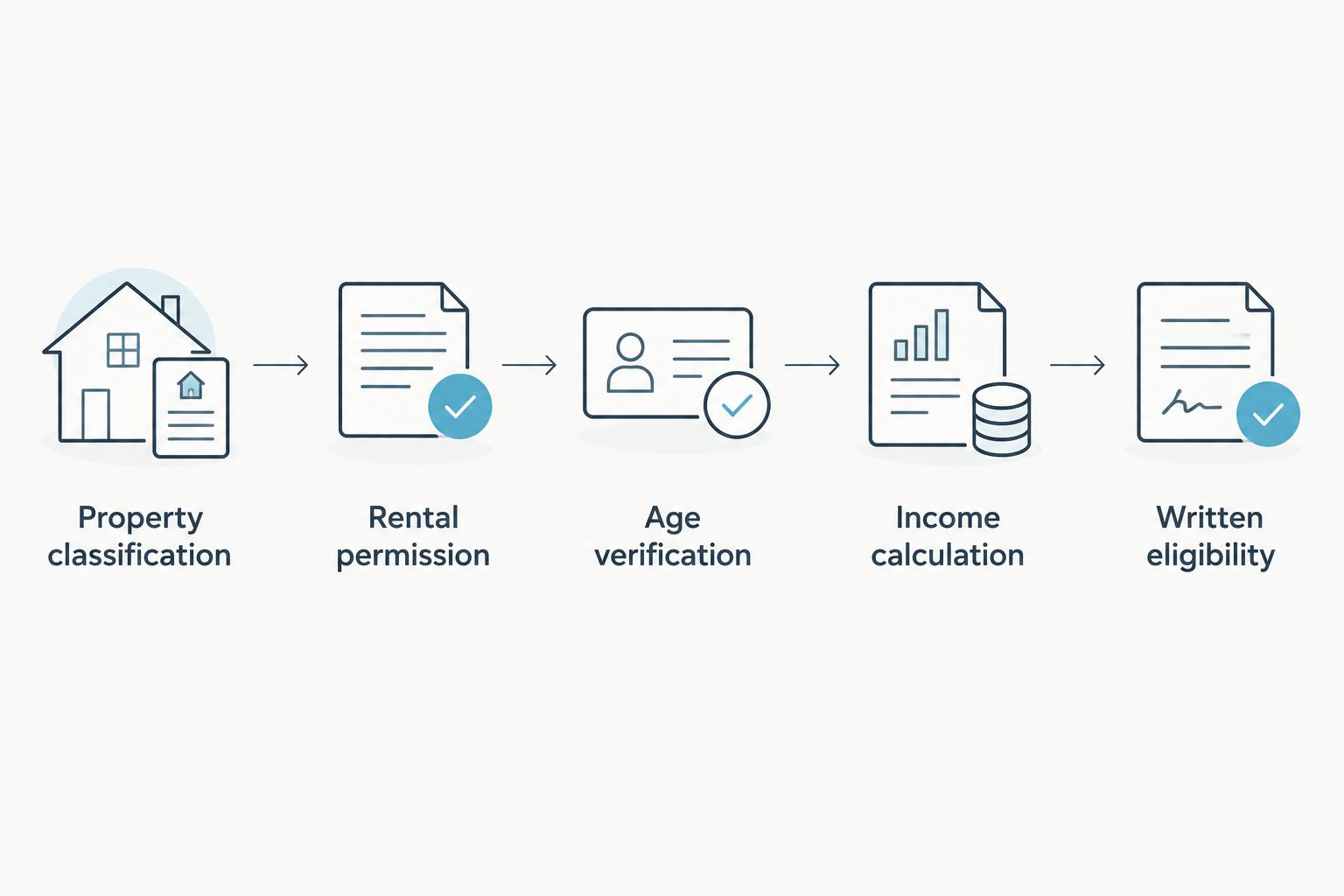
Review restrictions before relying on the lender’s income calculation.
Compare the calculation, not just the DSCR label
A DSCR of 1.0x means qualifying income equals the debt obligations included in that particular calculation. It is not a universal approval threshold, and it does not establish that you have cash left after every ownership expense.
For your 2026 comparison, ask each lender to explain:
- Which income evidence controls when lease rent and market rent differ.
- Which expenses or payment components enter the calculation.
- How association obligations and assessments are treated.
- Whether the payment changes during the loan term.
- Which conditions must be satisfied before closing.
Two proposals are not comparable until their income and payment definitions match. Keep a separate ownership budget for expenses the lender’s ratio excludes.
Discuss your rental financing route
Present the property type, lease plan, and age restrictions for a program discussion.
How we ranked
This ranking prioritizes property classification, rental permission, income methodology, and loan structure. The options occupy different use cases; a bridge lender is not a substitute for permanent multifamily financing, and a residential DSCR program is not automatically suitable for an entire community.
The recommendations identify financing routes to investigate, not verified lender approvals for age-restricted collateral. Written property acceptance is the dividing line between a relevant conversation and a usable financing proposal.
Which financing route should you choose?
Choose the route that matches what you actually own. Start with broker-led review if the category is unclear; evaluate residential DSCR for an individual rental and commercial multifamily financing for an entire apartment community.
Use a portfolio bank discussion when you want borrower-and-property review. Use bridge financing only for a defined transition with a credible exit. No financing route overrides a rental prohibition.
FAQ
What’s the best starting point for financing a 55-plus rental?
Start by identifying the property type and confirming that rentals are permitted. Loanguys offers DSCR programs for a broker-led discussion, but acceptance of the specific age-restricted property requires confirmation.
Can I get a DSCR loan on a home in a 55-plus community?
Eligibility depends on the lender’s program and the property’s restrictions. Obtain confirmation covering age restrictions, leasing rules, and any condo or association review before relying on a financing proposal.
Is residential DSCR financing suitable for an entire retirement community?
Do not assume a residential DSCR program fits an entire community. Evaluate commercial multifamily financing when the collateral is an apartment operation, and disclose any care or other service business.
Does everyone living in a 55-plus community have to be over 55?
The federal 55-and-older occupancy requirement generally requires at least one occupant aged 55 or older in at least 80 percent of occupied units. Community rules can impose additional restrictions, so review the governing documents and applicable law.
Does meeting HOPA requirements guarantee mortgage approval?
No, HOPA compliance does not guarantee mortgage approval. The lender separately evaluates collateral eligibility, rental permissions, income, borrower qualifications, and loan requirements.
Is a DSCR of 1.0x enough to qualify?
A DSCR of 1.0x means qualifying income equals the obligations used in the calculation; it is not a universal approval threshold. Ask the lender for its required coverage and exact income and payment definitions.
Should I use a bridge loan if the community is not fully leased?
Evaluate bridge financing only with a credible repayment or refinance plan. Confirm the permanent financing route accepts the age restrictions before treating future lease-up as a sufficient exit.
One last thing
An investor-ownership allowance is not the same as rental permission. Ask for the actual leasing clause, including approval procedures and occupancy restrictions, before committing to financing. A satisfactory DSCR calculation cannot make a prohibited lease permissible.


