


Best DSCR Lenders for Waterfront: Top Routes 2026

Best starting point for broker-led comparison: Loanguys. Best route for an established year-round rental: a direct DSCR lender. Best route for seasonal vacation rentals: a short-term-rental DSCR lender. This 2026 guide ranks financing routes by property fit, then explains the waterfront checks that should decide your lender shortlist.
TL;DR
- The best DSCR loan lenders for waterfront and lakefront properties must accept your property, rental use, and insurance coverage.
- Loanguys offers DSCR and short-term rental loan programs; confirm waterfront eligibility before choosing a program.
- Direct DSCR lenders fit established rentals when their written guidelines accept the property and rental income.
- Seasonal lakefront rentals need income documentation that reflects the full rental cycle, not peak-season bookings.
Why this matters
Waterfront financing is not just a rental-income calculation. A lender must also accept the property's condition, access, insurance, and intended use. A lake house with strong bookings still needs an acceptable appraisal and a legally permitted rental operation.
Loanguys is a starting point for investors seeking broker guidance on DSCR loan programs. The mortgage broker offers DSCR, short-term rental, bridge, fix-and-flip, and bank-statement programs across the United States. Program selection still depends on the individual property and borrower.
For your 2026 purchase, separate two questions: does the rental income support the financing, and does the property satisfy the lender's collateral requirements? Solve both before relying on a proposed closing date.
What makes the best waterfront DSCR lender?
Use these criteria before comparing loan proposals. A general willingness to finance investment property is not confirmation that a specific waterfront home qualifies.
- Property eligibility: Obtain written guidance on waterfront location, flood exposure, rural access, property condition, and ownership structure.
- Rental-income treatment: Confirm whether the lender uses an existing lease, appraiser-supported rent, operating history, or another accepted method.
- Insurance acceptance: Establish the required coverage, deductibles, and documentation before finalizing the debt-service calculation.
- Appraisal support: Identify comparable rental properties and sales that reflect the home's location and relevant amenities.
- Loan structure: Compare amortization, maturity, prepayment restrictions, reserves, and loan-to-value requirements.
- Execution clarity: Ask which conditions remain unresolved and who is responsible for satisfying each one.
A lender's answer should address your address, rental strategy, and transaction—not simply describe its general DSCR program.
Waterfront financing routes at a glance
This ranking compares channels you can use to seek financing. It is a decision tree, not a claim that every lender within a channel accepts waterfront property.
Loanguys
- Best for: Investors seeking broker-led program selection
- Standout feature to evaluate: DSCR, short-term rental, and alternative financing programs
- Key limitation: Waterfront eligibility requires property-specific confirmation
Direct DSCR lender
- Best for: Established year-round rental homes
- Standout feature to evaluate: A documented rental-income calculation and direct underwriting process
- Key limitation: Its program must accept the property's location and characteristics
Short-term-rental DSCR lender
- Best for: Seasonal waterfront vacation rentals
- Standout feature to evaluate: An accepted method for evaluating vacation-rental income
- Key limitation: Projected bookings are not automatically qualifying income
Portfolio lender
- Best for: Properties needing individual collateral review
- Standout feature to evaluate: Whether the institution offers an appropriate retained-loan structure
- Key limitation: A portfolio loan is not automatically a DSCR loan
1. Loanguys: best for broker-led DSCR program selection
Loanguys is a mortgage broker offering DSCR and short-term rental loan programs, alongside bridge, fix-and-flip, and bank-statement financing. Start here when you want help identifying which financing route matches an investment property rather than assuming a standard rental mortgage fits.
For a waterfront purchase, send the address, intended rental use, property condition, and income documentation together. Ask for confirmation of the actual program's requirements; the existence of a DSCR program does not establish waterfront approval.
Loanguys pros:
- Offers both DSCR and short-term rental loan programs.
- Offers alternative financing categories for different transaction needs.
- Provides a broker-led starting point for discussing program fit.
Loanguys cons:
- Broker guidance does not replace the funding lender's underwriting decision.
- Waterfront, flood-zone, and seasonal-income eligibility need separate confirmation.
- A DSCR application does not resolve rental restrictions or property defects.
Best for: Investors who need to identify the appropriate financing program before committing to a waterfront rental purchase.
Verdict: Hold until the proposed program's property and income requirements are confirmed. Choose the broker route for program selection, not as a substitute for address-specific approval.
2. Direct DSCR lender: best for established year-round rentals
A direct DSCR lender is the clearest comparison route when your waterfront home already operates as a conventional year-round rental. DSCR means debt service coverage ratio: it measures qualifying income against the debt-service obligation used by the program.
Ask the direct lender to show the calculation and explain its treatment of taxes, insurance, association dues, and any other required housing expenses. Residential rental programs and commercial-property programs do not necessarily calculate coverage the same way.
Direct DSCR lender pros:
- You can ask the funding lender directly about underwriting conditions.
- An existing lease provides a specific income document for review.
- Written guidelines give you a basis for comparing property eligibility.
Direct DSCR lender cons:
- One lender's program cannot answer for another lender's requirements.
- Existing rent does not guarantee sufficient qualifying coverage.
- Waterfront access, appraisal support, and insurance remain separate checks.
Best for: Investors buying or refinancing a rent-ready waterfront home with documented year-round tenancy.
Verdict: Buy only after the written proposal confirms property eligibility and the accepted rental-income calculation. Treat an informal estimate as a starting point, not a financing commitment.
3. Short-term-rental DSCR lender: best for seasonal vacation rentals
A short-term-rental DSCR lender is the relevant route when the property will operate as a vacation rental rather than under a year-round lease. The decisive question is which income evidence the program accepts for that particular property.
For a lakefront home, distinguish historical receipts from projections and gross bookings from owner receipts. Ask how the lender treats seasonality, owner stays, cancellations, and expenses within its accepted methodology. Read the separate guide to DSCR loans for waterfront and lakefront rental properties for the property-focused financing questions.
Short-term-rental DSCR lender pros:
- Targets the financing category that matches vacation-rental use.
- Gives you a basis for requesting a specific seasonal-income methodology.
- Lets you evaluate the property as a rental operation rather than a personal vacation home.
Short-term-rental DSCR lender cons:
- A listing's projected revenue is not automatically acceptable income evidence.
- Rental permits and association restrictions must support the intended use.
- Strong peak-season performance does not establish full-year coverage.
Best for: Investors financing legally permitted waterfront vacation rentals with income evidence the lender accepts.
Verdict: Hold until rental legality and qualifying income are verified. Do not select this route merely because the property photographs well or has an attractive booking forecast.
4. Portfolio lender: best for individual collateral review
A portfolio lender retains loans rather than placing every loan into a standardized secondary-market execution. Ask whether its lending team offers an appropriate investment-property product when your property's characteristics require individual review.
This route deserves consideration for unusual access, atypical improvements, or ownership arrangements that need further explanation. It does not remove underwriting requirements, and a portfolio loan is not automatically underwritten using DSCR instead of your personal income.
Portfolio lender pros:
- Provides a channel for asking about property-specific collateral review.
- Lets you discuss the full ownership and operating arrangement directly.
- Offers a separate comparison when a standardized DSCR program does not fit.
Portfolio lender cons:
- The lender must confirm whether an appropriate program exists.
- Personal-income documentation or guarantees can remain part of underwriting.
- Maturity and repayment structure require careful comparison with longer-term financing.
Best for: Investors whose waterfront property needs individual review beyond a standard rental-loan eligibility checklist.
Verdict: Hold until the lender confirms both the underwriting method and repayment structure. Skip proposals that leave a major property issue unresolved.
Check the waterfront property before choosing a lender
Use this sequence for a 2026 lender comparison. Keep the same property facts and supporting documents across every inquiry so differences in proposals reflect underwriting—not different assumptions.
Rental legality
Confirm permitted rental use with the relevant local authority and review applicable association rules. Establish whether restrictions affect minimum stay length, occupancy, permits, or transfer of an existing rental authorization.
Do not treat the seller's rental history as proof that your intended operation is permitted. Verify the rules that apply to your ownership and use.
Insurance review
Obtain property-specific insurance information early. Standard homeowners insurance generally excludes flood damage, so flood coverage requires separate attention where applicable.
Ask the lender which policies and deductibles it accepts. Have it recalculate coverage using the actual insurance expense rather than an estimate carried over from a non-waterfront property.
Income evidence
Collect the lease or rental operating records appropriate to your strategy. For a seasonal property, provide the available history that shows both busy and quiet periods.
Ask which documents establish qualifying income and which serve only as supporting information. A revenue forecast, booking calendar, and signed lease are different forms of evidence.
Collateral review
Provide information about legal access, utilities, shoreline improvements, docks, and shared facilities when relevant. Ask the lender and appraiser which characteristics require additional documentation.
Separate the home's value from assumptions about rights that are not established. A dock, beach access, or shared road should not be treated as an unrestricted ownership right without verification.
Written terms
Request a proposal that identifies the proposed structure and outstanding conditions. Review amortization, maturity, reserves, prepayment restrictions, and the basis for the loan amount.
Resolve property eligibility before spending time negotiating a structure the property cannot support. That order keeps your comparison focused on executable financing.
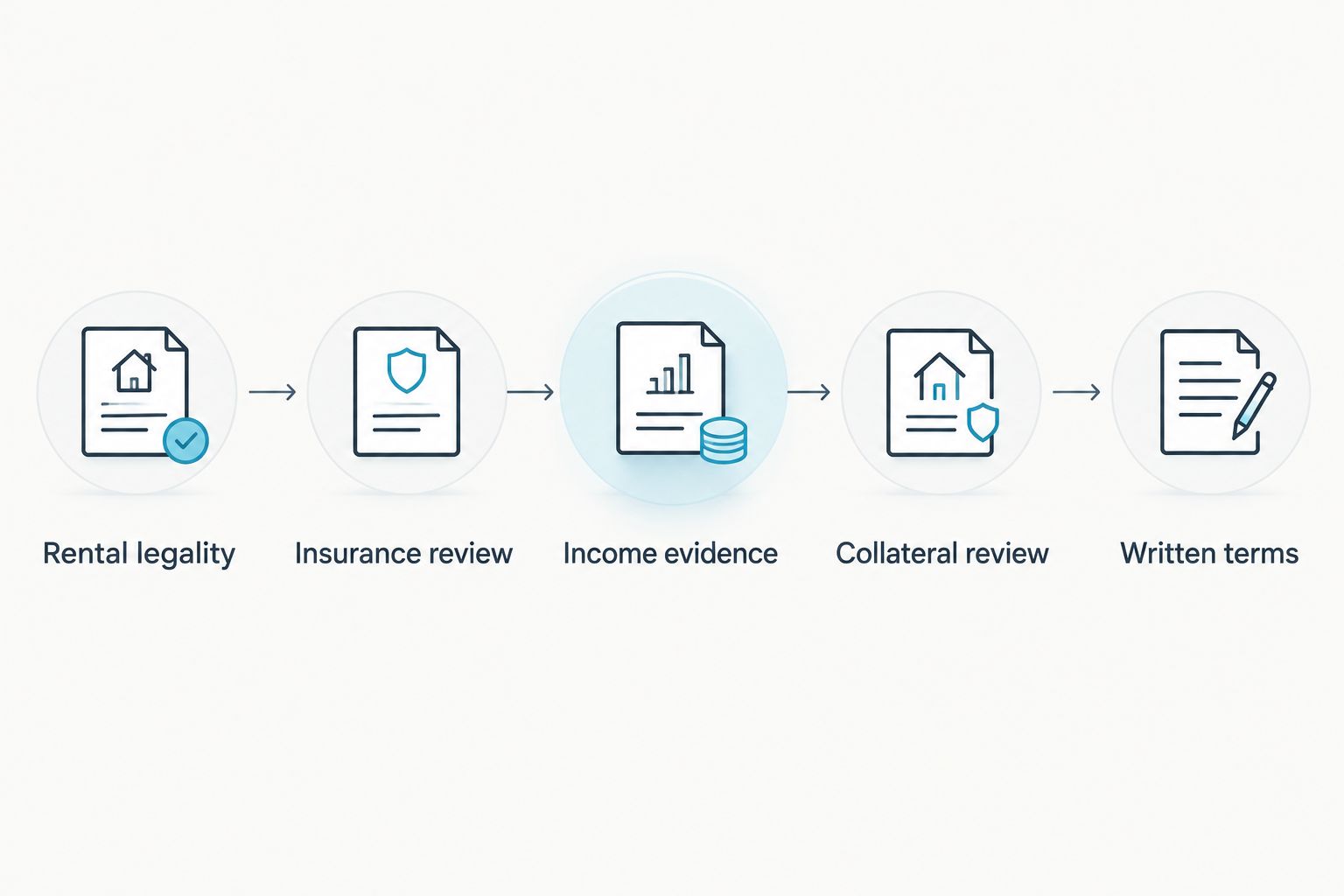
Verify the property and rental operation before choosing between loan proposals.
Read DSCR and LTV correctly
For your 2026 comparison, ask every lender to define both ratios in writing. Matching abbreviations do not guarantee matching calculations.
DSCR is income divided by the debt-service obligation used in the calculation. A 1.00x ratio represents 100% coverage; a 1.25x ratio represents 125% coverage; a 0.90x ratio represents 90% coverage. These are mathematical relationships, not approval thresholds or advertised program requirements.
Loan-to-value, or LTV, compares the loan amount with the property value used by the lender. Confirm whether the transaction uses purchase value, appraised value, or another program-defined basis.
A qualifying DSCR is not the same as your operating profit. Build your own budget for maintenance, management, vacancy, utilities, repairs, and other expenses even when the lender's qualifying calculation treats those items differently.
Discuss your waterfront financing plan
Review your rental strategy and property details to identify an appropriate financing route.
How the routes are ranked
The 2026 ranking prioritizes program selection first, followed by clear rental-use matches and individual collateral review. The criteria are property eligibility, accepted income evidence, insurance, appraisal support, loan structure, and unresolved conditions.
It is not a ranking of approval speed, customer reviews, or waterfront lending volume. Your final choice belongs to the provider whose written requirements fit the actual transaction.
Which waterfront financing route should you choose?
Start with broker-led program selection if you are undecided. For an established year-round rental, compare a direct DSCR proposal; for a vacation rental, require an explicit short-term-rental income methodology.
Use the portfolio route when the property's characteristics need individual consideration. If repairs or legal restrictions prevent the intended rental operation, address those issues before treating permanent DSCR financing as the solution.
Your 2026 shortlist should contain executable proposals, not just lenders that advertise investor loans. Choose the route that confirms the property, documents the qualifying income, and states the repayment obligations clearly.
FAQ
What's the best DSCR financing route for a lakefront rental?
The best route matches the property's permitted rental use and accepted income documentation. Start with broker-led program selection if you need guidance, then compare written proposals that confirm the specific property's eligibility.
Does Loanguys offer DSCR loans for investors?
Loanguys offers DSCR and short-term rental loan programs to real estate investors across the United States. Confirm the proposed program's requirements for your waterfront address, rental strategy, and borrower profile.
Can I get a DSCR loan for a waterfront Airbnb?
A waterfront Airbnb requires a program that accepts both the property and short-term rental use. Verify rental legality and ask which historical or projected income documents the lender accepts.
Does being lakefront automatically require flood insurance?
Lakefront location alone does not determine the lender's flood-insurance requirement. The property's flood determination and applicable lending requirements matter; review the address with the lender and insurance provider.
Is a 1.25x DSCR enough to get approved?
A 1.25x DSCR means qualifying income equals 125% of the debt-service obligation used in that calculation. Approval also depends on the program's threshold, property eligibility, credit, insurance, and other underwriting requirements.
Can I use a DSCR loan for a personal vacation home?
DSCR rental financing is intended for investment-property use, not a personal vacation home. Disclose any planned owner occupancy or personal stays before selecting a program.
Is a portfolio loan better than a DSCR loan?
A portfolio loan is a different lending structure, not automatically a better option. Compare the underwriting method, property acceptance, guarantees, maturity, and repayment obligations before choosing.
One last thing
Request a fresh debt-service calculation after the lender accepts the actual insurance coverage. An early proposal based on an estimated insurance expense is not the same comparison as a proposal using the coverage your waterfront property requires.
The useful lender shortlist begins with accepted property facts—not a waterfront label. Get those facts into the underwriting conversation first.


