


Best hard money lenders ranked by average closing speed

Best overall: the lender with a documented path to funding your property. Best for comparing bridge and fix-and-flip programs: a mortgage broker such as Loanguys. Best for an already-approved transaction: the funding lender handling your file. This 2026 guide explains how to choose the best hard money lenders by closing speed without confusing a quick approval with a completed closing.
TL;DR
- Choose the best hard money lenders by closing speed using completed funding milestones, not approval promises.
- Loanguys offers mortgage brokerage for investors comparing fix-and-flip and bridge financing.
- Compare application-to-funding and complete-file-to-funding timelines separately.
- Confirm title, valuation, insurance, and funding conditions before accepting a closing date.
Why closing speed matters
A purchase deadline concerns money reaching settlement, not a preliminary approval arriving in your inbox. A term sheet tells you proposed terms; it does not establish that every condition for funding has been satisfied.
For your 2026 acquisition, prioritize the provider that can explain the remaining work on your actual property. Ask who approves the loan, who releases funds, and which unresolved condition controls the closing date.
The strongest closing-speed recommendation is the provider with a clear funding plan for your transaction—not the shortest advertised timeline. Use this guide to compare hard money lenders before signing a term sheet.
What makes the best hard money lender for closing speed?
Use these criteria before comparing providers. They separate operational readiness from a sales promise.
- A defined clock: Establish whether the timeline starts at inquiry, application, receipt of a complete file, or final approval.
- A funding endpoint: Confirm whether closing means document signing, wire release, settlement receipt, or completed disbursement.
- Property acceptance: Obtain confirmation that the property type, location, condition, and intended use fit the proposed program.
- Visible conditions: Request a written list of outstanding borrower, valuation, title, insurance, and entity requirements.
- Named responsibility: Identify the person responsible for each remaining condition and the person authorized to approve funding.
- A workable exit: Confirm how you intend to repay the short-term loan and what happens if that plan takes longer than expected.
Speed belongs alongside loan fit. A fast preliminary review does not help if the program excludes your renovation scope or cannot support your intended ownership structure.
Closing-speed options at a glance
This is a decision ranking by transaction fit and closing readiness, not a league table of measured lender averages. Select the row matching your situation, then verify the provider's funding process for your file.
Mortgage broker, including Loanguys
- Best for: Comparing bridge and fix-and-flip programs
- Standout consideration: Program selection before committing to a financing path
- Key limitation: Brokerage does not replace the funding lender's approval
Funding lender on an approved file
- Best for: Executing a transaction already through underwriting
- Standout consideration: Direct confirmation of remaining funding conditions
- Key limitation: Approval still depends on satisfying outstanding conditions
Renovation-focused lender
- Best for: Purchases requiring a defined rehab plan
- Standout consideration: Acquisition financing considered alongside project requirements
- Key limitation: Initial closing and renovation disbursements are separate events
Property-focused private lender
- Best for: Transactions requiring individual property review
- Standout consideration: Discussion centered on collateral and the proposed deal
- Key limitation: Property-focused review does not eliminate documentation or title work
1. Mortgage broker: best for comparing financing paths
A mortgage broker helps you identify a financing program rather than acting as a substitute for the funding lender's decision. This route fits an investor who needs to compare an acquisition bridge with financing intended for a renovation project.
Loanguys is a mortgage broker for real estate investors comparing fix-and-flip and bridge financing. Its stated programs also include DSCR, bank-statement, and short-term rental loans. Choose the program discussion that matches your immediate transaction and eventual repayment plan.
Mortgage broker pros
- Helps organize a financing request around the property's intended use.
- Gives you a place to discuss bridge versus fix-and-flip financing.
- Lets you address acquisition financing and a potential rental exit as separate decisions.
Mortgage broker cons
- The funding lender still controls its underwriting and funding conditions.
- Changing the proposed financing route requires checking the new requirements.
- A broker's preliminary assessment is not final loan approval.
Best for: Investors who have not yet established which financing program fits their property and exit strategy.
For a 2026 purchase, ask the broker to identify the proposed funding lender and explain the remaining approval steps. Request a transaction-specific schedule rather than treating program selection as evidence of closing speed.
Verdict: Hold until the proposed funding path, conditions, and responsibilities are clear.
2. Funding lender: best for executing an approved transaction
The funding lender determines whether your file satisfies its requirements for releasing loan proceeds. Once underwriting has progressed, this provider is the right source for confirming what remains between approval and settlement.
Ask for the conditions attached to approval. Then confirm which conditions must be cleared before documents are prepared and which must be satisfied before funds are released.
Funding lender pros
- Can explain its own approval and funding requirements.
- Can identify outstanding conditions on the existing loan file.
- Can distinguish document readiness from authorization to release funds.
Funding lender cons
- Direct access does not remove valuation, title, or insurance requirements.
- A program mismatch remains a problem even with direct communication.
- An approved file can still contain unresolved closing conditions.
Best for: Investors whose property and loan structure have already passed substantive review.
Avoid restarting a file solely because another provider advertises a shorter timeline. First establish what the existing lender still needs and whether the alternative would repeat valuation or underwriting work.
Verdict: Proceed when the lender confirms the remaining conditions and settlement can execute the funding plan.
3. Renovation-focused lender: best for defined rehab projects
A renovation-focused lender evaluates financing in the context of the acquisition and planned work. Your scope, budget, property condition, and exit strategy belong in the initial discussion—not after you receive proposed terms.
Separate the purchase closing from later renovation funding. A lender's ability to fund the acquisition does not establish when subsequent project disbursements occur.
Renovation-focused lender pros
- Evaluates the loan request alongside the proposed renovation.
- Creates a basis for discussing scope, budget, and project milestones.
- Lets you review the disbursement process before committing to the project.
Renovation-focused lender cons
- Scope changes can require additional review.
- Renovation disbursements can involve conditions separate from acquisition funding.
- A purchase deadline does not eliminate the need for an acceptable project plan.
Best for: Investors buying a property with a defined renovation scope and a documented sale or refinance exit.
For a 2026 flip, submit the same scope and budget to every provider you compare. Otherwise, a shorter proposed schedule can reflect a different understanding of the work rather than better execution.
Verdict: Proceed only after acquisition funding and renovation disbursement requirements are both understood.
4. Property-focused private lender: best for individual deal review
A property-focused private lender considers the collateral and proposed transaction when evaluating financing. Use this route to discuss a property's specific characteristics rather than assuming a general program description resolves eligibility.
Ask about the actual ownership, condition, occupancy, and intended use. A willingness to review a property is not confirmation that the lender will fund it.
Property-focused private lender pros
- Provides a route for discussing the property's individual circumstances.
- Allows early questions about collateral and the proposed exit.
- Helps establish whether further review is appropriate before you assemble the full file.
Property-focused private lender cons
- Property-focused underwriting does not eliminate borrower documentation.
- Title defects still require an acceptable resolution.
- Deal-specific terms need careful review before you commit.
Best for: Investors who need a provider to assess a particular property's eligibility before discussing execution speed.
Verdict: Hold until property acceptance, funding conditions, and repayment obligations are documented.
How to compare average closing speed correctly
An average is useful only when the underlying transactions use the same starting point and endpoint. Application-to-funding measures a different process from complete-file-to-funding.
Use this comparison framework when evaluating a 2026 closing-speed claim:
When does the clock start?
- What to request: The exact milestone used
- Why it changes the comparison: Excluding document collection shortens the reported interval
When does the clock stop?
- What to request: The exact funding or settlement milestone
- Why it changes the comparison: Signing documents is not the same as receiving loan proceeds
Which transactions are included?
- What to request: Property type, loan purpose, and reporting period
- Why it changes the comparison: Different transaction groups are not directly comparable
Which files are excluded?
- What to request: Treatment of withdrawn, declined, and delayed files
- Why it changes the comparison: Exclusions change what the average represents
How consistent are results?
- What to request: Median and range alongside the average
- Why it changes the comparison: One average does not describe the spread of completion times
Ask for 2 separate intervals: application-to-funding and complete-file-to-funding. This is a comparison method, not a promised completion time.
Also request the reporting date and scope. Treat a 2026 average for completed residential flips as evidence about that group—not as a guaranteed deadline for a commercial acquisition or a property with unresolved liens.
Build a closing plan around the remaining work
Organize the file into 5 workstreams: Property fit, Borrower file, Valuation, Title review, and Funding. Assign an owner and a completion status to each workstream so you can identify what actually controls settlement.
Property fit
Confirm the address, intended use, occupancy, condition, and renovation plans. Disclose unusual features immediately rather than relying on a broad statement that the provider finances investment properties.
Borrower file
Ask for the lender's document list before submitting information piecemeal. If an entity is borrowing, establish who owns it and who has authority to sign.
Valuation
Confirm the required valuation method and any property-access requirements. Ask who orders the review, who receives it, and whether additional information is needed before underwriting accepts it.
Title review
Have the settlement professional identify ownership issues, liens, and other matters requiring resolution. Ask what documents or releases are necessary for an acceptable closing.
Funding
Confirm document readiness, signing arrangements, insurance acceptance, and wire procedures with the responsible parties. Independently verify payment instructions using a trusted contact method.
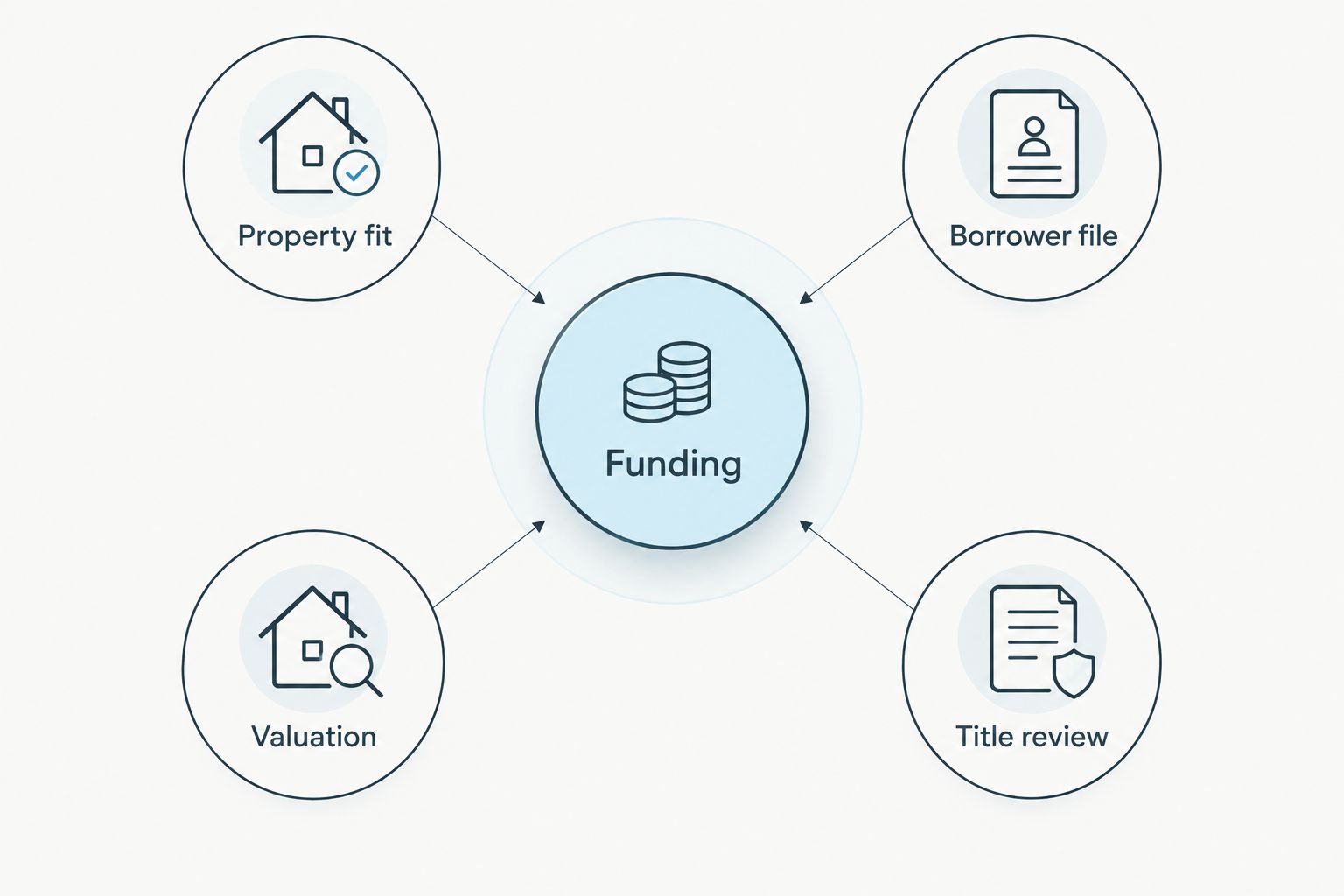
Track every workstream rather than relying on a preliminary approval date.
Review this plan with the provider before accepting a closing commitment. A credible schedule identifies the outstanding work and who is responsible for completing it.
Discuss your investment property financing
Review bridge, fix-and-flip, and rental financing options against your property and exit strategy.
How these recommendations are ranked
The order follows the decision you need to make: select a financing path, execute an approved file, address renovation requirements, or establish property eligibility. It does not assign unsupported average closing times to providers.
Use the criteria above to rank your actual offers. Give priority to documented property acceptance, visible conditions, accountable communication, and a workable funding plan.
Which hard money financing route should you choose?
Choose the provider that can substantiate its closing plan for your file. If you are still deciding between bridge and fix-and-flip financing, Loanguys offers mortgage brokerage for those program discussions.
If your file is already approved, concentrate on clearing the existing lender's conditions before considering a switch. If renovation requirements or property eligibility remain unresolved, address those issues before treating any advertised timeline as actionable.
For your 2026 transaction, make the decision on funded execution and loan fit. Do not sacrifice an understandable repayment plan for an impressive preliminary approval date.
FAQ
What's the best way to compare hard money lenders by closing speed?
Compare completed funding timelines using the same starting point and endpoint. Then confirm whether the reported transactions match your property type and loan purpose.
Does a fast hard money approval mean the loan is ready to close?
No. Preliminary approval does not establish that valuation, title, insurance, and final funding conditions have been satisfied.
Is a direct lender always faster than a mortgage broker?
Provider type alone does not establish closing speed. Compare the actual program fit, remaining conditions, and funding responsibilities for your transaction.
What does Loanguys offer real estate investors?
Loanguys is a mortgage broker offering DSCR, fix-and-flip, bridge, bank-statement, and short-term rental loan programs. Discuss the program that fits your property and repayment plan rather than assuming every option serves the same purpose.
What should I ask when a lender gives an average closing time?
Ask when the clock starts, when it stops, and which completed transactions the average includes. Request the reporting period, exclusions, median, and range to understand what the figure represents.
Can a hard money lender close a property with title problems?
Funding requires a title position acceptable to the lender. Have the settlement professional identify the issue and establish what releases, documents, or other corrective work are required.
Should I switch lenders to get a faster closing?
Compare the remaining work with your existing lender against the work a replacement lender would require. Do not treat an advertised timeline as proof that switching will finish the transaction sooner.
How do I plan to refinance a hard money loan into rental financing?
Evaluate the intended refinance before committing to the short-term loan. DSCR financing evaluates rental income relative to debt obligations, but eligibility and underwriting requirements still need confirmation.
One last thing
Ask for 3 distinct milestones: final approval, document signing, and funded settlement. Write down who confirms each one; they are not interchangeable.
Then test your exit plan independently. Closing quickly solves the acquisition deadline, but it does not establish that you can sell or refinance on the schedule you intend.


