


Best loan options for RV park and campground investors
Best overall for a stabilized property: a commercial term loan. Best for an eligible owner-operated campground: SBA 7(a). Best for a turnaround: a bridge loan. This 2026 RV park financing guide compares six structures by property condition, operating model, and repayment plan—not by lender advertising.
TL;DR
- Commercial term loans are the default RV park financing choice for stabilized campgrounds with documented cash flow.
- SBA 7(a) fits eligible operating-business acquisitions; SBA 504 targets qualifying fixed assets, not working capital.
- Bridge loans suit repositioning projects only when the refinance or sale plan is credible.
- Loanguys is a mortgage broker for investors comparing investment-property programs; confirm campground eligibility before applying.
Loanguys offers investment-property loan programs, but an RV park needs a property-specific eligibility review. A residential rental program is not automatically a campground financing program.
Why this matters
An RV park combines real estate, infrastructure, and an operating business. You need financing that recognizes all three. A campground dependent on nightly bookings presents a different repayment picture from a park collecting recurring monthly site rent.
For a 2026 acquisition, separate the property’s current performance from the seller’s expansion story. Existing cash flow supports debt today; proposed sites and future reservations require additional verification. Choose the loan around the income you can document and the improvements you must fund.
What makes the best RV park financing
Use these criteria before comparing proposals:
- Property eligibility: Confirm acceptance of RV parks, transient stays, cabins, and any mixed residential uses.
- Operating fit: Match the loan to an owner-operated business, passive investment, or development project.
- Cash-flow treatment: Ask how the lender handles seasonality, management expenses, and nonrecurring income.
- Funding scope: Separate acquisition, infrastructure work, equipment, and operating reserves.
- Repayment structure: Review amortization, maturity, guarantees, and any balloon payment.
- Exit requirements: For temporary debt, identify the evidence a future refinance lender will require.
A longer amortization spreads scheduled principal repayment over more time. It does not eliminate a balloon balance if the loan matures before that repayment schedule ends.
RV park financing options at a glance
1. Commercial term loan
- Best for: Stabilized parks with verifiable operations
- Standout feature: Debt structured around established property performance
- Key limitation: Weak records or unresolved infrastructure problems complicate underwriting
2. SBA 7(a) loan
- Best for: Eligible operating-business acquisitions
- Standout feature: Can address qualifying business and real estate purposes
- Key limitation: Passive investment structures do not qualify automatically
3. SBA 504 loan
- Best for: Eligible fixed-asset projects
- Standout feature: Long-term financing for qualifying real estate and equipment
- Key limitation: Does not fund working capital
4. Commercial bridge loan
- Best for: Repositioning an existing park
- Standout feature: Temporary financing tied to a defined transition
- Key limitation: Creates refinance or sale risk at maturity
5. Seller financing
- Best for: Negotiated acquisitions with a participating seller
- Standout feature: Buyer and seller negotiate repayment terms
- Key limitation: Requires seller agreement and careful lien documentation
6. Construction loan
- Best for: Ground-up development or major expansion
- Standout feature: Funding released against approved project progress
- Key limitation: Entitlements, infrastructure, and completion risk remain central
1. Commercial term loan: best for a stabilized RV park
A commercial term loan is the default starting point when an operating park has reliable records and no major unresolved redevelopment needs. The lender evaluates the property, operating income, borrower, and collateral together.
Commercial term loan pros:
- Matches a long-term hold better than temporary acquisition debt.
- Lets you present existing operating performance rather than rely entirely on projections.
- Creates a clear framework for reviewing amortization, maturity, and guarantees.
Commercial term loan cons:
- Incomplete books weaken the repayment case.
- A balloon maturity can arrive before the debt is fully amortized.
Ask whether the lender distinguishes transient campground revenue from recurring site rent. Confirm how replacement management and infrastructure maintenance enter the underwriting, even if the seller currently performs that work personally.
Best for: An established park with documented income and manageable capital needs.
Verdict: Buy when verified operations support the proposed debt and you understand the maturity obligation.
2. SBA 7(a): best for an eligible operating-business acquisition
SBA 7(a) deserves consideration when you are acquiring and operating a qualifying campground business rather than simply holding passive rental real estate. Eligible uses include business acquisition, real estate, equipment, and working capital, subject to program and lender requirements.
For eligible real estate financing, SBA 7(a) maturities can extend to 25 years. A transaction containing other uses requires a term review rather than an assumption that every component receives the same repayment period.
SBA 7(a) pros:
- Addresses several qualifying acquisition and business needs.
- Provides an established framework for operating-business financing.
- Supports long-term real estate repayment where eligible.
SBA 7(a) cons:
- Campground ownership alone does not establish program eligibility.
- Business operations, ownership, and repayment ability require detailed review.
Best for: A buyer taking over an eligible active campground business.
Verdict: Buy after the lender confirms the operating structure and proposed uses qualify under 2026 requirements.
3. SBA 504: best for qualifying fixed-asset investment
SBA 504 focuses on qualifying fixed assets, including real estate and certain equipment. Its structure generally combines a participating lender, a Certified Development Company, and borrower equity. It is not a substitute for a working-capital facility.
Eligible real estate projects have 20-year and 25-year maturity options. Ask a Certified Development Company to evaluate the campground’s business activity, occupancy structure, and project uses before treating SBA 504 as a financing route.
SBA 504 pros:
- Fits qualifying long-lived real estate investment.
- Separates fixed-asset financing from operating needs.
- Offers long-term maturity options for eligible projects.
SBA 504 cons:
- Working capital is not an eligible use.
- The transaction requires coordination across the financing participants.
A campground acquisition that includes goodwill, operating reserves, and real estate needs a funding plan for each component. Do not assume the entire purchase agreement fits within SBA 504.
Best for: An eligible operator financing qualifying property or fixed-asset improvements.
Verdict: Hold until the project allocation and business eligibility are confirmed.
4. Commercial bridge loan: best for repositioning an existing park
A commercial bridge loan funds a temporary stage between acquisition and a longer-term outcome. For an RV park, that stage might involve repairing infrastructure, improving records, or completing a defined operational turnaround.
Bridge loan pros:
- Matches financing to a specific transition rather than a permanent hold.
- Lets you evaluate acquisition and repositioning as one project.
- Creates a defined milestone for refinancing or selling.
Bridge loan cons:
- Repayment depends on executing the exit before maturity.
- An improved property still needs to meet the next lender’s standards.
Write the exit requirements before accepting temporary debt. Identify the operating history, completed work, permits, and cash-flow evidence needed for permanent financing. A planned refinance is not an approval.
Loanguys offers bridge loan programs; campground collateral and project eligibility still require confirmation. An investment-property product label does not establish RV park financing eligibility.
Best for: An existing park with a documented improvement plan and credible exit.
Verdict: Buy only when the transition budget and repayment route stand on their own.
5. Seller financing: best for a negotiated acquisition structure
Seller financing means the seller accepts a promissory note for an agreed portion of the transaction instead of receiving that portion at closing. The note’s security, repayment schedule, and remedies belong in enforceable transaction documents.
Seller financing pros:
- Allows direct negotiation over repayment structure.
- Can address a gap between buyer and seller transaction preferences.
- Gives both parties a way to connect financing terms with the sale agreement.
Seller financing cons:
- Depends on the seller’s willingness and financial position.
- Creates lien-priority and consent questions when another lender participates.
Use legal counsel to review default provisions, balloon obligations, collateral, and existing debt restrictions. Seller financing does not make an unpermitted campground or unsupported operating forecast financeable.
Best for: A buyer and seller who can agree on a documented, workable repayment arrangement.
Verdict: Buy when the note fits the acquisition and every participating lender accepts the structure.
6. Construction loan: best for new development or major expansion
A construction loan addresses work that has not yet been completed. Funding typically follows approved draws tied to project progress, with documentation and inspections governing disbursements.
For campground development, the construction plan must connect permitted sites with actual utility capacity. Roads, drainage, electrical service, water, and wastewater systems belong in the financing discussion—not just the site layout.
Construction loan pros:
- Matches funding to an approved development scope.
- Makes the project budget and completion milestones explicit.
- Supports a structured review of contractors and progress.
Construction loan cons:
- Cost overruns and delays threaten completion.
- Finished construction does not establish stabilized operating income.
Identify the permanent financing or sale strategy before starting. Opening a park and producing a lender-acceptable operating record are separate milestones.
Best for: An entitled project with a supportable budget, qualified execution team, and repayment plan.
Verdict: Wait until permits, infrastructure scope, contingency funding, and the exit are documented.
How to prepare an RV park financing package
For a 2026 application, build the file around four subjects: Revenue, Expenses, Site legality, and Infrastructure. These categories connect the seller’s financial claims to the property you will actually own.
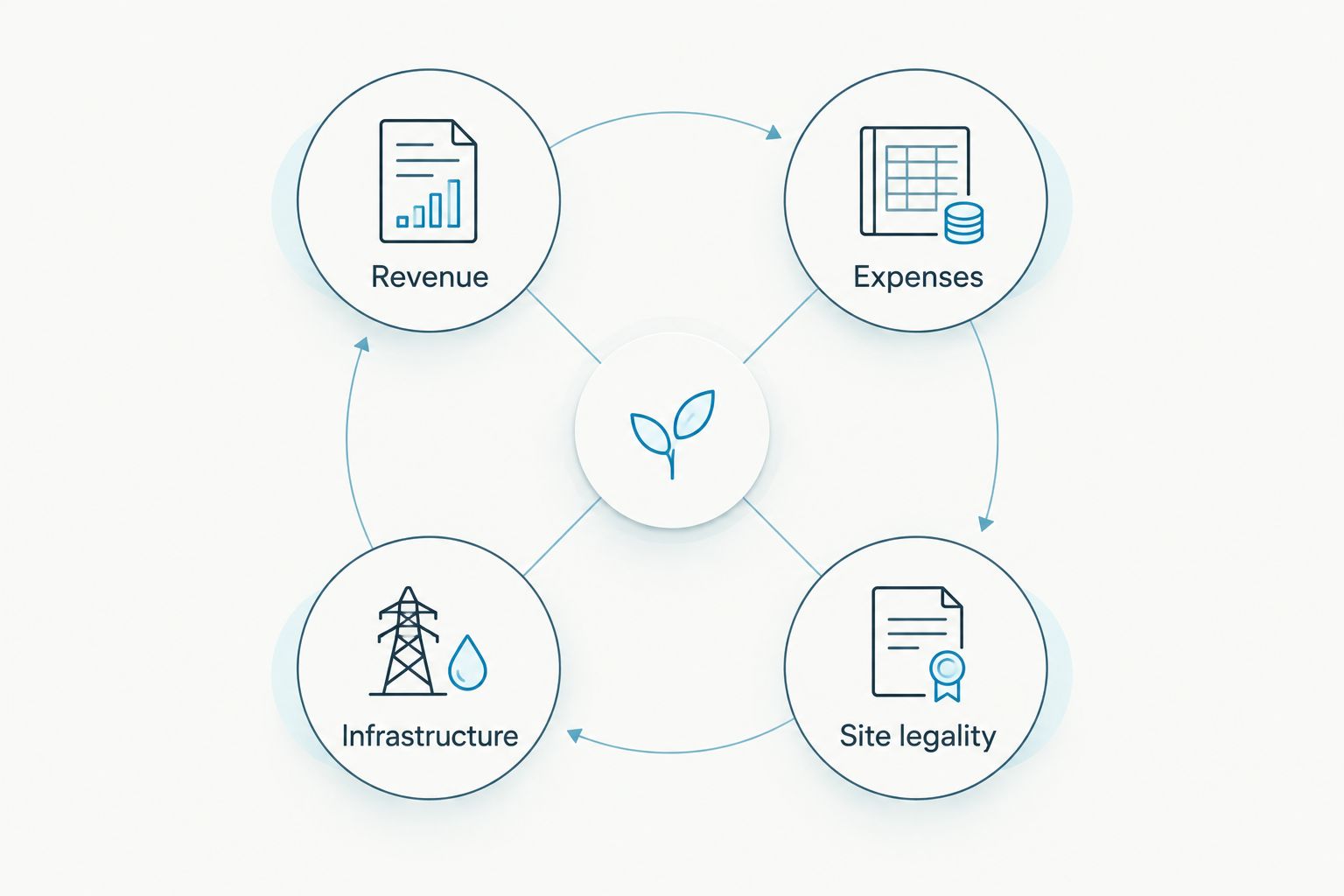
Revenue
Request monthly operating statements, booking records, site agreements, and deposit support. Separate nightly, weekly, and monthly stays, then distinguish site revenue from cabins, stores, laundry, and other activities.
Match operating records to the seller’s financial statements. A full park during peak season does not establish year-round repayment capacity. Ask the lender which income streams it recognizes and what supporting history it requires.
Expenses
Identify management, payroll, utilities, insurance, taxes, repairs, and recurring service obligations. Separate ordinary operations from capital replacements, but budget for both.
Show what changes after closing. Owner labor, related-party arrangements, and deferred maintenance can make historical statements look different from your actual operating plan.
Site legality
Verify permitted use, approved site count, occupancy restrictions, access rights, and any unresolved violations. Confirm whether cabins, permanent residents, and proposed additional sites fit the existing approvals.
For a 2026 purchase, use current records rather than relying on a seller’s description of longstanding use. A physical campsite and a legally approved revenue-producing site are not interchangeable.
Infrastructure
Obtain qualified assessments of electrical distribution, water supply, wastewater systems, roads, drainage, and relevant structures. Define who owns and maintains each system, including infrastructure shared with neighboring property.
The scope of commercial property inspections for lenders should match the collateral and identified risks; a building inspection alone does not answer questions about campground utility capacity. Separate physical-condition findings from environmental review and specialized system evaluations.
Use the RV park and campground investor loan guide alongside your property file to keep the financing discussion focused on the asset rather than a generic rental application.
How we ranked these financing options
The ranking puts established operations first, then separates active-business financing, fixed-asset investment, repositioning, negotiated seller debt, and development. Each option owns a different use case.
The criteria are property eligibility, operating fit, cash-flow treatment, funding scope, repayment structure, and exit requirements. This is a financing-structure comparison, not a claim that one lender approves every campground or offers the same terms to every borrower.
Which RV park financing should you choose?
Start with a commercial term loan if the park is stabilized. Investigate SBA 7(a) if you are acquiring an eligible operating business, and SBA 504 if qualifying fixed assets drive the project.
Choose temporary debt only for a temporary need. Bridge financing belongs with an executable turnaround; construction financing belongs with a documented development plan. Seller financing works when the negotiated note strengthens the transaction rather than postponing an unresolved repayment problem.
Loanguys is a mortgage broker for investors comparing investment-property programs. For RV park financing, ask Loanguys to confirm the property classification, financing purpose, and program eligibility before submitting a full application.
Discuss your property financing
Describe the campground, operating history, proposed work, and financing purpose before choosing a program.
FAQ
What's the best loan for buying an established RV park?
A commercial term loan is the default starting point for a stabilized RV park with verifiable cash flow. An eligible operating-business acquisition also warrants an SBA 7(a) review.
Can I use an SBA loan to buy a campground?
An eligible campground business can qualify for SBA financing, subject to program and lender requirements. The lender must evaluate the business activity, ownership structure, property use, and repayment ability; passive real estate investment does not qualify automatically.
Is SBA 7(a) better than SBA 504 for campground financing?
SBA 7(a) fits a broader mix of qualifying business purposes, while SBA 504 focuses on qualifying fixed assets. SBA 504 does not fund working capital, so compare the actual uses of funds before choosing.
Can I use a residential DSCR loan for an RV park?
Do not assume a residential DSCR program accepts RV parks. Debt service coverage ratio measures income relative to debt payments, but using that measure does not make commercial campground collateral eligible for a residential product.
How much down payment do I need for RV park financing?
The required equity depends on the loan structure, collateral, borrower, and project. Ask for written requirements that distinguish the down payment from reserves, transaction expenses, and improvement funding.
What records do lenders need for a seasonal campground?
Prepare monthly financial statements, occupancy or booking records, site agreements, and support for collected revenue. Show operating expenses and seasonal cash needs so the lender can evaluate more than peak-season performance.
Does Loanguys finance every type of RV park?
RV park eligibility requires a property-specific review. Loanguys offers investment-property programs, but that does not establish acceptance of every campground, operating model, or development project.
One last thing
Ask the lender to identify the income and sites it will actually underwrite. A seller’s revenue forecast can include unapproved expansion, proposed cabins, or operating changes you have not completed.
Before committing to a 2026 acquisition, align the purchase contract, approved property use, improvement budget, and financing assumptions. The strongest next move is not collecting more generic loan quotes; it is getting the property’s eligibility and repayment case clear.


