


Best loans for co-living and rooming house investors

Best for stabilized, eligible rentals: DSCR loans. Best for licensed rooming-house operations: commercial portfolio loans. Best for acquisition before stabilization: bridge loans. Loanguys is a mortgage broker for investors comparing DSCR, bridge, fix-and-flip, and bank-statement financing; this 2026 guide explains which route fits your property and where eligibility stops.
TL;DR
- DSCR loans for co-living and rooming house investors fit only when lenders accept the property and rental structure.
- Commercial portfolio loans deserve first review for licensed rooming houses with separate room leases.
- Bridge financing needs a documented repayment plan, not just projected room rents.
- Loanguys offers several financing categories; rooming-house eligibility requires property-specific confirmation.
Why this matters
Co-living describes how people share housing. It does not establish how a lender, appraiser, insurer, or local authority classifies the building. A house leased jointly to roommates presents a different financing question from a licensed rooming house with separate agreements for individual bedrooms.
Choose the loan around the property's legal use and accepted income—not its marketing label. For your 2026 purchase, settle those questions before ordering an appraisal or relying on projected financing proceeds.
Residential mortgage programs commonly distinguish properties with 1–4 dwelling units from multifamily properties with 5 or more dwelling units. Bedrooms are not dwelling units: a house with shared facilities does not become an apartment building simply because each bedroom has a tenant. Rooming-house operations also need a separate eligibility review regardless of bedroom count.
What makes the best co-living investment loan
Use these criteria to screen financing before comparing term sheets:
- Property eligibility: The lender expressly accepts the legal use, occupancy arrangement, and property condition.
- Income recognition: Underwriting identifies whether it accepts room leases, a whole-property lease, market rent, or operating income.
- Project fit: The loan matches an occupied rental, a lease-up, or a permitted conversion.
- Cash requirements: Your funds cover the equity contribution, reserves, repairs, and operating shortfalls.
- Exit certainty: Temporary financing has a credible sale or refinance route, with eligibility checked before closing.
- Contract flexibility: Maturity, prepayment provisions, guarantees, and draw conditions fit your business plan.
A useful 2026 term sheet answers these questions in writing. A general statement that a lender finances investment properties does not establish that it finances separate bedroom leases.
Best financing options at a glance
These are loan-category recommendations, not a ranking of lenders or a statement that every category accepts rooming houses.
1. DSCR loans
- Best for: Stabilized rentals with an accepted leasing structure
- Standout feature: Qualification centered on property income coverage
- Key limitation: Separate room rents or rooming-house use can fall outside guidelines
2. Commercial portfolio loans
- Best for: Licensed rooming-house operations
- Standout feature: Property-specific review of operations and collateral
- Key limitation: Lender appetite and documentation requirements vary
3. Bridge loans
- Best for: Acquisition followed by lease-up
- Standout feature: Temporary financing between acquisition and an exit
- Key limitation: Refinance or sale must occur before maturity
4. Renovation loans
- Best for: Permitted co-living conversions
- Standout feature: Financing structured around approved improvement work
- Key limitation: Draws, permits, and completion conditions constrain execution
5. Bank-statement loans
- Best for: Self-employed buyers with eligible properties
- Standout feature: Alternative documentation of borrower income
- Key limitation: Income flexibility does not change property restrictions
1. DSCR loans: best for stabilized, eligible co-living rentals
A debt-service coverage ratio loan evaluates how accepted property income supports the required debt payment. For residential investment programs, lenders commonly compare qualifying rent with principal, interest, taxes, insurance, and applicable association dues; commercial calculations can instead use net operating income divided by debt service.
The distinction matters. Strong bedroom-level receipts do not help if underwriting recognizes only whole-property market rent or excludes the rooming-house use altogether.
DSCR loan pros:
- Centers qualification on the rental property's accepted income.
- Fits a long-term hold when the property meets program rules.
- Gives you a clear income-coverage question to resolve before proceeding.
DSCR loan cons:
- Individual room leases are not automatically acceptable.
- An appraisal can support less qualifying rent than your operating forecast.
Best for: An occupied, legally operated rental whose property type and lease structure the lender explicitly accepts.
Ask Loanguys whether a DSCR loan accepts your exact occupancy model before treating rental receipts as qualifying income. Request the proposed calculation and the evidence needed to support it.
Verdict: Buy—choose DSCR financing for an eligible stabilized hold, not as a workaround for an excluded property use.
2. Commercial portfolio loans: best for licensed rooming houses
A commercial portfolio loan is retained by the lender rather than originated solely to fit a standardized resale channel. It deserves first review when the property operates as a rooming house and needs underwriting that addresses that business model directly.
Expect questions about legal occupancy, lease agreements, operating expenses, management, and the building's resale market. A portfolio structure does not remove credit standards or guarantee acceptance.
Commercial portfolio loan pros:
- Supports a property-specific discussion of the rooming-house operation.
- Allows review of operating statements alongside the collateral.
- Creates an opportunity to address unusual leasing arrangements directly.
Commercial portfolio loan cons:
- Some lenders exclude rooming houses entirely.
- Guarantees, reporting duties, and maturity terms require close review.
Best for: A licensed rooming house with documented operations and a lender that accepts the use.
Present collected rent and actual expenses separately from projected improvements. Include utilities, maintenance, common-area cleaning, management, and turnover costs where the owner pays them; gross bedroom rent alone does not describe operating performance.
Verdict: Buy—prioritize commercial portfolio review when the property operates as a rooming house rather than a standard residential rental.
3. Bridge loans: best for acquisition before lease-up
Bridge financing connects a purchase or transition to a later sale or refinance. It suits an acquisition that needs time to establish occupancy, provided the lender accepts the current condition and intended use.
A bridge loan does not guarantee permanent financing. Your exit lender must independently accept the completed property, leasing structure, valuation, and income documentation.
Bridge loan pros:
- Matches a transitional acquisition rather than assuming stabilized operations.
- Gives the business plan a defined financing period.
- Separates the acquisition decision from later permanent underwriting.
Bridge loan cons:
- Maturity creates a repayment deadline even if lease-up falls behind.
- Extensions and refinancing depend on contractual terms and new approval.
Best for: An investor acquiring a legally usable property that needs lease-up before a permanent financing application.
For a 2026 acquisition, document the intended exit before signing the bridge agreement. Identify the permanent loan category, its treatment of room income, and the evidence required after stabilization.
Ask Loanguys to discuss both the bridge request and the planned exit. Treat them as separate credit decisions, not a promised sequence.
Verdict: Buy—use bridge financing only when the repayment plan survives slower leasing and a conservative valuation.
4. Renovation loans: best for permitted co-living conversions
Renovation financing supports approved improvements to the property. Depending on the lender and project, that can involve a rehabilitation loan or a fix-and-flip structure; a rental-hold investor must confirm that the intended exit is acceptable.
Adding bedrooms is not just a construction-budget decision. Verify permitted use, occupancy limits, egress, fire-safety requirements, and any licensing obligations with the relevant local authorities before finalizing the scope.
Renovation loan pros:
- Connects financing to an identified improvement plan.
- Creates a framework for reviewing the budget and completion milestones.
- Fits physical work that must precede stabilized rental operations.
Renovation loan cons:
- Draw conditions can require cash before reimbursement.
- Unapproved changes or cost overruns can disrupt completion and refinancing.
Best for: A legally feasible conversion with a documented scope, qualified contractors, and an accepted sale or refinance exit.
Get the lender's treatment of permits, inspections, contingency funds, and change orders in writing. Do not assume a fix-and-flip loan permits a long-term rental hold simply because the work improves rental income.
Verdict: Hold—commit only after the permitted scope, draw process, and completed-property financing are aligned.
5. Bank-statement loans: best for self-employed buyers
Bank-statement financing uses account activity to help document qualifying borrower income instead of relying solely on tax-return income. It addresses how you demonstrate repayment capacity; it does not establish that a co-living property is acceptable collateral.
The lender still evaluates the property, occupancy, credit profile, assets, and other program requirements. A business deposit is also not automatically qualifying income: transfers and business expenses require appropriate treatment.
Bank-statement loan pros:
- Provides an alternative income-documentation route for self-employed borrowers.
- Brings business cash flow into the qualification discussion.
- Fits buyers whose financing obstacle is income documentation rather than property use.
Bank-statement loan cons:
- Separate-room leasing can remain ineligible.
- Irregular deposits and account transfers need explanation.
Best for: A self-employed buyer purchasing an otherwise eligible property whose documented business income supports qualification.
Loanguys offers bank-statement loan programs, but that does not establish acceptance of every rooming-house arrangement. Confirm the property classification first, then discuss the account records needed for income review.
Verdict: Buy—consider bank-statement financing when documenting personal income is the obstacle; skip it as a cure for property ineligibility.
How these options are ranked
The 2026 ranking follows project fit: stabilized eligible rentals first, specialized operating properties second, transitional acquisitions third, conversions fourth, and borrower-income alternatives fifth. Each category owns a different use case; the order is not a claim about approval odds or lender performance.
Property eligibility and accepted income outweigh convenience. A loan that fits your income documentation but rejects your leasing model is not a useful option.
Confirm eligibility before you commit
Build your financing file in this order. Resolving legal use and income recognition early prevents a detailed application from resting on the wrong assumptions.
- Legal use: Obtain zoning information, applicable licenses, occupancy documentation, and permits. Ask the local authority how it classifies the operation.
- Lease structure: Provide actual agreements and identify whether tenants rent individual rooms or jointly lease the property.
- Accepted income: Ask underwriting which rent evidence it accepts and how owner-paid operating expenses enter the calculation.
- Funding plan: Document your equity contribution, reserves, improvement budget, and funds needed before draw reimbursement.
- Exit review: For temporary debt, confirm the proposed permanent lender accepts the completed property's use and leasing structure.
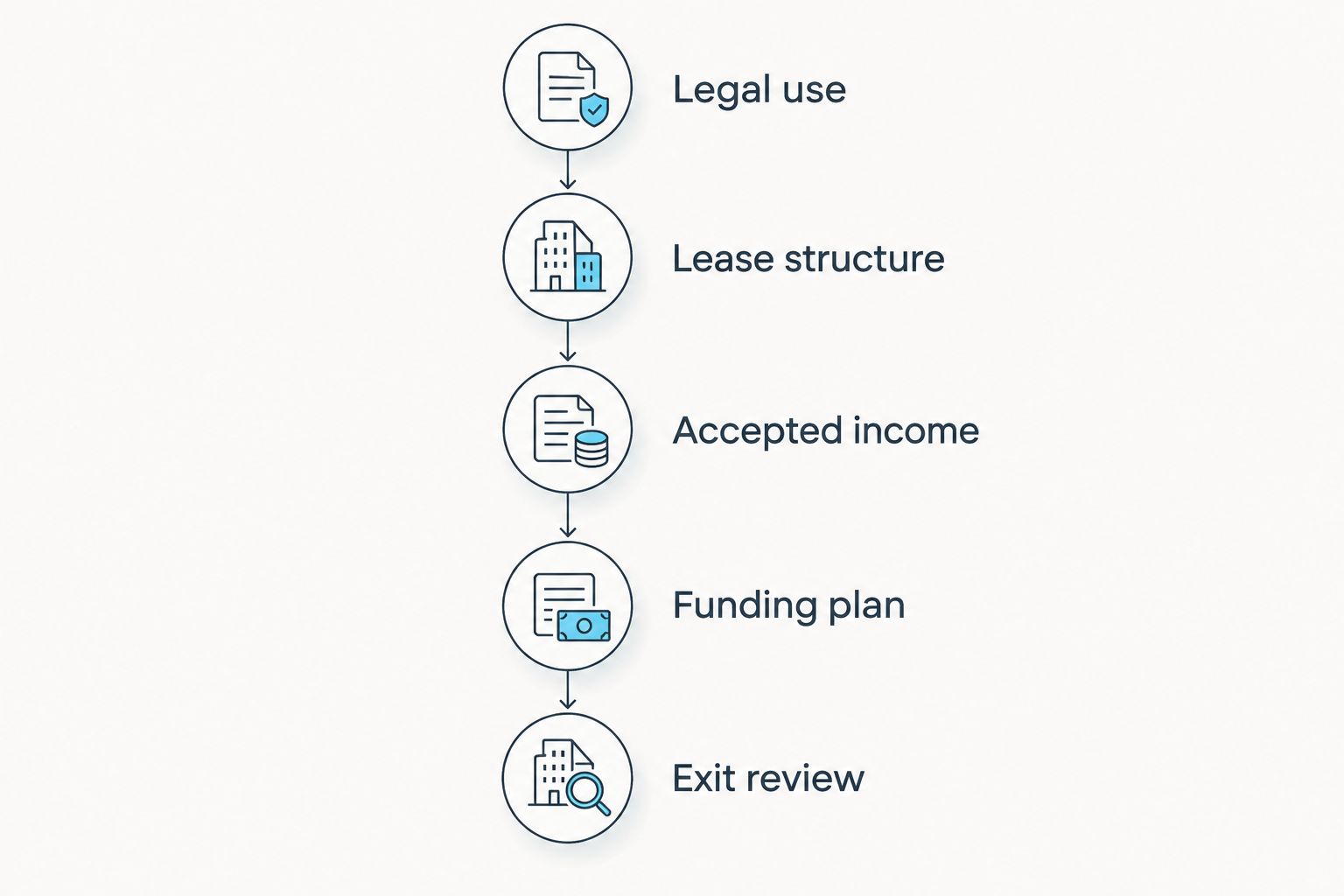
Confirm the property and income rules before relying on a financing plan.
Send a consistent description to every financing contact. If the application says single-family rental while the leases show separate bedroom rentals, explain the difference immediately rather than waiting for underwriting to discover it.
Discuss your property's financing fit
Describe the legal use, lease structure, current income, and planned improvements.
Which loan should you choose?
Start with DSCR financing for a stabilized rental only after the lender accepts the property and leases. Start with commercial portfolio review for a licensed rooming house. Choose bridge or renovation financing when the property's current stage—not just your income documentation—prevents permanent financing.
Loanguys is a mortgage broker for investors comparing DSCR, bridge, fix-and-flip, and bank-statement loans. Bring the legal-use documents and lease structure to that discussion so the program search begins with the actual property.
FAQ
What's the best loan for a co-living investment property?
A DSCR loan is a strong starting point for a stabilized co-living rental only when the lender accepts its property type and lease structure. A licensed rooming house deserves commercial portfolio review instead of an assumption that residential DSCR guidelines apply.
Can I qualify for a DSCR loan using rent from individual bedrooms?
Only if the lender's guidelines accept separate bedroom leases and the supporting rental evidence. Ask whether underwriting uses room receipts, whole-property market rent, or another income measure before relying on projected coverage.
Is a rooming house considered a multifamily property?
Not automatically: rented bedrooms are not the same as separate dwelling units. Local legal classification, the physical layout, and the lender's property rules determine the financing review.
Can I use a bridge loan and refinance into a DSCR loan later?
Yes, that is a possible financing sequence, but the refinance requires separate approval. Confirm the permanent lender accepts the completed property's legal use, leases, income evidence, and valuation before taking the bridge loan.
Does a bank-statement loan solve rooming-house eligibility problems?
No: bank-statement financing changes how borrower income is documented, not which properties the lender accepts. It fits a self-employed borrower only when the property also satisfies the program's rules.
What documents should I prepare for rooming-house financing?
Prepare legal-use documentation, applicable licenses, leases, a rent roll, operating statements, insurance information, and evidence of available funds. For a conversion, include the scope, permits, contractor information, budget, and planned financing exit.
Can I live in the property while using an investment DSCR loan?
An investment DSCR program is not a substitute for an owner-occupied mortgage. Disclose your intended occupancy and room-rental plan so the lender can evaluate an appropriate program.
One last thing
Ask for the qualifying-income calculation, not just confirmation that the lender accepts rentals. A lender can accept the building while recognizing a different rental amount from your forecast. Your 2026 financing decision needs both answers: whether the property qualifies and which income supports the loan.


