


Best loans for medical office building investors

Best overall for a stabilized rental building: a bank commercial mortgage. Best for lease-up or renovation: a commercial bridge loan. The best loans for medical office building investors in 2026 match the building’s current income, your ownership strategy, and a realistic repayment plan—not simply the borrower’s profession.
TL;DR
- Bank commercial mortgages lead loans for medical office building investors buying stabilized rental properties.
- Commercial bridge loans suit renovation and lease-up, but require a credible repayment or refinance plan.
- SBA financing serves eligible owner-occupied practices, not passive medical office rental investments.
- Loanguys is a mortgage broker; confirm medical office property eligibility before selecting a loan program.
Why this matters
A physician buying space for a practice and an investor buying a building leased to physicians have different financing needs. The tenant’s medical specialty does not turn a passive rental acquisition into an owner-occupied business purchase.
Loanguys offers investment-property loan programs, including bridge financing. For medical office building loans, start by confirming that the proposed lender accepts the commercial property type; a residential rental program does not become suitable merely because it uses rental income.
Choose the financing structure after identifying who occupies the building and what income exists today. That distinction removes unsuitable options before you spend time preparing a full application.
What makes the best medical office building loan?
Use these criteria to compare medical office financing in 2026:
- Property eligibility: Confirm acceptance of medical office use, tenant activities, and any mixed-use space.
- Income recognition: Establish how the lender treats collected rent, signed leases, concessions, and vacant suites.
- Lease durability: Compare tenant expiration dates, termination rights, renewal options, and guaranties.
- Capital needs: Account for tenant improvements, leasing commissions, repairs, and operating reserves.
- Repayment structure: Match amortization, maturity, prepayment provisions, and recourse to your ownership plan.
- Exit feasibility: For temporary financing, identify the conditions required for refinancing or selling.
A financing proposal should explain these items in writing. A large proposed loan amount is not useful if the lender excludes the property’s principal use or assumes rent the building has not earned.
Medical office building loans at a glance
The order below starts with stabilized rental ownership, then separates financing by transaction type. It is a suitability ranking, not a lender-performance ranking.
Bank commercial mortgage
- Best for: Stabilized buy-and-hold rentals
- Standout feature: Property underwriting alongside borrower review
- Key limitation: Approval depends on lender-specific property and borrower standards
Commercial bridge loan
- Best for: Renovation and lease-up
- Standout feature: Temporary financing tied to a transition plan
- Key limitation: Requires an executable repayment or refinance strategy
CMBS loan
- Best for: Stabilized assets prioritizing nonrecourse structure
- Standout feature: Securitized commercial mortgage structure
- Key limitation: Servicing and prepayment provisions can restrict flexibility
Commercial construction loan
- Best for: Ground-up medical office development
- Standout feature: Funding through construction draws
- Key limitation: Requires development documentation and completion planning
SBA owner-occupied financing
- Best for: Eligible practices purchasing their own premises
- Standout feature: Combines real estate financing with operating-business eligibility
- Key limitation: Not a passive rental-property financing route
1. Bank commercial mortgage: best for stabilized rental ownership
A bank commercial mortgage finances a medical office building using property income, collateral, and borrower qualifications. It is the default starting point when tenants are paying rent and the building does not require a major turnaround.
Ask how the bank calculates net operating income, or NOI: property revenue minus operating expenses, before debt service. Reconcile that calculation with actual financial records rather than relying on the seller’s marketing summary.
Bank commercial mortgage pros:
- Supports acquisition or refinancing of income-producing commercial real estate.
- Allows direct discussion of the property’s leases and operating history.
- Offers a route to financing without a construction or lease-up business plan.
Bank commercial mortgage cons:
- Borrower financial review and personal guarantees can apply.
- A loan’s maturity can arrive before its amortization schedule ends, leaving a balance to repay or refinance.
Best for: Investors purchasing an occupied medical office building for ongoing rental income.
Verdict: Buy with a bank commercial mortgage when documented income supports the debt and the maturity fits your hold strategy.
2. Commercial bridge loan: best for renovation and lease-up
A commercial bridge loan provides temporary financing while you complete a defined property transition. For medical offices, that transition might involve renovating vacant suites, replacing an expiring tenant, or completing improvements required by a signed lease.
The financing plan must connect the current building to a financeable end state. Review how to get a bridge loan for a commercial property purchase alongside your leasing and renovation assumptions.
Commercial bridge loan pros:
- Separates the acquisition stage from permanent financing.
- Accommodates a transaction built around a documented property transition.
- Provides a structure for discussing improvement funding and reserve requirements.
Commercial bridge loan cons:
- Maturity creates repayment pressure if leasing or construction slips.
- Extension rights and additional funding depend on the loan documents.
Best for: Investors with a specific renovation or lease-up plan and the liquidity to handle delays.
Verdict: Buy with bridge financing only when the exit works without assuming every vacant suite leases immediately.
3. CMBS loan: best for stabilized assets seeking nonrecourse terms
Commercial mortgage-backed securities, or CMBS, financing involves commercial mortgages pooled into securities. It belongs on the comparison list for stabilized medical office investments when the borrower prioritizes a nonrecourse structure and accepts its contractual restrictions.
Nonrecourse does not mean the borrower has no obligations. Carve-outs can create liability for specified conduct, and the controlling loan documents define the exposure.
CMBS loan pros:
- Provides a financing structure centered on commercial property cash flow.
- Offers a route to nonrecourse borrowing, subject to contractual carve-outs.
- Suits comparison when the investment plan involves holding a stabilized asset.
CMBS loan cons:
- Prepayment provisions can complicate an early sale or refinance.
- Servicing requirements can limit changes to leases, ownership, or collateral without consent.
Best for: Investors with stabilized properties who value nonrecourse terms more than transactional flexibility.
Verdict: Hold until counsel has reviewed prepayment, servicing, transfer, and carve-out provisions against your business plan.
4. Commercial construction loan: best for ground-up development
A commercial construction loan funds a development project through draws tied to the loan’s requirements. Medical office development needs a coordinated construction budget, permitted use, tenant specifications, and a repayment plan after completion.
Do not treat a shell building and a completed clinical suite as the same deliverable. Establish who funds interior improvements and which work must finish before tenants begin paying rent.
Commercial construction loan pros:
- Aligns funding with construction progress.
- Makes project scope and completion requirements explicit.
- Supports a development plan rather than requiring an already operating building.
Commercial construction loan cons:
- Requires detailed review of plans, budget, contractor, and project feasibility.
- Cost overruns or delayed completion can require additional borrower capital.
Best for: Experienced sponsors developing medical office space with documented construction and leasing plans.
Verdict: Wait until the budget, contingencies, approvals, and permanent-financing strategy are documented.
5. SBA financing: best for eligible owner-occupied practices
SBA financing belongs in this comparison because medical professionals often purchase buildings for their own practices. It is not a substitute for passive investment-property financing; the operating business and occupancy structure must qualify.
Under SBA occupancy rules, an operating business generally must occupy at least 51% of an existing building. For new construction, the initial occupancy requirement is generally 60%, with additional rules governing future occupancy and leased space. Confirm the current 2026 requirements with the participating lender before structuring the purchase.
SBA financing pros:
- Connects a qualifying premises purchase to the operating practice.
- Accommodates eligible business-owner real estate transactions.
- Distinguishes practice occupancy from space leased to unrelated tenants.
SBA financing cons:
- Passive rental investments do not become eligible through medical tenancy alone.
- Business eligibility, occupancy, and ownership arrangements require review.
Best for: Eligible medical or dental practice owners purchasing premises their businesses will occupy.
Verdict: Skip SBA financing for a purely passive rental acquisition; assess it separately for qualifying practice occupancy.
How these loan options are ranked
This 2026 ranking follows property condition, income recognition, capital needs, and repayment structure. Bank financing leads for stabilized rental ownership; bridge financing addresses transition; CMBS addresses a distinct structural preference; construction financing addresses development; SBA financing addresses eligible business occupancy.
No named lender wins this comparison because the right commercial property program must be confirmed for the individual transaction. Loanguys is a mortgage broker for investors comparing loan programs, not a substitute for property-specific eligibility confirmation.
Underwrite the leases before selecting the loan
For a medical office acquisition in 2026, examine what the leases actually require. A recognizable tenant name is not evidence that a parent company guarantees the rent, and specialized improvements do not establish that another tenant will reuse them.
Check these items before relying on the rent roll:
- Tenant identity: Match the lease obligor to the entity whose financial condition you are evaluating.
- Lease expirations: Identify clustered expirations and options controlled by tenants.
- Expense recovery: Separate landlord expenses from amounts tenants must reimburse.
- Tenant improvements: Identify unfinished work, unpaid allowances, and ownership of installed equipment.
- Use restrictions: Review permitted uses, exclusivity rights, and restrictions affecting replacement tenants.
For an exchange acquisition, commercial appraisers for 1031 exchanges must distinguish real property from any separately transferred equipment or business interests in the valuation scope. An appraisal does not establish tax eligibility; coordinate that question with your tax adviser and exchange professionals.
Build the loan file in the right order
A clear submission helps the lender evaluate the actual transaction rather than an incomplete property description. Use this sequence before requesting final terms.
Property use
Describe whether the building is leased to unrelated practices, occupied by your business, vacant, or under development. Include the tenant roster and any specialized clinical uses so the lender can check property eligibility first.
Lease evidence
Provide executed leases, amendments, the current rent roll, and operating statements. Identify concessions and arrears rather than presenting scheduled rent as collected income.
Capital plan
Separate acquisition funding from repairs, tenant improvements, leasing commissions, and reserves. Explain which costs the financing request covers and which you will fund independently.
Exit plan
For temporary debt, identify the income, occupancy, and property conditions needed for refinancing. For permanent debt, compare maturity and prepayment terms with your intended sale timeline.
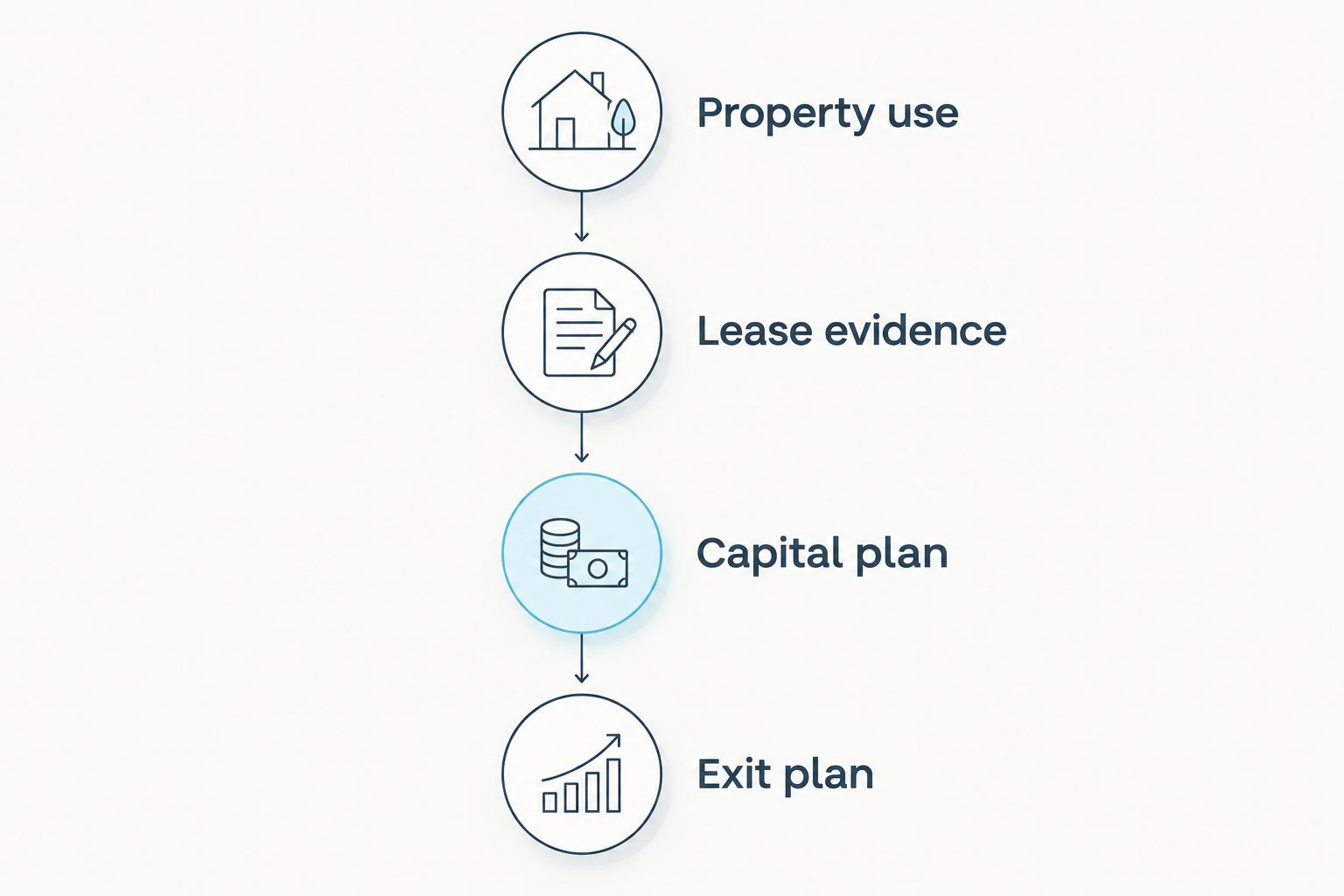
Confirm property eligibility before building the full financing request.
Understand DSCR without confusing loan eligibility
Debt-service coverage ratio, or DSCR, compares income available for debt payments with required debt service. In commercial property underwriting, lenders generally calculate it using underwritten NOI divided by annual debt service.
A 1.00x DSCR means underwritten income equals the debt service used in the calculation. It does not establish loan eligibility or provide a cushion for expenses excluded from NOI.
The distinction matters: a lender can use DSCR to evaluate a commercial medical office building without offering the same product marketed as a residential DSCR loan. Ask for the property eligibility rules and the actual calculation, including adjustments to expenses and income.
Which medical office building loan should you choose?
Start with a bank commercial mortgage for an occupied, income-producing rental building. Use a commercial bridge loan when the property needs a defined transition before permanent financing, and evaluate construction financing when the project is genuinely a development.
Compare CMBS when nonrecourse structure is a priority and you accept the contractual restrictions. Consider SBA financing only when a qualifying operating practice will occupy the required space—not because the tenants happen to provide healthcare.
For medical office building loans, Loanguys should receive the property type, occupancy details, and financing objective before you select a program. Confirm those fundamentals before paying for transaction-specific third-party work.
FAQ
What's the best loan for a fully leased medical office building?
A bank commercial mortgage is the default starting point for a stabilized medical office rental building. Compare the lender’s treatment of leases, expenses, guarantees, maturity, and prepayment against your ownership plan.
Can I use an SBA loan to buy a medical office investment property?
SBA financing is not a route for a purely passive medical office rental investment. A qualifying operating business must satisfy the applicable occupancy and eligibility rules.
Can a residential DSCR loan finance a medical office building?
Do not assume a residential DSCR program accepts a commercial medical office building. Commercial lenders also use DSCR, but the calculation does not determine the program’s eligible property types.
Is a bridge loan better than a commercial mortgage for vacant medical space?
A commercial bridge loan fits a documented lease-up or renovation plan better than financing that requires stabilized income. The borrower still needs sufficient capital and a credible repayment or refinance strategy.
What documents do I need for a medical office building loan?
Prepare the rent roll, executed leases and amendments, property operating statements, purchase information, and a capital plan. The lender will specify borrower financial documents and third-party reports for the transaction.
Does a medical tenant guarantee the building's rental income?
A medical tenant does not guarantee uninterrupted rental income. Review the actual lease obligor, guaranties, termination rights, financial condition, and rent collection history.
One last thing
An occupied suite is not necessarily a rent-paying suite. Before committing to a medical office acquisition in 2026, reconcile lease commencement, improvement completion, concessions, and actual collections; each can change the income a lender recognizes.


