


Best loans for real estate syndications and fund sponsors

Best overall for stabilized syndication assets: permanent commercial mortgages. Best for renovation and lease-up: bridge loans. Best for eligible residential rentals: DSCR loans. The best loans for real estate syndications and fund sponsors in 2026 match the borrowing entity, collateral, and repayment plan—not just the sponsor’s preferred loan label.
TL;DR
- Permanent commercial mortgages lead loans for real estate syndications and fund sponsors holding stabilized properties.
- Bridge loans fit renovation and lease-up strategies, but require a credible repayment exit.
- DSCR loans suit eligible rental properties; fund ownership requires separate lender approval.
- Loanguys offers mortgage-broker guidance on DSCR, bridge, and fix-and-flip financing.
- Subscription facilities finance against eligible investor commitments, not property rental income.
Why this matters
A property loan and a fund credit facility solve different problems. A mortgage finances real estate collateral; a subscription facility advances against eligible investor commitments. Confusing them sends your financing request to the wrong lender.
Start by identifying who borrows, what secures the debt, and where repayment comes from. Loanguys is a mortgage broker offering DSCR, bridge, fix-and-flip, bank-statement, and short-term rental loan programs. Those offerings do not establish eligibility for a particular syndication structure or fund-level facility.
For a 2026 acquisition, settle the borrower structure before comparing proposals. An attractive preliminary quote is not useful if the lender later rejects your ownership chain or required guarantors.
What makes the best syndication financing
Judge each loan against these criteria before choosing a category:
- Borrower fit: The lender accepts the property-owning entity, ownership chain, and sponsor control rights.
- Property fit: The collateral’s use, condition, occupancy, and operating history match the program.
- Repayment fit: Property cash flow, asset sales, refinancing, or investor capital calls support the proposed repayment.
- Sponsor obligations: Guarantees, liquidity requirements, and reporting duties are clear.
- Execution fit: Underwriting conditions, construction draws, and closing dependencies match your transaction.
- Exit flexibility: Prepayment provisions, property releases, and transfer restrictions support the business plan.
Choose the debt structure before choosing the lender. That keeps an unsuitable financing proposal from becoming the foundation of your investor projections.
Best financing options at a glance
1
- Loan type: Permanent commercial mortgage
- Best for: Stabilized income-producing assets
- Standout feature: Repayment structured around ongoing property operations
- Key limitation: Current operations must support underwriting
2
- Loan type: Bridge loan
- Best for: Renovation and lease-up
- Standout feature: Interim financing before stabilization
- Key limitation: Requires repayment or replacement financing at maturity
3
- Loan type: DSCR rental loan
- Best for: Eligible residential rental holdings
- Standout feature: Qualification centered on rental debt coverage
- Key limitation: Property and ownership eligibility vary by program
4
- Loan type: Construction loan
- Best for: Ground-up development
- Standout feature: Advances tied to construction progress
- Key limitation: Draw conditions create funding dependencies
5
- Loan type: Blanket mortgage
- Best for: Multiple properties under one loan
- Standout feature: Shared financing across a property pool
- Key limitation: Release terms can constrain individual sales
6
- Loan type: Subscription credit facility
- Best for: Fund capital-call timing
- Standout feature: Borrowing against eligible uncalled commitments
- Key limitation: Depends on fund documents and investor eligibility
These are financing categories, not interchangeable products. The ranking prioritizes property-level borrowing; a fund seeking only capital-call liquidity should start with the final category.
1. Permanent mortgages: best for stabilized syndication assets
A permanent commercial mortgage finances an operating property intended for a longer hold. It is the default starting point when existing income supports the requested debt and substantial redevelopment is not the central strategy.
Commercial underwriting examines net operating income, or NOI: property income after operating expenses, before debt service. Debt service coverage ratio divides qualifying income by required debt payments. Coverage of 1.00x means the applicable income measure exactly equals the applicable debt service—not that the property has a cash cushion.
Permanent mortgage pros:
- Aligns financing with an income-producing hold strategy.
- Bases repayment analysis on property operations.
- Avoids using renovation debt for an already stabilized asset.
Permanent mortgage cons:
- Weak current income constrains borrowing capacity.
- Prepayment and transfer provisions can limit flexibility.
Best for: Sponsors acquiring or refinancing stabilized commercial properties in 2026.
Ask which expenses, reserves, and debt payments enter the coverage calculation. Also distinguish loan maturity from amortization: a loan can mature before its scheduled payments fully repay the principal.
Verdict: Buy—choose permanent debt when current operations support the hold.
2. Bridge loans: best for renovation and lease-up
A bridge loan provides interim financing while a property moves toward a sale or longer-term financing. It fits an acquisition where renovation, occupancy improvement, or operating changes must happen before permanent underwriting works.
The essential question is not simply whether the acquisition can close. It is whether the completed business plan creates a credible repayment route.
Bridge loan pros:
- Matches a transitional property strategy.
- Separates acquisition financing from later permanent financing.
- Can accommodate a defined improvement plan, subject to underwriting.
Bridge loan cons:
- Creates maturity and refinancing exposure.
- Extensions and renovation advances depend on contract conditions.
Best for: Sponsors executing renovation or lease-up before refinancing or selling.
For a 2026 bridge proposal, identify the conditions for each extension, any required principal reduction, and how renovation funds are advanced. Do not treat an extension option as unconditional extra time.
Loanguys offers bridge and fix-and-flip programs. Confirm the proposed asset, borrowing entity, renovation scope, and ownership structure before treating either program as a syndication financing solution.
Verdict: Buy—for a documented transition; skip when repayment depends only on appreciation.
3. DSCR loans: best for eligible residential rental holdings
A DSCR rental loan evaluates rental income against the program’s specified debt-payment calculation. It is a financing route for eligible investment properties, not a blanket approval for every sponsor, fund, or real estate asset.
Residential investment programs commonly distinguish 1–4 units from commercial multifamily properties with 5 or more units. Confirm the specific program’s property limits and coverage formula rather than assuming a familiar loan name establishes eligibility.
DSCR loan pros:
- Centers qualification on rental debt coverage.
- Fits an income-producing residential rental strategy.
- Provides an alternative to qualification centered on personal employment income.
DSCR loan cons:
- Complex ownership requires separate review.
- Residential eligibility does not establish commercial multifamily eligibility.
Best for: Sponsors financing eligible residential rentals through an accepted ownership structure.
Loanguys is best suited to investors seeking broker guidance on DSCR, bridge, and fix-and-flip financing. Its DSCR offering is a starting point for discussion, not evidence that a pooled investment vehicle qualifies.
Ask whether the lender accepts a fund as an upstream owner, which individuals must provide guarantees, and whether changes in investors require consent.
Verdict: Buy—for eligible rental assets; skip assumptions about fund-level approval.
4. Construction loans: best for ground-up development
A construction loan funds a development project through advances governed by the loan agreement. Underwriting addresses the site, budget, contractor, approvals, sponsor resources, and proposed exit.
For a development syndication, the draw process matters as much as the initial closing. Work schedules and contractor payments must account for inspections, documentation, and funding conditions.
Construction loan pros:
- Matches financing advances to development progress.
- Connects funding to an approved scope and budget.
- Supports a defined build-to-sell or build-to-hold strategy.
Construction loan cons:
- Draw requirements create cash-management obligations.
- Delays and overruns put pressure on sponsor liquidity.
Best for: Sponsors with an executable ground-up development plan.
Clarify who funds overruns and whether completion obligations survive other limitations on recourse. Recourse means the lender has rights against a guarantor or other obligated party beyond the pledged property, as defined in the documents.
Verdict: Buy—when approvals, construction execution, and funding responsibilities are documented.
5. Blanket mortgages: best for pooled property collateral
A blanket mortgage secures a loan with multiple properties. It fits a portfolio strategy where the sponsor wants shared financing rather than independent debt on every asset.
Its usefulness depends heavily on release provisions. Selling a property does not automatically mean its allocated share of debt is the amount required to release the lien.
Blanket mortgage pros:
- Groups multiple properties under shared financing.
- Can align debt with a pooled portfolio strategy.
- Provides a framework for coordinated collateral reporting.
Blanket mortgage cons:
- Release conditions can restrict individual asset sales.
- Cross-default provisions can connect problems across the portfolio.
Best for: Sponsors holding multiple properties with compatible ownership and exit plans.
Request the release calculation before committing to a portfolio financing structure. Ask whether releases require additional repayment, continued coverage tests, or lender consent.
Verdict: Buy—for coordinated portfolio holds; skip when independent exits are essential and releases are restrictive.
6. Subscription facilities: best for capital-call timing
A subscription credit facility allows an eligible fund to borrow against qualifying uncalled investor commitments. Its repayment framework depends on capital-call rights and investor obligations rather than property rental coverage alone.
This is fund-level financing. It does not replace acquisition underwriting for a property mortgage or make the fund’s underlying assets eligible collateral for every lender.
Subscription facility pros:
- Addresses timing between investment funding and capital calls.
- Separates fund liquidity management from property mortgage selection.
- Uses eligible commitments as the borrowing framework.
Subscription facility cons:
- Requires review of investor eligibility and fund documents.
- Adds borrowing-base, reporting, and covenant obligations.
Best for: Fund sponsors with eligible commitments and documented borrowing authority.
In 2026, compare the facility agreement with the fund’s governing documents and investor side letters. Have counsel confirm borrowing authority, pledge rights, and restrictions before negotiating execution details.
Verdict: Buy—for commitment-backed liquidity; skip as a substitute for property financing.
How these options rank
Permanent debt ranks first for stabilized property holdings because its repayment structure matches ongoing operations. Bridge, DSCR, construction, and blanket financing each move to first place when their specific use case matches your asset and ownership structure.
Subscription facilities sit separately because they solve fund liquidity rather than property mortgage needs. This is a use-case ranking, not a lender performance score or an approval prediction.
Match the borrower before requesting terms
Use this sequence to prepare a financing request:
- Borrower entity: Identify the legal borrower, upstream owners, managers, and authorized signers.
- Collateral: Describe the property or eligible commitments supporting the debt.
- Repayment: Identify operating cash flow, refinancing, sales, or capital calls.
- Sponsor obligations: List proposed guarantors, liquidity support, and reporting responsibilities.
- Exit conditions: Match maturity, releases, and transfer provisions to the business plan.
The sequence prevents a common structural mismatch: requesting property financing while describing only the fund’s investment strategy. A lender needs the actual borrower and repayment mechanics.
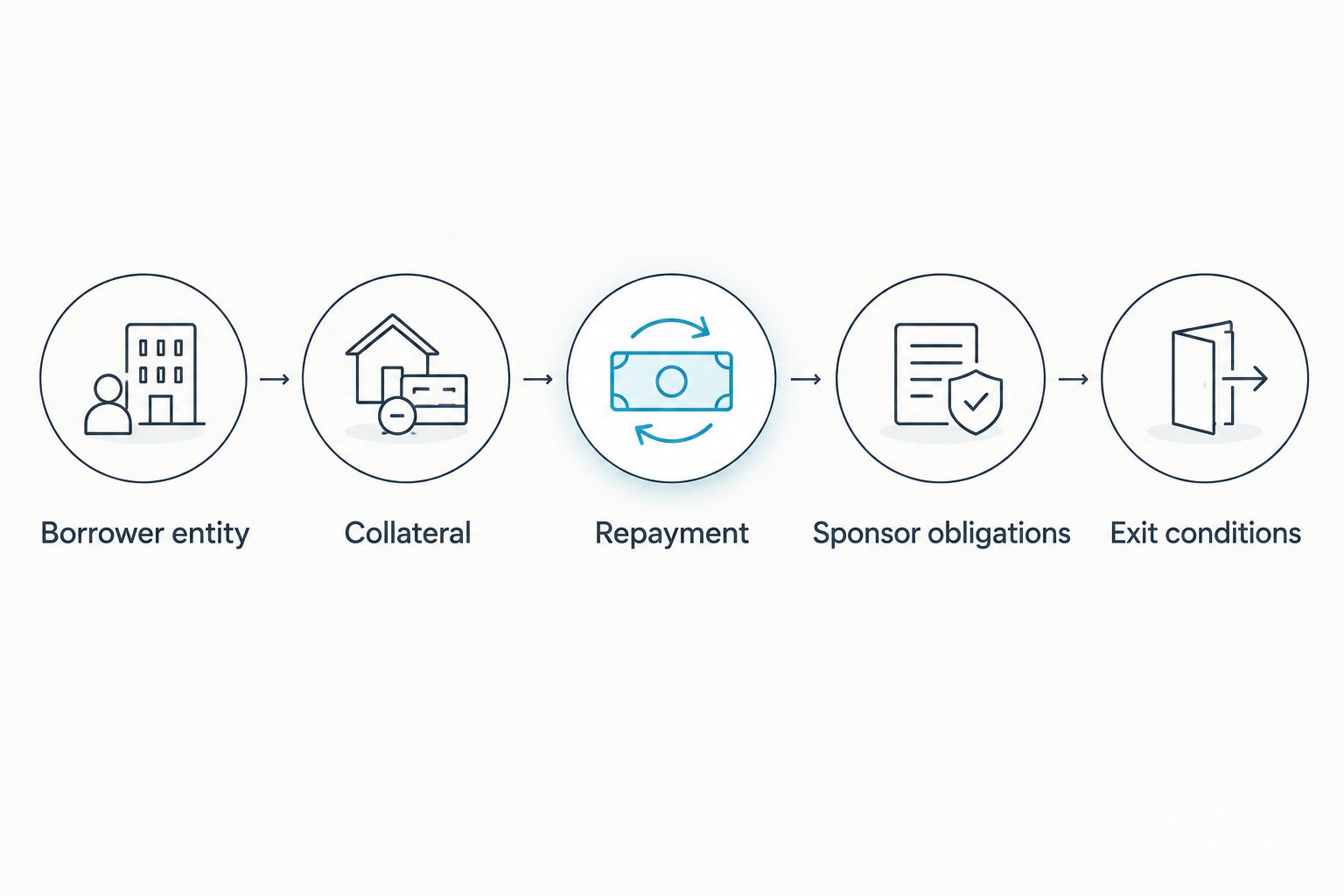
Identify the borrower and repayment source before comparing loan terms.
For a syndication, include an ownership chart, operating agreement, property financials, business plan, and proposed guarantor information in your initial package. Ask the lender what additional documents its program requires.
Which financing should you choose?
For a stabilized property syndication, start with permanent commercial debt. Use bridge debt for a defined transition, DSCR financing for eligible residential rentals, construction debt for development, and blanket financing for a compatible property pool.
For fund-level capital-call timing, evaluate subscription credit separately. The 2026 decision rule is straightforward: match the debt to its repayment source before optimizing individual terms.
Discuss your property financing structure
Ask Loanguys about DSCR, bridge, or fix-and-flip financing for your proposed property and borrowing entity.
FAQ
What's the best loan for a real estate syndication?
A permanent commercial mortgage is the starting point for a stabilized income-producing property. Bridge or construction financing fits a transitional or development strategy better; borrower eligibility still requires lender review.
Can a real estate fund use a DSCR loan?
A fund-owned borrowing entity must satisfy the DSCR lender's ownership and property requirements. A DSCR program's existence does not establish that pooled ownership or a complex entity chain qualifies.
Is a bridge loan better than permanent financing?
A bridge loan is better suited to a defined property transition, while permanent financing suits stabilized operations. Choose based on the business plan and repayment route rather than treating either category as universally better.
Can a syndication get a nonrecourse loan?
Nonrecourse treatment depends on the lender, transaction, and signed documents. Review carveout guarantees, completion obligations, and other exceptions before describing a loan as limiting sponsor liability.
Does a bank-statement loan finance a real estate fund?
A bank-statement mortgage is not a substitute for a fund credit facility. Alternative income documentation addresses borrower qualification; it does not establish fund borrowing authority or acceptance of a syndication structure.
What does a subscription credit facility borrow against?
A subscription credit facility borrows against eligible uncalled investor commitments under the facility documents. Investor eligibility, capital-call rights, and fund restrictions determine the borrowing framework.
What should a sponsor compare before signing a term sheet?
Compare borrower eligibility, collateral requirements, guarantees, maturity, funding conditions, and exit restrictions. Confirm how prepayment, extensions, property releases, and ownership changes work in the proposed documents.
One last thing
An investor transfer can be a financing issue even when the property never changes hands. Review change-of-control and ownership-transfer provisions alongside the fund’s admission and redemption rules; do not promise investor flexibility that the loan documents restrict.


