


Best loans for tiny home and micro-unit rental investors

Best overall for an eligible, income-producing property: a DSCR loan. Best for new builds: a construction loan. Best for a renovation-to-rental project: a bridge or rehab loan. The right loans for tiny home and micro-unit rental investors depend on what you own, whether you can legally rent it, and how the lender classifies the collateral—not simply its size.
TL;DR
- DSCR loans for tiny home and micro-unit rental investors fit eligible, completed properties with supportable rental income.
- Loanguys offers DSCR, bridge, bank-statement, and short-term rental programs; confirm tiny-home eligibility before applying.
- Construction loans match new builds; bridge loans require a credible repayment or refinance exit.
- A movable tiny home needs a different financing review from a permanently attached rental dwelling.
Why this matters
A tiny house on wheels, a backyard accessory dwelling unit, and an apartment building filled with micro-units are different lending propositions. Treating them as interchangeable sends your application toward the wrong program.
Loanguys is a mortgage broker offering investor loan programs, including DSCR, fix-and-flip, bridge, bank-statement, and short-term rental financing. Loanguys is best for rental investors comparing those mortgage routes before choosing a program. Property-specific acceptance still needs confirmation.
For a 2026 purchase, establish the property's legal use and title classification before choosing a financing route. Attractive projected rent does not establish mortgage eligibility.
What makes the best tiny-home rental financing?
Use these criteria before comparing loan names:
- Collateral fit: Does the lender accept the foundation, construction type, ownership structure, and property classification?
- Legal rental use: Do zoning, permits, occupancy approvals, and rental restrictions support your intended operation?
- Income evidence: Will underwriting use leases, appraised market rent, operating statements, or your personal income?
- Project stage: Is the dwelling completed, under construction, or awaiting substantial rehabilitation?
- Repayment fit: Does the loan support a long-term hold, or require a sale or refinance?
- Cash exposure: What reserves, equity contribution, inspections, and carrying expenses must you fund?
There is no universal winner across these criteria. A strong financing match solves your actual constraint without creating an unmanageable repayment deadline.
Best loan options at a glance
DSCR loans for micro-unit and tiny-home rentals
- Best for: Completed, income-producing rentals
- Standout feature: Qualification centers on property income
- Key limitation: Unusual collateral still needs acceptance
Construction loan
- Best for: Ground-up rental development
- Standout feature: Funds an approved building project through draws
- Key limitation: Requires construction documentation and completion planning
Bridge or rehab loan
- Best for: Acquisition with renovation or lease-up work
- Standout feature: Connects a transitional property to its next financing stage
- Key limitation: Requires a defined repayment exit
Bank-statement mortgage
- Best for: Self-employed investors documenting income through deposits
- Standout feature: Alternative income documentation
- Key limitation: Does not resolve property eligibility problems
Commercial multifamily loan
- Best for: A building containing multiple micro-apartments
- Standout feature: Evaluates the rental building as an operating asset
- Key limitation: Building income and commercial underwriting matter
Chattel financing
- Best for: Eligible movable homes classified as personal property
- Standout feature: Finances the dwelling rather than a real-estate mortgage interest
- Key limitation: Land and rental use need separate review
These are financing categories, not verified approvals for a particular property. Use the comparison to identify which underwriting conversation belongs first.
1. DSCR loan: best for completed, income-producing rentals
A debt-service coverage ratio loan evaluates rental income relative to debt service under the lender's calculation. It is the first route to examine for a completed investment property whose rental use and physical characteristics meet the program's rules.
DSCR is not a substitute for property approval. A lender still evaluates the collateral, valuation, borrower profile, and transaction structure.
DSCR loan pros:
- Centers qualification on the property's rental income.
- Matches an income-producing buy-and-hold strategy.
- Creates a direct framework for discussing rent and debt service.
DSCR loan cons:
- Tiny homes and unusual unit configurations require specific acceptance.
- Rental income calculations differ by program and property type.
- A property's ability to qualify does not establish its profitability.
A DSCR of 1.0x means the income measure equals the debt-service measure used in that calculation. It does not mean you have covered every repair, vacancy, or future capital expense; ask exactly what goes into the numerator and denominator.
Best for: A legal, completed rental with supportable income and accepted collateral.
Verdict: Buy only after the lender confirms property eligibility and explains the income calculation.
2. Construction loan: best for ground-up rental development
Construction financing supports a building project rather than treating an unfinished dwelling as a completed rental. Funds are generally released through draws tied to the lender's construction requirements.
For a tiny-home development, the financing discussion must include site work, utilities, foundations, and approvals—not just the dwelling itself. Obtain a complete scope before submitting your project.
Construction loan pros:
- Aligns funding with an approved construction process.
- Brings the budget, builder, and completion plan into underwriting.
- Addresses a project stage that completed-property mortgages do not.
Construction loan cons:
- Draw conditions affect when funds reach the project.
- Delays create additional carrying expenses and completion risk.
- Permanent rental financing needs its own eligibility review.
In your 2026 construction plan, identify who funds expenses before reimbursement and who covers overruns. Do not assume that finishing the house automatically qualifies it for a DSCR refinance.
Best for: Investors building permitted, permanently situated rental dwellings.
Verdict: Buy only with a documented completion budget and a reviewed permanent-financing plan.
3. Bridge or rehab loan: best for renovation-to-rental projects
Bridge and rehab financing address a temporary stage, such as buying a property that needs repairs before it supports long-term financing. The intended exit is usually a sale, refinance, or another identified repayment source.
For micro-unit conversions, confirm the proposed layout and legal unit count before treating renovation financing as the solution. Funding construction does not legalize a conversion.
Bridge or rehab loan pros:
- Matches an acquisition-plus-improvement business plan.
- Separates the transitional stage from the permanent rental loan.
- Supports a clearly defined path from repairs to occupancy.
Bridge or rehab loan cons:
- A repayment deadline creates risk if work or leasing slips.
- Rehab funding comes with conditions and documentation.
- Refinancing remains subject to the next lender's rules.
Ask the prospective refinance lender to review the intended finished property before closing the bridge loan. Your exit should rest on an accepted property type, not just a projected value.
Best for: Investors acquiring a property that needs an identifiable renovation or stabilization period.
Verdict: Buy only when the renovation scope and repayment exit are documented.
4. Bank-statement mortgage: best for self-employed investors
A bank-statement mortgage uses an alternative approach to documenting qualifying income through account activity. It addresses the borrower-income question, not whether an unusual tiny home is acceptable collateral.
Loanguys offers bank-statement loan programs alongside its rental financing options. Ask which route fits both your income records and your intended investment-property use.
Bank-statement mortgage pros:
- Gives self-employed borrowers another income-documentation route.
- Allows a discussion based on deposits and business activity.
- Separates personal-income qualification from a purely property-income approach.
Bank-statement mortgage cons:
- Account deposits are not automatically qualifying income.
- Business expenses and transfers need explanation.
- Collateral and occupancy restrictions still apply.
For a 2026 application, organize statements so business receipts, transfers, and nonrecurring deposits are distinguishable. Ask the lender what documentation period and expense treatment its program requires rather than assuming a standard rule.
Best for: Self-employed investors whose primary obstacle is documenting qualifying income.
Verdict: Buy only if the program accepts the investment use and the specific property.
5. Commercial multifamily loan: best for micro-apartment buildings
A building containing many small apartments is not the same lending proposition as a standalone tiny house. Commercial multifamily underwriting evaluates the building's operating income, expenses, condition, and ownership structure.
The familiar residential mortgage category covers 1–4 dwelling units; a property with 5 or more dwelling units generally enters multifamily commercial financing. Confirm the legally recognized unit count rather than counting bedrooms or advertised rental spaces.
Commercial multifamily loan pros:
- Fits an entire apartment building rather than isolated units.
- Brings operating expenses and building income into the review.
- Supports analysis of the property as a rental business.
Commercial multifamily loan cons:
- Vacancies and operating expenses affect underwritten income.
- Illegal units undermine the proposed rental model.
- Commercial terms require separate review from residential mortgage terms.
A micro-unit building needs evidence that the apartments are lawful dwelling units. Shared kitchens, room rentals, or hospitality operations require a different classification discussion.
Best for: Investors buying a legally established micro-apartment building.
Verdict: Buy only after confirming legal unit count and the lender's operating-income calculation.
6. Chattel financing: best for movable personal-property homes
Chattel financing is a loan secured by personal property rather than a real-estate mortgage. It belongs in the discussion when a tiny dwelling remains movable or is titled as personal property.
Do not assume a lender offering manufactured-home or recreational-vehicle financing accepts every tiny-house build. Construction classification, title, and intended rental use require explicit review.
Chattel financing pros:
- Addresses a dwelling that is not mortgageable real estate.
- Separates home financing from land ownership.
- Avoids treating a movable unit as a conventional rental house.
Chattel financing cons:
- Financing the dwelling does not finance the site automatically.
- Rental use must be accepted by the financing provider.
- Moving or retitling the home creates additional questions.
Best for: Investors evaluating an eligible movable dwelling on an approved site.
Verdict: Hold until title classification, site rights, and rental-use acceptance are confirmed.
Resolve the property before submitting the loan
For a 2026 transaction, prepare a property packet before asking for a firm financing decision. Follow this sequence so each answer supports the next:
- Property classification: Establish real estate versus personal property, foundation type, and legal unit count.
- Legal use: Gather zoning confirmation, permits, occupancy documentation, and rental restrictions.
- Income evidence: Provide leases, rent records, or the market-rent evidence the lender requests.
- Exit plan: Explain whether you will hold, sell, or refinance, including the project's unfinished work.
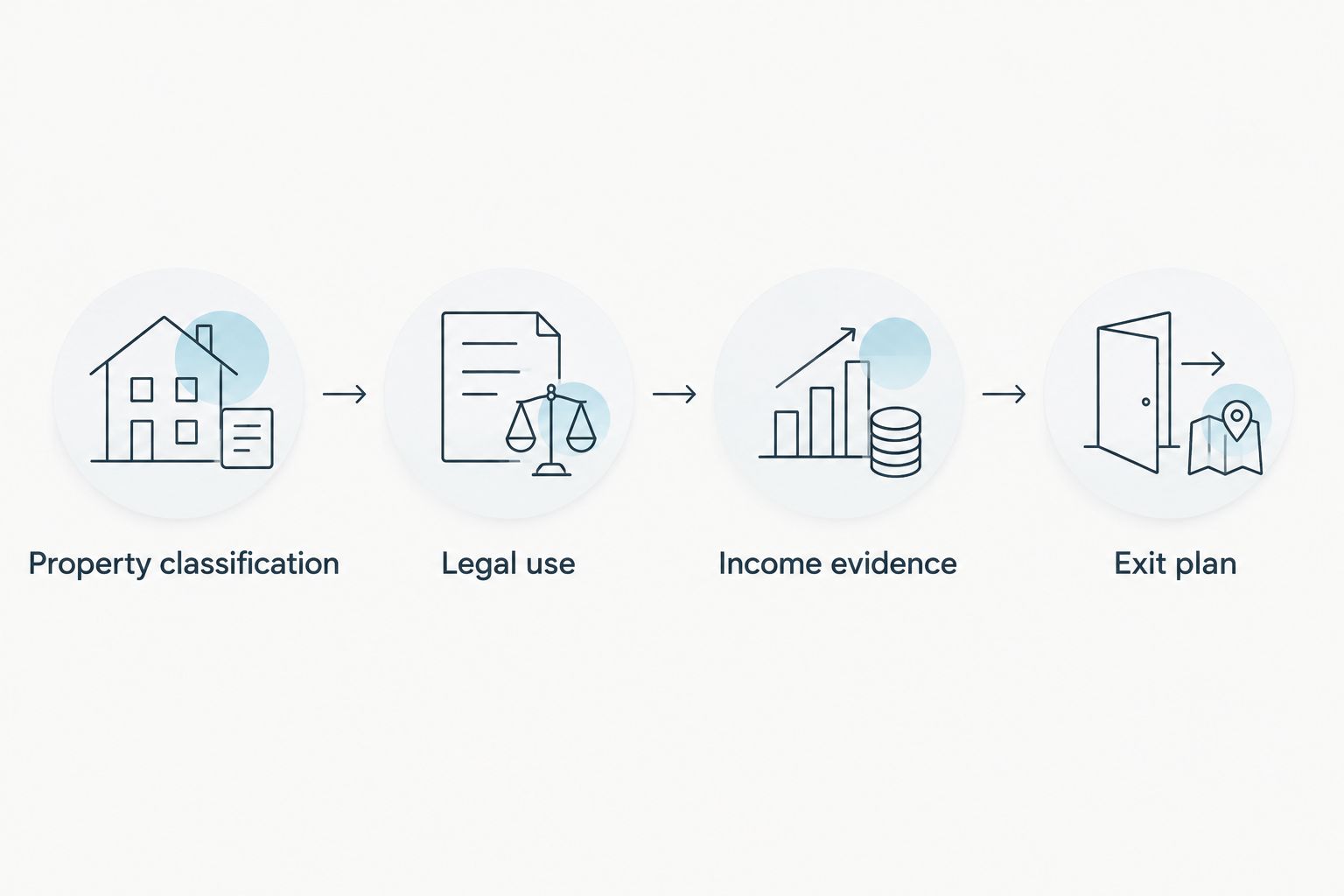
Confirm the property and legal use before relying on rental income to support financing.
For an accessory dwelling unit, choosing between custom or pre-approved ADU plans is a design decision; it does not by itself establish site approval or loan eligibility. Give the lender the plans that match the actual site, proposed use, and approval status.
Request a written eligibility response before committing to nonrefundable project expenses. Ask whether the review covers the entire parcel, an individual dwelling, or the operating property as a whole.
How these loan options are ranked
This ranking prioritizes collateral fit, legal rental use, income evidence, project stage, repayment fit, and cash exposure. DSCR comes first for completed rentals; construction and bridge financing take priority when the property is not ready for permanent financing.
The order does not rank individual lenders or promise approval. Bank-statement and chattel financing solve different problems, so neither replaces a property-income loan simply because another application fails.
Which loan should you choose?
Start with a DSCR eligibility review if your rental is complete, legal, and income-producing. Choose construction financing for a new build, bridge financing for a defined transition, and commercial multifamily financing for an apartment-building acquisition.
For your 2026 comparison, ask Loanguys to distinguish borrower qualification from property eligibility. Those are separate decisions, and both must work before a financing proposal becomes actionable.
Discuss your rental financing plan
Explain the property type, rental strategy, and project stage before choosing a loan program.
FAQ
What's the best loan for a tiny-home rental?
A DSCR loan is the first option to evaluate for a completed, legal rental that meets the lender's collateral rules. A movable dwelling, unfinished project, or apartment building needs a different financing review.
Can I get a DSCR loan for a tiny house on wheels?
Do not assume a tiny house on wheels qualifies for a DSCR mortgage. Confirm whether it is personal property or real estate and whether the lender accepts its construction, title, and rental use.
Is a bank-statement loan better than a DSCR loan?
A bank-statement loan addresses borrower-income documentation, while a DSCR loan centers on property income. The better fit depends on your records, the property's income, and program eligibility.
Can I finance tiny homes before they are built?
Construction financing is the category to evaluate for a ground-up rental project. The lender needs to review the site, approvals, budget, builder, and completion plan.
Does a good DSCR guarantee approval?
No, a good DSCR does not guarantee approval. The lender also reviews collateral eligibility, valuation, credit, reserves, and transaction requirements.
Can I refinance a bridge loan after renting the property?
Refinancing requires the finished property and borrower to meet the new lender's requirements. Review that exit before taking the bridge loan rather than assuming a lease guarantees permanent financing.
Are micro-apartments financed like tiny houses?
Not necessarily: micro-apartments belong to a building whose legal unit count and operating structure determine the financing discussion. A standalone tiny house raises separate questions about title, foundation, land, and rental use.
One last thing
Ask what the appraiser will value before you focus on projected rent. A dwelling, its land, and an operating rental business are not interchangeable collateral descriptions; uncertainty here can derail an otherwise convincing application.
Send Loanguys a concise property summary that identifies ownership, title classification, legal rental use, and project stage. That gives the financing discussion a defined starting point.


