


Best rental loans for property management companies

Best overall: a LoanGuys DSCR loan for a management company that owns a stabilized rental. Best for several owned properties: a blanket mortgage. Best for a purchase before the property is ready to rent: a bridge loan. The right rental loan depends on who owns the property, how it earns income, and what needs to happen before long-term financing works.
TL;DR
- LoanGuys DSCR loans are the best rental loans for property management companies buying stabilized rentals they own.
- A blanket mortgage fits several owned properties; a bridge loan fits a purchase before stabilization.
- A property manager cannot borrow against a client's rental simply because it manages the property.
- Use bank-statement financing when qualifying income is the obstacle; use fix-and-flip financing for renovation before leasing.
Why this matters
A property management company can manage homes without owning any of them. Management authority is not ownership, and a management contract does not turn a client's property into collateral for the manager's loan. Before comparing rental loans in 2026, identify the legal borrower, the property owner and the purpose of the financing.
If the company owns rentals or buys them through an affiliated ownership entity, LoanGuys services include lending programs relevant to investors. If it only manages properties for clients, the property owner needs to pursue property financing. The management company must assess financing for its own business separately; rental-property debt is not a substitute for business financing.
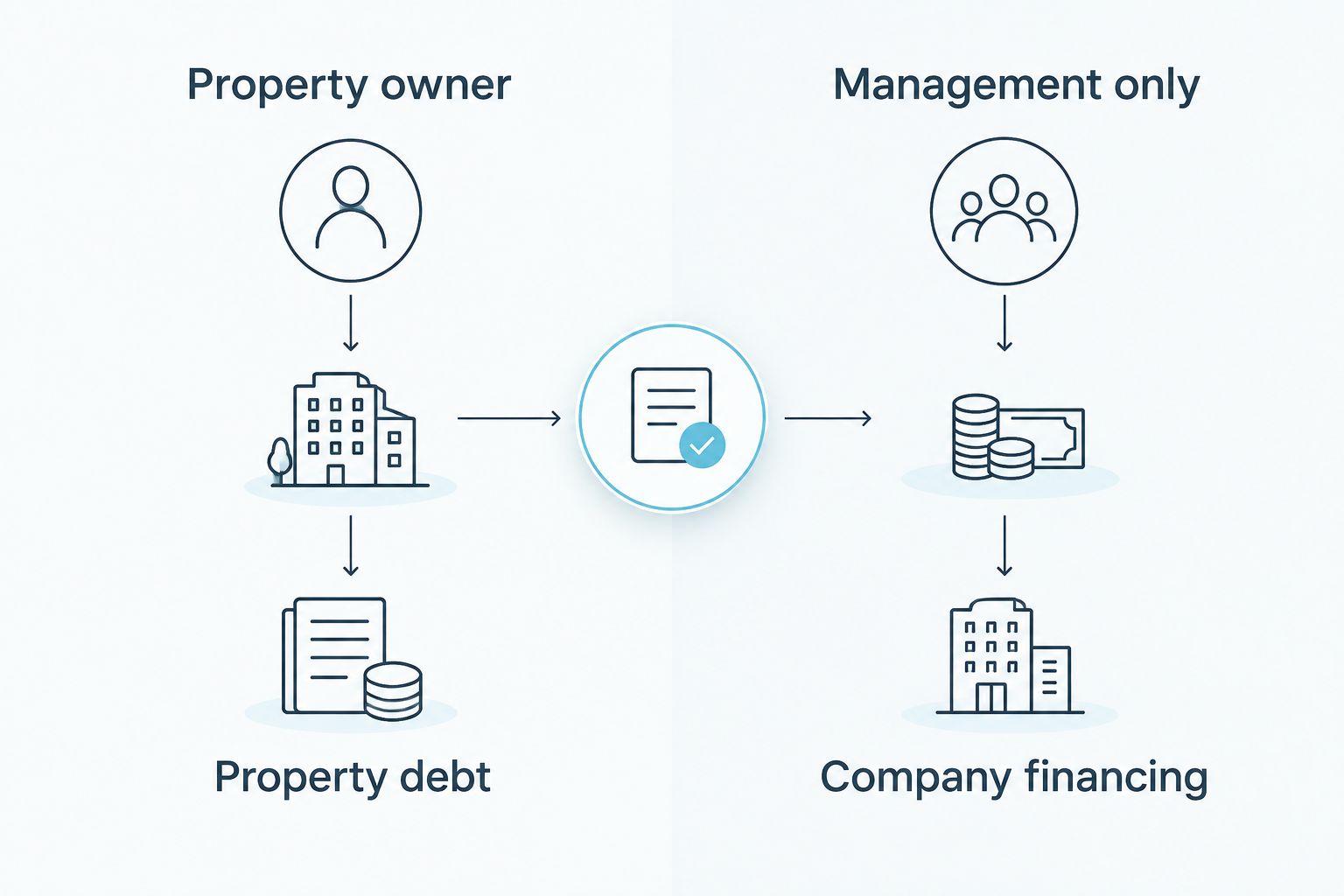
Ownership determines whether property debt is the right financing path.
That distinction changes the shortlist. A 1-unit house held for rent raises a different lending question from a 5-unit building, and a vacant renovation raises a different question from an occupied rental. Match the loan to the asset and the next step, not to the company's job title.
What makes the best rental loans for property management companies?
Use these criteria before comparing loan types. Each addresses a reason a seemingly suitable loan can fail the actual deal.
- Eligible borrower: Confirm that the applicant owns or is buying the collateral. If the property sits in an LLC, disclose the ownership structure rather than assuming every program accepts it.
- Property and unit count: Separate a 1- to 4-unit rental from a 5-unit-or-larger building. Ask whether the proposed program accepts the actual property type.
- Current rental status: A leased property, a vacant building awaiting repairs and a planned short-term rental present different evidence of income.
- Qualifying income: Decide whether the application is best supported by property cash flow or the borrower's documented income, including business deposits where appropriate.
- Exit from short-term debt: If the loan funds a purchase or renovation before stabilization, identify the refinance or sale plan before accepting that structure.
- Portfolio control: Financing several properties together simplifies the borrowing structure but makes it important to understand how an individual property can be released or sold.
No category wins every criterion. For 2026 decisions, start with the property you control today and the condition it will be in when you apply for permanent financing.
Rental loan options at a glance
- Best for: Stabilized rentals owned by the borrower
- Standout feature: Focuses on property income
- Key limitation: An unsuitable rent-to-payment relationship can block the plan
- Best for: Multiple owned properties
- Standout feature: Groups properties under one loan
- Key limitation: Selling one property requires attention to release terms
- Best for: Time-sensitive purchase before stabilization
- Standout feature: Funds a defined transition
- Key limitation: Needs a credible exit from short-term debt
Bank-statement loan
- Best for: Variable business income
- Standout feature: Reviews documented deposits
- Key limitation: Business deposits still require lender review
Fix-and-flip loan
- Best for: Renovation before leasing
- Standout feature: Ties financing to a property improvement plan
- Key limitation: Poor fit for a finished, long-term rental
These are loan types, not interchangeable offers. Compare actual lender terms for the same borrower, property and intended use before choosing a program.
1. LoanGuys DSCR loan: best for an owned, stabilized rental
A debt-service coverage ratio, or DSCR, compares a property's income with its debt obligation under the lender's calculation. The appeal for an investor is straightforward: the rental's ability to support the loan becomes central to the review. LoanGuys offers DSCR programs, making this the strongest starting point when a property management company or its ownership entity is acquiring a rental with supportable income.
Best for: A company that owns, or is buying, a property intended to produce rental income and wants the financing discussion centered on that property. A management agreement for somebody else's property does not meet that test.
LoanGuys DSCR loan pros:
- Puts the property's income at the center of the financing conversation.
- Fits a buy-and-hold goal better than borrowing designed around a renovation exit.
- Provides a clear question to test early: can the property's eligible income support the proposed debt?
LoanGuys DSCR loan cons:
- Weak or uncertain rental income can make qualification difficult.
- Property type, ownership structure and documentation still matter; a DSCR label is not approval.
- It does not finance a management company's operations merely because that company collects rent for clients.
For a 2026 acquisition, bring the lease or other relevant income records, the proposed ownership details and the property's current occupancy status into the first financing discussion. Do not assume gross rent alone establishes the lender's DSCR calculation; ask which income and debt items the lender will use. Verdict: Buy when the applicant owns the collateral and the rental income supports the proposed loan. Otherwise, wait until the property and borrower fit are clear.
2. Blanket mortgage: best for multiple owned properties
A blanket mortgage places multiple properties under one loan. It addresses a portfolio problem rather than a single-property income problem: several separately financed rentals can create separate debt obligations and sale decisions. The borrower still needs to own or acquire the properties included as collateral.
Best for: An investor or management-company affiliate holding multiple rentals and considering financing them together. This is not a way to borrow against homes the company manages for unrelated owners.
Blanket mortgage pros:
- Groups multiple eligible properties into one financing structure.
- Makes the portfolio, rather than one address, the subject of the borrowing decision.
- Gives an expanding owner a reason to review existing property debts together.
Blanket mortgage cons:
- One property's sale can be complicated by the lender's release requirements.
- Cross-collateralizing properties can reduce flexibility compared with keeping loans separate.
- A single-property buyer gains no portfolio benefit from the structure.
In 2026, ask for the release provisions before comparing a blanket loan with separate loans. If you expect to sell one rental while retaining the others, the ability to remove that property from the collateral matters as much as the convenience of grouped financing. Verdict: Buy for a portfolio you intend to hold together; hold if individual property sales are central to the plan.
3. Bridge loan: best for buying before stabilization
A bridge loan addresses the gap between a purchase and a later financing event. It is a match for a time-sensitive acquisition when the property is not yet positioned for the longer-term loan you want. That later event must be specific: refinancing after the property is ready to rent, or selling under a defined plan.
Best for: A property owner buying an asset that needs a transition before permanent rental financing makes sense. A bridge loan is not the default for a leased property that already fits a long-term rental program.
Bridge loan pros:
- Separates the immediate purchase decision from the later permanent-financing decision.
- Fits a property whose current condition or occupancy does not yet support the intended rental loan.
- Allows the borrower to plan financing around a documented improvement or leasing stage.
Bridge loan cons:
- The borrower must address how the bridge debt will be repaid or replaced.
- A delayed renovation or leasing plan can put pressure on that exit.
- Borrowing for a transition adds another financing decision after the purchase.
Write down the planned exit before treating speed as the deciding factor. If the plan is to refinance, test whether the property is expected to meet the next lender's requirements after the work is complete; do not treat future approval as automatic. Verdict: Buy for a defined acquisition-to-stabilization plan. Skip it when permanent rental financing already fits the property.
4. Bank-statement loan: best for variable business income
A bank-statement loan uses documented account activity as part of the borrower's income review. LoanGuys offers bank-statement lending programs, which makes this route relevant when the property owner also runs a management business and conventional income documentation does not tell the full story. It is still a property-financing application tied to an eligible borrower and property, not a loan against a client's managed homes.
Best for: A management-company owner buying an investment property who needs the lender to review business deposits as part of qualification. Start by separating the company's own revenue from money it collects and holds for property owners.
Bank-statement loan pros:
- Creates a qualification path centered on documented account activity.
- Addresses the borrower's income presentation rather than assuming the property alone carries the application.
- Gives a business owner a reason to organize deposits before applying.
Bank-statement loan cons:
- Deposits require interpretation; collected rent belonging to clients is not automatically the company's income.
- The program does not solve a collateral-ownership problem.
- Inconsistent records make it harder to explain which deposits reflect the borrower's business activity.
In 2026, keep owner funds, management fees and property-level rent records distinct. The rent apps for multiple properties question matters here because a record of rent collection does not, by itself, establish who earned the money or owns the collateral. Present the lender with records that answer both questions. Verdict: Buy when the applicant owns the investment property and documented business income is the qualification issue; skip it when the company only manages another owner's asset.
5. Fix-and-flip loan: best for renovation before leasing
A fix-and-flip loan is built around acquiring and improving a property, then completing a defined exit. LoanGuys offers fix-and-flip programs. For a future rental, the relevant exit can be a move into suitable long-term financing after renovation, but that next loan needs its own qualification review.
Best for: An investor buying a property that needs substantial work before it can support the intended rental strategy. The management company must be the owner or act through an eligible ownership entity, not merely manage the renovation for a client.
Fix-and-flip loan pros:
- Makes the scope of improvements central to the financing plan.
- Fits an acquisition whose present condition does not match a finished rental.
- Encourages an explicit decision about what happens when the work ends.
Fix-and-flip loan cons:
- Renovation execution becomes part of the borrowing risk.
- A plan to hold the property creates a second financing step.
- It adds little value when the rental is already finished and income-producing.
Before choosing this route in 2026, define the work, the intended use after renovation and the documents the next lender will need. A plan to lease the property is not the same as demonstrated rental income. Verdict: Buy for a renovation with a defined exit; skip it for a stabilized buy-and-hold purchase.
How we ranked these options
The ranking follows the decision a property management company must make, not a claim that one loan has better terms for every borrower. First establish ownership. Then weigh the property's rental status, the borrower's income documentation, whether several assets need financing together and whether short-term debt has a credible exit.
The DSCR option ranks first because the question is about rental loans for a company that also owns investment property. Blanket, bridge, bank-statement and fix-and-flip financing move ahead only when their distinct use cases describe the deal more accurately. No loan type ranks as a substitute for owning or buying the property offered as collateral.
Which rental loan should you choose?
Choose a DSCR loan as the default for an owned rental with income that supports the financing review. Choose a blanket mortgage when the main decision is financing several owned properties together. Choose a bridge loan for a purchase that needs a defined transition, a bank-statement loan when the owner's documented business income is the obstacle, or a fix-and-flip loan when renovation comes before leasing.
For a 2026 shortlist, state the borrower, property owner, current property condition and intended exit before requesting terms. That short description prevents a management-only business from being assessed as though it owns its clients' rentals. It also gives each lender the same transaction to evaluate.
FAQ
What are the best rental loans for property management companies?
A DSCR loan is the best starting point when the company or its ownership entity owns a stabilized rental with supportable income. A blanket mortgage, bridge loan, bank-statement loan or fix-and-flip loan fits a different portfolio, purchase, income or renovation need.
Can a property management company get a loan against a client's rental?
Managing a client's rental does not give the management company ownership of the property. Property financing depends on an eligible borrower and collateral; the client owner's property is not the manager's asset simply because the manager collects rent.
Is a DSCR loan better than a bank-statement loan for a rental?
A DSCR loan is the clearer starting point when the owned property's income is the main basis for the financing discussion. A bank-statement loan addresses a borrower's income-documentation issue, so the better fit depends on what the application needs to establish.
When does a blanket mortgage make sense for rental properties?
A blanket mortgage makes sense when an owner wants to finance multiple properties under one loan. Review property-release terms before choosing it if you plan to sell any property separately.
Should a property manager use a bridge loan to buy a rental?
Use a bridge loan when the buyer has a defined reason the property cannot yet use the intended long-term financing and has a credible exit. If the rental already fits permanent financing, compare that route first.
Can management fees count as rental income for a DSCR loan?
Management fees earned for servicing someone else's property are not rent earned by owning that property. Ask the lender which property income it accepts for the proposed DSCR loan and document management-business income separately.
Can a fix-and-flip loan be used for a property the buyer plans to rent?
A fix-and-flip loan can fit an acquisition that needs renovation before the buyer's intended rental use. If the buyer plans to hold the property, the later rental financing remains a separate qualification decision.
One last thing
A rent roll can show what tenants pay, but it does not establish who owns the building. Verify title and the proposed borrowing entity before comparing loan programs. That single check keeps a 2026 property-management financing search focused on assets the applicant can actually finance.


