


Can you get a HELOC on a rental property you don't live in?

Yes, you can get a HELOC on a non-owner occupied rental property in 2026 if a lender accepts investment properties and you meet its underwriting requirements. Approval depends on the property, your equity, your finances, and the lender's rules—not simply whether you live there. The rental secures the debt, so missed payments put the property at risk.
TL;DR
- A HELOC on non-owner occupied rental property requires a lender that accepts investment-property collateral.
- A rental-property HELOC preserves the existing mortgage but adds another payment obligation.
- Compare a HELOC, home equity loan, and cash-out refinance by borrowing purpose and repayment structure.
- Loanguys offers investment-property financing programs; confirm the specific loan structure before applying.
Can you get a HELOC on a rental property you don't live in?
Yes. Non-owner occupancy does not automatically disqualify a rental property from HELOC financing. The first hurdle is finding a lender whose program accepts that occupancy type, property type, ownership structure, and location.
A HELOC and a home equity loan both borrow against property equity, but they provide funds differently. The distinction matters when comparing home equity loans for rental property owners.
Rental-property HELOC
- Best for: Expenses spread across a project or borrowing period
- Main advantage: Draw funds as needed within the agreement
- Main drawback: Variable-rate exposure and changing payment obligations
Home equity loan
- Best for: A defined expense requiring a lump sum
- Main advantage: A separate loan without replacing the existing mortgage
- Main drawback: Less flexibility when the eventual borrowing need is uncertain
Cash-out refinance
- Best for: Investors who also want to replace their existing mortgage
- Main advantage: Combines the replacement mortgage and equity withdrawal
- Main drawback: Changes the financing on the entire refinanced balance
For your 2026 comparison, request terms for the actual rental address. A general home-equity advertisement does not establish that a lender accepts non-owner occupied properties.
Why this matters
A rental can have substantial equity without producing enough income to comfortably support another debt payment. Equity protects the lender's collateral position; cash flow supports your ability to repay. You need both sides of the analysis.
A HELOC also creates a mismatch if you use flexible borrowing for an expense with no clear repayment source. Choose the financing around how you will repay it, not just how easily you can draw it.
Start by separating the amount you need today from possible future expenses. That distinction helps you decide whether access to revolving credit serves a real purpose or simply encourages unnecessary borrowing.
How do you qualify for a rental-property HELOC?
Use this sequence before submitting a full application. It separates basic program eligibility from the financial review that follows.
- Confirm eligibility. State that the property is a rental you do not occupy. Provide its location, property type, rental use, and legal owner, including any LLC or trust.
- Review equity. Gather your current mortgage statement and disclose other liens. The lender determines an acceptable property value and applies its permitted borrowing limit.
- Document income. Ask which personal-income and rental-income records the program requires. Provide leases, payment records, and financial documents requested for your application.
- Check repayment. Evaluate the proposed line alongside your existing mortgage, operating expenses, and other debts. Include the repayment phase, not just the initial draw-period payment.
- Compare terms. Review the rate structure, draw rules, repayment schedule, collateral requirements, and conditions that permit the lender to restrict further borrowing.
Keep the same property and borrowing request across applications. Otherwise, differences in the proposed line amount or occupancy assumptions can make competing terms look more comparable than they are.
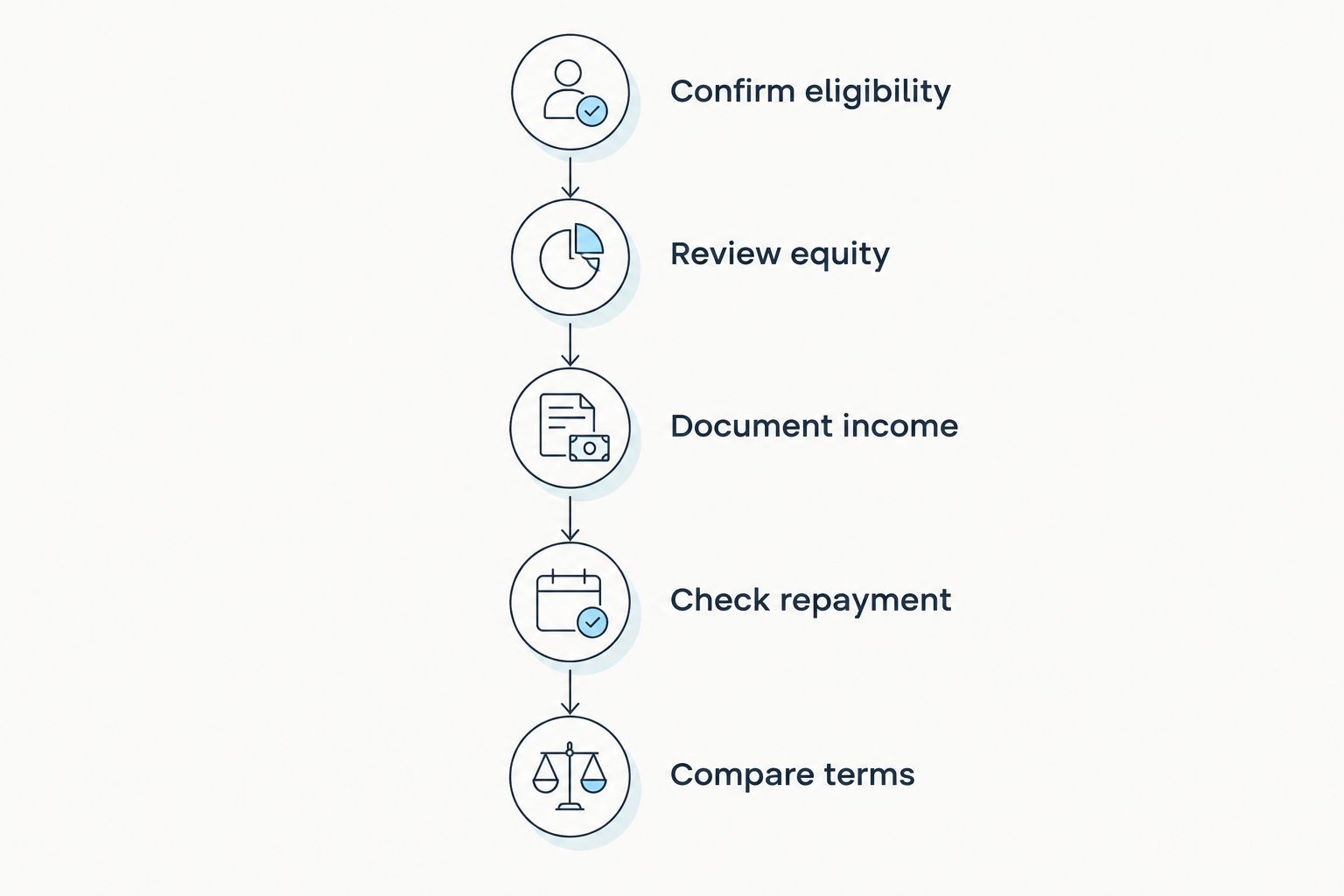
Confirm rental-property eligibility before completing the financial review.
What should you gather before applying?
Prepare the property's current mortgage statement, ownership information, lease documents, insurance information, and records of rental receipts. Also gather the personal financial documents the lender requests rather than assuming rent alone will establish qualification.
Keep these records consistent. Explain discrepancies between the lease, rent deposits, mortgage statement, and ownership documents before they become unresolved underwriting questions.
For a 2026 application, ask the lender how recent each document must be. An older valuation or expired lease does not necessarily satisfy the current application requirements.
Why rental-property HELOC eligibility varies
There is no single approval standard shared by every investment-property HELOC program. These factors determine which requirements you need to investigate:
- Occupancy and use. Disclose whether the property is a long-term rental, short-term rental, or mixed-use property. Ask whether that exact use qualifies.
- Equity and existing liens. The lender considers the property's accepted value and debt already secured against it. Equity is not automatically an approved credit limit.
- Credit and obligations. Your credit profile and existing debts affect the lender's repayment assessment. Ask which obligations enter its calculation.
- Income documentation. Programs differ in how they assess personal earnings and rental income. Do not substitute projected rent for documented income without approval.
- Property and location. Confirm that the lender accepts the property's type, condition, and state before paying application-related expenses.
- Legal ownership. Personal ownership, an LLC, and a trust are distinct application facts. Confirm the permitted borrower and title structure before making changes.
Get eligibility requirements in writing before treating a proposed line as usable project funding. A preliminary discussion is not a commitment to lend.
How much equity can you borrow against?
Your usable borrowing capacity is not the same as your total equity. Total equity is the property's value minus debt secured against it; a lender generally leaves part of that equity outside the permitted borrowing amount.
Loan-to-value, or LTV, compares a loan balance with property value. Combined loan-to-value, or CLTV, considers the applicable debts secured by the same property, including the proposed additional financing.
Ask whether the lender calculates its limit using the full HELOC commitment or another defined amount. Also ask which valuation method it requires; your own estimate is not an approved collateral value.
For your 2026 planning, avoid building a renovation budget around an assumed percentage. Use the lender's written calculation, then distinguish the approved line from the amount you actually intend to borrow.
When does another investment-property loan fit better?
A HELOC fits staged borrowing; it does not automatically fit every rental-property financing problem. A defined project expense calls for a different comparison than replacing an existing mortgage or financing a property purchase.
A home equity loan deserves consideration when you know the amount you need and prefer a separate lump-sum loan. A cash-out refinance deserves consideration when replacing the existing mortgage is part of the plan—not merely an unavoidable side effect.
DSCR financing adds another qualification approach to discuss. DSCR means debt service coverage ratio: it compares qualifying property income with the debt-payment measure used by the lender. Confirm the program's calculation rather than assuming every lender treats expenses and rental income identically.
Loanguys is a mortgage broker for real estate investors comparing DSCR and bank-statement loan programs. Its stated programs also include fix-and-flip, bridge, and short-term rental financing; those categories do not establish that a particular HELOC is offered or that you qualify.
Discuss your borrowing purpose with Loanguys before choosing a structure. The benefit of comparing investment-property financing is a broader view of the available approaches; the limitation is that a different loan structure does not reproduce a HELOC's revolving draw feature.
How do you compare HELOC terms without missing the risk?
Start with the agreement's mechanics. A manageable initial payment tells you little about the payment after the draw period ends or after a variable rate changes.
Read the proposed terms against these questions:
- How is the interest rate determined, and when can it change?
- What payments are required during the draw period?
- What happens to the balance when the repayment period begins?
- What conditions allow the lender to freeze or reduce further draws?
- What obligations apply if you sell, refinance, or close the line?
- Does the agreement require a particular minimum draw or outstanding balance?
Distinguish a revolving credit line from a loan that simply permits staged disbursements. The ability to borrow, repay, and borrow again depends on the contract, not the product's informal description.
When comparing line of credit lenders, jurisdiction matters: an Australian home-loan comparison does not establish US rental-property eligibility. Use the actual US lender's agreement to verify collateral, occupancy, and repayment requirements.
Keep your 2026 comparison focused on the same requested borrowing amount and intended use. Comparing an undrawn line with a fully funded replacement mortgage otherwise obscures the obligations you are choosing between.
Can you keep your current mortgage and add a HELOC?
Yes, a HELOC can sit alongside an existing mortgage if the lender approves the lien structure. The new borrowing does not automatically replace the original loan, which is a key distinction from a cash-out refinance.
Keeping the original mortgage does not eliminate the new obligation. Review the combined payments and confirm how both loans would be handled if you later sell or refinance the rental.
Can you qualify using rental income alone?
Rental income alone qualifies only when the specific program's underwriting rules permit it. Do not assume that every investment-property HELOC uses a DSCR calculation or ignores personal income.
Ask whether the lender uses leases, collected rent, tax documents, an appraisal's rent assessment, or a combination. A projected rent figure and documented receipts are different evidence.
Can you get a HELOC if your rental is owned by an LLC?
LLC ownership requires a lender that accepts the proposed borrower and title arrangement. Ask whether the LLC can borrow, whether a personal guarantee is required, and which entity documents the lender needs.
Do not transfer the property into your personal name merely to fit an application without reviewing the consequences. Existing loan terms, insurance, legal liability, and tax treatment require separate attention.
FAQ
Can I get a HELOC on a rental property I don't live in?
Yes, you can get a HELOC on a rental property you do not occupy if the lender accepts investment-property collateral and approves your application. Confirm the property's use, location, ownership, and financial requirements before applying.
Is a rental-property HELOC the same as a home equity loan?
No. A HELOC provides revolving borrowing under its agreement, while a home equity loan provides a lump sum. Both use the property as collateral, so repayment failure puts the property at risk.
Do I have to refinance my first mortgage to get a HELOC?
No, a HELOC does not inherently require replacing your first mortgage. The lender must approve the existing debt and proposed lien arrangement.
What credit score do I need for an investment-property HELOC?
The required credit score depends on the lender and program. Request the applicable requirement for a non-owner occupied rental rather than relying on an owner-occupied home-equity advertisement.
Can I use a rental-property HELOC for another property purchase?
A rental-property HELOC can fund another purchase when the agreement permits that use and the purchase lender accepts the borrowed funds. Disclose the new debt and account for its payment when evaluating the purchase.
Can my LLC apply for a rental-property HELOC?
Your LLC can apply only through a program that accepts the proposed entity borrower and ownership structure. Confirm guarantee requirements and required entity documents before proceeding.
Does Loanguys offer a HELOC on every rental property?
Do not assume that Loanguys offers a HELOC for every rental property. Its stated investment-property programs do not establish eligibility for a particular revolving credit line; confirm the proposed product directly.
One last thing
An approved credit limit is not the same as a dependable cash reserve. A HELOC agreement can permit restrictions on future draws under specified conditions, while repairs and mortgage payments still require cash.
Before accepting a rental-property HELOC in 2026, identify a repayment source that does not depend entirely on refinancing or selling at a favorable value. Keep operating reserves separate from your borrowing plan.


