


Can you refinance out of a DSCR loan into a conventional mortgage?

Yes, you can refinance a DSCR loan into a conventional mortgage in 2026 if you meet the new lender’s income, credit, equity, property, and ownership requirements. Your existing loan’s prepayment penalty and the new mortgage’s closing costs affect whether switching makes financial sense. Rental cash flow that qualified you for a DSCR loan does not automatically qualify you for conventional financing.
TL;DR
- To refinance DSCR loan into conventional mortgage financing, you must qualify under the new lender’s underwriting rules.
- Conventional refinancing requires qualifying income; strong property cash flow alone does not establish eligibility.
- Check prepayment penalties, title ownership, and refinance seasoning before ordering an appraisal.
- Loanguys offers DSCR loans for investors seeking property-income-based financing, not automatic conventional approval.
Can you refinance out of a DSCR loan into a conventional mortgage?
Yes. A conventional refinance replaces your DSCR mortgage with a new loan; it does not convert the existing contract or carry over its approval. The conventional lender evaluates your current finances and the property under the replacement program’s requirements.
The practical difference is how you qualify. DSCR underwriting emphasizes the rental property’s income relative to its housing payment, while conventional underwriting evaluates your qualifying income and debt obligations, including eligible rental income.
Best for
- Keep the existing DSCR loan: Investors whose qualification depends on property income
- Refinance into a conventional mortgage: Borrowers who qualify through documented income and debts
Main advantage
- Keep the existing DSCR loan: Avoids replacing a loan that already fits your financing needs
- Refinance into a conventional mortgage: Can change the rate, repayment structure, or loan term
Main limitation
- Keep the existing DSCR loan: Existing payment terms remain in place
- Refinance into a conventional mortgage: Requires a new approval and closing
Ownership
- Keep the existing DSCR loan: Existing ownership structure remains, subject to loan terms
- Refinance into a conventional mortgage: Borrower and title structure must meet the replacement program’s rules
Rental income
- Keep the existing DSCR loan: Existing loan uses its agreed underwriting approach
- Refinance into a conventional mortgage: Rental income must satisfy conventional documentation and calculation rules
Exit expense
- Keep the existing DSCR loan: No refinance payoff occurs
- Refinance into a conventional mortgage: Existing prepayment provisions and closing expenses must be reviewed
Start by identifying whether you want payment relief or equity access. The guide to rate-and-term refinance loans for rental property owners explains the payment-focused route.
Why this matters
Conventional financing is an option, not an automatic upgrade. A replacement mortgage only improves your position when its qualification requirements, ownership rules, and total financing costs fit your plans.
For a 2026 refinance, compare the actual proposed loan against your current contract. A lower payment created by extending repayment is different from a lower payment created by reducing the interest rate. Check both the monthly obligation and the remaining repayment period.
What must qualify for a conventional refinance?
Your documented income and debts
The lender calculates debt-to-income ratio, or DTI: your qualifying monthly debt obligations divided by qualifying gross monthly income. This differs from DSCR, which measures property income against the housing payment used by that program.
Employment income, self-employment income, and rental income each require supporting records. For self-employed borrowers, business deposits do not automatically equal qualifying income; the lender must apply the permitted income analysis.
Ask for an income review before paying for property-related services. If your original DSCR loan solved an income-documentation problem, establish what has changed since that approval.
Your credit, equity, and reserves
The conventional lender reviews credit history, mortgage payment history, and the equity supporting the new loan. Loan-to-value ratio, or LTV, compares the proposed loan balance with the property value accepted for underwriting.
Cash reserves are funds remaining after closing that satisfy the program’s requirements. Do not assume equity substitutes for reserves or that a strong credit profile eliminates income documentation.
Request the requirements for your exact transaction. Investment occupancy, cash-out proceeds, property type, and other financed properties affect the review.
Your property’s eligibility
Standard agency conventional residential financing covers eligible properties with 1–4 residential units. A 1-unit rental house and a 4-unit residential building fall within that unit-count scope, but both still require property and borrower approval. A building with 5 residential units falls outside that standard scope.
Unit count is not the only test. Condition, legal use, condominium project eligibility, and appraisal findings also matter. A property accepted by a DSCR lender is not automatically eligible for conventional financing.
For a short-term rental, ask how the lender will document and calculate eligible rental income. Booking receipts and projected revenue are not interchangeable with an accepted underwriting calculation.
Your ownership and title structure
An LLC-owned property needs an ownership review early in the process. Standard agency conventional borrowing generally requires eligible individual borrowers, with permitted trust arrangements subject to specific rules.
Do not transfer the deed simply to prepare an application. Coordinate any required change with the current loan servicer, replacement lender, title professional, insurance provider, and legal or tax adviser. The transfer must fit the existing contract as well as the new transaction.
Which refinance route fits your goal?
Rate-and-term refinance: change the financing
Best for: borrowers seeking revised loan terms rather than substantial equity withdrawal. A rate-and-term refinance focuses on replacing the existing debt, subject to the replacement program’s limits on proceeds and financed expenses.
Its advantage is a focused objective: improve the financing without treating the transaction primarily as an equity withdrawal. Its limitation is that eligibility still depends on the new loan’s full underwriting requirements.
Compare the remaining term on your DSCR mortgage with the proposed conventional term. Restarting amortization can reduce the monthly payment while extending how long you repay the balance.
Cash-out refinance: access equity
Best for: borrowers who need equity proceeds and qualify for the resulting loan. A cash-out refinance replaces the existing mortgage with a larger loan and distributes permitted proceeds after payoffs and transaction expenses.
Its advantage is access to equity through the replacement mortgage. Its limitation is additional debt and a separate set of cash-out eligibility requirements, including applicable ownership and mortgage seasoning rules.
Do not assume a property qualifies for cash-out because it qualifies for a payment-focused refinance. Ask the lender to classify the proposed transaction before comparing offers.
Why conventional refinance eligibility varies
For a DSCR-to-conventional refinance in 2026, these factors determine the path:
- Income documentation: The lender needs acceptable evidence of qualifying income, not simply proof that rent arrives.
- Debt obligations: Personal debts and other property obligations affect the conventional income calculation.
- Property eligibility: Unit count, condition, legal use, and condominium status affect the available route.
- Equity and reserves: The accepted value, proposed balance, and post-closing funds must satisfy the program.
- Ownership history: LLC ownership, title transfers, and acquisition history require review before closing.
- Existing contract: Prepayment provisions and payoff terms affect the economics and timing of leaving the DSCR loan.
There is no single waiting period or equity threshold that answers every version of this question. Get the requirements attached to your occupancy, refinance purpose, ownership history, and selected program.
How do you prepare for a DSCR-to-conventional refinance?
Define the goal
Choose the result you need: lower financing expense, a different repayment term, removal of an interest-only structure, or access to equity. A clear objective prevents you from selecting a loan based only on its advertised payment.
Write down your expected holding period, too. A refinance that depends on years of future savings deserves a different assessment if you plan to sell soon.
Review the payoff
Request a current payoff statement and review the existing note’s prepayment provisions. Ask the servicer to explain any penalty calculation and the date on which the applicable provision changes or expires.
A statement balance is not a complete payoff figure. Accrued interest and other applicable amounts affect what must be paid at closing.
Verify income
Provide the records needed for an initial qualification review. These can include employment documentation, tax returns where required, leases, rental schedules, asset statements, and statements for other mortgages.
Ask which income the lender accepts and how it handles rental income or losses. Resolve that question before assuming the property’s cash flow supports approval.
Confirm title
Identify who owns the property and who owes the current debt. Give the lender the acquisition date, existing loan date, and details of any ownership changes.
Get a coordinated plan for any required title adjustment. Do not use an unapproved deed transfer as a shortcut.
Compare the offer
Compare the proposed loan with keeping the DSCR mortgage, using the same expected holding period. Review the rate, term, payment components, financed expenses, cash required at closing, and any penalty for paying off the existing loan.
A useful comparison separates financing savings from payment changes caused by a longer term or different escrow assumptions. Keep taxes, insurance, and association charges consistent when comparing housing payments.
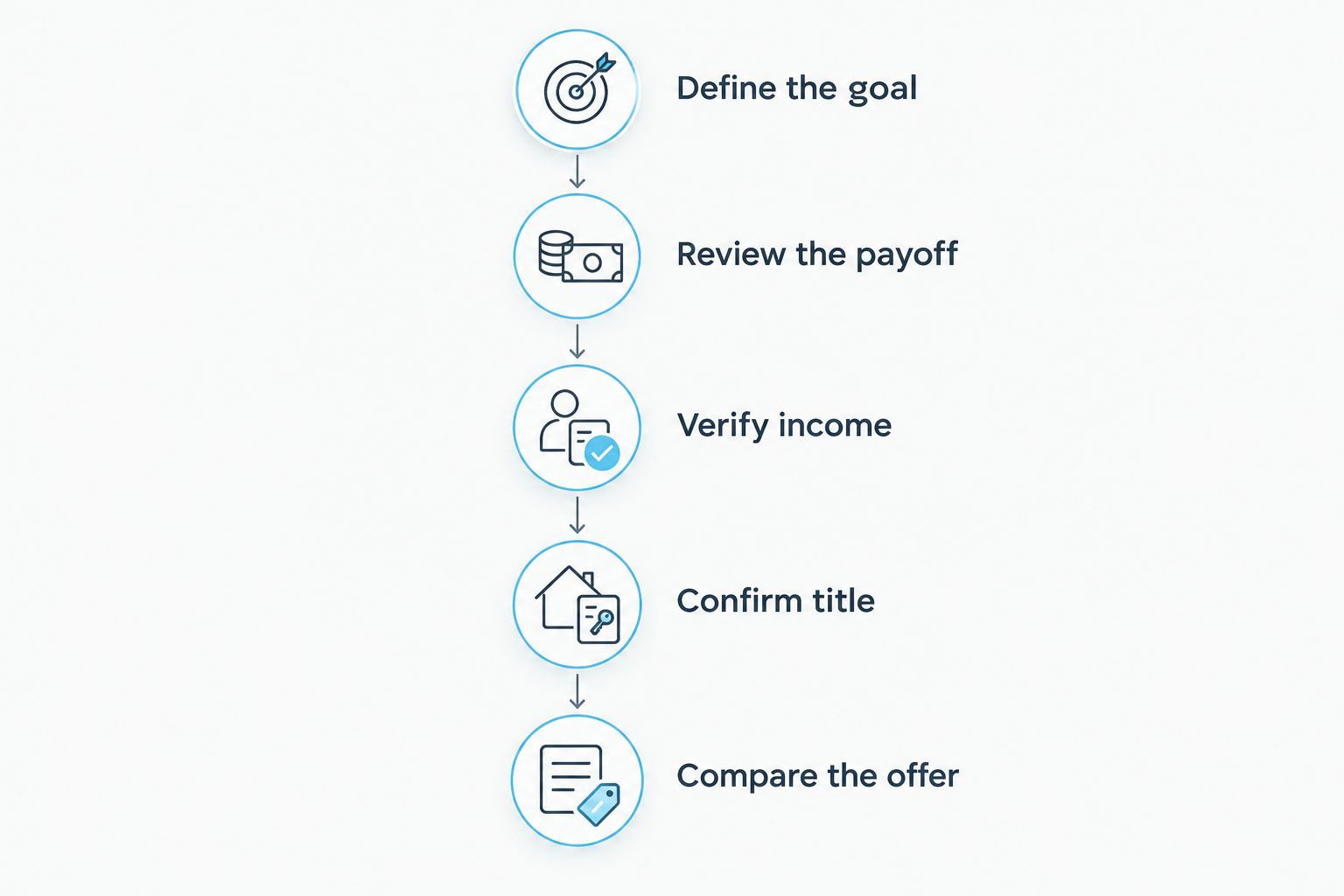
Review income and ownership before committing to a replacement loan.
When should you keep the DSCR loan instead?
Keep the DSCR loan when the replacement mortgage does not solve your financing problem. That includes cases where conventional income qualification fails, required ownership changes conflict with your plans, or switching expenses outweigh the benefit during your expected holding period.
Waiting also deserves consideration when a contractual prepayment provision is close to changing. Compare the documented payoff terms rather than assuming an immediate refinance is the only option.
Loanguys is best suited to investors seeking DSCR financing based on rental-property income. The mortgage broker offers DSCR, bridge, fix-and-flip, bank-statement, and short-term rental loan programs. Those alternatives do not establish eligibility for a conventional refinance or guarantee that replacing your current loan is beneficial.
If conventional qualification is the obstacle, Loanguys provides a relevant starting point for discussing its stated investment-property financing programs. Evaluate any alternative against the same payoff, ownership, and repayment questions.
Can I refinance without moving into the rental?
Yes. Conventional investment-property refinancing does not require you to turn an eligible rental into your primary residence. The application must accurately describe the property’s occupancy and intended use.
In 2026, a change of financing does not itself change occupancy. Do not apply for owner-occupied terms unless the actual circumstances satisfy that program’s requirements.
Can I refinance while the property is in an LLC?
LLC ownership requires an early title and borrower review. An existing DSCR loan’s acceptance of an LLC does not mean a conventional replacement will accept the same structure.
Ask the replacement lender what ownership structure is required and how any transfer affects eligibility. Obtain legal and tax guidance before changing title.
Does strong rental cash flow replace personal income qualification?
No. Strong rental cash flow does not replace conventional income and debt underwriting. Eligible rent can support qualification, but the lender must document and calculate it under the selected program’s rules.
This distinction is especially important when tax-return income differs substantially from business deposits or gross rent collections.
FAQ
Can I refinance a DSCR loan into a conventional mortgage in 2026?
Yes, if you satisfy the conventional lender’s borrower, property, equity, and ownership requirements. The new lender makes a separate underwriting decision rather than relying on the DSCR approval.
How long do I have to wait before refinancing a DSCR loan?
The required wait depends on the replacement program, transaction type, and ownership and mortgage history. Separately, your current loan’s prepayment provisions affect the expense of leaving.
Will conventional refinancing automatically lower my payment?
No, conventional refinancing does not automatically lower your payment. Compare the proposed rate, term, balance, and payment components with your existing mortgage.
Can I use rent to qualify for the conventional mortgage?
Yes, eligible rental income can support conventional qualification when documented and calculated under the program’s rules. Gross rent collections are not automatically the amount accepted for underwriting.
Can I take cash out when replacing my DSCR loan?
Yes, if you qualify for a conventional cash-out refinance. Cash-out eligibility is separate from eligibility for a refinance focused on replacing the existing debt.
Does Loanguys offer DSCR loans for real estate investors?
Yes, Loanguys offers DSCR loan programs for real estate investors. That offering does not establish approval for a conventional replacement mortgage.
One last thing
Check what changed since you chose the DSCR loan. If the original obstacle was income documentation, ownership structure, or property eligibility, a new application needs a solution to that same obstacle—not just a different loan label.
Before starting a 2026 refinance, get an initial income assessment and an explanation of the current loan’s payoff terms. Those checks establish whether conventional refinancing deserves the next step.


