


Cash-out refinance investment property for BRRRR strategy investors: complete 2026 guide

BRRRR investors’ cash-out refinancing is the replacement of an existing property loan with a larger mortgage to recover invested capital while keeping the rental. Your exit depends on completed renovations, supportable rent, an accepted property value, and loan requirements—not simply the equity you expect to create.
TL;DR
- Cash-out refinance investment property for BRRRR investors: confirm rental qualification and net proceeds before committing to the next purchase.
- Loanguys offers bridge and DSCR loan programs for investors comparing acquisition financing with longer-term rental financing.
- DSCR approval does not prove a rental has enough cash flow after maintenance, vacancy, and capital expenses.
- Recovering all invested capital is not a requirement for a successful BRRRR rental.
Why cash-out refinancing matters for BRRRR investors
BRRRR means buy, rehab, rent, refinance, repeat. Cash-out refinancing connects a completed rental to your next acquisition, but it also replaces the debt supporting the property you already own. The right refinance preserves a workable rental, not just a larger cash distribution.
Unlike an investor refinancing a long-held property, you must coordinate renovation completion, lease documentation, valuation, and acquisition-debt repayment. A missed condition can interrupt the repeat stage even when the renovation succeeds.
For your 2026 plan, separate the acquisition decision from the refinance decision. If you used short-term financing, review the process for refinancing a hard money loan into a DSCR loan before assuming the replacement loan will close on your schedule.
How to prepare your BRRRR cash-out refinance
1. Define the exit before buying
Start with a spreadsheet. Record acquisition expenses, renovation spending, financing expenses, expected rent, and your intended holding strategy before you commit to a property.
Work backward from the refinance rather than forward from the purchase. A property can be an attractive renovation project yet remain unsuitable for your intended rental loan because of its condition, legal use, ownership structure, or rental-income documentation.
Your 2026 exit plan should also include a fallback: holding with more capital invested, reducing the requested loan, or delaying the next purchase. Do not make a second acquisition dependent on proceeds that have not closed.
- Identify the property type and intended rental use.
- Ask prospective lenders whether that property and ownership structure qualify.
- Record the acquisition loan’s maturity and extension provisions.
- Set the minimum cash flow and reserves you will retain.
2. Calculate net proceeds instead of headline equity
Build a proceeds worksheet using the proposed loan amount, a current payoff statement, and transaction estimates. Equity is the difference between property value and secured debt; it is not the amount deposited into your account after refinancing.
Loan-to-value, or LTV, expresses the loan amount as a percentage of the property value accepted for underwriting. An LTV of 100% means the loan equals that value; it does not describe an available program or a recommended borrowing level.
Net cash released equals the new loan minus required debt payoffs, closing expenses, and other closing deductions. Separately identify reserve requirements: funds you must retain are not necessarily funds deducted at closing, but neither belongs in your next purchase budget.
- Obtain an updated payoff covering the expected closing date.
- Include any applicable prepayment charge on the existing debt.
- Separate closing deductions from funds you must keep available.
- Compare net proceeds with your actual cash invested.
3. Match the qualification method to the rental
First, compare financing routes yourself using the same property facts and requested proceeds. Ask each lender which income documents, rental evidence, ownership documents, and property conditions apply. A comparison built on different assumptions is not useful.
Loanguys is best for BRRRR investors seeking a mortgage broker offering both bridge and DSCR loan programs. Loanguys also offers bank-statement programs, giving self-employed investors another qualification route to discuss rather than assuming rental-income underwriting is the only option.
A broker conversation helps you compare program fit without independently approaching every lender. The limitation remains the underlying lender’s requirements: Loanguys’ program categories do not establish your eligibility, cash-out limit, or closing date.
- Ask whether qualification centers on rental income or personal income.
- Confirm whether cash-out is permitted for your exact scenario.
- Disclose entity ownership and all existing property debt.
- Compare documentation requirements before ordering third-party work.
4. Verify seasoning and valuation rules
Gather your purchase settlement statement, renovation invoices, payment records, permits, and completion evidence. These documents establish what happened to the property; an expected after-repair value does not.
Seasoning means a required period of ownership or another qualifying history under the selected program. Ask whether the lender applies separate rules to ownership, existing debt, rental history, and recognition of increased value. Do not treat those questions as interchangeable.
For a 2026 refinance, obtain the current program’s answer before scheduling around a projected cash-out date. A completed rehab does not automatically establish that the lender will base the loan on your preferred valuation method.
- Confirm the event that starts each applicable seasoning period.
- Ask which value basis applies to the proposed transaction.
- Keep paid invoices and before-and-after condition records.
- Resolve open permits, title issues, and incomplete work early.
5. Test rental coverage and actual cash flow
Use your lease, rent records, insurance estimate, tax information, and association charges to build a rental worksheet. Then ask the lender which income and payment figures enter its debt-service coverage ratio, or DSCR.
DSCR measures qualifying income against the debt-service amount used in underwriting. A ratio of 1.0x means those amounts are equal. Below 1.0x, the qualifying income is less than the measured debt service; neither figure alone establishes an individual program’s approval threshold.
Your operating budget needs a separate test. Residential rental DSCR calculations can differ from commercial-property calculations, and the lender’s formula does not necessarily deduct every expense you face as an owner. Approval and durable cash flow are different questions.
- Obtain the lender’s exact DSCR calculation in writing.
- Include maintenance, vacancy, management, and capital expenses in your budget.
- Recalculate cash flow using the proposed mortgage payment.
- Test lower rent and higher operating expenses before choosing proceeds.
6. Coordinate the closing around the existing loan
Create a shared document folder and a deadline list before submitting the application. Include the property address, borrower entity, payoff contact, insurance information, lease, and renovation records so inconsistencies surface early.
Ask which conditions must be satisfied before appraisal, underwriting completion, and funding. An initial indication is not a final approval, and a scheduled closing is not money available for another purchase.
For your 2026 pipeline, keep the refinance timeline separate from the acquisition loan’s contractual deadline. If the dates conflict, address the existing loan directly rather than assuming underwriting will accelerate.
- Request a written list of outstanding closing conditions.
- Confirm the borrower name matches title and entity documents.
- Check insurance and rental-use information for consistency.
- Obtain updated payoff instructions through a verified channel.
7. Release capital without emptying the rental
Decide how much cash the property needs before deciding how much cash to remove. Start with the lender’s reserve requirement, then build your own operating reserve around the property’s condition, expenses, and exposure to vacancy.
Recovering 100% of your invested capital is not the definition of a successful BRRRR deal. Leaving money in a rental can support a smaller payment and a stronger operating position. The trade-off is slower capital recycling.
Use the following sequence to keep the next acquisition from consuming money that belongs to the existing rental.
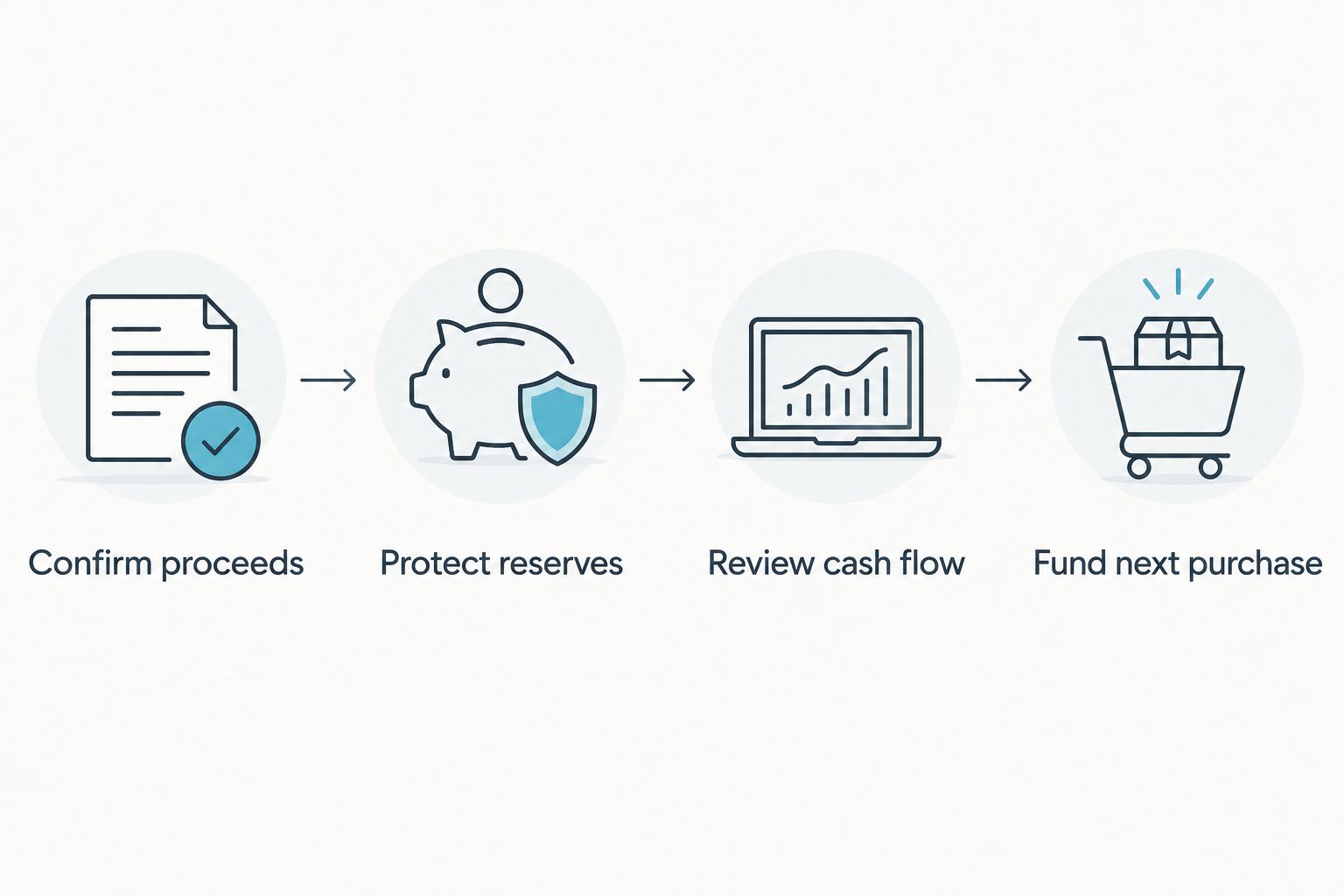
Protect the existing rental before allocating refinance proceeds to another property.
The repeat decision belongs after closing reconciliation, not after an encouraging appraisal. Check what actually funded and what obligations remain before transferring money to another transaction.
- Confirm proceeds against the final settlement statement.
- Protect reserves for lender requirements and property operations.
- Review cash flow using the final loan terms.
- Fund next purchase only from capital you can redeploy.
Discuss your BRRRR refinance plan
Compare DSCR, bridge, and bank-statement program fit for your property and financing exit.
Compare financing options for your BRRRR exit
Choose the qualification route and transaction type separately. DSCR and bank-statement describe underwriting approaches; cash-out and rate-and-term describe transaction purposes. They are not interchangeable labels.
Use this 2026 comparison to decide what to investigate, not to infer approval. Ask for current written terms using the same property, ownership, and proceeds assumptions.
DSCR cash-out refinance
- Best for: Investors seeking qualification centered on rental income
- Main advantage: Connects underwriting to property income
- Key limitation: Rental coverage, valuation, and program conditions constrain borrowing
Conventional cash-out refinance
- Best for: Investors with documentable qualifying income
- Main advantage: Uses an established personal-income underwriting route
- Key limitation: Personal income, debts, and property rules still apply
Bank-statement refinance
- Best for: Self-employed investors evaluating alternative income documentation
- Main advantage: Uses bank-statement analysis under the selected program
- Key limitation: Deposits are not automatically treated as qualifying income
Rate-and-term refinance
- Best for: Investors prioritizing replacement of existing debt
- Main advantage: Focuses on restructuring the mortgage rather than extracting capital
- Key limitation: Does not serve the same substantial equity-withdrawal objective
Investment-property home equity financing
- Best for: Owners evaluating separate debt while retaining the first mortgage
- Main advantage: Keeps the existing first mortgage in place
- Key limitation: Adds another repayment obligation and separate qualification requirements
Bridge financing
- Best for: Investors whose project still needs a transitional funding stage
- Main advantage: Addresses a temporary financing need
- Key limitation: Requires its own repayment or refinance exit
Compare net proceeds, ongoing obligations, and exit risk together. The route producing the largest initial distribution is not automatically the best route for a rental you intend to keep.
Common mistakes BRRRR investors make
Treating renovation spending as guaranteed value
Your invoices document cost, not the property value an appraiser or lender must accept. Separate your renovation budget from the value assumption in your refinance worksheet, and check whether a lower accepted value still leaves a workable exit.
Assuming rent automatically proves coverage
A signed lease does not tell you how the lender calculates qualifying rent or debt service. Confirm the formula before selecting a loan amount, then test the rental again using your full operating budget.
Ignoring the acquisition loan’s exit terms
A bridge or rehab loan can carry maturity, extension, and payoff conditions that affect the refinance. Review the signed documents before choosing a closing target; refinance expectations do not amend the existing contract.
Spending proceeds before protecting reserves
A cash distribution can make the next acquisition look funded while leaving the first rental exposed. Separate required reserves, your operating cushion, and redeployable capital before you repeat the strategy.
FAQ
What is a cash-out refinance for BRRRR investors?
A BRRRR cash-out refinance replaces an existing property loan with a larger mortgage and releases remaining proceeds after required payoffs and closing deductions. Investors use it to recover capital while retaining the rental, subject to qualification and property requirements.
Is a DSCR loan better than a conventional refinance for BRRRR?
A DSCR loan fits investors seeking qualification centered on rental income, while a conventional refinance fits borrowers who meet its personal-income and property requirements. Compare the same requested proceeds and ownership structure rather than assuming either route always wins.
How long do I have to own the property before refinancing?
The required ownership period depends on the selected loan program and transaction. Ask separately about ownership seasoning, existing-debt history, and the value basis used to calculate the loan.
Can I recover all my purchase and renovation money?
Full capital recovery is not guaranteed. Accepted value, permitted borrowing, rental coverage, debt payoffs, and closing deductions determine how much money the refinance releases.
Can I refinance before the rental has a tenant?
Refinancing without an existing tenant depends on the program’s occupancy and rental-income documentation rules. Confirm whether the lender accepts market-rent evidence or requires a lease and additional rental records.
Does a DSCR approval mean my rental has positive cash flow?
A DSCR approval does not establish positive cash flow after every operating expense. Build a separate budget for vacancy, maintenance, management, capital expenses, and the final mortgage payment.
Can Loanguys help me compare BRRRR financing routes?
Loanguys offers DSCR, bridge, fix-and-flip, and bank-statement loan programs as a mortgage broker. Discuss the property, existing debt, renovation status, and intended cash-out objective to identify which program requirements to examine.
One last thing
A refinance can improve your exit without recovering every dollar you invested. If a smaller loan leaves the rental easier to hold and adequately funded, the capital left in the property serves a purpose.
Before your next 2026 acquisition, ask Loanguys to discuss the refinance route alongside the acquisition financing. Then make the repeat decision from verified proceeds and operating cash flow—not the renovation’s projected value.


