


Cash-out refinance investment property for out-of-state landlords: complete 2026 guide

Out-of-state landlords’ cash-out refinancing is replacing a rental property’s mortgage with a larger loan to release equity for repairs, reserves, or another investment. A cash-out refinance investment property for out-of-state landlords requires coordinating property-state lending rules, rental documentation, local access, and closing arrangements without relying on your physical presence.
TL;DR
- Cash-out refinance investment property for out-of-state landlords starts with usable equity and sustainable rental cash flow.
- Loanguys is best for investors comparing DSCR and bank-statement loan programs through a mortgage broker.
- Confirm property-state eligibility, ownership seasoning, and remote closing arrangements before paying for an appraisal.
- Compare net proceeds and post-refinance cash flow, not just the largest loan amount.
Why cash-out refinancing matters for out-of-state landlords
Equity in a distant rental does not pay for repairs until you sell, borrow against it, or use other cash. A cash-out refinance converts part of that equity into borrowed funds while leaving you responsible for the property and a new mortgage.
Distance adds coordination work. Your property manager handles access, your insurer documents coverage in the property’s state, and the settlement team confirms how you can sign. A missing lease or unresolved title issue becomes harder to fix when the people responsible work in different places.
Start with the broader requirements for rental property loans for out-of-state investors. Then evaluate the refinance against your actual use for the money.
For your 2026 decision, separate two questions: does the property qualify, and does borrowing improve your position? An approved refinance is not automatically a sound investment decision. Taking cash out reduces equity and changes the rental’s debt obligation.
How to prepare an out-of-state rental for cash-out refinancing
Define the job for your cash-out proceeds
Build a worksheet before requesting quotes. Name the intended use, the amount needed, and the funds you will retain for the existing rental rather than committing everything to the next deal.
Separate essential repairs from optional expansion. If a distant property needs work to remain rentable, sending all proceeds toward another purchase leaves the original asset exposed. Include management, turnover, insurance, and owner-paid expenses in your planning.
Write down a stop condition as well. If the new payment leaves insufficient operating cash, reduce the borrowing request or postpone the transaction. That decision belongs before the appraisal, not after you have invested time in closing.
- Identify the specific use of proceeds.
- Separate repairs, reserves, and acquisition funds.
- Record the current mortgage balance and payment.
- Set your minimum acceptable operating cash flow.
- Decide what result would make you decline the refinance.
Calculate usable equity and test the new payment
Use your records and a conservative property-value estimate to build a preliminary worksheet. Loan-to-value, or LTV, means the loan amount divided by the property value used by the lender. Your estimate is a planning input, not the lender’s final valuation.
Net proceeds equal the new loan amount minus mortgage payoffs, closing expenses, and other required deductions. Equity and spendable proceeds are different figures. Include any existing second lien or contractual payoff obligation when estimating the difference.
For rental underwriting, ask how the lender calculates the debt service coverage ratio, or DSCR. A ratio of 1.00x means the qualifying income equals the debt-service amount used in that calculation; debt service consumes 100% of that qualifying income. It does not prove the rental covers every operating expense.
- Request a current payoff statement.
- Confirm which valuation basis the lender will use.
- Ask for the applicable cash-out LTV limit.
- Obtain the lender’s exact DSCR calculation.
- Test cash flow with vacancy and repairs included.
Match the qualification method to your records
Start by organizing the documents you already have: income records, leases, bank statements, and mortgage statements. Ask your existing lender which refinance paths fit those records before assuming you need an alternative program.
A conventional application evaluates borrower income and obligations under its underwriting rules. A DSCR application emphasizes the rental’s qualifying income relative to its payment. Bank-statement underwriting provides another way to evaluate eligible self-employed borrowers’ income, but it still requires documentation.
Loanguys offers DSCR and bank-statement loan programs through its mortgage brokerage. Loanguys is best for investors comparing DSCR and bank-statement loan programs through a mortgage broker. The limitation is that the program category alone does not establish your property’s eligibility, cash-out amount, or closing terms.
For a 2026 application, request a written document checklist for the actual program being considered. Do not treat a preliminary conversation as an underwriting decision.
- Ask which income method fits your circumstances.
- Confirm that the program permits cash-out refinancing.
- Disclose every financed rental and ownership entity.
- Identify credit, reserve, and documentation requirements.
- Compare written terms using the same borrowing request.
Confirm property-state and ownership eligibility
Prepare a simple ownership summary using the deed, mortgage statement, and entity documents. Distinguish where you live from where the collateral sits; both belong in the application, but the property’s location affects the lending and settlement process.
Ask the lender to confirm that it can originate the proposed transaction in the property’s state. Also disclose whether title sits in your individual name, a limited liability company, or a trust. Do not transfer ownership simply to match an assumption about eligibility.
Ownership seasoning means the length of time a program requires you to have held the property. A separate rule can govern how long an existing mortgage must have been in place. Ask how acquisition dates, recent renovations, and title changes affect the proposed refinance.
- Provide the property address and actual occupancy.
- Confirm eligibility in the property’s state.
- Identify the exact legal owner.
- Ask about ownership and mortgage seasoning separately.
- Obtain approval before making any proposed title change.
Assemble a remote-ready property file
Create a shared document folder and ask your property manager to check it against current records. Executed leases, rent ledgers, insurance documents, and tax records should describe the same property and ownership arrangement.
For annual cash-flow planning, reconcile 12 months of collections against the corresponding annual expenses when those records exist. This is a budgeting method, not a claim that every lender requires that documentation period. Explain gaps rather than presenting scheduled rent as collected income.
Your lender’s accepted rental-income evidence depends on the program and rental type. Long-term leases, short-term rental histories, and market-rent opinions are not interchangeable. Disclose how the property operates today and any planned change after closing.
- Gather executed leases and current rent records.
- Reconcile collections with management statements.
- Collect tax, insurance, and association documents.
- Provide entity records and signing authority when applicable.
- Explain vacancies, concessions, and recent changes in use.
Coordinate local access and remote signing
Make a contact sheet yourself before asking anyone to schedule appointments. Name the person who can admit the appraiser, answer property-condition questions, and arrange repairs if an underwriting condition requires them.
Appraisal access and closing signatures are separate tasks. Your manager can coordinate the former without automatically having authority to sign loan documents. Ask the settlement team which signing arrangements the lender, title insurer, and property-state requirements permit.
For your 2026 closing, do not assume online notarization or a power of attorney will be accepted. Confirm the permitted method before arranging travel or authorizing another person to act. Independently verify wiring instructions using a trusted telephone number, not contact details supplied in an unexpected email.
- Assign a local access contact.
- Confirm tenant-notice requirements before appointments.
- Disclose known condition or title problems early.
- Obtain written signing instructions from settlement staff.
- Verify wire details through an independent channel.
Compare the final result before committing
Put competing proposals into the same worksheet. Compare the loan structure, net proceeds, payment, cash reserves, and restrictions rather than choosing the proposal with the most prominent headline rate.
Ask what remains conditional. An estimated value, unverified rent figure, or pending title review can change the result. Separate a preliminary quote from terms supported by completed underwriting.
Loanguys offers multiple investment-property loan categories, which makes program comparison relevant. The broker’s range does not replace your review of the proposed lender’s documents. Choose the structure your rental can support, not simply the one that releases the most equity.
- Compare proposals using the same property and cash-out goal.
- Check fixed, adjustable, amortizing, or interest-only features.
- Review prepayment restrictions and any balloon obligation.
- Recalculate proceeds after all required deductions.
- Confirm remaining conditions before committing funds elsewhere.
The decision sequence stays the same regardless of where you live: establish the need, test the rental, confirm eligibility, prepare records, and coordinate closing.
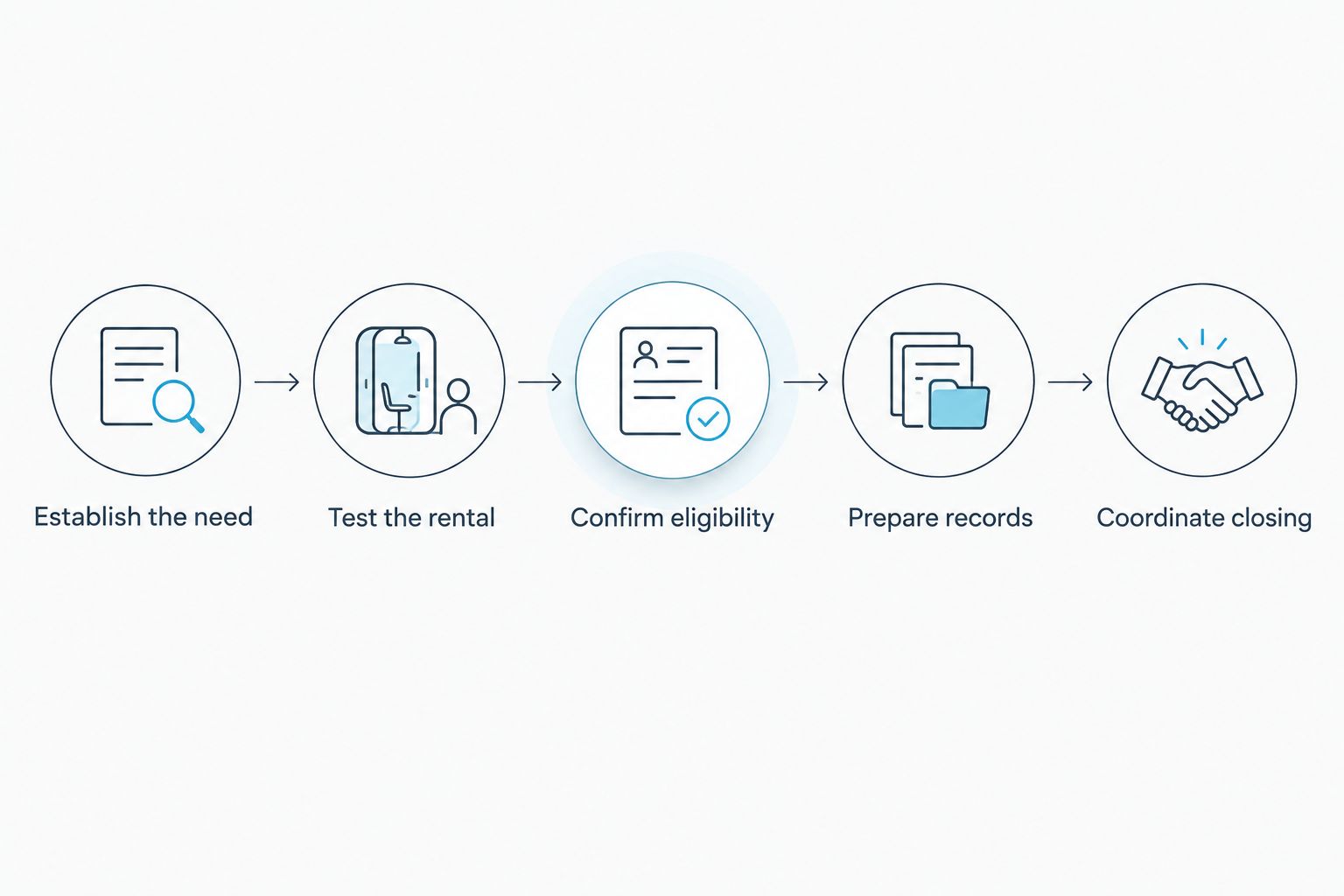
Confirm eligibility before arranging the closing or committing the expected proceeds.
Compare financing options for your rental
The best option depends on whether you need a replacement mortgage, additional borrowing, or no new debt. These categories describe possible approaches, not guaranteed program eligibility. Ask each provider to explain its requirements for your property, ownership structure, and intended use.
Conventional cash-out refinance
- Best for: Landlords whose documented income supports qualification
- Main advantage: Evaluates the transaction through established borrower-income underwriting
- Key limitation: Personal income and other mortgage obligations affect qualification
DSCR cash-out refinance
- Best for: Investors with rental income that supports the proposed payment
- Main advantage: Focuses qualification on the rental’s income coverage
- Key limitation: Lender-defined rent and payment calculations control the result
Bank-statement refinance
- Best for: Eligible self-employed landlords using business cash-flow records
- Main advantage: Provides an alternative income-documentation method
- Key limitation: Deposits are not automatically treated as qualifying income
Investment-property equity loan or line
- Best for: Owners who want to preserve their first mortgage
- Main advantage: Adds borrowing without replacing the existing first loan
- Key limitation: Creates another secured obligation; lender and property eligibility differ
Keep the existing mortgage
- Best for: Owners whose refinance would weaken cash flow
- Main advantage: Avoids replacing debt solely to access equity
- Key limitation: Leaves equity tied up in the property
A home-equity option deserves comparison when replacing your current mortgage would materially change the payment on the entire outstanding balance. A refinance replaces that balance; an additional lien creates a separate obligation. Neither approach removes repayment risk.
For your 2026 comparison, request terms for the same intended use of funds. Mixing a repair-financing request with an expansion request makes proposals harder to compare.
Discuss your rental financing options
Ask which DSCR or bank-statement program fits your property, ownership, and income records.
Common mistakes out-of-state landlords make
Treating an online estimate as approved value
A website estimate is not the value accepted for underwriting. Keep the next purchase independent of anticipated refinance proceeds until valuation and loan conditions are resolved. Otherwise, a valuation change at the existing rental can disrupt a separate transaction.
Leaving the property manager out of the process
A manager who learns about the refinance only when an appraiser calls cannot prepare tenants or reconcile records in advance. Assign responsibility for access, leases, collections, and condition questions at the start. Keep borrowing and signing authority separate from routine management duties.
Counting rent without counting remote ownership expenses
Scheduled rent does not equal money available for debt service. Review management charges, turnover, owner-paid utilities, maintenance, insurance, and taxes in your own budget even when underwriting uses a narrower calculation. A passing DSCR does not replace a complete operating statement.
Assuming the same closing process applies everywhere
Your home-state experience does not establish the signing rules for another property. Confirm the settlement process with the professionals handling that transaction. Address entity authority and notarization before documents are ready, not on the planned signing date.
Spending proceeds before protecting the existing rental
Expansion creates another property to support; it does not eliminate the original property’s repair needs. Allocate reserves before committing proceeds elsewhere. In your 2026 plan, document which cash belongs to the refinanced rental and which funds are available for another investment.
FAQ
Can I refinance a rental property if I live in another state?
Living in another state does not by itself prevent a rental-property refinance. The lender must accept the property location, ownership structure, borrower profile, and proposed transaction.
What is the best cash-out refinance option for an out-of-state landlord?
The best option is the one that fits your documentation and leaves sustainable rental cash flow after closing. Compare conventional, DSCR, and eligible bank-statement approaches rather than choosing solely by maximum proceeds.
Does a DSCR cash-out refinance require no documents?
A DSCR cash-out refinance still requires documentation. Ask for the program’s requirements for rental income, property value, credit, assets, title, and entity ownership.
Can I close an investment-property refinance without traveling?
A remote signing arrangement is possible only when the transaction’s lender and settlement requirements permit it. Confirm the accepted notarization and signing method before making travel plans.
Can an LLC refinance an out-of-state rental property?
An LLC can pursue refinancing through a program that accepts its ownership structure. Confirm entity eligibility, authorized signers, and any guarantee requirements before changing title or ordering an appraisal.
How much cash can I take out of my rental property?
Your net cash depends on the approved loan amount minus mortgage payoffs and required deductions. Property value, permitted LTV, income coverage, and program limits affect the approved amount.
Can Loanguys help me compare rental-property loan programs?
Loanguys offers DSCR and bank-statement loan programs through its mortgage brokerage. Ask which approach fits your property’s state, rental use, ownership, and documentation; program offerings alone do not establish approval.
One last thing
Ask your property manager to review the post-refinance operating budget before you accept the loan. The person handling repairs and tenant turnover can identify expenses that a mortgage-payment comparison misses. Keep the borrowing decision with you, but bring local operating knowledge into it.


