


Commercial Real Estate Loans for Laundromats (2026 Guide)
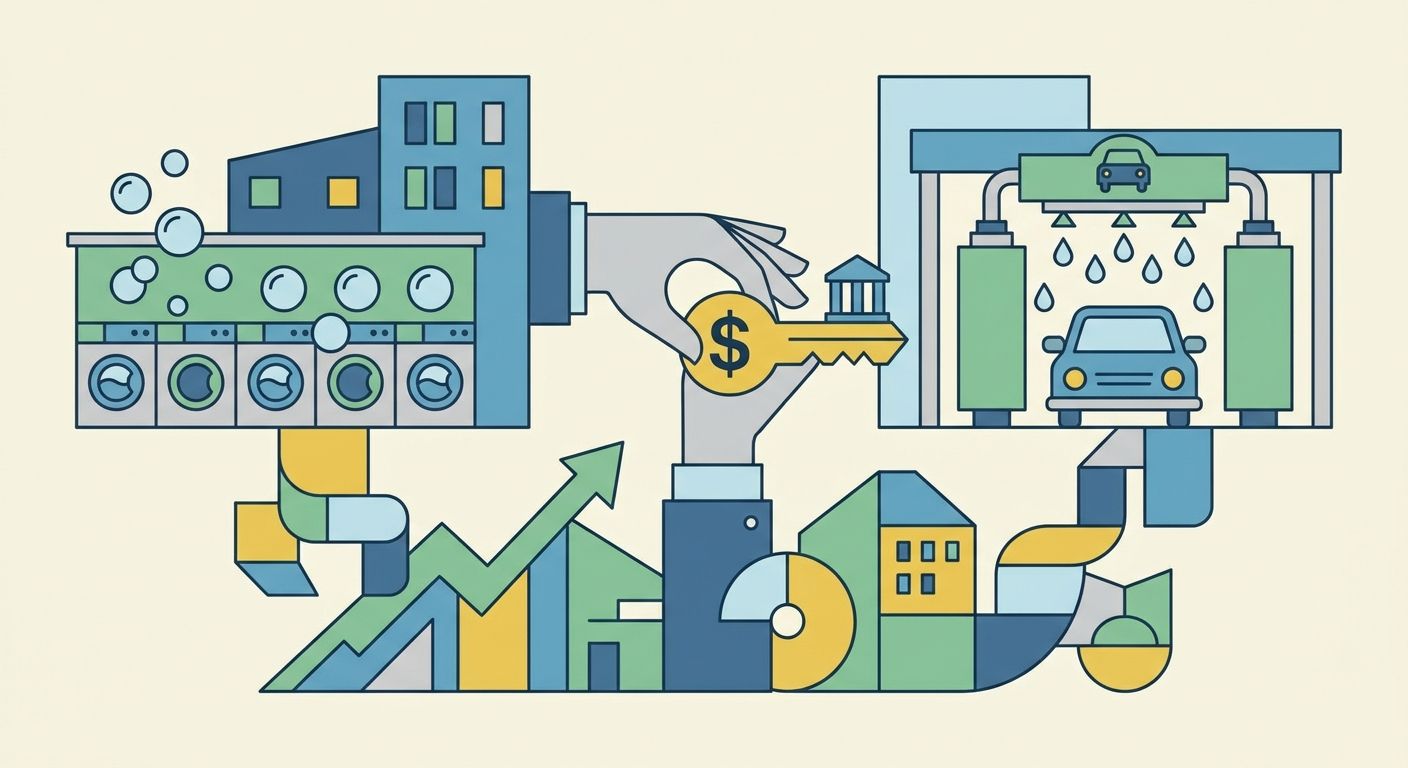
Buying real estate for a laundromat or car wash isn't the same underwriting exercise as buying an apartment building, and lenders treat these deals differently because the business and the real estate are tied together. This guide breaks down what qualifies as a strong commercial real estate loan for laundromats and car washes in 2026, what to avoid, and which loan structure fits which buyer.
TL;DR
- SBA 504 loans win for laundromat owner-occupants with two years of clean tax returns — Buy.
- Bridge loans close car wash acquisitions in 2-3 weeks when a listing is competitive — Buy for time pressure.
- No-tax-return commercial loans fit cash-intensive laundromats with soft paper profit — Consider.
- Skip small conduit CMBS loans under $1 million; minimums usually price out a single-location laundromat.
Why this matters
Laundromats and car washes are cash businesses first and real estate second, which is exactly the profile that trips up conventional bank underwriting. A bank statement shows deposits from coin boxes and card readers, but the tax return often shows a fraction of that because of depreciation on washers, dryers, and wash tunnel equipment. That mismatch is why generic commercial mortgage shopping wastes time for this buyer group, and why picking the right commercial real estate loans for owner-occupied small businesses structure matters more than chasing the lowest advertised rate.
The property itself also carries quirks a generalist lender won't price correctly. Car washes have environmental exposure from chemical runoff and reclaim systems. Laundromats carry heavy fixed equipment that isn't always counted as real property value. Get the wrong loan type and you either overpay for flexibility you don't need, or you get stuck with a structure that can't close before the seller walks.
Who this is for
This breaks down commercial real estate loans for laundromats and car washes for two buyer types: the operator purchasing the building they already run their business from, and the investor acquiring a stabilized laundromat or car wash as an income property. Both groups usually have strong revenue on deposit records and weaker taxable income on paper, and both need a lender who underwrites the deal on cash flow rather than a W-2.
What to look for in commercial real estate loans for laundromats and car washes
Cash flow underwriting, not tax return underwriting
Most laundromat and car wash owners write off equipment depreciation aggressively, which shrinks taxable income even when the business generates strong revenue. A lender that underwrites off bank deposits or a debt service coverage calculation instead of net income on a 1040 will approve deals a conventional bank rejects outright.
Loan-to-value that matches your down payment reality
SBA 504 programs commonly go up to 90% LTV for owner-occupied real estate in 2026, while conventional commercial mortgages on special-use property like car washes often cap closer to 65-75%. Know your program's ceiling before you fall in love with a listing you can't actually close.
Speed to close relative to the seller's timeline
SBA loans take longer to underwrite because of the government guarantee paperwork, often 60-90 days start to finish. If you're competing for a listed car wash against a cash buyer, a bridge loan that closes in 2-3 weeks matters more than shaving a point off your rate.
How equipment gets valued and financed
Washers, dryers, wash tunnels, vacuum systems, and reclaim equipment can represent 30-50% of a laundromat or car wash's total value, but not every lender will finance that equipment inside the real estate loan. Ask upfront whether the appraisal and loan amount include fixed equipment or treat it as a separate line item.
Environmental and franchise considerations
Car washes with chemical storage and wastewater discharge sometimes require a Phase I environmental assessment before a lender will fund, adding time and cost to closing. Franchise-affiliated car washes may also need lender approval of the franchise agreement itself, which slows things down further.
Prepayment flexibility if you plan to refinance or sell
SBA 504 loans carry prepayment penalties that step down over roughly the first half of the term. If you're buying with an exit plan inside 3-5 years, that penalty structure changes your real cost of capital more than the headline rate does.
Talk through your laundromat or car wash deal
Get matched with a program built around cash flow, not just tax returns.
Top picks for laundromat and car wash real estate financing
SBA 504 loan — the safe pick. Up to 90% LTV and terms stretching to 25 years on the real estate portion make this the standard route for owner-occupants with two years of documented tax returns and decent personal credit. The tradeoff is underwriting time and a prepayment penalty that lingers for roughly half the loan term. Buy if you're occupying the property and can wait 60-90 days to close. Compare it against best SBA lenders for real estate investment properties before picking a program.
Bridge loan — the fast pick. Closing timelines of 2-3 weeks let you beat competing offers on a stabilized car wash or laundromat listing, with the plan to refinance into permanent debt once you're past the sale. Rates run higher than SBA or conventional, and most bridge lenders expect a clear refinance or sale exit inside 12-24 months. Buy if the deal is time-sensitive and your exit plan is solid; see how to get a bridge loan for a commercial property purchase for the mechanics.
Cash-flow-based commercial loan — the wildcard. Instead of tax returns, the lender underwrites off 12-24 months of bank deposits or a debt service coverage ratio, which works in your favor when equipment depreciation has crushed your reported profit. Rates sit above SBA but the qualification bar is lower and the paperwork is lighter. Consider this if your laundromat or car wash shows strong deposits but thin taxable income.
Conventional commercial mortgage — the traditional pick. Banks and credit unions still offer straight commercial mortgages on car wash and laundromat real estate, typically at 65-75% LTV with 5-10 year terms and a balloon payment. This works cleanly for buyers with strong personal financials and two full years of clean returns. Consider it as a rate-shopping baseline against SBA and cash-flow programs.
Small-balance CMBS/conduit loan — skip it. Conduit lenders package loans for securitization and generally want deal sizes above $1-2 million with strict prepayment lockout periods, which mismatches most single-location laundromat purchases. The fixed structure also makes early refinancing expensive if you outgrow the property or want to sell. Skip unless you're financing a multi-location portfolio, not a single site.
What to avoid
- Loans that ignore equipment value entirely. If the appraisal only counts the shell of the building, you'll be underfinanced on a laundromat where washers and dryers are half the value.
- Brokers promising 100% financing with no documentation. Real underwriting on special-use commercial property always looks at cash flow, credit, or collateral in some combination; anyone skipping all three isn't a real lender.
- Fixed-rate long-term debt on a property you plan to renovate or flip fast. A 25-year SBA term makes no sense if your plan is to add capacity and sell within three years — a bridge structure fits that timeline better.
A comparable pattern shows up in commercial real estate loans for auto repair and service shops: cash-heavy, equipment-dependent small businesses need the same cash-flow-first underwriting approach as laundromats and car washes.
Verdict comparison
SBA 504
- Max LTV: ~90%
- Typical close: 60-90 days
- Best for: Owner-occupants with clean returns
- Verdict: Buy
Bridge loan
- Max LTV: 65-75%
- Typical close: 2-3 weeks
- Best for: Time-sensitive purchases
- Verdict: Buy
Cash-flow/no-tax-return
- Max LTV: 65-80%
- Typical close: 3-4 weeks
- Best for: Cash-heavy operators, soft paper income
- Verdict: Consider
Conventional mortgage
- Max LTV: 65-75%
- Typical close: 45-60 days
- Best for: Strong personal financials, buy-and-hold
- Verdict: Consider
Small-balance CMBS
- Max LTV: 65-70%
- Typical close: 45-75 days
- Best for: Multi-location portfolios only
- Verdict: Skip
FAQ
What's the best commercial real estate loan for a laundromat?
For owner-occupants with two years of tax returns, an SBA 504 loan is the strongest fit in 2026 because it goes up to 90% LTV with a 25-year term. Operators with weaker paper income but strong bank deposits typically do better with a cash-flow-based commercial loan instead.
Can you get a commercial real estate loan for a car wash with bad credit?
Yes, though the loan-to-value drops and the rate rises compared to a buyer with strong credit. Asset-based and cash-flow underwriting programs weigh the property's income and your equity more heavily than a credit score alone.
Is a bridge loan better than SBA for buying a laundromat?
A bridge loan wins on speed, closing in as little as 2-3 weeks versus 60-90 days for SBA, which matters when you're competing for a listed property. SBA wins on long-term cost once you refinance out of the bridge into permanent financing.
How much down payment do you need for a car wash real estate loan?
Expect 10-25% down depending on the program: SBA 504 loans can go as low as 10% for owner-occupants, while conventional commercial mortgages often require 25-35% given the special-use nature of car wash property.
Do lenders finance the equipment inside a laundromat purchase?
Some do and some don't, so confirm this before you sign a purchase agreement. When equipment isn't included in the real estate loan, you'll need a separate equipment finance or asset-based facility to cover washers, dryers, and wash tunnel systems.
Why do laundromat owners struggle to qualify for conventional loans?
Aggressive equipment depreciation shrinks taxable income on the tax return even when the business generates strong cash revenue, and conventional banks underwrite primarily off that tax return figure. A no-tax-return or bank-statement style commercial loan solves this by underwriting off deposits instead.
Do car washes need environmental review before financing?
Many lenders require a Phase I environmental assessment for car washes because of chemical storage and wastewater discharge, which adds time and cost before closing. Budget an extra 2-4 weeks in your closing timeline if the property hasn't been reviewed recently.
What loan term is typical for laundromat real estate?
SBA 504 loans commonly run 25 years on the real estate portion in 2026, while conventional commercial mortgages tend to amortize over 20-25 years with a balloon payment at 5-10 years. Bridge loans are short by design, usually 12-24 months.
One last thing
The detail most laundromat buyers miss: the appraisal method matters as much as the lender. A property appraised on comparable sales alone will undervalue a car wash or laundromat that's cash-flowing well above market rent for the space, which caps your loan amount below what the business can actually support. Ask any lender upfront whether they'll order an income-approach appraisal, because that single choice can change your available loan amount by a meaningful margin before you even discuss rate.


