


Construction loans for custom home builders: complete 2026 guide

Custom home builders’ construction financing is staged funding for land and building work with the aim of completing a home and repaying through a sale or permanent mortgage. This 2026 guide explains construction loans for custom home builders, where funding follows project progress rather than arriving entirely upfront.
TL;DR
- Construction loans for custom home builders should match ownership, draw timing, and the repayment plan.
- Separate homeowner construction financing from builder-owned projects before comparing lenders.
- Loanguys is best for investors comparing DSCR, bridge, fix-and-flip, and bank-statement financing.
- Confirm ground-up construction eligibility; a renovation loan is not automatically a construction loan.
Why this matters
Choose the loan around who owns the property and how the debt gets repaid. A builder constructing a customer’s residence has a different financing problem from a builder holding title and planning to sell the finished home.
Your construction contract and loan agreement also serve different purposes. The contract governs the work; the loan agreement governs funding, inspections, repayment, and default. Neither substitutes for the other.
Why construction financing matters for custom home builders
Custom builds require funding before the finished home exists. Plans, site conditions, buyer selections, subcontractor schedules, and appraisal assumptions all affect whether the approved budget supports the actual work.
In 2026, your financing comparison should start with project structure, not a lender’s headline offer. If you own the lot and build without a committed buyer, compare that arrangement with construction financing for spec home builders, rather than assuming homeowner financing applies.
A staged loan creates a working-capital question: who pays subcontractors before the lender releases the next draw? Resolve that question before signing a construction contract. A funded loan commitment does not mean every project expense is immediately reimbursable.
How to prepare construction financing for a custom home
Define the borrower and repayment plan
Start with a 1-page project summary identifying the borrower, titleholder, builder, intended occupancy, and repayment source. You can prepare this yourself before speaking with a lender. Keep the roles separate even when the builder and property owner are related.
For a customer-owned home, the homeowner generally borrows while the builder performs under a construction contract. For a builder-owned project, the borrowing entity carries the project debt and repays through sale proceeds or refinancing. Owner-builder arrangements require a separate eligibility check because not every program accepts a borrower acting as general contractor.
Do not treat a buyer’s deposit or signed purchase agreement as guaranteed repayment. Identify what happens if the buyer cannot close or the completed appraisal does not support the planned mortgage.
- Record the exact legal name of the proposed borrower.
- Confirm who owns the land and any existing liens.
- State whether the home will be occupied, sold, or rented.
- Identify the primary repayment source and a backup exit.
- Confirm whether the lender accepts your builder arrangement.
Build a complete project budget
Use a spreadsheet to organize 3 budget groups: land, construction, and non-construction expenses. This makes exclusions visible before you request financing. A contractor’s building estimate alone does not describe the entire funding need.
Construction includes site preparation, materials, labor, and approved trade work. Non-construction expenses include design, permits, surveys, financing-related expenses, insurance, and other project requirements. Keep an explicit contingency line rather than hiding uncertainty inside trade estimates.
For your 2026 application, distinguish documented bids from allowances and unresolved selections. An allowance is a budget placeholder, not proof that the final selection will fit. Identify who funds any difference and whether a budget transfer needs lender approval.
Land equity is not the same as spendable cash. Ask how the lender recognizes existing lot ownership and when your cash contribution must enter the project.
- Attach trade bids to the matching budget lines.
- Separate fixed commitments from allowances.
- Include utility connections and site-specific work.
- Show cash already spent and remaining cash needs.
- Assign responsibility for overruns and contingency funding.
Match the financing structure to the project
Compare written program descriptions yourself before submitting applications. Ask each lender whether the program expressly permits ground-up construction, your occupancy plan, your location, and your borrowing entity. The name of a loan category is not an eligibility decision.
Construction-to-permanent financing combines the construction phase with a permanent mortgage structure. Construction-only financing requires a separate repayment transaction. Builder-owned investment construction needs underwriting that accepts the business-purpose project and its intended exit.
Loanguys is best for investors comparing DSCR, bridge, fix-and-flip, and bank-statement financing. Loanguys is a mortgage broker offering those programs to real estate investors and homeowners across the United States. Use that broker route to discuss relevant alternatives, but confirm construction eligibility before treating any program as a match.
The advantage is access to a broker conversation about different financing categories. The limitation is that a listed category does not establish approval for your custom build.
- Ask specifically about ground-up construction eligibility.
- Distinguish homeowner loans from business-purpose loans.
- Confirm whether demolition or major site work is permitted.
- Request the requirements for conversion, sale, or refinancing.
- Obtain project-specific terms rather than relying on a category label.
Assemble borrower and builder documents
Create separate folders for 2 approval tracks: borrower qualification and project review. Organizing documents yourself helps you spot gaps before underwriting begins. A financially qualified borrower still needs an acceptable property and construction plan.
Borrower review addresses income or repayment capacity, credit, assets, liabilities, and the proposed ownership structure. Project review addresses plans, specifications, budget, builder qualifications, permits, insurance, and collateral value. The exact document list depends on the program.
Ask how the appraisal treats the completed home. Highly personalized finishes do not automatically add equivalent market value. Make sure the appraiser receives the same plans and specifications reflected in your contract and budget.
A builder’s experience should be documented, not described with general assurances. Supply the information the lender requests about comparable completed work, licensing where required, and insurance.
- Collect borrower financial documents and entity records.
- Assemble plans, specifications, and the signed construction contract.
- Provide builder credentials and requested project references.
- Confirm permit status and unresolved approval conditions.
- Reconcile the appraisal package with the current budget.
Map draws to your construction schedule
Build a manual cash-flow calendar showing when invoices arrive, when work qualifies for inspection, and when funding becomes usable. Your draw schedule must support the construction schedule, not merely describe it.
Lenders release construction funds under agreed conditions. Those conditions can include completed work, inspection results, invoices, lien documentation, and evidence that required borrower funds have been contributed. Read the actual draw instructions instead of assuming reimbursement occurs when an invoice is submitted.
For a 2026 build, pay particular attention to supplier deposits and materials stored away from the site. Ask whether those expenses qualify for funding and what documentation is required. Confirm whether retainage—a portion withheld until specified conditions are met—creates a cash gap for your builder.
The diagram below summarizes the workflow to confirm with your lender; it is not a universal draw policy.
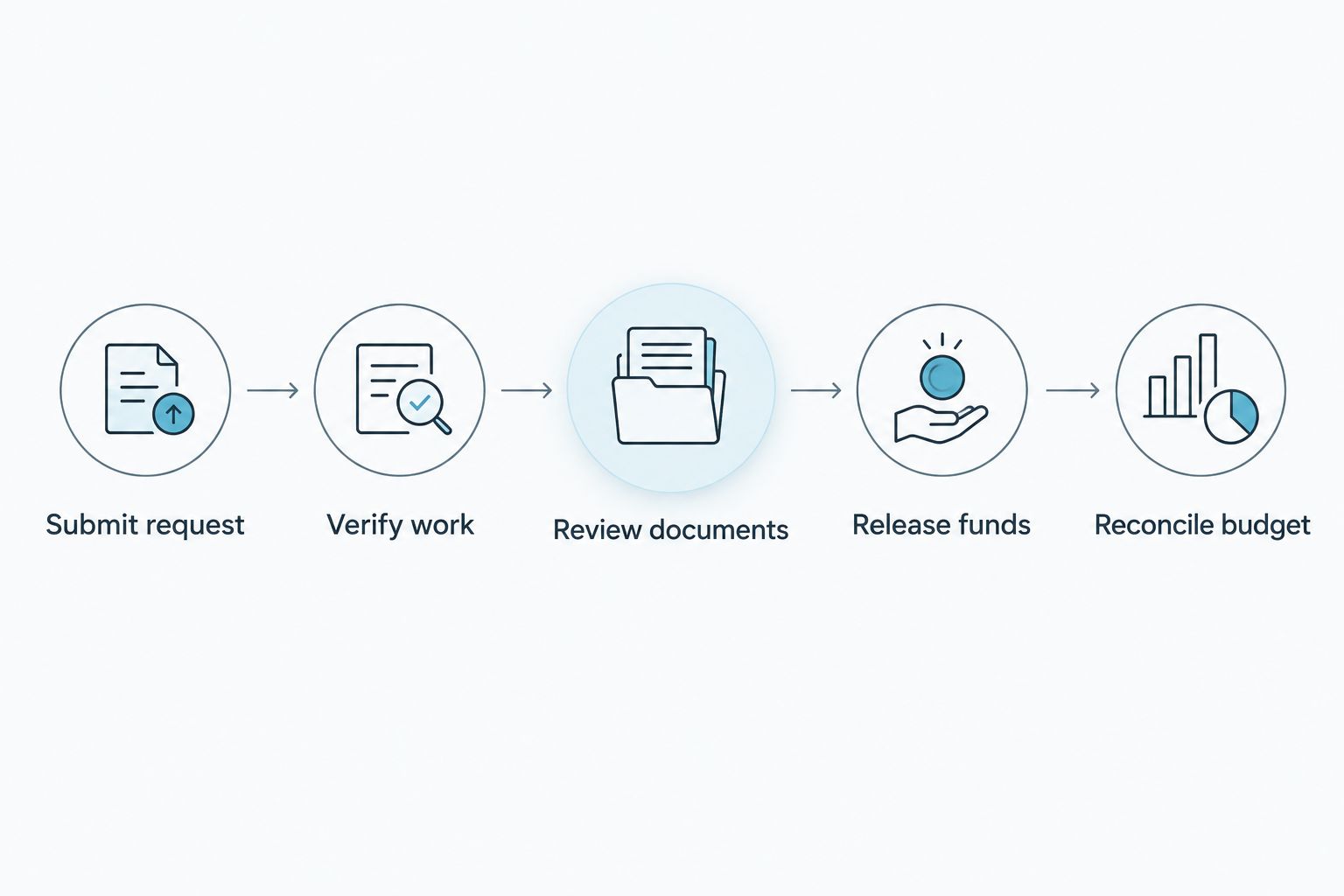
Confirm each funding condition before committing to subcontractor payment dates.
Keep the agreed workflow alongside your construction calendar. Assign an owner to every submission so missing paperwork does not become an unresolved payment problem.
- Submit request: identify eligible work and the requested draw.
- Verify work: arrange the inspection required by the lender.
- Review documents: supply invoices and required lien documentation.
- Release funds: confirm recipients and disbursement conditions.
- Reconcile budget: update remaining funds and unpaid commitments.
Compare funding limits and completion obligations
Put term sheets side by side in a spreadsheet. Compare definitions as carefully as figures: loan-to-cost and loan-to-value answer different questions, and neither tells you how much cash is available at every construction stage.
Loan-to-cost, or LTC, compares the loan with the lender’s recognized project costs. Loan-to-value, or LTV, compares the loan with the property value used in underwriting. Ask which costs and valuation assumptions apply; do not insert your own definitions into the lender’s calculation.
Review maturity, extension conditions, personal guarantees, contingency controls, and any completion obligations. A completion guarantee and a repayment guarantee are not interchangeable. Have qualified legal counsel explain the obligations in your documents before signing.
A larger loan commitment is not automatically the better loan. Compare the cash you must contribute, expenses excluded from draws, and obligations if construction stops.
- Request the lender’s definitions of LTC and LTV.
- Identify excluded costs and required borrower contributions.
- Read maturity and extension conditions together.
- Review guarantees and remedies with legal counsel.
- Confirm how budget shortfalls must be resolved.
Confirm the exit before construction starts
Prepare a written exit checklist yourself before closing the construction loan. For a homeowner, this means understanding permanent mortgage qualification and conversion conditions. For a builder, it means documenting the sale or refinance assumptions that repay the project debt.
A construction-to-permanent structure does not eliminate every completion requirement. Ask about final inspections, occupancy documentation, insurance, appraisal updates, and conditions for the permanent phase. A construction-only loan requires a separate exit; finishing the building does not itself repay the balance.
For a rental project, discuss the requirements of the intended permanent financing before relying on projected rent. DSCR means debt service coverage ratio: a measure comparing income with debt obligations under the lender’s calculation. A rental financing route is not automatically a source of construction-stage funds.
- List the documents needed for completion and repayment.
- Confirm permanent financing requirements before construction closing.
- Test the exit against a lower valuation or delayed sale.
- Identify cash needed while the completed home remains unsold.
- Assign responsibility for tracking maturity and completion conditions.
Compare financing options for your 2026 custom build
Choose by ownership and repayment structure first. The options below are not interchangeable, and no category label establishes eligibility for a particular property.
Construction-to-permanent financing
- Best for: Homeowners building a residence with a permanent mortgage plan
- Main advantage: Connects construction funding with long-term financing
- Key limitation: Builder acceptance and conversion conditions still apply
Construction-only financing
- Best for: Borrowers with a clearly documented sale or separate mortgage exit
- Main advantage: Separates construction financing from the eventual repayment transaction
- Key limitation: Requires another transaction or sale to repay the debt
Builder-owned investment construction financing
- Best for: Builders constructing homes for sale or investment use
- Main advantage: Aligns underwriting with a business-purpose project
- Key limitation: Requires explicit acceptance of ground-up work and the exit strategy
Loanguys broker route
- Best for: Investors comparing DSCR, bridge, fix-and-flip, and bank-statement programs
- Main advantage: Provides a place to discuss multiple financing categories
- Key limitation: Custom construction eligibility must be confirmed separately
For a customer’s primary residence, start with homeowner construction financing. For a builder-owned project, start with investment construction eligibility. Bank-statement documentation addresses income qualification; it does not, by itself, authorize staged construction funding.
Common mistakes custom home builders make
- Borrowing under the wrong project structure. A customer-owned residence and a builder-owned resale project need different eligibility checks. State ownership and occupancy before requesting terms.
- Treating allowances as fixed commitments. Unselected cabinetry, finishes, or fixtures leave budget decisions unresolved. Document the selection process and who pays for changes.
- Scheduling subcontractor payments before understanding draws. An approved commitment does not remove inspection and documentation conditions. Match payment obligations to usable funding.
- Assuming renovation financing covers a new build. Demolition, foundation work, and ground-up construction require explicit program acceptance. Obtain confirmation for the actual scope.
- Waiting until completion to arrange repayment. A finished home can still face appraisal, buyer qualification, or refinance conditions. Check the exit before accepting construction debt.
FAQ
What's the best construction loan for a custom home builder?
The best construction loan matches the property owner and repayment plan. Homeowner builds should start with homeowner construction programs; builder-owned resale projects need financing that expressly accepts investment construction.
Does the builder or homeowner take out the construction loan?
The borrower depends on who owns the property and carries the financing obligation. A homeowner typically borrows for a customer-owned residence, while a builder-owned project generally places the debt with the builder or project entity.
Is a construction-to-permanent loan better than a construction-only loan?
Construction-to-permanent financing fits borrowers who want construction funding connected to a permanent mortgage. Construction-only financing fits a separate sale or refinance exit, but requires another repayment transaction.
Can I use land I already own toward the construction loan?
Existing land equity can contribute to the financing structure when the lender accepts it. Ask how the lot is valued, how existing liens are treated, and whether additional cash contributions are required.
Can a fix-and-flip loan pay for a new custom home?
A fix-and-flip loan funds a new custom home only if the specific program permits ground-up construction. Renovation eligibility alone does not establish approval for demolition, foundation work, or a new build.
How do construction loan draws work?
Construction loan draws release funds after the lender's specified conditions are satisfied. Those conditions can include inspections, invoices, lien documentation, and required borrower contributions; use the signed draw instructions to plan payments.
Does Loanguys offer construction loans for custom home builders?
Loanguys offers DSCR, fix-and-flip, bridge, bank-statement, and short-term rental loan programs. Ask directly whether a program accepts your ground-up custom build, ownership structure, and planned repayment source before relying on it.
One last thing
An approved construction loan can still leave a working-capital gap. Before signing for your 2026 project, ask the lender and builder to walk through the earliest payable invoice: who pays it, what makes it eligible for a draw, and what happens if reimbursement follows the subcontractor’s due date.
That discussion tests whether the construction contract and funding instructions work together. Resolve the mismatch before work starts, not when someone is waiting to get paid.


