


Furnished Finder income to DSCR loan qualification: 2026 workflow

Instead of manually rebuilding your Furnished Finder income file for every DSCR loan request, create a property-level workflow that matches signed leases to collected rent, then confirms which income the lender accepts. A listing alone does not establish qualifying income; the lender’s rental-income rules determine what counts.
TL;DR
- Furnished Finder income DSCR loan qualification depends on accepted rental evidence, not advertised rent.
- Loanguys offers DSCR loans; investors should confirm furnished-rental income requirements before ordering third-party reports.
- Match signed leases, rent records, and bank deposits without counting security deposits as rental income.
- Keep your operating cash-flow analysis separate from the lender’s qualifying DSCR calculation.
Why this matters
Furnished rental records answer different questions. A listing shows what you advertise, a lease documents an agreement, and a bank statement shows money received. None automatically establishes the rental income a particular DSCR program will use.
DSCR means debt service coverage ratio: income divided by the applicable debt-service obligation. Residential investor programs can use qualifying monthly rent against a housing payment, while commercial calculations use net operating income against debt service. Get the program’s exact formula before calculating your ratio.
Loanguys is a mortgage broker offering DSCR financing for real estate investors. Loanguys DSCR financing is best for investors seeking a rental-income-based mortgage assessment. The benefit is a property-income qualification route; the limitation is that advertised furnished rent does not guarantee accepted qualifying income.
For your 2026 application, treat income acceptance as the first decision—not the final document request.
Before you start
- Gather source records. Collect signed leases and amendments, your rent ledger, receiving-account statements, and available property expense records. Keep listing information as supporting context, not a replacement for payment evidence.
- Get the lender’s requirements. Ask which furnished-rental arrangements the program accepts, how it establishes rent, what history it requires, and whether appraisal-based rental analysis is necessary. Confirm the property’s permitted rental use separately.
- Preempt the income mismatch. A tenant payment can include rent, refundable deposits, or other charges. A deposit date can also differ from the rental period it covers. Preserve both distinctions before summarizing income.
This workflow uses a spreadsheet and document folders, not a claimed Furnished Finder integration. Bold field names below are labels you create yourself, not platform buttons or existing menu names.
Property file configuration
Start with 1 property per worksheet. A portfolio summary is useful later, but combining addresses at intake makes it harder to trace the income supporting a specific mortgage.
- Create a folder named for the property address and your 2026 application. Add subfolders labeled Leases, Payment evidence, Property expenses, and Lender requirements.
- Create spreadsheet fields named Property address, Unit, Lease reference, Rental period, Rent due, Rent received, Receipt date, Deposit reference, and Exception note.
- Add separate fields for Refundable deposits, Other charges, and Refunds. Do not bury these amounts in the rent field.
- Assign a lease reference to every tenancy and use that reference in the document filenames and ledger. Record the legal tenant and payer names where they differ.
- Save original records unchanged. Make corrections in your working ledger and explain the change rather than editing source documents to force agreement.
Track 2 dates for each receipt: the receipt date and the rental-period date. This preserves the difference between when cash arrives and when rent is earned under the agreement.
Expected result: You can move from any ledger entry to its lease and payment evidence without guessing which tenancy it belongs to.
Rental evidence reconciliation
Build 3 evidence groups: signed agreements, rent records, and bank evidence. Each group supports a different part of the income story, so do not substitute one for another without the lender’s agreement.
- Read each signed lease and amendment. Enter the applicable rental period, rent obligation, concessions, and any documented changes.
- Match each rent receipt to the receiving-account transaction. Use Deposit reference to identify the relevant statement entry or supporting payment record.
- Separate refundable deposits, transfers between your own accounts, and non-rent receipts. Flag unexplained differences in Exception note rather than labeling everything rental income.
- Identify advance payments, partial payments, unpaid rent, refunds, and payments covering multiple rental periods. Preserve the source dates even when your ledger allocates a receipt across periods.
- Where a deposit combines multiple payments, attach a reconciliation showing how the individual receipts connect to the bank entry. Keep the original payment records alongside it.
Expected result: Your ledger explains both the rent obligation and the cash received, with unresolved differences visible.
Which evidence should lead the file?
Use this comparison to organize your submission, not to choose the lender’s underwriting method.
Signed lease and amendments
- Best for: Documenting an existing tenancy
- Strength: Shows agreed rent and rental terms
- Limitation: Does not prove collection or lender acceptance
Rent ledger matched to deposits
- Best for: Documenting collection history
- Strength: Connects recorded rent to received funds
- Limitation: Requires explanations for combined receipts and timing differences
Lender-required market-rent analysis
- Best for: Establishing rent under an appraisal-based method
- Strength: Provides the rental analysis required by that program
- Limitation: Does not automatically recognize an advertised furnished-rental premium
Lead with the evidence the lender requires, then use the remaining records to explain it. A larger file is not automatically a stronger file; clear relationships between documents matter more than duplicated screenshots.
Qualification worksheet configuration
Do not turn your reconciled ledger into qualifying income by assumption. The lender must first identify the accepted rental-income basis and the payment components used in its calculation.
- Create fields named Accepted income basis, Accepted monthly income, Qualifying payment, Required DSCR, and Requirement source. Leave unconfirmed fields blank.
- Ask whether the program uses a current lease, documented historical income, appraiser-supported rent, or another permitted method. Ask how it treats vacancy, furnished-rental terms, concessions, and owner-paid services.
- Obtain the qualifying payment definition. Confirm whether it includes principal, interest, property taxes, insurance, and association dues, and how any special payment structure is evaluated.
- If the program confirms a monthly rent-to-payment method, divide Accepted monthly income by Qualifying payment. Use matching periods and the lender’s stated inputs.
- Record the lender’s required ratio and the source of that requirement. Mark your result Preliminary until the lender validates both inputs.
Expected result: Your worksheet shows a traceable preliminary calculation, not an unsupported approval estimate.
For the 2026 file, record when the lender confirmed the method. Refresh that confirmation if the program, property use, or proposed loan structure changes.
Keep qualification separate from operating cash flow
A qualifying ratio does not replace a rental-business budget. Maintain a separate operating view for utilities, maintenance, furnishing replacement, management, vacancy, and other expenses relevant to your property.
A furnished rental can satisfy a lender’s income test while leaving less spendable cash than you expect. Use the lender’s worksheet to assess qualification and your operating budget to assess ownership. Do not describe the qualifying ratio as your profit margin.
Submission package configuration
Package the file so a reviewer can follow the evidence without reconstructing your bookkeeping. Keep factual explanations short and attach the record that supports each one.
- Write a property summary covering the address, ownership, rental arrangement, application purpose, and current occupancy. Distinguish actual receipts from future contractual rent and projected income.
- Attach the required leases, reconciled ledger, receiving-account statements, and any requested rental analysis. Supply complete documents through the lender’s designated secure channel.
- Add an exception schedule for unmatched deposits, missing payments, concessions, refunds, or tenancy changes. Explain what happened and identify the supporting document.
- Include the preliminary worksheet with its requirement source. Ask the lender to confirm the accepted income and payment inputs before treating the calculation as settled.
- Maintain a request log showing each outstanding item, its owner, and its status. Respond with the requested evidence rather than resending the whole file after every question.
Expected result: The lender receives an organized property file with a clear calculation trail and an explicit list of unresolved items.
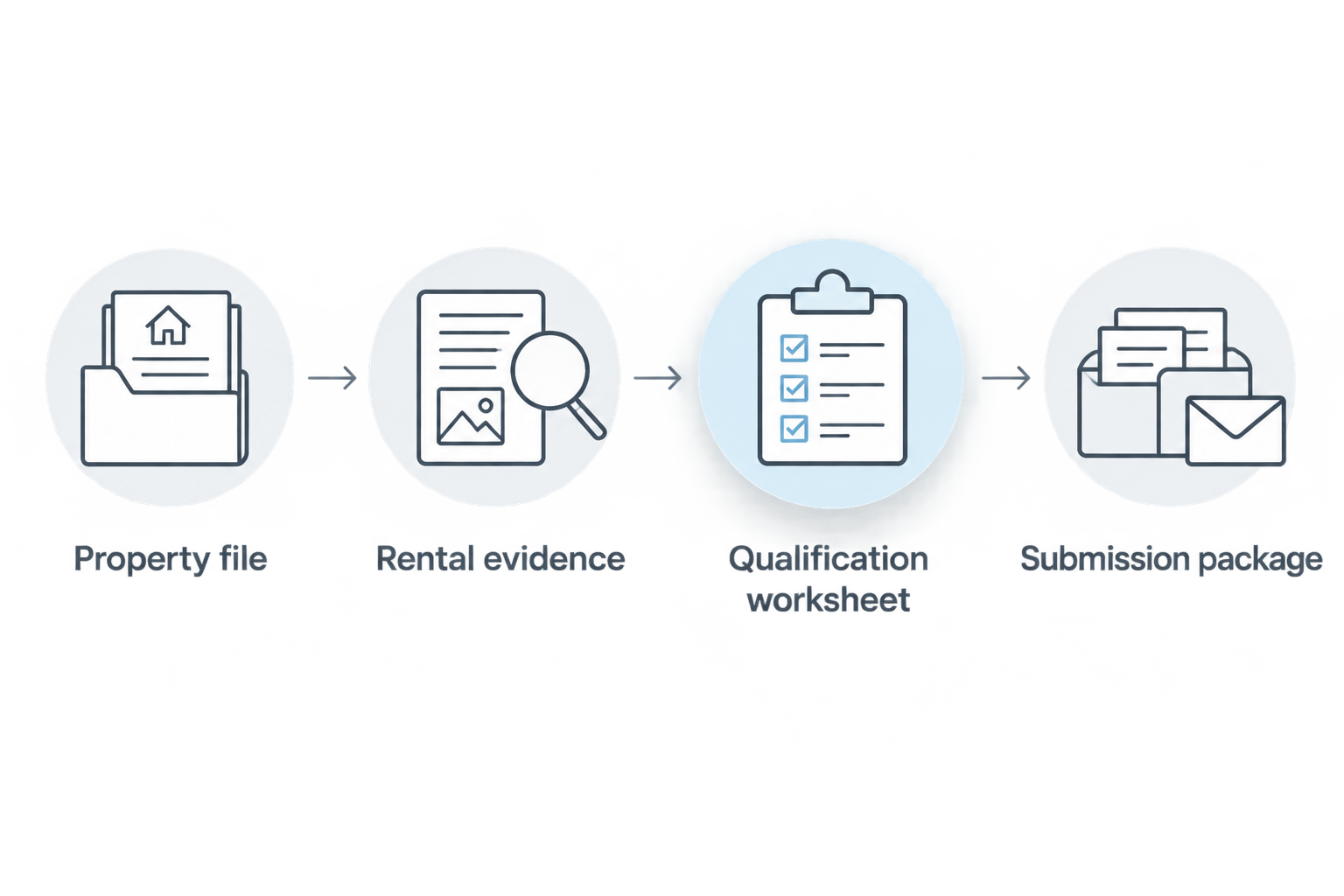
Confirm the income method before treating your worksheet as a qualification result.
For a program-specific assessment, contact Loanguys with the property type, rental arrangement, available history, and financing goal. Ask which records the proposed DSCR program requires before commissioning additional reports.
Update the file whenever a tenancy changes
Best for: existing furnished rentals preparing for a later purchase or refinance application. Updating records as tenants change preserves the connection between lease terms and collected income; the trade-off is ongoing record maintenance rather than a single application-time cleanup.
When a lease renews, a tenant leaves, or a payment changes, follow this shorter workflow:
- Save the signed amendment, replacement lease, or termination record without overwriting the earlier agreement.
- Update the ledger for the affected rental period and reconcile the associated receipt, refund, or unpaid balance.
- Preserve the prior worksheet as a dated version. Recalculate only after confirming whether the change affects the lender’s accepted income basis.
- Notify the loan contact if an application is already active. Do not leave a changed tenancy hidden behind an earlier summary.
Your 2026 renewal file should preserve the prior agreement as well as the new one. A reviewer needs to understand the transition, not just see the latest rent obligation.
Whether you use a spreadsheet or lease and rent management software, keep lease obligations separate from payment transactions. Software can organize the records; it does not determine which receipts qualify under a mortgage program.
Troubleshooting
The bank deposit does not equal the rent ledger
Check for combined payments, processing deductions, refunds, advance rent, and non-rent receipts. Attach the underlying transaction records and reconcile the difference explicitly; do not alter gross rent merely to match the deposit.
The lender will not use the advertised furnished rent
Ask which income method the program permits and which evidence supports it. If the program uses appraiser-supported rent or another defined basis, rebuild the worksheet around that basis rather than arguing from the listing alone.
The property has little or no collection history
Disclose the actual history and ask whether the program permits qualification using another documented rental basis. Do not extend a short occupied period into an annual income figure unless the lender expressly authorizes that treatment.
The preliminary DSCR differs from the lender’s calculation
Compare the numerator, denominator, and periods separately. Common points to check include accepted rent, housing-payment components, association dues, and treatment of the proposed payment structure.
The tenant name differs from the payer name
Document the relationship using the lease and available payment records, then request the lender’s evidence requirements. A matching amount alone does not explain who paid or which rental obligation the payment satisfies.
Customize your workflow
Expand the process by adding a separate property tab and reconciliation file for each additional rental. Consolidate portfolio totals only after the individual property records are complete.
For an entity-owned property, keep ownership documents and account names consistent with the proposed borrowing structure. Loanguys offers DSCR loan programs, but a particular property’s income acceptance and eligibility still require program review.
For your 2026 application, prioritize accepted income, documented ownership, and a complete evidence trail before optimizing the presentation. A polished spreadsheet cannot resolve an unsupported rental assumption.
FAQ
Can Furnished Finder income qualify me for a DSCR loan?
Furnished rental income can support a DSCR application when the lender accepts the rental arrangement and its documentation. The listing source alone does not establish qualifying income; confirm the program’s rent calculation and evidence requirements.
Does a Furnished Finder listing count as proof of rental income?
A listing alone does not prove collected rental income. Use the lender’s required evidence, which can include signed leases, matched payment records, bank statements, and rental analysis.
Do I need a direct Furnished Finder integration for this workflow?
No direct integration is necessary for this document workflow. Organize your signed agreements, rent ledger, and receiving-account records, then submit them through the lender’s designated channel.
Can I include security deposits in DSCR rental income?
Do not count refundable security deposits as earned rent in your ledger. Separate them from rent receipts and ask the lender how any applied or retained amounts must be documented.
What DSCR do I need for a furnished rental loan?
The required DSCR depends on the lending program. Obtain the current threshold, accepted income basis, and qualifying payment definition before assessing your property.
Can I qualify without a full rental history?
Qualification without a full rental history depends on the program’s permitted income methods. Ask whether the lender accepts appraiser-supported rent or another documented basis, and disclose the history you actually have.
Is the lender’s DSCR calculation the same as my cash flow?
The lender’s qualifying DSCR is not the same as your operating cash flow. Maintain a separate budget for vacancy, maintenance, utilities, management, and other ownership expenses.
One last thing
Preserve the difference between rent owed and rent received. Advance payments can make a bank statement look stronger without increasing the recurring rent obligation, while late payments can make a collection month look weaker without changing the lease. Keeping both views gives the lender an explainable file.


