


How much rental income do you need to qualify for a DSCR loan?

The rental income needed to qualify for a DSCR loan equals the lender’s qualifying monthly property payment multiplied by its required debt-service coverage ratio. There is no single dollar minimum that applies to every property or lender in 2026. The calculation depends on the rent the lender accepts and the payment components it includes, and it does not replace your separate budget for repairs, vacancy, and other ownership expenses.
TL;DR
- Rental income needed to qualify for a DSCR loan depends on accepted rent, qualifying payment, and the lender’s required ratio.
- At 1.00 times coverage, accepted rental income equals the qualifying payment; that does not establish a universal approval minimum.
- LoanGuys offers DSCR financing for real estate investors; confirm the applicable income calculation before relying on a rental projection.
- A qualifying DSCR is not the same as positive cash flow after maintenance, vacancy, and management expenses.
How much rental income do you need to qualify for a DSCR loan?
Required monthly rental income = qualifying monthly property payment × required DSCR. Ask the lender to identify both inputs before calculating your target. A rent estimate alone cannot tell you whether the property qualifies.
For a residential investment-property DSCR calculation, the qualifying payment commonly includes principal, interest, property taxes, insurance, and applicable association dues. Confirm the exact treatment for your program rather than using the mortgage’s principal-and-interest payment alone.
LoanGuys is a mortgage broker offering DSCR and other investment-property loan programs. LoanGuys DSCR financing is for real estate investors seeking qualification based on rental-property income. That approach makes the property’s accepted rent central to the calculation, but rent coverage is not the entire approval decision.
The following comparison explains the arithmetic, not any lender’s advertised qualification tiers:
1.00 times coverage
- Accepted rent relative to qualifying payment: Rent equals the payment
- What the calculation tells you: The calculation has no coverage cushion
- What it does not tell you: Whether the program accepts this ratio
1.20 times coverage
- Accepted rent relative to qualifying payment: Rent equals 120% of the payment
- What the calculation tells you: Rent exceeds the payment by 20%
- What it does not tell you: Whether all ownership expenses are covered
1.25 times coverage
- Accepted rent relative to qualifying payment: Rent equals 125% of the payment
- What the calculation tells you: Rent exceeds the payment by 25%
- What it does not tell you: Whether the borrower and property qualify
Why this matters
A property can collect rent and still fall short of a lender’s required coverage. The reverse also matters: a property can satisfy the lender’s ratio without producing the cash flow you want after operating expenses.
Keep those decisions separate. Use DSCR to assess the lender’s income test, then use a property budget to assess the investment. Neither calculation replaces the other.
For a 2026 purchase or refinance, work from current property expenses and the proposed financing structure. An older mortgage statement or a seller’s informal rent projection does not establish the payment or income your lender will use.
Coverage at 1.00 times: rent equals the qualifying payment
A DSCR of 1.00 times means accepted rental income equals the qualifying payment. Mathematically, the payment consumes all the income included in that calculation.
That is a useful reference point, not a blanket approval rule. Do not interpret break-even coverage as a promise that a lender will approve the loan.
The distinction becomes important when you budget for maintenance, tenant turnover, or management. If those expenses are outside the lender’s payment denominator, matching rent to that payment leaves nothing for them within the same income stream.
Best use: understanding the break-even point in the lender’s calculation. Limitation: break-even coverage does not demonstrate a sustainable operating cushion.
Coverage at 1.20 times: rent exceeds the payment by 20%
A DSCR of 1.20 times means accepted rental income equals 120% of the qualifying payment. The difference is 20% of the payment—not 20% of rental income.
That distinction prevents an easy budgeting mistake. A coverage cushion expressed against debt service is not the same as a profit margin expressed against revenue.
Use this ratio as an arithmetic illustration unless the lender confirms it as the applicable requirement. Nothing about a property reaching this number independently establishes approval.
Best use: understanding how a coverage cushion changes the income target. Limitation: the cushion still needs to be tested against expenses excluded from the lender’s calculation.
Coverage at 1.25 times: rent exceeds the payment by 25%
A DSCR of 1.25 times means accepted rental income equals 125% of the qualifying payment. Holding the payment constant, this ratio requires more accepted rent than 1.20 times coverage.
The formula also works backward. Divide accepted monthly rental income by the required ratio to calculate the maximum qualifying payment supported by that income under the stated assumptions.
Maximum qualifying payment = accepted monthly rental income ÷ required DSCR. This is a screening calculation, not a loan amount or an approval decision.
Best use: checking whether a proposed payment fits an established income target. Limitation: translating that payment into a loan amount requires the actual financing terms and property expenses.
Why the rental income requirement varies
The formula stays simple, but its inputs change. Review these factors before deciding that a property meets the income requirement:
- Accepted rent: The lender’s qualifying rent can differ from your advertised rent or expected collections. Establish which evidence controls the calculation.
- Payment components: Taxes, insurance, and applicable association dues affect coverage when included in the qualifying payment. Principal and interest alone can understate the denominator.
- Financing structure: Loan amount, repayment structure, and loan terms affect the payment against which rent is measured. Recalculate when the proposed structure changes.
- Rental strategy: A long-term lease and a short-term rental projection provide different kinds of income evidence. Confirm the program’s documentation method for the intended use.
- Property type: Do not assume a residential rental calculation applies unchanged to an apartment building or commercial property. Commercial DSCR commonly uses net operating income rather than gross residential rent.
- Program requirements: The lender determines the applicable coverage threshold and other eligibility conditions. A mathematical example is not a published program requirement.
Do not increase your assumed rent just to make the ratio pass. Resolve the income evidence or financing structure instead.
How do you calculate your property’s required rental income?
Build a short worksheet before making a financing decision. For a 2026 application, distinguish verified inputs from figures that still need lender confirmation.
- Confirm rent. Identify the income figure the lender will accept and the documents supporting it. Label an unsupported estimate as an estimate, not qualifying income.
- Confirm payment. Obtain the proposed qualifying payment with its included components. Check that the income and payment cover the same period.
- Confirm ratio. Ask for the required DSCR for your property and transaction. Do not substitute an online example for the applicable requirement.
- Calculate coverage. Divide accepted rent by the qualifying payment, or multiply the payment by the required ratio to find the income target.
- Check cash flow. Prepare a separate budget that includes expenses outside the qualifying payment. Decide whether the remaining cash flow supports your investment plan.
The order matters. A precise calculation with unconfirmed inputs produces an unconfirmed answer.
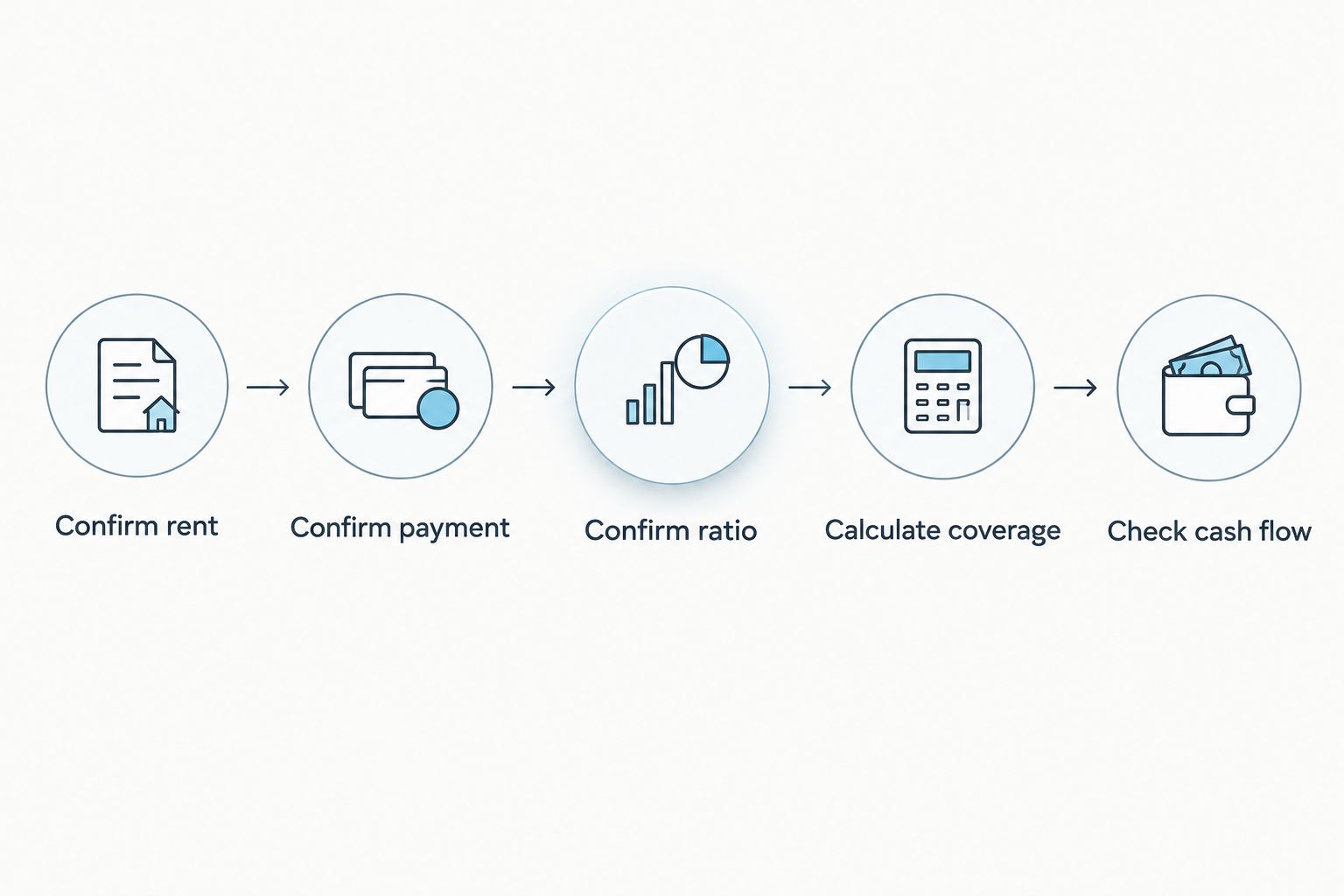
Confirm the lender’s inputs before treating a coverage calculation as a qualification result.
Keep the worksheet with your financing documents. If the rent, insurance, taxes, or proposed payment changes, update the calculation rather than relying on the earlier result.
What should you ask the mortgage broker?
Ask for an explanation you can reproduce yourself. A useful financing discussion answers these questions plainly:
- Which rental-income figure will underwriting use?
- What evidence supports that figure?
- Which expenses are included in the qualifying payment?
- What DSCR requirement applies to this transaction?
- What borrower or property conditions remain after the income test?
LoanGuys offers DSCR, fix-and-flip, bridge, bank-statement, and short-term rental loan programs. The advantage of discussing the transaction with a broker is identifying the financing category that matches the project; the limitation is that a program category alone does not establish eligibility or terms.
Discuss your rental-property financing
Ask which rent evidence, payment components, and coverage requirement apply to your transaction.
Can I qualify if my rental income only covers the payment?
1.00 times coverage means accepted rent exactly covers the qualifying payment, but approval depends on the program’s actual threshold and remaining requirements. Treat this as a break-even calculation, not confirmation that the property qualifies.
Also check expenses excluded from that payment. A property that breaks even on the lending calculation still needs a way to fund repairs and vacancy.
Does a higher DSCR mean the rental will be profitable?
1.25 times coverage means rent equals 125% of the qualifying payment, not that the property earns a 25% profit margin. Profitability depends on the full expense budget and the income you actually collect.
Separate the underwriting worksheet from the operating forecast. The first tests a lending requirement; the second tests whether the investment works for you.
How do I find the highest payment my rental income supports?
1.20 times coverage requires dividing accepted rent by 1.20 to find the supported qualifying payment, if that is the lender’s confirmed requirement. Use the resulting payment ceiling to evaluate the proposed financing, not to infer a guaranteed loan amount.
The calculation changes when the accepted rent or required ratio changes. Keep both inputs visible in your worksheet.
What documentation should you prepare?
Prepare evidence that explains both sides of the ratio. For a 2026 review, request the lender’s current checklist before paying for reports or assuming existing documents will satisfy underwriting.
Rental-income evidence
Gather the available lease, rent roll, and records supporting the property’s rental income. For a vacant property or a short-term rental, ask which appraisal-based income analysis, operating history, or projections the program accepts.
The purpose is not to submit the largest possible income figure. It is to establish a figure underwriting can use.
Property-payment evidence
Collect property-tax information, insurance details, and association dues where applicable. Pair those records with the proposed financing payment rather than assuming the seller’s current mortgage represents your future obligation.
Check for inconsistencies before submitting the file. An annual expense entered as a monthly expense—or the reverse—changes the result even when the underlying document is correct.
Borrower and transaction evidence
DSCR qualification focuses on property income, but the loan still involves borrower, collateral, and transaction review. Ask what credit, asset, ownership, and property documents are required for your application.
A rent calculation is a screening tool, not a substitute for underwriting. Confirm outstanding conditions before treating the financing as settled.
FAQ
What is the rental income needed to qualify for a DSCR loan in 2026?
The rental income needed to qualify for a DSCR loan equals the qualifying property payment multiplied by the lender’s required DSCR. Confirm the accepted rent, payment components, and applicable ratio before calculating your target.
Does a DSCR of 1.00 mean I qualify?
A DSCR of 1.00 means accepted rent equals the qualifying payment; it does not automatically mean you qualify. The lender’s coverage threshold and other underwriting requirements still apply.
Do I use gross rent or net income for a DSCR loan?
Use the income definition required by the specific loan program. Residential rental DSCR calculations commonly compare qualifying rent with a housing payment, while commercial calculations commonly compare net operating income with debt service.
Can projected rent count if the property is vacant?
Projected rent counts only when the applicable program accepts that income evidence. Ask which appraisal-based rental analysis or other documentation is required before relying on the projection.
Are taxes and insurance included in the DSCR payment?
Taxes and insurance commonly form part of the qualifying payment for residential rental DSCR loans. Confirm association dues and any other included components so you do not calculate coverage using principal and interest alone.
Does short-term rental revenue count the same as long-term rent?
Do not assume short-term rental revenue receives the same treatment as long-term lease income. Confirm the accepted documentation and calculation method for the property’s intended rental use.
Can a larger down payment help my DSCR?
A larger down payment improves DSCR when it reduces the qualifying payment while accepted rent remains unchanged. It does not remove the need to meet the program’s other requirements.
Does LoanGuys offer DSCR loans for rental-property investors?
LoanGuys offers DSCR loan programs for real estate investors. Ask which income documentation and coverage requirement apply to your property and transaction.
One last thing
The most useful number is the lender’s accepted rent—not the rent needed to make your spreadsheet work. Start there, confirm the qualifying payment, and calculate the ratio without adjusting assumptions to force a pass.
For your 2026 financing discussion, bring both the lender-qualification worksheet and your operating budget. A property needs to satisfy the financing requirements and your investment standards; passing either test alone is not enough.


