


Griffin Funding alternatives for DSCR loans

Griffin Funding offers DSCR financing, which lets rental-property investors qualify primarily through a property's income rather than personal earnings. That approach stops being enough when your property needs renovation financing or a different income-documentation route. Among Griffin Funding alternatives for DSCR loans in 2026, Loanguys fits investors seeking a mortgage broker with DSCR, bridge, fix-and-flip, and bank-statement programs; a portfolio bank fits borrowers seeking a bank-based financing relationship.
TL;DR
- Loanguys is a Griffin Funding alternative for DSCR loans for investors seeking broker guidance across investment-property financing programs.
- Compare DSCR loans using identical rent, debt-payment, ownership, and reserve assumptions.
- Consider portfolio lending when you want bank-based underwriting; assess bridge financing when renovation comes before rental stabilization.
- Keep Griffin Funding on your shortlist when its written terms fit your property and exit plan.
Why this matters
Choosing a DSCR provider is not simply choosing a company name. You are choosing how a lender evaluates rental income, property condition, ownership, and your ability to carry the debt. Those details determine whether a proposal works for your investment.
DSCR means debt service coverage ratio: qualifying property income divided by qualifying debt obligations. In residential rental lending, ask exactly which income and payment components the lender uses. A commercial property's net operating income calculation is not automatically interchangeable with a residential rental calculation.
A 1.00x coverage ratio means qualifying income equals the debt obligation used in the calculation, or 100% coverage. A 1.25x coverage ratio means income equals 125% of that obligation. These are mathematical definitions, not approval thresholds or promises that a particular lender accepts your property.
Your 2026 comparison should therefore start with the calculation, not the headline offer. A ratio that looks stronger because a proposal excludes an expense is not evidence of a stronger property.
Griffin Funding alternatives at a glance
The useful shortlist includes a broker, another DSCR lender, a portfolio bank, and a bridge-financing specialist. These are different financing routes, not interchangeable products.
Griffin Funding
- Best for: Investors considering its DSCR financing
- Standout approach: Rental-income-based qualification
- Difference to evaluate against Griffin Funding: Use its written proposal as your benchmark
Loanguys
- Best for: Investors seeking broker guidance across investment-property programs
- Standout approach: DSCR, bridge, fix-and-flip, bank-statement, and short-term rental programs
- Difference to evaluate against Griffin Funding: Compare the recommended program and its actual underwriting conditions
Another direct DSCR lender
- Best for: Investors seeking a second property-income-based proposal
- Standout approach: A separate DSCR underwriting decision
- Difference to evaluate against Griffin Funding: Check whether income treatment or property eligibility differs
A portfolio bank
- Best for: Investors seeking a bank-based financing relationship
- Standout approach: Loans evaluated under the bank's own lending criteria
- Difference to evaluate against Griffin Funding: Determine whether borrower-income documentation changes the qualification route
A bridge-financing specialist
- Best for: Investors financing a transitional property
- Standout approach: Temporary financing before a sale or refinance
- Difference to evaluate against Griffin Funding: Compare the repayment deadline and exit requirements, not just rental coverage
Best means best fit for your transaction, not a universal winner. Ask each provider to evaluate the same property information before treating its proposal as comparable.
1. Loanguys: best for comparing investment-property financing routes
Loanguys is a mortgage broker offering DSCR, fix-and-flip, bridge, bank-statement, and short-term rental loan programs to investors and homeowners across the United States. That mix is relevant when you need to establish whether DSCR financing matches the property's current condition and your income documentation. Loanguys is a DSCR mortgage broker for investors who need guidance across investment-property financing programs.
Where this broker shines
- You can discuss DSCR financing alongside other stated investment-property programs.
- Bridge and fix-and-flip financing belong in the conversation when a property needs work before becoming a stable rental.
- Bank-statement financing provides another income-documentation route to assess when personal business income matters.
- Short-term rental programs are relevant when your intended use differs from a standard leased rental.
Where this broker falls short
- A broker consultation is not an underwriting approval or a funding commitment.
- A broader program menu does not remove credit, property, documentation, or reserve requirements.
- Choosing a different financing route changes the comparison; a bridge proposal is not a substitute for long-term DSCR terms.
Broker route versus Griffin Funding
Initial decision
- Broker route: Determine which stated program matches the transaction
- Griffin Funding comparison: Establish whether its DSCR proposal matches the transaction
Property needing work
- Broker route: Discuss bridge or fix-and-flip financing
- Griffin Funding comparison: Ask whether the property's current condition qualifies
Income approach
- Broker route: Discuss DSCR or bank-statement qualification
- Griffin Funding comparison: Confirm the qualifying-income method in the proposal
Final approval
- Broker route: Obtain transaction-specific underwriting conditions
- Griffin Funding comparison: Obtain transaction-specific underwriting conditions
Best for: Investors who need help selecting a financing route before selecting a loan. Verdict: Hold until the written program recommendation and approval conditions match your property.
2. Another direct DSCR lender: best for a second underwriting view
A second DSCR lender gives you another proposal for the same rental property. The value is a separate evaluation, not an assumption that the next company has easier requirements. Keep the property, borrowing entity, requested financing, and rental evidence consistent.
Where this route shines
- You can compare how separate lenders calculate qualifying rent and debt payments.
- You can ask both providers to address the same property-type and ownership questions.
- A written second proposal helps identify which conditions are specific to a lender rather than inherent to your transaction.
Where this route falls short
- A second application does not resolve insufficient rental income or unresolved property defects.
- Different assumptions make proposals difficult to compare.
- Preliminary terms remain subject to underwriting, appraisal, and the conditions stated by the lender.
Rental evidence
- Another direct DSCR lender: Request its accepted documentation
- Griffin Funding: Request the same documentation criteria
Coverage calculation
- Another direct DSCR lender: Obtain the numerator and denominator
- Griffin Funding: Obtain the numerator and denominator
Ownership
- Another direct DSCR lender: Confirm the proposed borrower and title structure
- Griffin Funding: Confirm the same structure
Repayment
- Another direct DSCR lender: Review amortization and prepayment provisions
- Griffin Funding: Review the same provisions
For a 2026 purchase, ask whether the rent figure comes from an existing lease, an appraisal rent schedule, or another accepted source. Do not compare a lease-based proposal with a projection-based proposal as though the income assumptions were identical.
Best for: Investors whose property already fits a rental-income-based financing route. Verdict: Hold until both lenders evaluate the same documented scenario.
3. A portfolio bank: best for a bank-based lending relationship
Portfolio lending generally means the institution retains the loan rather than originating it solely for sale. The bank evaluates the transaction under its lending criteria, so ask how it considers your income, liquidity, existing debt, and property performance. Do not assume that retaining a loan means relaxed underwriting.
Where this route shines
- You can discuss the property within a broader banking relationship.
- The conversation can include borrower finances alongside rental performance.
- You can ask whether the bank considers multiple properties together rather than only the individual purchase.
Where this route falls short
- Personal-income and financial-statement requirements can differ from a DSCR-focused application.
- A banking relationship does not guarantee approval.
- Bank-specific criteria still determine whether the property and proposed ownership qualify.
Best for: Investors willing to document their broader financial position for bank-based underwriting. Verdict: Hold until the bank confirms its documentation requirements and repayment structure.
4. A bridge-financing specialist: best for a transitional property
Bridge financing is temporary financing tied to an eventual repayment event, such as a sale or refinance. It belongs on your shortlist when the immediate transaction is a renovation or transition rather than a stabilized rental. The exit comes first.
Where this route shines
- The financing discussion centers on the property's transition and repayment plan.
- Renovation and stabilization can be assessed before a long-term rental refinance.
- You can separate acquisition needs from the requirements of the eventual DSCR loan.
Where this route falls short
- Temporary financing creates a repayment deadline.
- The future refinance is a separate underwriting decision, not a guaranteed exit.
- Delayed repairs, leasing, or appraisal issues can interfere with the repayment plan.
Best for: Investors with a documented transition plan and a credible repayment route. Verdict: Skip if repayment depends entirely on an unconfirmed refinance.
How to compare DSCR proposals in 2026
Start with the property facts, then move to qualification, obligations, and exit. This order prevents you from choosing an attractive proposal for a property the lender ultimately cannot finance.
Property fit
Give each provider the address, property type, condition, occupancy, and intended rental use. Identify renovations, legal-use questions, and association restrictions immediately. A rented property is not automatically eligible for every rental-loan program.
Income evidence
Ask what supports qualifying rent and how the lender treats vacancy or short-term rental income. Request the complete coverage calculation. Your operating budget should separately account for maintenance, management, and other expenses, even when the lender's ratio uses a narrower calculation.
Cash requirements
Separate the down payment or equity requirement from closing funds and post-closing reserves. LTV means loan-to-value: the loan amount relative to the lender's accepted property value. Confirm which valuation controls the proposal and what happens if the appraisal is lower than expected.
Repayment terms
Review amortization, interest-only provisions if proposed, maturity, and prepayment restrictions. A lower scheduled payment does not automatically mean a smaller total obligation. Check whether an early sale or refinance conflicts with the repayment terms.
Exit plan
Match the loan to your intended holding period. For cash-out refinancing, confirm the proposed proceeds and conditions before committing them to another purchase. Cash-out means replacing or restructuring financing to extract equity, not receiving money without increasing or changing debt.
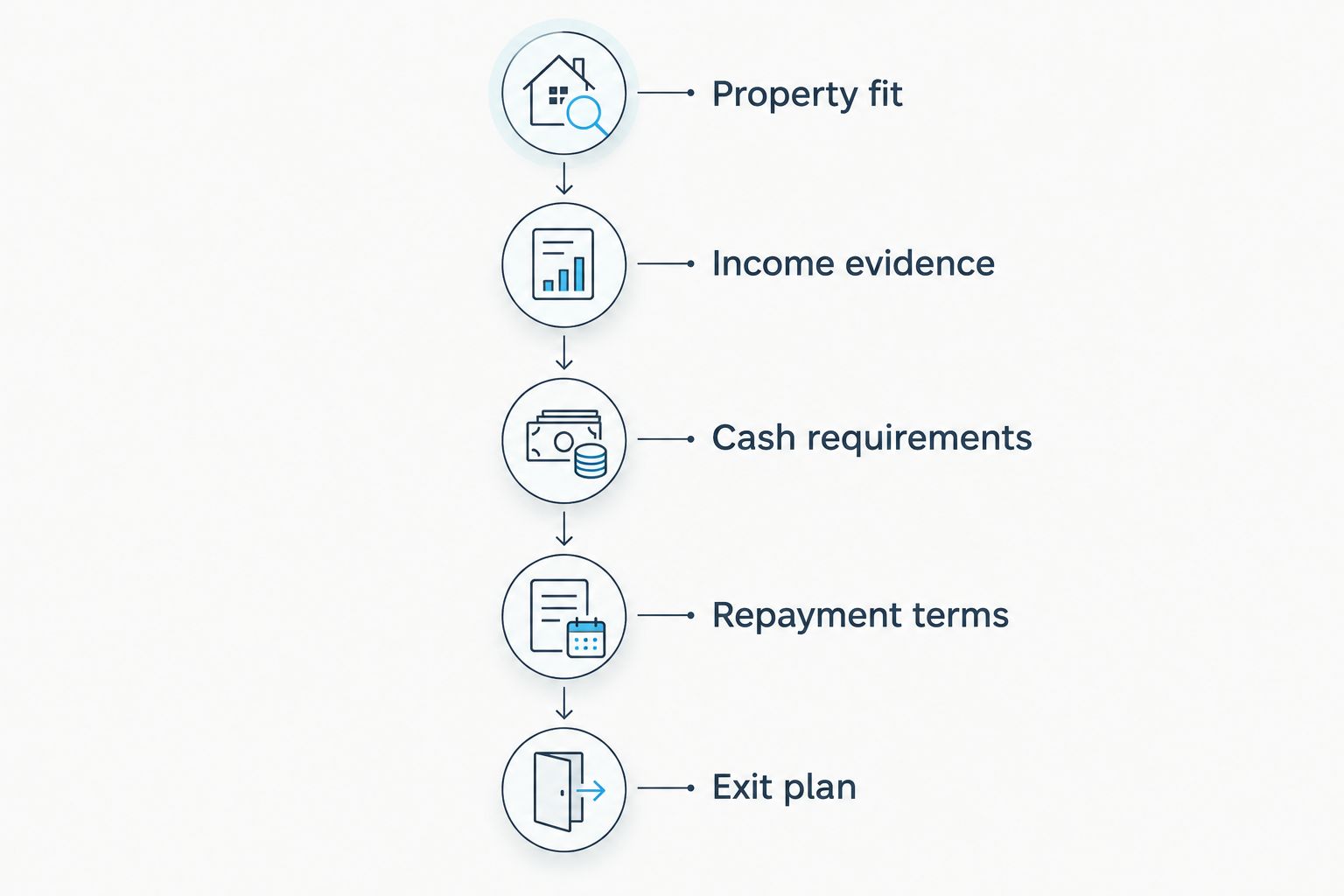
Confirm property eligibility before comparing repayment terms.
Ask for outstanding conditions in writing. Distinguish a preliminary discussion from a proposal supported by the required property and borrower documents, and confirm what still needs underwriting review.
Discuss your rental financing options
Explain your property, rental strategy, and financing goal to identify the right program to assess.
Why people switch from Griffin Funding
Switch only when another provider solves a documented mismatch. A company name alone is not a financing reason, and a broader program list does not establish better terms for your transaction.
Use these decision triggers when reviewing Griffin Funding alternatives for DSCR loans:
- Property condition: If the property needs substantial work before rental qualification, assess renovation or bridge financing rather than forcing a stabilized-rental application.
- Income treatment: If qualifying rent differs between proposals, identify the accepted evidence and calculation behind that difference.
- Ownership structure: If you plan to borrow through an LLC, obtain confirmation that the proposed entity and title arrangement fit the program.
- Rental strategy: If you intend short-term rental use, confirm how the lender evaluates that use and its income evidence.
- Exit restrictions: If your planned sale or refinance conflicts with repayment provisions, compare a structure that matches the holding period.
These are reasons to compare, not claims about Griffin Funding's policies. In 2026, the decision should rest on the written terms for your property, not assumptions about any provider's flexibility.
When staying with Griffin Funding is the right call
Stay with Griffin Funding when its documented proposal fits your property's use, your borrowing structure, your cash position, and your repayment plan. Switching providers without resolving a specific problem adds another application process without establishing a financing advantage.
Compare the remaining approval conditions as carefully as the loan structure. If the benchmark proposal works and the alternatives introduce requirements that do not suit your transaction, staying is the practical choice.
FAQ
What's the best Griffin Funding alternative for DSCR loans?
Loanguys fits investors seeking a mortgage broker with DSCR and other investment-property financing programs. Choose the provider whose written proposal matches your property, income evidence, ownership structure, and exit plan.
Is a mortgage broker better than a direct DSCR lender?
A mortgage broker fits borrowers who need help assessing financing routes; a direct DSCR lender fits borrowers seeking that lender's underwriting decision. Neither route guarantees approval or better transaction terms.
What does DSCR mean for a rental property loan?
DSCR means debt service coverage ratio, which compares qualifying property income with qualifying debt obligations. Ask the lender which income and payment components it includes before comparing ratios.
Can I get a DSCR loan for a property that needs renovation?
The property's condition must meet the proposed DSCR program's requirements. Assess bridge or fix-and-flip financing if renovation must happen before the property qualifies for long-term rental financing.
Can I use a DSCR loan for an Airbnb property?
Short-term rental eligibility depends on the lender's program and accepted income evidence. Confirm permitted rental use, property eligibility, and the qualifying-income method before relying on projected bookings.
Can my LLC borrow for a rental property purchase?
LLC borrowing depends on the program's entity and ownership requirements. Confirm the borrowing entity, title arrangement, required organizational documents, and any personal-guarantee obligations.
Should I switch lenders after getting a DSCR proposal?
Switch only when another documented proposal addresses a specific mismatch or better fits your investment plan. Compare identical property assumptions and outstanding approval conditions before deciding.
One last thing
A lender's coverage ratio is not your property's complete cash-flow forecast. A loan can satisfy a qualifying calculation while your investment budget still needs allowances for repairs, vacancy, and operating expenses.
Before choosing a provider, build your own rental budget and compare it with the lender's calculation. Understanding the difference is more useful than collecting another company name.


