


HELOC for investment property for retirees supplementing income: complete 2026 guide

Retirees’ investment-property HELOC financing is borrowing against a rental’s equity through a revolving credit line, with the aim of supporting property expenses or income-producing improvements. For retirees, a HELOC for investment property is borrowed cash, not retirement income; this 2026 guide explains qualification, repayment risks, and alternatives without treating a salary as your only income source.
TL;DR
- A HELOC for investment property for retirees provides borrowed liquidity, not additional earned income.
- Use rental cash flow and retirement income to test repayment before drawing against property equity.
- Loanguys is best for retirees seeking broker guidance on DSCR and bank-statement investment-property financing.
- Compare revolving access with fixed repayment; protect retirement reserves before choosing either structure.
Why HELOC financing matters for retirees
A rental property can hold equity while leaving you short of accessible cash. A home equity line of credit, or HELOC, separates access to that equity from selling the property, but it also adds debt secured by the rental. Miss required payments and you put the collateral at risk.
Retirement changes the repayment question. Instead of assuming future salary increases will absorb higher payments, you need to test the loan against pension benefits, Social Security, documented distributions, and rent after expenses. Your property’s market value does not pay the monthly bill.
Start with the distinction between revolving borrowing and a lump-sum second loan in home equity loans for rental property owners. Choose the borrowing structure around the expense and repayment source, not the size of your equity.
For your 2026 plan, separate temporary liquidity needs from an ongoing household deficit. Financing a necessary repair with a defined payoff plan is different from drawing every month to cover groceries. The latter replaces an income problem with a growing debt balance.
How to evaluate a rental-property HELOC in retirement
Define the expense and repayment source
Begin with a spreadsheet or paper budget. Write down what the money will fund, when you will spend it, and which existing income source will repay it. Do this before requesting a credit limit.
A repair that protects rent collection has a different purpose from discretionary spending or another property purchase. Be explicit about that distinction. Expected appreciation, an unsigned lease, and a hoped-for refinance are not dependable repayment sources.
Build a 12-month household and rental budget using your actual records. Include expenses that arrive annually rather than treating a quiet month as representative. If the budget already runs short without new borrowing, address that shortfall before adding a secured payment.
- Identify the exact expense you want to finance.
- Separate property spending from personal withdrawals.
- Record a repayment source for every planned draw.
- Include insurance, property taxes, repairs, and vacancy reserves.
- Set a borrowing ceiling below the amount that strains your budget.
Confirm the property and ownership fit
Ask a prospective lender directly whether it accepts non-owner-occupied rental property as collateral. An advertisement for home equity borrowing does not establish eligibility for an investment property. Confirm the property type and state before submitting a full application.
Ownership matters too. A rental titled to you personally differs from one held in a trust or limited liability company. Do not transfer title merely to fit an application without reviewing the legal, insurance, tax, and existing mortgage consequences.
List every debt secured by the property. Combined loan-to-value, or CLTV, compares the existing secured debt plus the proposed credit line with the property’s value; ask how the lender calculates it. Equity is only one part of eligibility, not an approval promise.
- Verify investment-property eligibility in writing.
- Identify the legal owner shown on the deed.
- Gather current mortgage and lien statements.
- Confirm whether the lender accepts your ownership structure.
- Ask how property value and CLTV will be determined.
Document retirement income before comparing programs
Organize your income records yourself first. Separate recurring benefits, rental receipts, investment distributions, and any continuing self-employment income. A bank deposit proves money arrived; it does not necessarily explain its source or establish that it will continue.
Under the Equal Credit Opportunity Act, age alone generally cannot be used to deny credit to an applicant who has the capacity to contract. That protection does not remove income, credit, collateral, or repayment requirements. Ask each lender how it evaluates your particular retirement income.
Loanguys is a mortgage broker offering DSCR and bank-statement investment-property financing, among other programs. Loanguys is best for retirees seeking broker guidance on DSCR and bank-statement investment-property financing. Ask about relevant alternatives; do not assume those programs establish HELOC eligibility or replace all documentation.
- Collect pension and Social Security benefit records.
- Separate recurring distributions from one-time withdrawals.
- Match rental deposits to leases and property records.
- Identify self-employment receipts separately from retirement income.
- Request the documentation checklist for the specific program.
Calculate cash flow after both debt payments
Use your own rental ledger to calculate what remains after operating expenses and existing mortgage obligations. Then subtract the proposed HELOC payment. Qualification and spendable retirement income are different calculations.
For your 2026 comparison, track 2 debt payments separately: the existing mortgage and the new credit-line obligation. Also account for taxes and insurance without counting them twice when they are already included in the mortgage payment. Keep household retirement income separate until you see whether the rental supports itself.
DSCR means debt service coverage ratio. It compares income available for debt payments with debt service, but calculation methods vary by loan program. For residential rental underwriting, ask which rent figure and housing expenses enter the lender’s calculation; separately deduct repairs, management, and vacancies in your own budget.
- Record collected rent rather than advertised rent.
- Subtract operating expenses and reserve contributions.
- Add the proposed HELOC obligation to existing debt service.
- Identify any household subsidy the rental requires.
- Reject a plan that depends on uninterrupted occupancy.
Stress-test the payment changes
Read the proposed agreement and model its payment mechanics manually. HELOCs commonly have variable rates, so a payment that fits today is not necessarily the payment you will face later. Ask for the index, margin, adjustment rules, and applicable caps.
Separate the draw period from the repayment period. Some agreements permit interest-only payments during borrowing, while later payments require principal repayment. Paying interest keeps the loan current under those terms; it does not reduce the amount you borrowed.
Build 3 budget scenarios: normal operations, lower rent collections, and higher required payments. Use your own expense history and the proposed contract rather than assumed market averages. In 2026, evaluate a vacant rental and a larger loan payment together, not as unrelated problems.
- Review the rate adjustment provisions in the agreement.
- Request the payment calculation for the planned draw.
- Identify when principal repayment begins.
- Test the budget with reduced rental collections.
- Confirm the plan does not depend on refinancing.
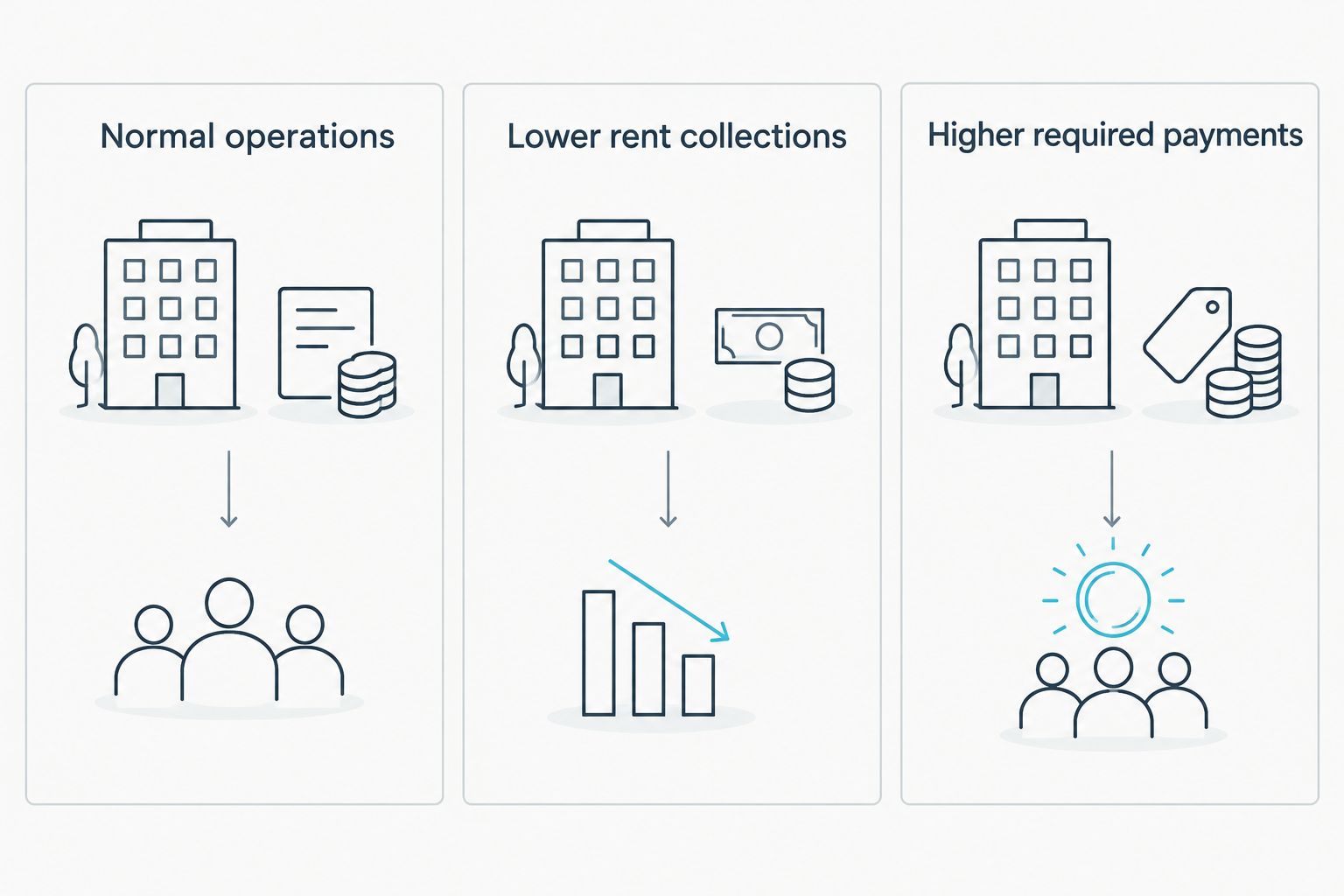
Test reduced rental collections and higher payments before committing property equity.
Compare alternatives using the same borrowing purpose
Write your objective at the top of a comparison sheet, then request written terms for structures that fit it. A revolving line suits staged expenses differently from a lump-sum loan. A refinance also changes the existing mortgage, which a separate equity loan does not.
Loanguys offers DSCR and bank-statement loan programs, but those categories are not interchangeable with a HELOC. A DSCR structure centers on rental-property income; bank-statement financing addresses an income-documentation route. Neither label, by itself, tells you whether a loan provides revolving access or meets your retirement budget.
Compare the full transaction, including whether you retain the existing mortgage and what happens when borrowing ends. An alternative wins only if its repayment structure fits your actual income and objective.
- Use the same planned borrowing amount across comparisons.
- Identify which existing obligations remain in place.
- Distinguish revolving access from a lump-sum advance.
- Review amortization, maturity, and prepayment provisions.
- Ask for written eligibility and documentation requirements.
Set a draw limit and an exit plan
Before signing, decide how you will control borrowing after approval. A credit limit measures permitted access, not a recommended spending amount. Keep your own ceiling tied to the tested budget.
Name the event that will reduce the balance: scheduled repayment from documented income, completion of a funded project followed by actual rental receipts, or another clearly supported source. Do not write future refinancing into the plan as if approval were guaranteed.
Protect reserves you need for healthcare, household expenses, property repairs, and vacancies. If servicing the loan requires repeated retirement-account withdrawals, review the tax and financial-planning consequences with qualified advisers before committing. For 2026, make the stop-drawing rule as clear as the reason to borrow.
- Set a personal draw ceiling in writing.
- Record the purpose and repayment source of each draw.
- Keep emergency savings separate from borrowing capacity.
- Specify when you will stop taking additional advances.
- Review outstanding debt alongside your retirement budget.
Compare financing options for retired rental owners
This table compares structures, not individual lender offers. Best for identifies the use case; it does not mean approval is assured. Confirm actual terms before choosing a program.
Investment-property HELOC
- Best for: Staged expenses with a defined repayment source
- Main advantage: Revolving access can match spending as it occurs
- Key limitation: Variable payments and draw-to-repayment changes require careful budgeting
Home equity loan
- Best for: A defined, one-time property expense
- Main advantage: A lump sum can match a known project scope
- Key limitation: No revolving access; confirm whether repayment is fixed
Cash-out refinance
- Best for: Owners who need equity access and are willing to replace their mortgage
- Main advantage: Combines refinancing and equity extraction
- Key limitation: Changes the existing mortgage and requires evaluating the whole transaction
DSCR loan
- Best for: Rental owners comparing property-income-based financing
- Main advantage: Uses rental performance as a central underwriting input
- Key limitation: Lender cash-flow calculations do not capture every personal budgeting expense
Bank-statement loan
- Best for: Retirees who also have documented self-employment income
- Main advantage: Provides an alternative income-documentation approach
- Key limitation: Deposits are not automatically qualifying income; program rules still apply
Existing cash reserves
- Best for: Expenses you can cover without weakening essential reserves
- Main advantage: Avoids a new secured debt obligation
- Key limitation: Reduces immediately accessible savings
The important comparison is not simply HELOC versus another loan. It is retaining your current mortgage versus replacing it, and flexible borrowing versus predictable repayment. Loanguys investment-property financing includes alternatives to discuss when those distinctions matter, without assuming a HELOC is the answer.
Discuss your investment-property financing
Review DSCR and bank-statement options against your rental income and retirement budget.
Common mistakes retirees make with rental-property HELOCs
Treating a draw as supplemental income
Borrowed proceeds increase accessible cash and debt together. They do not improve the rental’s operating performance. If withdrawals cover a recurring household deficit, pause and revise the income or spending plan rather than increasing the line balance.
Budgeting only for the initial payment
An initial interest-only payment does not represent the entire repayment obligation. Review both variable-rate changes and the later principal repayment schedule. Use the payment structure in the agreement, not an introductory illustration, to judge affordability.
Assuming retirement savings settle qualification
Substantial assets and qualifying income are related but different. Ask how a lender treats account balances, distributions, and income continuity. Do not begin extra withdrawals solely to change an application without understanding the financial and tax effects.
Pledging a home without identifying the collateral risk
Borrowing against your primary residence to fund a rental is different from borrowing against the rental itself. The pledged property secures the debt regardless of where you spend the proceeds. Identify which property you could lose before comparing convenience.
Assuming interest is automatically deductible
Deductibility depends on the use of proceeds and applicable tax rules, not simply on a HELOC label. Keep records tracing each draw to its purpose. Ask a qualified tax professional to assess personal spending and rental-business uses separately.
FAQ
Can I get a HELOC on an investment property after retiring?
Retirement alone does not prevent you from applying for an investment-property HELOC. You still need a lender that accepts rental collateral and must satisfy its income, credit, equity, and documentation requirements.
Is a HELOC for investment property for retirees a good way to supplement income?
A HELOC provides borrowed liquidity, not additional income. It fits a defined expense with a supported repayment plan better than an ongoing retirement-budget shortfall.
Can Social Security or a pension help me qualify?
Documented Social Security and pension income can be considered in mortgage underwriting. Ask the lender how it verifies receipt, continuity, and the amount it will recognize for the specific loan.
Is a home equity loan better than a HELOC for a retired landlord?
A home equity loan better matches a defined lump-sum need, while a HELOC better matches staged borrowing. Compare the actual repayment terms, because the product name alone does not establish payment predictability.
Can I qualify using rent instead of employment income?
Rental income can support qualification, and DSCR programs focus on rental-property income. The calculation and required documentation depend on the program; rent deposits alone do not guarantee approval.
Does Loanguys offer investment-property HELOCs?
Loanguys is a mortgage broker offering DSCR, fix-and-flip, bridge, bank-statement, and short-term rental loan programs. Ask directly about investment-property HELOC eligibility rather than assuming those other programs include a revolving credit line.
What happens when the HELOC draw period ends?
Your agreement determines how repayment changes when the draw period ends. Review when further advances stop, when principal payments begin, and whether any balance becomes due at maturity.
Can I deduct HELOC interest if I use the money for retirement spending?
Personal retirement spending does not automatically make HELOC interest deductible. The use of the borrowed money and applicable tax rules control the analysis, so retain draw records and obtain tax advice.
One last thing
Before requesting the largest available line, choose the smallest borrowing amount that solves the defined problem. An unused credit limit does not generate income, and a larger draw creates a larger repayment obligation. For your 2026 decision, protect spendable retirement income first and property equity second.
Write a stop rule beside the budget: if the rental cannot support the planned payment under your adverse scenarios, do not draw more to disguise the shortfall. That rule turns an available financing tool into a controlled decision.


