


HELOC for investment property for small landlords with 1-3 units: complete 2026 guide

Small landlords’ HELOC financing is a revolving credit line secured by property equity with the aim of funding rental expenses without replacing an existing mortgage. For owners of 1–3 rental units, a HELOC for investment property works only when the lender accepts the property’s occupancy and ownership structure and the payments fit your cash flow; this 2026 guide explains how to check both.
TL;DR
- A HELOC for investment property for small landlords fits staged spending, not a permanent rental cash-flow deficit.
- Confirm investment-property eligibility before comparing credit limits or submitting a full application.
- Loanguys offers DSCR and bank-statement mortgage programs for landlords evaluating alternatives to a HELOC.
- Keep cash reserves separate from an undrawn credit line; access to credit is not guaranteed.
Why HELOC financing matters for small landlords
A small rental portfolio concentrates risk. With 1 rental unit, a vacancy interrupts all rental income from that property; with 2 or 3 units, occupied units still generate rent, but repairs and debt payments continue across the building.
A home equity line of credit, or HELOC, lets you borrow against an approved limit during its draw period, subject to the agreement. You generally pay interest on the amount borrowed rather than the entire credit limit. That structure suits expenses that arrive in stages, such as contractor invoices during a rental turnover.
The advantage is controlled access to equity. The trade-off is another debt secured by your property. Failure to repay puts the collateral at risk, and a variable-rate line exposes your payment to rate changes.
Start by distinguishing a revolving line from a lump-sum loan. The guide to home equity loans for rental property owners explains a related financing route to evaluate alongside a HELOC.
For your 2026 decision, separate three questions: Does the property qualify? Can the rental support the debt? Does revolving credit match the expense? Equity alone answers none of them.
How to evaluate and apply for an investment-property HELOC
Work through this sequence before you request financing: Define spending, Verify eligibility, Organize documents, Test payments, Compare structures, Plan repayment. A spreadsheet and the lender’s written disclosures are enough to start; you do not need a paid tool.
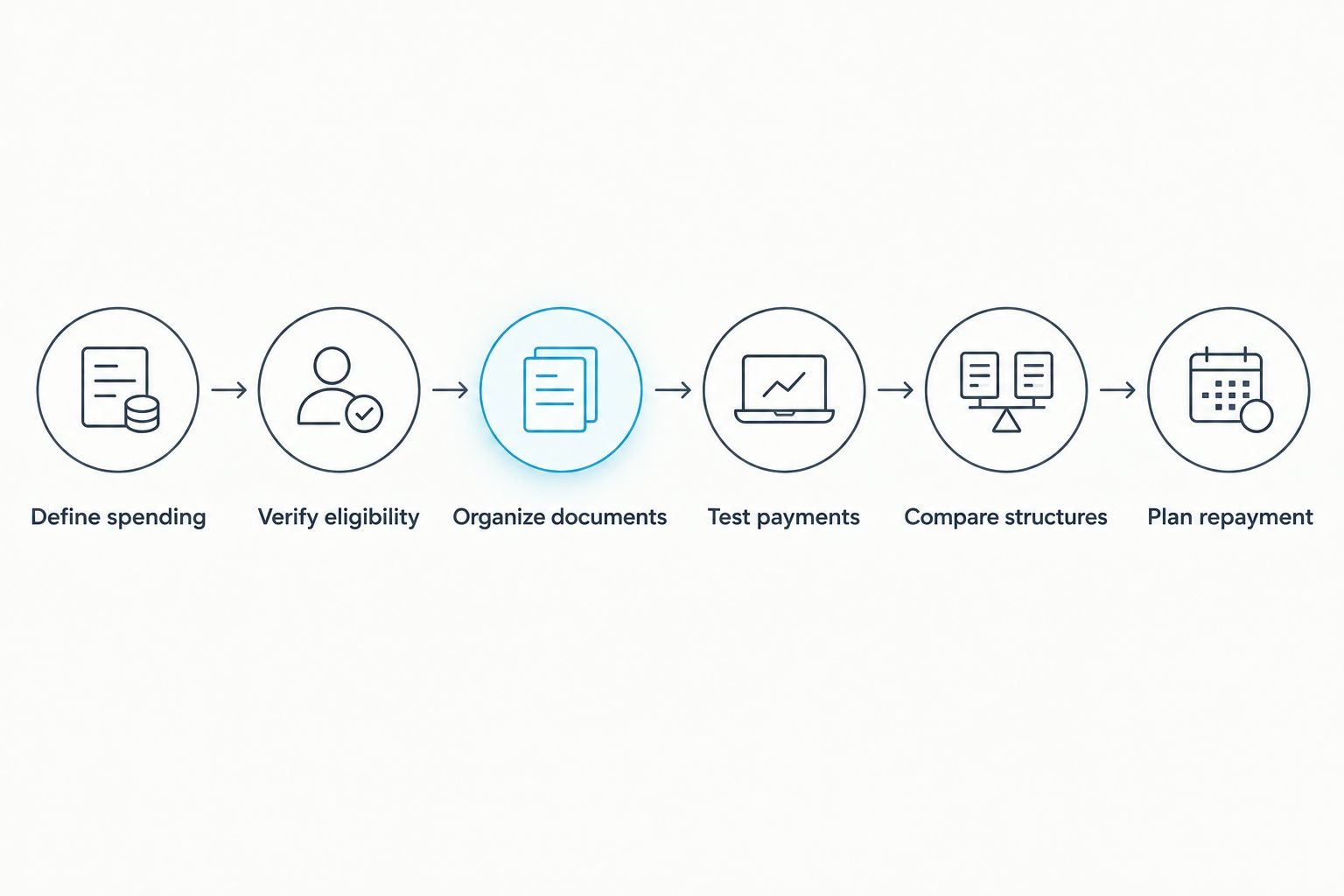
Check eligibility and payment capacity before choosing a financing structure.
Define spending before choosing a credit line
Best for: landlords with staged repairs or recurring projects that have identifiable repayment sources. List the expense, when you need the money, and how you will repay each draw. A HELOC is a financing structure, not a repair budget.
Separate required work from optional upgrades. Replacing a failed building system has a different repayment case from remodeling an occupied unit to pursue higher rent. Use written contractor estimates rather than an assumed increase in property value.
For a 1-unit rental, account for the loss of rent during a turnover. For a 3-unit building, identify whether the work affects one apartment or a shared system serving every tenant. The unit count changes the cash-flow exposure, even when the project itself looks similar.
Avoid borrowing simply because equity exists. A credit line creates capacity to spend; it does not establish that the spending will improve your return.
- Define spending by project and payment milestone.
- Separate essential repairs from optional improvements.
- Identify the repayment source for each planned draw.
- Keep emergency cash outside the renovation budget.
Verify eligibility before submitting a full application
Best for: landlords screening lenders before paying for property reviews or assembling a complete file. Ask whether the lender accepts non-owner-occupied collateral, your property’s unit count, its location, and the name on the deed. A primary-residence HELOC description does not establish eligibility for a rental.
Distinguish a duplex you live in from a duplex rented entirely to tenants. Occupancy is an underwriting fact, not a choice of wording. Describe the actual use accurately, including any short-term rental activity.
Next, ask how the lender determines combined loan-to-value, or CLTV. CLTV compares the existing mortgage and additional secured financing with the property’s accepted value. Ask whether the calculation uses the proposed full credit limit rather than just your planned first draw.
For 2026 applications, obtain the program’s current written criteria. Do not transfer eligibility requirements from another lender or assume that a strong credit profile overcomes an excluded property type.
- Verify eligibility for investment-property occupancy.
- Confirm acceptance of your exact unit count and property type.
- Disclose individual, trust, or LLC ownership accurately.
- Request the lender’s CLTV calculation and valuation process.
- Ask about existing liens and required lien position.
Organize documents around the actual qualification method
Best for: landlords whose income combines employment, self-employment, and rental receipts. Build a folder containing ownership records, mortgage statements, leases, rent receipts, insurance information, and the income documents the lender requests. Begin with documents you already have.
Ask which income counts and how the lender treats rental expenses. Gross rent is not the same as money available for debt payments. A lender’s calculation also differs from the operating budget you use to manage repairs, vacancy, and reserves.
If the qualification method does not fit your finances, compare other mortgage structures rather than repeatedly submitting the same file. Loanguys is best suited to small landlords comparing DSCR and bank-statement mortgage programs alongside a HELOC. The broker offers those programs, but they are not interchangeable with revolving credit.
Loanguys also offers bridge and fix-and-flip financing. Ask which structure matches your purpose; the program name alone does not establish your eligibility or approval.
- Organize documents by property, borrower, and income source.
- Reconcile lease amounts with actual rent deposits.
- List mortgage debt and other recorded liens.
- Ask how rental expenses affect qualifying income.
- Confirm additional documents needed for LLC-owned collateral.
Test payments beyond the initial draw period
Best for: landlords protecting rental cash flow from repayment changes. Request a payment illustration for your intended borrowing amount. Then ask how the payment changes if the rate rises, the balance grows, or the line enters its repayment period.
HELOC agreements separate access to credit from repayment obligations. Some provide interest-only payments during the draw period; that does not mean the principal disappears. Read the actual contract rather than assuming that every line works the same way.
Use your rental operating budget for a second check. Subtract mortgage payments, property taxes, insurance, maintenance, management expenses, and a vacancy allowance before assessing the additional payment. A lender’s approval is not a substitute for that calculation.
For a 2026 borrowing decision, test the repayment-period obligation before accepting the draw-period payment. Reject a plan that depends on uninterrupted occupancy or a future refinance that has not been approved.
- Test payments using the intended balance, not just the first draw.
- Ask for the rate index, margin, adjustment rules, and cap.
- Review principal repayment after the draw period ends.
- Check minimum-payment and balloon-payment provisions.
- Preserve cash for vacancy and urgent repairs.
Compare structures without sacrificing the existing mortgage
Best for: landlords deciding between staged borrowing and a single funded loan. Create a side-by-side worksheet using written terms. Compare whether each option keeps or replaces your current mortgage, how money is disbursed, and how principal is repaid.
A HELOC generally adds a separate secured obligation while leaving the existing first mortgage in place. A cash-out refinance replaces the mortgage being refinanced. That distinction matters because the new loan changes financing on the existing balance, not just the cash you receive.
A home equity loan provides a lump sum rather than reusable borrowing capacity. It fits a defined project better than an expense schedule that remains uncertain, provided the repayment terms fit your budget.
Loanguys’ DSCR and bank-statement loan programs provide alternative qualification approaches, not an automatic substitute for a HELOC. DSCR means debt service coverage ratio; bank-statement programs use account records to evaluate qualifying income under the program’s rules.
- Compare structures using the same funding purpose.
- Identify whether the existing first mortgage remains intact.
- Separate revolving credit from lump-sum funding.
- Check repayment terms and prepayment provisions.
- Compare qualification requirements before choosing a program.
Plan repayment before drawing funds
Best for: landlords who want borrowing to remain tied to a defined project. Write down when you will draw, what each draw pays for, and which cash source will reduce the balance. Keep this plan separate from the lender’s maximum approved limit.
A future sale or refinance is an exit strategy with conditions, not guaranteed repayment. Property value, occupancy, credit, and lender requirements still matter when you apply later. Include an alternative source of repayment that does not depend on the property appreciating.
Maintain records showing where borrowed money went. Clear records help you track project performance and give your tax professional the information needed to evaluate interest treatment. Do not assume that every dollar of interest receives the same tax treatment.
Finally, ask when access to unused credit can be restricted under the agreement. A cash reserve remains usable cash; an undrawn line remains conditional borrowing capacity.
- Plan repayment around documented cash sources.
- Match each draw to an invoice or defined expense.
- Track borrowing and repayment in your property ledger.
- Establish a backup if a sale or refinance fails.
- Review restrictions on future draws before relying on them.
Compare financing options for small landlords
Use this table to shortlist structures, not to infer approval. In 2026, the correct choice depends on the spending pattern, collateral, income documentation, and repayment plan—not simply the amount of equity you own.
Investment-property HELOC
- Best for: Staged expenses with a defined repayment source
- Main advantage: Revolving access during the contractual draw period
- Key limitation: Variable-rate exposure and possible restrictions on future draws
Home equity loan
- Best for: A defined project funded upfront
- Main advantage: A lump-sum loan with a stated repayment schedule
- Key limitation: Not a reusable credit line; adds secured debt
Cash-out refinance
- Best for: Landlords willing to replace an existing mortgage to release equity
- Main advantage: Combines refinancing and cash access
- Key limitation: Changes financing on the existing mortgage balance
DSCR mortgage
- Best for: Rental investors seeking property-income-based qualification
- Main advantage: Evaluates rental income relative to the program’s debt-payment calculation
- Key limitation: Coverage, collateral, and borrower requirements still apply
Bank-statement mortgage
- Best for: Self-employed landlords seeking an alternative income-documentation method
- Main advantage: Uses bank records under program-specific rules
- Key limitation: Deposits do not automatically equal qualifying income
Bridge loan
- Best for: A temporary financing need with a defined exit
- Main advantage: Connects an immediate transaction to later financing or sale
- Key limitation: Repayment depends on executing the exit within the contractual term
Choose a HELOC for revolving access, not merely because you want to extract equity. Choose another structure when a defined lump sum or a different qualification method better matches the transaction.
Common mistakes small landlords make
Treating gross rent as available cash
Lease income must also cover operating expenses and existing debt. Test the added payment against the cash left after those obligations, not against the rent advertised for the property.
Calling an undrawn line an emergency reserve
A credit line is not cash already in your account. Keep funds for urgent repairs and interrupted rent even after the line is approved.
Confusing portfolio size with property unit count
Owning 3 single-unit rentals differs from owning one 3-unit building. Give the lender each property’s address, unit count, occupancy, and ownership details rather than describing everything as a small portfolio.
Funding persistent losses with repeated draws
Borrowing can cover a timing gap, but it does not correct a rental that consistently spends more than it earns. Identify the operating problem before adding another secured payment.
Assuming a refinance will repay the line
Future refinancing requires a new qualification decision. Build a repayment plan that still works if the refinance is delayed or declined.
FAQ
Can a small landlord get a HELOC on an investment property?
A small landlord can qualify when a lender accepts investment-property collateral and the borrower meets its requirements. Confirm occupancy, unit count, ownership, equity, and income rules before submitting a full application.
Is a HELOC better than a home equity loan for rental repairs?
A HELOC fits staged borrowing, while a home equity loan fits a defined lump-sum expense. Compare repayment terms and rate exposure before choosing either secured obligation.
Can I keep my existing mortgage with an investment-property HELOC?
A HELOC generally adds a separate secured loan without replacing the existing first mortgage. Confirm lien position and any restrictions imposed by the existing mortgage or proposed lender.
Can I get a HELOC on an LLC-owned rental?
LLC eligibility depends on the lender’s ownership and borrower rules. Ask whether the lender accepts the entity on title and what entity documents or guarantees it requires.
Does a rental-property HELOC always have interest-only payments?
No, interest-only payments are not a universal HELOC feature. Read the agreement for draw-period payments, principal repayment, rate adjustments, and any balloon obligation.
Can I use a HELOC for another rental property's down payment?
Borrowed down-payment funds must satisfy the purchase lender’s rules as well as the HELOC agreement. Disclose the source and account for payments on both properties before committing.
What does Loanguys offer if a HELOC does not fit?
Loanguys offers DSCR, bank-statement, bridge, fix-and-flip, and short-term rental loan programs. These are mortgage financing options with different purposes and qualification methods, not a promise of HELOC eligibility.
One last thing
Choose the smallest borrowing plan that completes the project, not the largest limit the lender approves. Before signing in 2026, ask for payment illustrations using your intended balance and the full repayment terms. That makes the decision about your rental’s capacity to repay rather than its capacity to secure more debt.


