


How long does a hard money loan take to close?

A hard money loan closes when the lender clears its conditions and the closing agent can complete settlement and release funds; there is no single closing timeline that applies to every deal in 2026. An initial approval is not a funding commitment, so confirm the remaining property, title, insurance, and borrower requirements before promising a seller a closing date.
TL;DR
- How long does a hard money loan take to close? Your lender's outstanding conditions determine the funding date.
- Hard money loan approval and funding are separate milestones; ask which date a closing estimate actually describes.
- Loanguys is a mortgage broker for investors seeking fix-and-flip or bridge financing, not a universal closing-time guarantee.
- Confirm property review, title clearance, insurance, and signing requirements before committing to a purchase deadline.
How long does a hard money loan take to close?
Use a transaction-specific funding date, not a lender's fastest advertised closing. A reliable estimate accounts for your property's review, the borrowing entity, title work, insurance, and the conditions attached to approval.
Before accepting a timing claim, use this guide to compare hard money lenders before signing a term sheet. Ask whether the estimate starts at your first inquiry, receipt of a complete application, or final approval. Those starting points describe different amounts of work.
The closing process has distinct milestones. Keep them separate when discussing a deadline:
Initial review
- What it establishes: The lender has considered the proposed transaction
- What it does not establish: Final acceptance of the property or borrower
Conditional approval
- What it establishes: The lender has identified requirements for moving forward
- What it does not establish: That every requirement is satisfied
Closing preparation
- What it establishes: Loan documents and settlement arrangements are being prepared
- What it does not establish: That funds have been released
Signing
- What it establishes: Required parties have executed documents
- What it does not establish: That settlement is complete
Funding
- What it establishes: Loan proceeds have been released under closing instructions
- What it does not establish: That later renovation advances are also released
Your purchase contract should reflect the milestone that actually satisfies its requirements. Have your real estate professional or attorney confirm how the contract defines closing rather than assuming a signed loan package is enough.
Why this matters
A closing estimate affects more than your moving calendar. It shapes the purchase deadline you negotiate, when you arrange insurance, and when you commit to contractors or other project expenses.
For a 2026 investment purchase, work backward from the seller's deadline and identify every unfinished requirement. An approval message is useful, but an outstanding-condition list tells you what still stands between the transaction and funding.
Speed also has limits. A lender's willingness to move quickly does not resolve an ownership dispute, produce a missing payoff statement, or give an unavailable signer authority to act for an LLC.
What happens before a hard money loan funds?
Use the following sequence to organize your closing. Some tasks run at the same time, but each applicable requirement still needs an owner and a clear completion status.
Submit a complete file
Provide the purchase contract, property address, borrowing-party information, and the documents the lender requests. For a renovation project, include the requested scope of work and budget rather than relying on a verbal description.
Ask the lender to confirm whether the application is complete. Sending documents and having an accepted, review-ready file are different things.
Complete property review
Confirm how the lender will evaluate the property and whether an inspection, appraisal, or other valuation is required. Arrange access promptly and disclose known damage, occupancy issues, or unfinished work.
For a rehabilitation loan, distinguish the property's current condition from the proposed finished condition. The lender needs to understand the project you are actually financing.
Clear closing conditions
Request a written list of outstanding conditions and identify who must resolve each item. Separate borrower tasks from lender, insurance, seller, and title-company tasks.
Do not assume that uploading a document clears a condition. Ask whether the reviewer has accepted it or needs clarification.
Prepare settlement
Confirm the borrowing entity, authorized signers, insurance details, and required closing funds before documents are finalized. Names should match the approved transaction structure.
Ask the closing agent about signing arrangements and funding instructions. Independently verify wire instructions through a trusted contact method before sending money.
Confirm funding
After signing, ask whether all funding conditions are satisfied and whether proceeds have been released. Obtain confirmation from the party responsible for settlement rather than inferring completion from a scheduled appointment.
If the loan includes renovation funding, separately confirm how future advances work. Acquisition funding and access to the entire rehabilitation budget are not interchangeable.
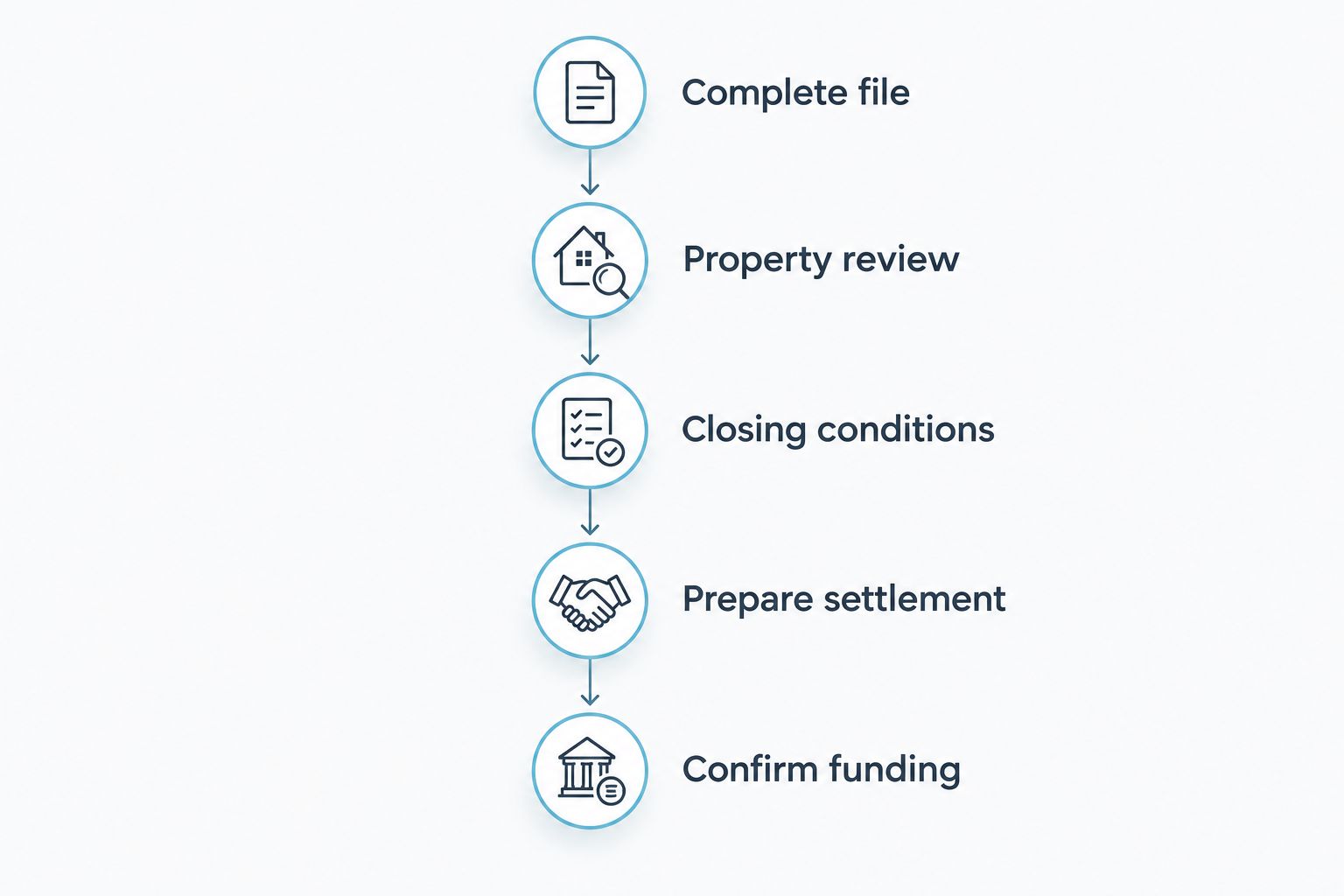
A signed loan package is a milestone; confirmed funding is a separate step.
Why hard money closing times vary
Your closing schedule depends on the work left in the file, not just the loan's label. These are the practical checks to discuss with the lender and closing agent:
- Application completeness. Missing identification, inconsistent entity names, or unanswered requests leave the file unfinished. Ask for one consolidated document list.
- Property review. Access arrangements and required valuation work affect when the lender can finish reviewing its collateral. Disclose property-condition concerns at the start.
- Title and payoffs. Existing liens, ownership discrepancies, and missing payoff information require resolution acceptable to the lender and title company. Identify the responsible party immediately.
- Insurance. Confirm that the proposed coverage fits the property's use and condition and satisfies the lender's requirements. A quote alone does not establish that coverage is in place.
- Borrowing structure. An LLC or other entity requires confirmation of its existence and signing authority. Keep the borrower name consistent across the application and closing documents.
- Settlement coordination. Signer availability, document corrections, and funding instructions affect execution. Confirm the closing agent's requirements before scheduling the appointment.
In 2026, ask for a status update that names the unresolved issue, the person responsible, and the next action. A general statement that the file is progressing does not tell you whether the purchase deadline remains realistic.
How can you help a hard money loan close faster?
Remove avoidable rework before asking for a shorter deadline. A complete, consistent file gives the lender and closing agent something they can finish reviewing.
Start with the purchase contract. Check the buyer name, property address, closing deadline, and any amendments before forwarding it. If you intend to borrow through an entity, discuss that structure before loan documents are prepared.
Next, put the property information in one place. Include access instructions, occupancy details, known condition issues, and the requested rehabilitation plan. Keep the scope and budget consistent with what you tell the lender.
Finally, make your availability explicit. Tell the closing agent where signers will be, flag travel plans, and ask how signing will be arranged. Avoid changing the borrowing entity or project scope without first discussing the effect on approval.
What should you ask before relying on a closing estimate?
Use these questions during your next lender conversation:
- Does the estimate begin with my inquiry or with an accepted, complete application?
- Does the target date mean signing, settlement, or released funds?
- Which property-review requirements remain open?
- Has the title company identified anything that must be resolved?
- Which conditions depend on me, the seller, or another party?
- What change would cause the target date to move?
Request the answers in writing. That creates a shared checklist without treating an estimate as a guarantee.
When does a mortgage broker fit the decision?
Loanguys is best for investors seeking a mortgage broker for fix-and-flip or bridge financing. Its stated investment-property programs also include DSCR financing, which evaluates rental-income coverage, alongside other mortgage programs.
The benefit of discussing Loanguys investment-property financing is matching your borrowing purpose to a relevant program. The limitation is that program fit does not establish a closing date; the actual transaction still needs review and cleared conditions.
For a 2026 purchase deadline, explain the property, intended use, borrowing entity, project scope, and seller's required date together. Ask which financing path fits that complete picture rather than selecting a loan solely because it sounds fast.
Discuss your purchase deadline
Explain your property, project, and target closing date before committing to a financing schedule.
Can a hard money loan close before title issues are resolved?
An unresolved title issue needs an acceptable resolution before you rely on a funding date. Ask the title company and lender whether the issue prevents closing and what documentation or action will resolve it.
A lien and a disputed ownership interest are different problems. Describe the specific issue rather than asking whether the lender accepts properties with title problems in general.
Does approval mean my hard money loan is ready to close?
Approval does not necessarily mean the loan is ready to close. Conditional approval leaves requirements outstanding, and signing remains separate from the release of funds.
Ask for the current condition list and funding status. Those answers are more useful than an approval label without an explanation of what it covers.
Does a refinance follow the same closing schedule as a purchase?
A refinance has its own closing requirements, including the treatment of existing debt and the instructions for releasing proceeds. A purchase estimate does not automatically apply to a refinance of another property.
Tell the lender whether the property is an investment or your residence and explain the loan's purpose. Consumer-protection requirements differ by transaction, so have the lender identify any applicable disclosures or waiting periods rather than assuming every hard money loan follows the same rules.
FAQ
How long does a hard money loan take to close in 2026?
A hard money loan's closing time depends on the lender's review and the transaction's outstanding conditions. Obtain a written funding estimate based on your complete file, property review, title status, insurance, and settlement requirements.
What's the difference between hard money approval and funding?
Approval indicates a lending decision at a stated stage; funding means loan proceeds have been released under closing instructions. Ask whether approval is conditional and what must happen before funds are released.
Can I count on the lender's fastest advertised closing time?
Do not treat an advertised fastest closing as a commitment for your property. Ask the lender to assess your actual file and explain which assumptions support its proposed date.
What documents should I prepare for a hard money closing?
Prepare the purchase contract, identification, borrowing-entity information, and the property and financial documents your lender requests. Renovation transactions also require the project information specified by that lender.
Will signing loan documents mean the seller has been paid?
Signing loan documents does not by itself confirm that the seller has been paid. Ask the closing agent whether settlement and disbursement are complete.
Can Loanguys guarantee my investment-property closing date?
Do not treat a general program description as a closing guarantee. Ask Loanguys for a transaction-specific assessment and written confirmation of the conditions attached to any proposed date.
Do I receive the entire renovation budget when the purchase closes?
Do not assume the entire renovation budget is disbursed at purchase closing. Ask whether rehabilitation funds are held back and what documentation, inspections, or other conditions apply to later advances.
What should I do if my seller's deadline is approaching?
Request the outstanding-condition list and a revised funding assessment immediately. If the deadline is no longer workable, discuss a written extension with your real estate professional or attorney before the contract deadline passes.
One last thing
Ask what remains before funding, not just whether you are approved. That question forces the conversation toward actionable work: an accepted document, a cleared title item, an insurance correction, or a completed signing requirement.
For your 2026 closing, keep one shared checklist with a responsible person beside each open item. A shorter list of unresolved conditions is more useful than repeated reassurance that the transaction is moving quickly.


