


How long does it take to close a DSCR loan?

A DSCR loan closes when the lender finishes underwriting, accepts the property and rental-income documentation, clears title and insurance requirements, and authorizes funding—not after a universal number of days. For a 2026 purchase or refinance, get a written, file-specific closing estimate before committing to a deadline. Confirm whether that estimate ends at document signing or actual funding, because those are different milestones.
TL;DR
- How long does it take to close a DSCR loan? The answer depends on underwriting, appraisal, title, and funding readiness.
- Loanguys offers DSCR financing through its mortgage brokerage; request a closing estimate tied to your property and documents.
- Conditional approval is not permission to fund. Track unresolved conditions before relying on a closing date.
- Ask which milestone starts the estimate: application, complete submission, or appraisal delivery.
How long does it take to close a DSCR loan?
There is no universal DSCR closing timeline. Your usable estimate is the lender’s schedule for your specific file, with outstanding conditions identified. A timeline measured from a complete application is not interchangeable with one measured from an initial inquiry.
When discussing DSCR financing with Loanguys, provide the property address, transaction type, intended rental use, borrowing entity, and contractual deadline. Ask for the expected funding date and the assumptions behind it.
Use these milestones to understand what remains between application and funding:
- File intake. Submit the application and requested borrower, property, asset, and entity documents. Confirm that the lender considers the submission complete enough for review.
- Property review. The lender evaluates the property’s eligibility, value, and acceptable rental-income evidence. Coordinate access for any required appraisal or inspection.
- Underwriting. The underwriter reviews the file against the selected program’s requirements. Approval can include conditions that still need documents or explanations.
- Condition clearance. Resolve the lender’s remaining requests and coordinate title, insurance, and settlement details. Sending a document is not the same as having it accepted.
- Funding. Complete the closing documents and satisfy the lender’s funding instructions. Confirm when the settlement agent can disburse proceeds.
Some work happens in parallel. Ask which unfinished task controls the funding date rather than adding estimated durations for every task together.
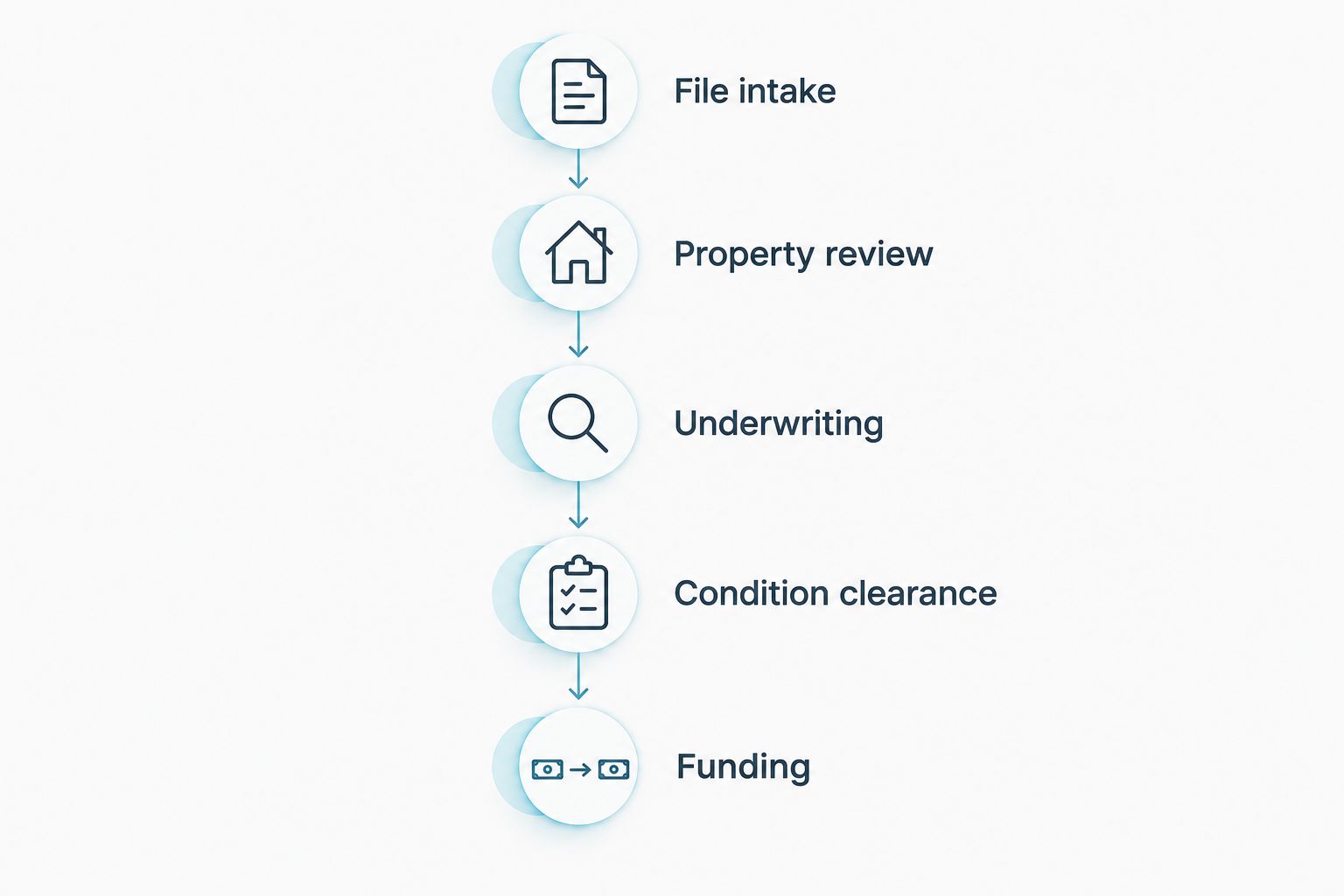
Track the milestone that remains unfinished, not just the date you submitted the application.
Why this matters
Your financing schedule needs to match your purchase contract or refinance obligation. An encouraging conversation does not establish that the lender can meet the deadline written into those documents.
For your 2026 closing plan, separate the target date, the lender’s current estimate, and the contractual deadline. They serve different purposes. Ask your real estate agent or attorney about contract protections and extension procedures before a timing problem becomes a missed deadline.
The practical question is not simply whether a lender closes quickly. It is whether the lender has reviewed enough of your transaction to support the date you need.
Purchase and refinance timelines have different dependencies
A purchase involves coordination with a seller and a contractual transfer date. A refinance replaces existing financing, so payoff documentation and any applicable program requirements become part of the schedule.
Neither transaction type automatically guarantees a faster closing. Compare the unresolved work, not the label on the application.
Purchase
- Main coordination issue: Seller, property access, title, and contract deadline
- Scheduling advantage: The contract provides a defined target
- Timing limitation: Seller-side documents or access issues can interrupt progress
Rate-and-term refinance
- Main coordination issue: Existing loan payoff and replacement financing
- Scheduling advantage: No purchase seller needs to coordinate a transfer
- Timing limitation: Payoff accuracy and lender conditions still affect funding
Cash-out refinance
- Main coordination issue: Payoff, ownership history, and requested proceeds
- Scheduling advantage: The borrower controls the decision to proceed
- Timing limitation: Eligibility and proceeds depend on the lender’s review
For a purchase, share the executed contract and relevant amendments promptly. For a refinance, identify the existing loan servicer and ask who requests the payoff statement. Do not assume the balance shown on your regular statement is the final payoff amount.
Purchase closing preparation
Confirm who will provide property access and who handles seller-side title requests. If the property is tenant-occupied, coordinate access without assuming the tenant can accommodate an appointment immediately.
Ask the lender whether the purchase contract’s closing date remains achievable after the initial review. Repeat that question when the appraisal arrives or a material issue changes the file.
Refinance closing preparation
Ask whether ownership history, an existing loan’s terms, or the proposed borrowing entity affects eligibility. Identify those questions before arranging a payoff around an expected funding date.
For cash-out transactions, distinguish approval of the loan from confirmation of the amount available after payoff and settlement adjustments. A preliminary estimate is not final authorization to release proceeds.
Why DSCR loan closing times vary
DSCR underwriting focuses on the property’s ability to support its debt payments, but that does not eliminate the rest of the mortgage review. A rental-income-based application still needs acceptable collateral, documentation, and closing arrangements.
These dependencies explain why otherwise similar files can move differently:
- Document readiness. Incomplete applications, missing pages, and inconsistent borrower names create follow-up work. Ask for a document checklist and confirm receipt of each requested item.
- Appraisal and rent evidence. Property access, report completion, and questions about value or rental support affect when underwriting can finish its review.
- Property eligibility. Condition, intended rental use, and property characteristics need to fit the selected program. Describe unusual features at intake rather than waiting for the appraisal.
- Title and ownership. Existing liens, ownership discrepancies, and unresolved title requirements need attention before settlement. Ask the title professional to identify unresolved items early.
- Entity documentation. An LLC borrower needs documentation acceptable to the lender and settlement agent. Confirm the legal name and who has authority to sign.
- Insurance and settlement coordination. The lender must accept the required coverage and closing arrangements. Send insurance information for review before treating the policy as settled.
For a 2026 application, ask for the selected program’s current checklist rather than relying on documents from an earlier transaction. Different lenders and programs do not necessarily accept the same evidence.
Prepare the file before asking for a firm date
Your strongest timing move is to remove uncertainty before underwriting reaches it. Organize documents by the lender’s checklist, keep complete copies, and answer requests in the format the loan team specifies.
Borrower and entity documents
Confirm exactly how the borrower will take title. If an LLC will borrow, make sure the application, entity records, contract, and insurance information use consistent names or clearly explain any differences.
Ask which formation, ownership, and signing-authority records the lender requires. If the company is new, review the guide to closing a DSCR loan with a newly formed LLC before assuming formation alone completes the entity review.
Property and rental documents
Provide the property’s current occupancy status and intended rental use. Ask which leases, rent schedules, appraisal materials, or operating records the lender will accept for that use.
Do not present projected rent as established collections. Clearly label what the property currently earns and what you expect it to earn, then let the lender confirm the acceptable underwriting basis.
Funds and insurance documents
Ask what evidence the lender needs for the down payment, settlement funds, and any required reserves. Follow the lender’s instructions for documenting transfers instead of moving funds without keeping the supporting records.
Request insurance appropriate to the property and intended use. Ask your insurance professional to coordinate the lender’s coverage and mortgagee-information requirements before the closing package is prepared.
Ask for a closing estimate you can actually use
A useful estimate explains what must happen next. Ask the loan team to connect the proposed date to the file’s current status, not just the date you first contacted them.
Use this checklist during your 2026 financing discussions:
- What event starts the closing estimate?
- Is the estimate expressed in calendar days or business days?
- Has the lender accepted the property type and intended rental use?
- Has the appraisal been ordered, scheduled, delivered, or reviewed?
- Which underwriting conditions remain unresolved?
- What must title, insurance, or the settlement agent still provide?
- Does the proposed date mean signing, funding authorization, or disbursement?
Ask who owns each open item and when the team expects the next update. A status report that identifies the next dependency is more useful than repeated assurances that the file is moving.
Where a mortgage broker fits
Loanguys is best suited to real estate investors seeking a mortgage broker for DSCR financing. The brokerage also offers fix-and-flip, bridge, bank-statement, and short-term rental loan programs, making the financing purpose an important part of the initial discussion.
The benefit of discussing DSCR financing with Loanguys is access to a broker offering that loan category. The limitation is straightforward: the program offering itself does not establish your approval or funding date. Request a transaction-specific assessment instead of interpreting access to financing as a closing guarantee.
Discuss your DSCR closing plan
Share your property, borrowing entity, and deadline to discuss the financing steps.
Does conditional approval mean my DSCR loan is ready to close?
Conditional approval means the lender still requires specified items before the file can move forward. Read the conditions as a work list, not as permission to schedule funding without further confirmation.
Ask which conditions affect underwriting approval and which remain for closing or funding. Have the loan team confirm acceptance after you submit the requested documents.
Can a DSCR loan close faster without tax returns?
A DSCR program that does not use personal tax returns for income qualification still requires its own underwriting review. Removing that document category does not remove appraisal, rental-income, credit, asset, title, or insurance requirements applicable to the file.
Less personal-income documentation is not the same as no documentation. Evaluate the actual outstanding requirements before concluding that a particular loan will close faster.
What should I do if my DSCR closing date slips?
Ask for the specific unresolved condition, the person responsible, and the next action needed to resolve it. Share the revised timing with your agent or attorney promptly if a purchase contract is involved.
Do not change loan programs solely because another lender advertises speed. Ask what work the replacement lender must repeat and whether existing reports or documents are acceptable before deciding to restart.
FAQ
How long does it take to close a DSCR loan in 2026?
A DSCR loan has no universal closing duration; the funding date depends on the lender’s review and the transaction’s outstanding requirements. Request a written estimate tied to your complete file, appraisal, title, insurance, and underwriting conditions.
When does the DSCR loan closing timeline start?
The starting point depends on how the lender defines its estimate. Ask whether the clock starts at initial application, complete document submission, or another milestone, and whether the endpoint is signing or funding.
Does a DSCR loan preapproval guarantee my closing date?
Preapproval does not guarantee a DSCR loan closing date. Ask what has actually been reviewed and which property, underwriting, title, and funding requirements remain.
Can I close a DSCR loan through a new LLC?
A newly formed LLC needs to satisfy the selected lender’s entity and signing-authority requirements. Confirm eligibility and required documents before relying on a closing estimate.
Will a vacant rental property delay my DSCR loan?
Vacancy changes the rental-income evidence the lender needs to evaluate. Ask whether the program accepts the property’s occupancy status and what documentation supports the qualifying rent.
Can I sign DSCR loan documents before the loan funds?
Signing and funding are distinct events. Ask the lender and settlement agent which funding conditions remain after signing and when they can disburse proceeds.
What is the best way to avoid a DSCR closing delay?
Submit a complete, consistent file and resolve the lender’s identified conditions promptly. Coordinate property access, entity documents, insurance, and title work before treating the target date as confirmed.
One last thing
A document marked received is not necessarily a condition marked cleared. Before your 2026 closing, ask the loan team to distinguish documents awaiting review from requirements the lender has accepted.
That distinction gives you a better status check than the age of the application. Focus your follow-up on the unfinished approval or funding requirement.


