


How many months of bank statements do you need for a loan?

For a mortgage in 2026, 2 months of bank statements is a common starting point when the lender is verifying your savings; bank-statement income programs commonly review 12 or 24 months instead. The distinction matters: proving you have money for closing is different from proving your business generates qualifying income. Your lender’s written checklist determines the exact period, accounts, and supporting documents you need.
TL;DR
- How many months of bank statements needed for loan approval depends on whether statements verify assets or income.
- A mortgage asset review commonly starts with 2 months; bank-statement income programs commonly use 12 or 24 months.
- Loanguys offers bank-statement mortgages; confirm the required history before gathering documents.
- Submit consecutive, complete statements and explain transfers rather than treating every deposit as income.
Why this matters
Sending the wrong statement period leaves the lender without the evidence needed to evaluate your application. A short asset history does not establish a full business-income history, and a long deposit history does not automatically prove that every dollar qualifies.
For self-employed applicants, the distinction is especially useful. The guide to bank-statement loans for small business owners covers the financing category; this page explains how to prepare the statement history behind an application.
Ask what the statements must prove before asking how many to upload. That question separates your asset checklist from your income checklist immediately.
How many months of bank statements do you need for a loan?
For mortgage planning in 2026, distinguish the following documentation purposes. These are common category practices, not a promise that a particular lender accepts your file with that statement count.
Mortgage asset verification
- Common review period: Often 2 months
- Best for: Borrowers documenting savings and closing funds
- Advantage: Shows recent balances and account activity
- Limitation: Does not replace income documentation
Bank-statement income qualification
- Common review period: Commonly 12 months
- Best for: Self-employed borrowers applying to an eligible program
- Advantage: Establishes a full annual deposit history
- Limitation: Deposits still require review and adjustments
Longer bank-statement income qualification
- Common review period: Commonly 24 months
- Best for: Borrowers applying to programs that require a longer history
- Advantage: Shows income patterns across a longer period
- Limitation: Requires more records and includes older business performance
Fannie Mae’s Selling Guide, section B3-4.2-01, provides an established agency-mortgage reference for asset verification, including statement-period requirements that differ by transaction. Bank-statement income mortgages use lender-specific underwriting rules rather than a universal agency requirement for deposit-based income qualification.
Use the table to prepare questions, not to select your own qualifying period. Confirm the current requirements for your 2026 application before submitting financial records.
Asset verification: commonly 2 months of statements
Two months of statements commonly supports a mortgage asset review, not a bank-statement income calculation. The lender examines the money you intend to use for your down payment, closing funds, and any required reserves. Reserves are funds remaining after closing.
This route is best for borrowers whose income is documented separately, such as through employment records or tax returns. Its advantage is a shorter statement package. Its limitation is that an account balance alone does not establish your ability to repay the mortgage.
A lender also needs to understand where relevant funds came from. A transfer into your savings account is easier to trace when you retain the corresponding statement from the account that sent it.
Do not assume every mortgage requires exactly the same asset period. Loan type, transaction details, and the verification method affect the request; electronic asset verification also changes how you supply the information.
Bank-statement income qualification: commonly 12 months
Twelve months of statements is a common documentation option in bank-statement mortgage lending. It gives the underwriter an annual record of deposits to evaluate under the program’s income rules. It does not mean the underwriter counts every deposit as earnings.
This option is best for a self-employed borrower whose lender accepts an annual statement history for the proposed loan. Its advantage is a shorter collection period than a longer-history program. Its limitation is that eligibility still depends on the lender’s treatment of the business, deposits, expenses, and income pattern.
Business deposits represent receipts before business expenses. Personal-account deposits also need context when they include business transfers, reimbursements, or other funds that are not qualifying earnings.
Before relying on this option, ask whether the lender accepts personal statements, business statements, or a specified combination. Also ask how business ownership affects the income attributed to you.
Bank-statement income qualification: commonly 24 months
Twenty-four months of statements is another common bank-statement mortgage requirement. A longer record shows deposits across a broader period, including recurring busy seasons and slower stretches. It also adds more documents to review.
This option is best for borrowers whose selected program requires a longer income history. The advantage is visibility into business patterns beyond a single annual cycle. The limitation is that older performance remains part of the record, even when your recent business results have changed.
Do not assume a longer history always produces more qualifying income. The result depends on the eligible deposits, business expenses, ownership, and underwriting method—not simply the number of uploaded statements.
If the business recently changed, explain the change before the lender calculates income. A new operating account, ownership adjustment, or change in payment processing needs context rather than an unexplained gap in the records.
Why the required statement history varies
Your 2026 mortgage checklist depends on what the lender needs to verify. These factors explain why another borrower’s document request is not a reliable substitute for your own:
- Documentation purpose. Asset verification establishes available funds; bank-statement income qualification evaluates eligible earnings from account activity.
- Loan program. Agency mortgages and lender-specific bank-statement programs use different documentation frameworks.
- Account type. Business receipts and personal deposits require different explanations, especially when money moves between your accounts.
- Income pattern. Seasonal receipts, changing revenue, and business interruptions affect how a lender evaluates the history.
- Deposit sources. Transfers, borrowed funds, refunds, and business revenue do not all receive the same income treatment.
- Statement timing. A file reviewed later in the transaction can require updated records to satisfy the lender’s documentation requirements.
A request for additional statements is not automatically a rejection. It is a request for evidence. Ask which issue the additional records must resolve so you supply the right account and period.
How to prepare your bank statements for a mortgage
Prepare your 2026 statement package around the lender’s written instructions. Organizing the records helps the underwriter distinguish actual income from account movements without relying on your explanation alone.
- Confirm the purpose. Ask whether the request covers assets, qualifying income, or both. Get the required statement period and account list in writing.
- Download complete statements. Use bank-issued documents with the account holder, statement dates, balances, and transaction pages. Include all pages, even when a page has no transactions.
- Check date coverage. Arrange statements by account and closing date. Identify missing cycles, overlapping downloads, or an account that opened during the requested period.
- Explain deposit sources. Keep records supporting relevant transfers and unusual deposits. Identify payments that are business receipts separately from refunds, loans, or money moved between your own accounts.
- Use secure submission. Send sensitive documents through the lender’s designated process. Retain your original files and keep any explanation separate from the bank-issued statement.
The sequence matters: confirm the requirements before downloading and labeling a large document package. Complete records are useful; extra records from the wrong accounts are not a substitute for the requested evidence.
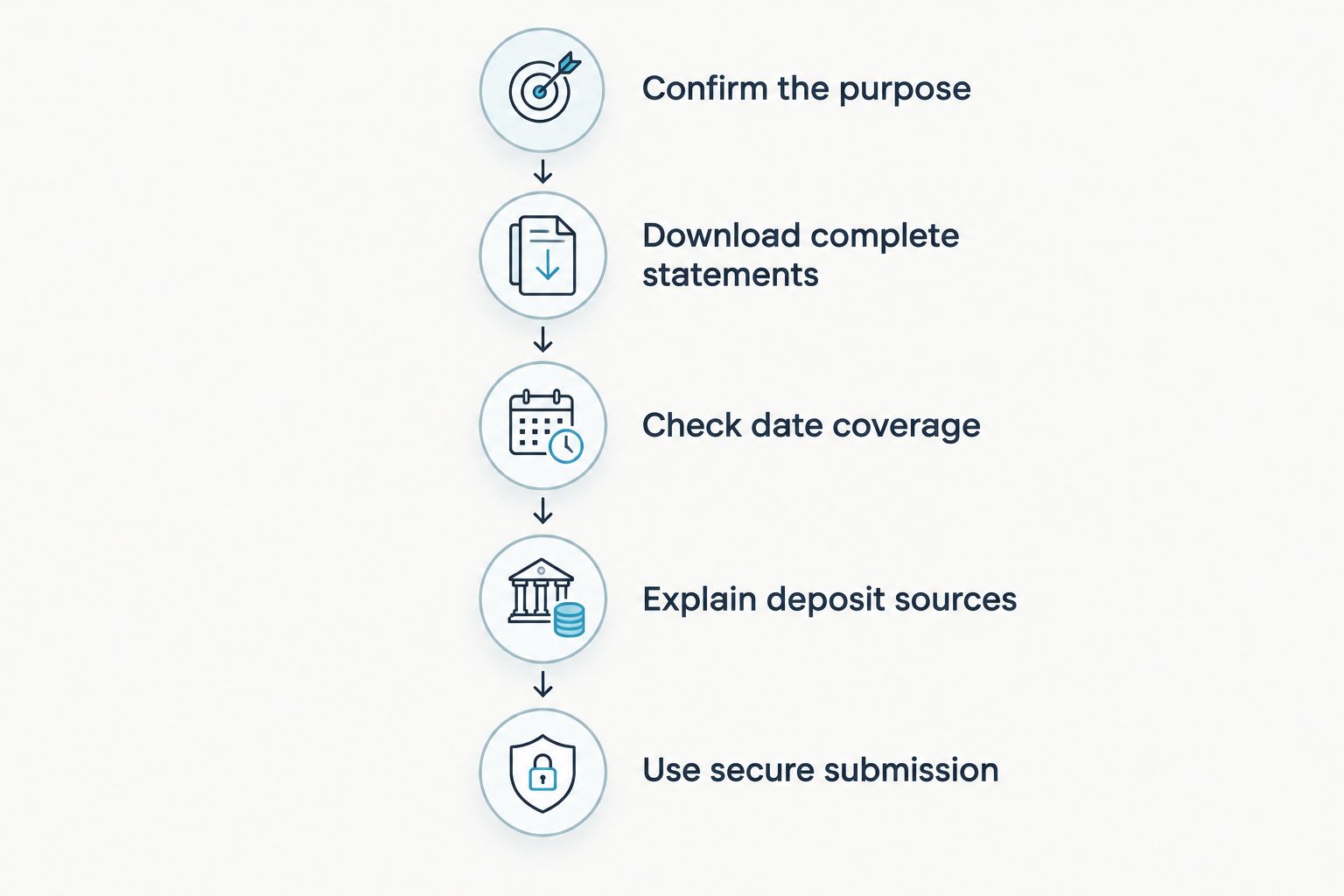
Confirm the required accounts and statement period before assembling your mortgage documents.
Keep transfers separate from earnings
Moving money between accounts does not create new income. If a customer payment enters your business account and you later transfer that money to your personal account, the transfer needs to be distinguished from the original receipt.
Keep the records that connect the movement. Do not delete transactions, alter descriptions, or edit statement pages to make the history look simpler.
Match explanations to supporting records
A written explanation helps identify a transaction, but it does not replace evidence of its source. Keep the corresponding transfer record, payment record, or other relevant documentation available when the lender requests it.
Avoid sending unrelated customer information without instructions. Ask what evidence is necessary and how to submit it securely.
Does a bank-statement loan count every deposit as income?
No—12 or 24 months of statements does not make every deposit qualifying income. Underwriters distinguish eligible receipts from transfers and other non-income deposits, then apply the program’s calculation rules.
For business accounts, the expense treatment matters because revenue is not the same as money available to support your mortgage payment. Ask how the lender determines qualifying income before estimating your borrowing capacity from total deposits.
Can I qualify with fewer statements?
Two months of asset statements does not establish eligibility for a bank-statement income mortgage. A shorter documentation route must be an actual option under the lender’s program, not a period you choose because it shows your strongest deposits.
Ask whether another supported documentation method fits your circumstances. Do not submit selected months while omitting the rest of a requested consecutive history.
Should I choose a shorter or longer statement period?
Twelve months versus 24 months is an underwriting question, not a reason to select only favorable records. Ask which periods the program permits and how the lender evaluates income changes before deciding which eligible route to pursue.
Loanguys is best suited to borrowers seeking a mortgage broker offering bank-statement and real estate investor loan programs. Loanguys bank-statement mortgages are relevant when you need deposit-based income qualification; the limitation is that a program offering alone does not establish your eligibility or required statement count.
Ask Loanguys to confirm the documentation requirements for your circumstances before treating either history length as an available option.
Confirm Your Statement Requirements
Discuss the accounts, statement history, and supporting records needed for your mortgage application.
FAQ
Do I need 2 months or 12 months of bank statements for a mortgage?
Two months commonly supports asset verification, while 12 months is a common bank-statement income documentation period. Ask whether the lender is verifying your available funds, calculating qualifying income, or doing both.
Do bank-statement mortgage programs always require 24 months?
No—24 months is a common requirement, but some bank-statement programs accept 12 months. The applicable lender guidelines determine which option is available for your application.
Can I use personal bank statements instead of business statements?
Personal statements are accepted by some bank-statement mortgage programs, but acceptance and income treatment depend on the lender. Confirm the account requirements before submitting records.
Do the bank statements have to be consecutive?
Submit consecutive statements covering the full period the lender requests. Selected high-deposit months do not provide a complete record of income activity.
Are screenshots enough for mortgage bank statements?
Do not assume screenshots satisfy a mortgage statement request. Follow the lender’s instructions for complete bank-issued statements or an approved electronic verification method.
Will transferring money between my accounts increase qualifying income?
No—transferring your own money between accounts does not create new income. Keep records connecting the accounts so the lender can identify the original source and avoid counting the same funds twice.
Does submitting all my bank statements guarantee mortgage approval?
No—complete statements satisfy a documentation request, not the entire mortgage approval process. The lender also evaluates the other requirements that apply to your loan and property.
One last thing
The statement period and the age of the business are separate questions. Having the requested account history does not establish that you meet the program’s business-history requirement.
For your 2026 application, ask for both requirements together: how long the business must have operated and exactly which statement cycles the lender needs. That prevents you from building a complete document package around a program that does not fit your circumstances.


