


How much does a hard money loan cost compared to a conventional loan?

Hard money loans generally cost more than conventional mortgages because they finance short-term, property-focused transactions with different risks and repayment structures. Your actual cost in 2026 depends on the written interest rate, upfront charges, time outstanding, and payoff terms—not the loan label alone. A planned refinance adds another closing and a separate approval requirement to the comparison.
TL;DR
- For hard money loan cost vs conventional loan, compare total financing expense through your expected payoff date.
- Conventional mortgages generally suit longer holds; hard money financing serves short-term transactions that fit its underwriting.
- Loanguys offers investment property loan programs, including DSCR, bridge, and fix-and-flip financing.
- Include points, draw charges, extension terms, and refinancing expenses when comparing written offers.
How much does a hard money loan cost compared to a conventional loan?
Hard money generally has higher borrowing costs, but no single premium applies to every property or borrower. Compare written offers for the same transaction and expected payoff date. An advertised interest rate does not capture upfront fees, minimum-interest provisions, or the expense of replacing short-term debt.
Use this comparison before reviewing individual terms. The guide to comparing hard money lenders before signing a term sheet provides a related starting point.
Best for
- Hard money loan: Short-term investment projects with a defined repayment plan
- Conventional mortgage: Eligible properties and borrowers planning a longer hold
Interest expense
- Hard money loan: Generally higher; check the balance used to calculate interest
- Conventional mortgage: Generally lower; compare equivalent investment-property offers
Upfront charges
- Hard money loan: Review origination points and all separately listed charges
- Conventional mortgage: Review points, origination charges, and third-party closing expenses
Repayment
- Hard money loan: Often interest-only with principal due at maturity
- Conventional mortgage: Commonly amortizing, with principal repaid through scheduled payments
Property condition
- Hard money loan: Some programs accommodate substantial rehabilitation
- Conventional mortgage: Standard programs require the property to meet condition requirements
Main advantage
- Hard money loan: Financing structured around a transitional property or project
- Conventional mortgage: Financing designed for sustained ownership and repayment
Main drawback
- Hard money loan: Maturity, extension, and exit-financing exposure
- Conventional mortgage: Qualification and property requirements can exclude a transaction
Neither column establishes approval. A property needing extensive repairs and a move-in-ready rental are different lending risks, even when their purchase amounts match.
Why this matters
The relevant question is which eligible loan leaves your project financially workable. A conventional mortgage that cannot finance the property is not a usable substitute for a rehabilitation loan. Equally, a short-term loan becomes a poor fit when your plan requires indefinite ownership without an approved replacement.
For your 2026 purchase, separate financing expense from cash requirements. A down payment is equity you contribute, not a lender fee. Principal repayments reduce debt; interest and lender charges do not.
That distinction prevents a misleading comparison between an interest-only payment and an amortizing payment. The smaller payment does not automatically represent the less expensive loan.
Hard money loans: compare costs through the exit
Best for: investors with a short-term project and a documented sale or refinance plan. Hard money underwriting places substantial emphasis on the property and transaction, although lenders also assess borrower qualifications. It is not automatic approval based solely on collateral.
Start with the interest calculation. Ask whether interest applies only to disbursed funds or to a larger committed balance, especially when the loan includes a rehabilitation budget. Undisbursed construction funds and acquisition proceeds do not necessarily receive identical treatment.
Then examine origination charges, draw inspections, servicing charges, and payoff conditions. Some contracts include minimum-interest obligations or prepayment provisions. Others handle early repayment differently; the signed documents control.
The advantage is access to financing structured for a transitional project. The drawback is the obligation to repay or replace the loan at maturity, whether the renovation, sale, or refinance is ready or not.
Conventional mortgages: compare costs over your ownership period
Best for: borrowers and properties that meet conventional requirements and support a longer hold. A conventional mortgage generally offers a lower-cost structure for sustained ownership. Standard underwriting evaluates income, debts, credit, assets, and the property.
Match the occupancy type when requesting offers. An owner-occupied mortgage is not an equivalent benchmark for financing a rental property, and quoting one against the other creates a false savings calculation.
An amortizing payment includes principal reduction as well as interest. When comparing it with interest-only debt, show the interest expense and remaining loan balance separately instead of treating the entire payment as a financing charge.
For a 2026 investment purchase, ask whether repairs must be completed before closing and whether the property meets the program's requirements. The advantage is long-term repayment without relying on a near-term refinance. The limitation is that a standard conventional program does not fit every property condition or borrower profile.
Why the cost difference varies
The gap between hard money and conventional financing changes with the transaction. These factors belong in your comparison:
- Property condition: Major repairs, incomplete work, or unresolved defects affect which programs can finance the purchase.
- Loan-to-value: LTV compares the loan amount with the applicable property value. Confirm whether the lender uses current value or an after-repair valuation.
- Borrower qualifications: Credit, documented income, liquidity, and investment experience affect eligibility and the terms offered.
- Time outstanding: Interest accumulates while debt remains unpaid, while upfront charges do not disappear after an early payoff.
- Rehabilitation funding: Draw procedures, inspections, withheld funds, and the interest calculation affect cash needs during construction.
- Exit requirements: A sale or refinance has its own conditions; extensions and prepayment terms affect the consequences of a changed schedule.
Compare the same assumptions before comparing the offers. A lower stated rate does not settle the decision when the loan advances less usable cash or requires a different repayment date.
How do I calculate the total financing cost?
Use a transaction worksheet rather than comparing monthly payments alone. Keep purchase expenses, renovation spending, and property operating expenses visible, but separate them from lender charges.
Match the transaction
Give each lender the same purchase contract, intended occupancy, property condition, rehabilitation scope, and borrowing request. State whether you intend to sell or retain the property. Otherwise, you risk comparing offers for different transactions.
List upfront charges
Record origination points, underwriting charges, appraisal expenses, title-related charges, and other required closing items. Identify which charges are financed, deducted from proceeds, or paid separately. A financed charge remains a cost even when you do not pay it out of pocket at closing.
Calculate holding interest
Use the lender's written accrual method and expected funding schedule. For a draw-based loan, account for when rehabilitation advances occur rather than assuming the full budget is funded immediately. Check any minimum-interest provision before assuming an early payoff reduces expense proportionately.
Check payoff terms
Read the maturity date, extension conditions, prepayment language, and payoff charges. Do not treat an extension as guaranteed unless the agreement creates that right and you satisfy its conditions. Ask for clarification in writing when the term sheet and loan documents differ.
Include exit financing
If you plan to refinance, include the replacement loan's closing expenses and qualification requirements. Record the expected payoff balance separately from financing expense. Repaying borrowed principal is a cash obligation, but counting it as interest would overstate borrowing cost.
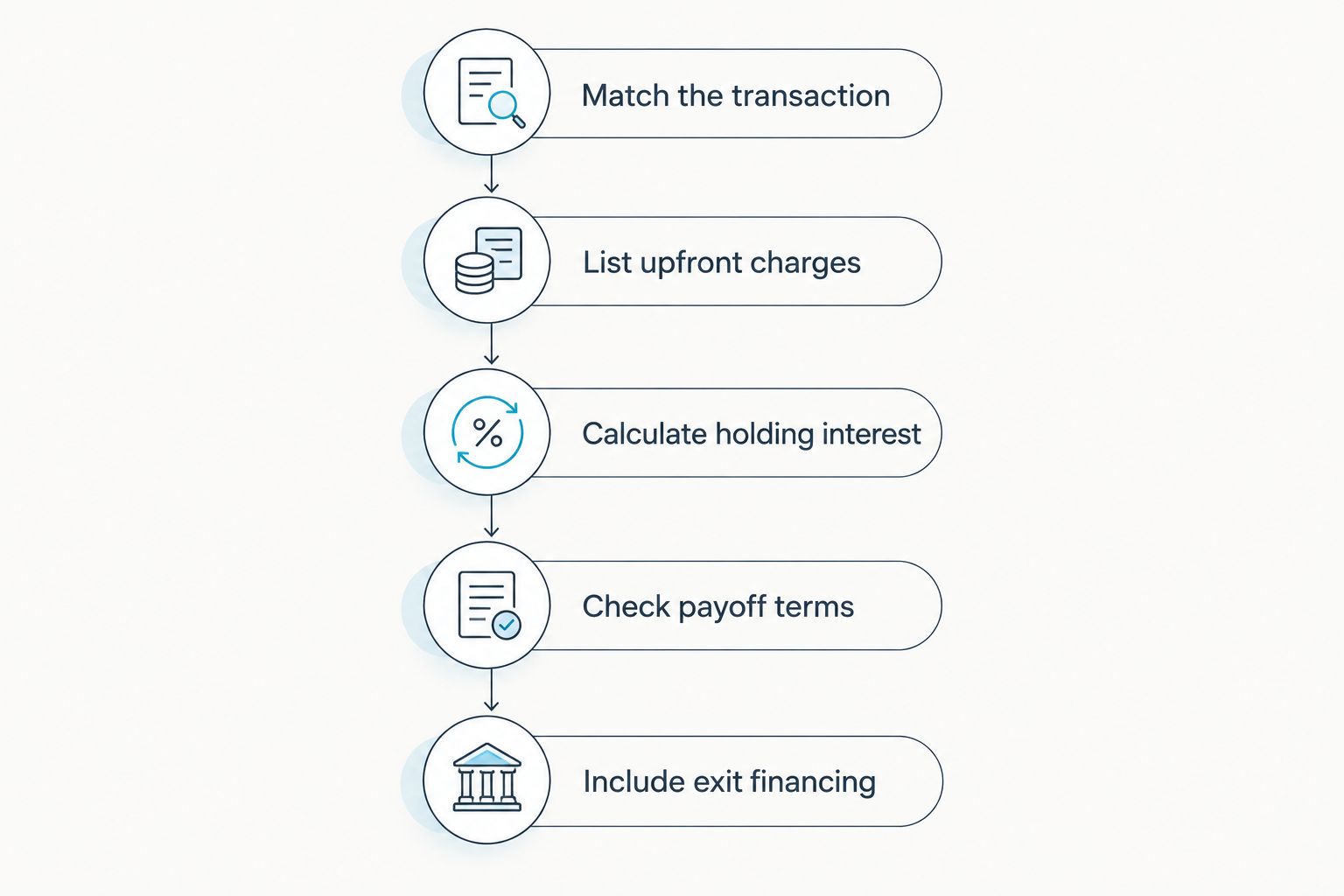
Compare the entire borrowing period, including the cost and conditions of replacing the loan.
Your 2026 worksheet should show financing expense, cash needed at closing, cash needed during renovation, and the balance due at exit. Those are separate outputs. Combining them into a single payment figure hides the decisions you need to make.
What do points and basis points mean?
One discount point equals 1% of the loan amount. Origination charges expressed in points also need a clearly stated calculation base; confirm that base in the offer rather than assuming every percentage applies to the same amount.
A percentage point equals 100 basis points. Basis points describe differences between rates or percentage-based charges; they are not a separate fee category.
These definitions help you read a term sheet, not estimate a current offer. A lender's points, rate, and other charges must come from its written quote. Also distinguish discount points intended to reduce the interest rate from origination charges for arranging the loan.
Is hard money cheaper if I pay it off quickly?
A quick payoff reduces accrued interest only as the contract allows; it does not erase upfront charges. Minimum-interest provisions and prepayment charges can limit the savings from repaying early.
Ask for a payoff illustration tied to your expected exit date. Then request another based on a delayed sale or refinance. Use dates supported by your project schedule, not a universal assumption about renovation speed.
An early sale also changes the comparison with conventional financing. If both loans require substantial closing charges, spreading those expenses over a brief ownership period makes the upfront structure especially important. Compare actual offers through the same payoff date.
Can I refinance hard money into a conventional mortgage?
Refinancing hard money into a conventional mortgage requires a new approval. The replacement lender must accept your qualifications, property condition, ownership history, and transaction structure under its applicable requirements.
Start that review before taking the acquisition loan. Ask the prospective refinance lender which documents, completed repairs, valuation evidence, and ownership requirements it will apply. An acquisition lender's willingness to fund does not bind a future refinance lender.
If you intend to hold a rental, also distinguish personal-income underwriting from property-income underwriting. DSCR means debt-service coverage ratio: it compares qualifying property income with the debt obligation under the lender's calculation. It is a separate financing approach, not a promise of conventional eligibility.
Where a mortgage broker fits
Loanguys is a mortgage broker for investors comparing DSCR, bridge, and fix-and-flip financing. Its investment property loan programs also include bank-statement and short-term rental options, giving you relevant categories to discuss when standard documentation or a transitional property complicates the transaction.
Use Loanguys loan services to identify programs for your intended use, then request written terms for your specific property. Program variety does not establish the lowest cost or guarantee approval. The deciding evidence remains the offer, its conditions, and your ability to repay.
For a 2026 financing discussion, bring the purchase contract, repair scope, income documentation, available funds, and intended exit. Ask which assumptions remain subject to underwriting. That conversation is more useful than requesting a headline rate without describing the deal.
FAQ
How much more does hard money cost than a conventional loan?
Hard money generally costs more, but the difference depends on the written offers and your payoff date. Compare interest, upfront charges, draw-related expenses, and any extension or refinance costs for the same transaction.
What's the best loan for a rental property I plan to keep?
A conventional mortgage is generally a stronger long-term fit when you and the property qualify. Short-term hard money requires an exit, so include the cost and approval conditions of any planned replacement financing.
Does a lower monthly payment mean the loan costs less?
A lower monthly payment does not establish a lower borrowing cost. An interest-only payment leaves principal outstanding, while an amortizing payment includes principal reduction.
Are points the same as the interest rate?
Points are upfront percentage-based charges, not the annual interest rate. One discount point equals 1% of the loan amount; confirm how each charge in your offer is calculated.
Can I avoid hard money fees by refinancing immediately?
Refinancing immediately does not remove fees already incurred. Check minimum-interest and prepayment provisions, then include the replacement loan's closing expenses and approval requirements.
Do hard money loans require no income or credit review?
Hard money lending does not automatically eliminate income or credit review. Underwriting requirements vary by lender and program, so request the actual documentation requirements before relying on an approval.
Can Loanguys help me compare investment property loan programs?
Loanguys offers DSCR, fix-and-flip, bridge, bank-statement, and short-term rental loan programs. Discuss your property, documentation, and exit plan to identify which programs warrant a written offer.
One last thing
Ask what happens if your refinance is declined—not just what happens if it closes. A repayment plan that depends entirely on a future approval leaves an unresolved obligation at maturity. Review the sale alternative, extension language, and available cash before signing the acquisition loan.


