


Delayed Financing for Rental Property Purchase (2026)

Delayed financing lets you buy a rental property with cash, then refinance into a mortgage within six months and pull out up to 75% of what you paid — without waiting through the usual seasoning period lenders require. It works on conventional loans and on DSCR loans in 2026, but the two paths cap your cash-out differently and ask for different paperwork.
TL;DR
- Delayed financing for rental property purchase returns up to 75% of your documented acquisition cost within six months of the cash closing.
- Fannie Mae's delayed financing exception caps cash-out at what you actually paid, not the new appraised value.
- DSCR delayed financing skips income and tax-return documentation and often waives seasoning entirely in 2026.
- Missing closing disclosures or proof-of-funds paperwork sinks more delayed financing applications than credit issues do.
- BRRRR investors use delayed financing to recycle cash into the next deal instead of leaving it tied up in one property.
Why this matters
Cash buyers win bidding wars, but cash sitting in one rental property earns nothing until it's refinanced back out. Delayed financing exists specifically to solve that: it treats your cash purchase as if it happened with a mortgage already in place, so you don't have to sit out the standard six-to-twelve-month waiting period most cash-out refinances require.
For investors running the BRRRR strategy — buy, rehab, rent, refinance, repeat — delayed financing is the mechanism that makes the model work at all. Without it, every cash deal locks up capital for the better part of a year before you can move to the next purchase. Loanguys structures both conventional delayed financing and DSCR delayed financing for investors who need that capital back fast in 2026.
How does delayed financing work for a rental property purchase?
The mechanics are the same regardless of loan type: you close on the property with cash (no mortgage recorded), document the source of those funds, then apply for a refinance that treats the transaction as a purchase-money refi rather than a standard cash-out. The lender caps your loan amount at your actual documented cost, not a higher appraised value, and closing typically lands 30-45 days after application.
Seasoning required
- Conventional delayed financing: None, if refinanced within 6 months
- DSCR delayed financing: Often none — varies by lender
Income documentation
- Conventional delayed financing: Full income and asset verification
- DSCR delayed financing: None — qualifies on property cash flow
Typical cash-out cap
- Conventional delayed financing: Up to 75% of purchase price (1-unit)
- DSCR delayed financing: Roughly 70-75% LTV, lender-dependent
Property titled to
- Conventional delayed financing: Individual name usually required
- DSCR delayed financing: LLC or individual, lender-dependent
Best for
- Conventional delayed financing: Investors with strong W-2 or tax-return income
- DSCR delayed financing: Self-employed investors and portfolio builders
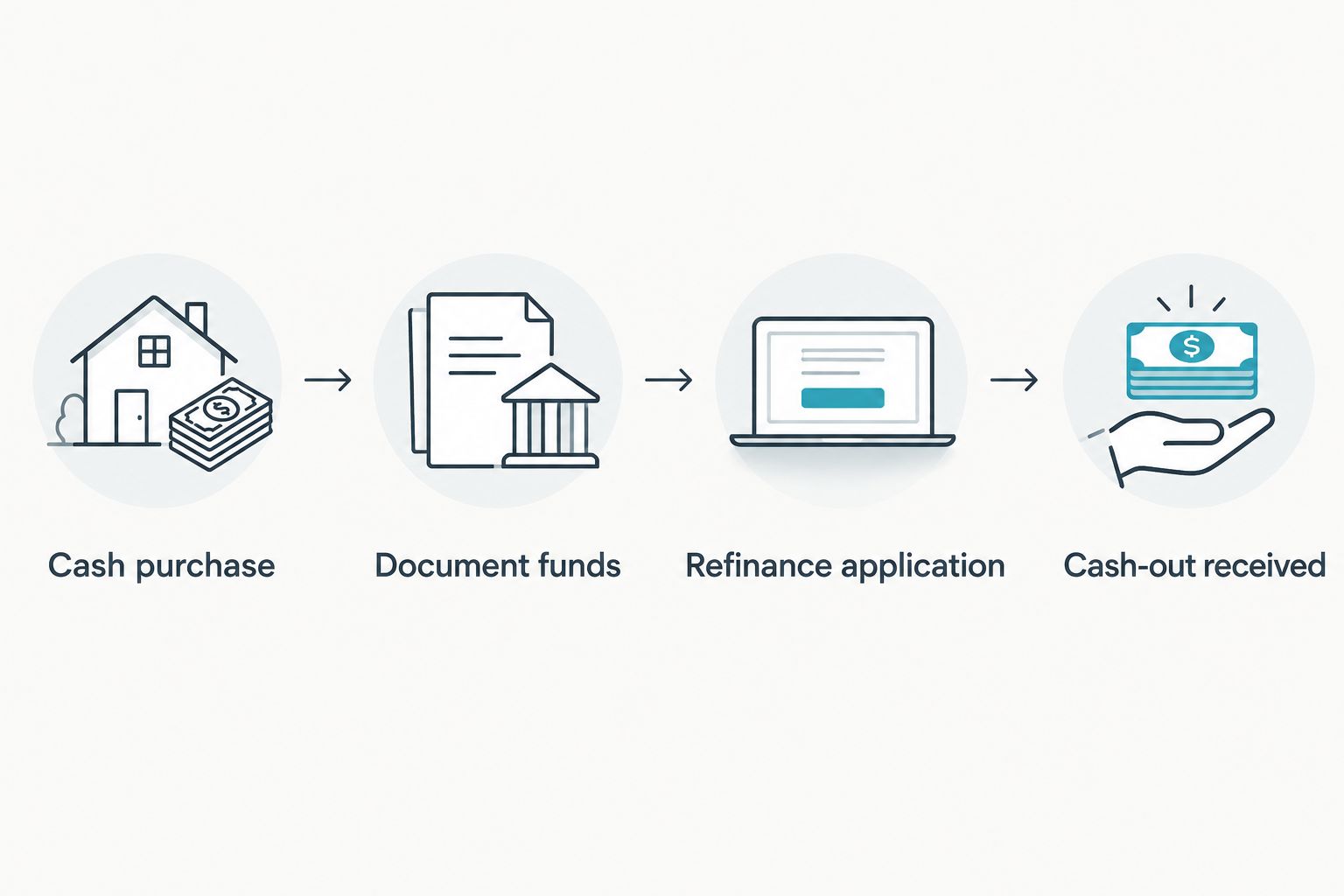
Delayed financing compresses what used to be a six-to-twelve-month wait into one refinance cycle.
Conventional delayed financing: up to 75% of purchase price
Fannie Mae's delayed financing exception is the rule most conventional lenders follow: it lets a borrower refinance a property purchased entirely with cash within six months of closing, without waiting out the standard seasoning period. The catch is the cash-out amount is capped at your documented acquisition cost plus closing costs and prepaid items — not the new appraised value — and the loan-to-value ceiling still applies, which lands around 75% for a single-unit investment property.
This path requires full income documentation: tax returns, W-2s or 1099s, and asset statements proving the cash purchase came from your own funds and not a short-term loan or gift with strings attached. It works well for investors with clean, provable income who bought below market and want the equity back at a conservative rate.
DSCR delayed financing: no income docs, similar caps
DSCR delayed financing qualifies you on the property's rental income instead of your personal income, so there's no tax-return pull and no debt-to-income calculation. Many DSCR lenders also skip the six-month seasoning window that conventional guidelines enforce, letting investors refinance sooner after a cash close in 2026.
Cash-out caps land in a similar range to conventional delayed financing — typically 70-75% loan-to-value — but the qualifying math is different: the lender looks at monthly rent against the projected mortgage payment (debt-service coverage ratio) rather than your personal income statements. Self-employed investors, LLC-titled portfolios, and anyone who bought the property under an entity benefit most from this route. Loanguys structures DSCR loans this way for investors who don't want their personal tax returns in the file at all.
Verdict: DSCR delayed financing wins for self-employed and LLC-titled investors; conventional delayed financing wins for W-2 borrowers chasing the lowest rate.
Why delayed financing terms vary
- Property type — single-unit investment properties typically get better LTV caps than 2-4 unit or condotel properties.
- Entity on title — an LLC-titled purchase routes you toward DSCR delayed financing since conventional guidelines generally require individual title.
- Source of the cash — funds from a HELOC, bridge loan, or short-term loan used to buy the property can disqualify a purchase from being treated as a true cash close.
- Lender overlays — individual lenders set their own seasoning windows and documentation rules on top of any baseline guideline, so terms differ shop to shop.
- Rental history — a property with no lease yet may need projected rent from an appraisal rather than actual signed-lease income for DSCR qualification.
- Time since closing — the further past the six-month mark you go, the fewer lenders treat the refinance as delayed financing rather than a standard cash-out.
Can you use delayed financing on an LLC-titled property?
Yes, but conventional delayed financing generally requires the property to be titled in your individual name, which forces many LLC-titled purchases toward DSCR delayed financing instead. DSCR loans routinely close in an LLC's name, which is why most investors who buy through an entity use that path from the start.
Is there a minimum time you have to wait to use delayed financing?
There's no minimum wait for delayed financing itself — that's the point of the exception — but you generally have to refinance within six months of the original cash closing to qualify under the standard delayed financing framework. DSCR lenders set their own windows, and some will refinance even sooner than that.
Does delayed financing cost more than a normal purchase mortgage?
Delayed financing is underwritten as a refinance, not a purchase, so rate and fee structure follow refinance pricing rather than purchase pricing, which can run slightly higher depending on the lender and loan type in 2026. The bigger cost driver is usually the cash-out LTV cap, since a lower ceiling means less capital returned to redeploy.
Talk through your delayed financing options
See DSCR and conventional delayed financing terms for your cash purchase.
Investors running multiple deals a year often pair delayed financing with a straight BRRRR strategy bridge loan to fund the cash purchase in the first place, then refinance out once the property's rented and stabilized. That combination is what lets a single pool of capital fund several acquisitions in the same year instead of one.
FAQ
What is delayed financing for a rental property purchase?
Delayed financing lets you refinance a rental property bought entirely with cash within six months of closing, without waiting through the standard seasoning period other cash-out refinances require. The refinanced amount is capped at your documented purchase cost, not the new appraised value.
How much cash can you get back with delayed financing?
You can typically get back up to 75% of your documented purchase price on a single-unit investment property under Fannie Mae's delayed financing exception. DSCR delayed financing runs a similar 70-75% LTV range depending on the lender.
Do you need income documentation for delayed financing?
Conventional delayed financing requires full income and asset documentation, including tax returns and bank statements proving the cash source. DSCR delayed financing skips personal income documentation entirely and qualifies on the property's rental income.
Can you use delayed financing if you bought the property in an LLC?
Conventional delayed financing generally requires the property to be titled in your individual name, so LLC-titled purchases usually route to DSCR delayed financing instead. DSCR loans commonly close directly to an LLC.
Is delayed financing the same as a cash-out refinance?
Delayed financing is a specific exception within cash-out refinancing that removes the seasoning requirement for a property bought with cash. A standard cash-out refinance on a property you've owned longer than six months follows normal seasoning and appraised-value rules instead.
How long does delayed financing take to close?
Delayed financing typically closes in 30-45 days after application, similar to a standard refinance timeline. DSCR delayed financing can move faster since there's no income documentation to underwrite.
Can you use a bridge loan for the cash purchase and still qualify for delayed financing?
No — delayed financing requires the original purchase to be made entirely with your own documented funds, so a bridge loan, HELOC, or private note used to close disqualifies the property from delayed financing treatment. That purchase would need a standard refinance instead once seasoning requirements are met.
Does delayed financing work on a property that isn't rented yet?
Yes, delayed financing doesn't require an existing lease for conventional qualification since it's based on your personal income. DSCR delayed financing on an unrented property typically qualifies using projected market rent from the appraisal instead of actual lease income.
One last thing
The part investors miss most: delayed financing caps your cash-out at what you actually paid, plus documented closing costs — not what the property appraises for after you refinance. If you bought below market in 2026, that gap between purchase price and appraised value stays on the table until you do a standard cash-out refinance later, once normal seasoning has passed.


