


Mortgage After W2 to 1099: What Qualifies in 2026
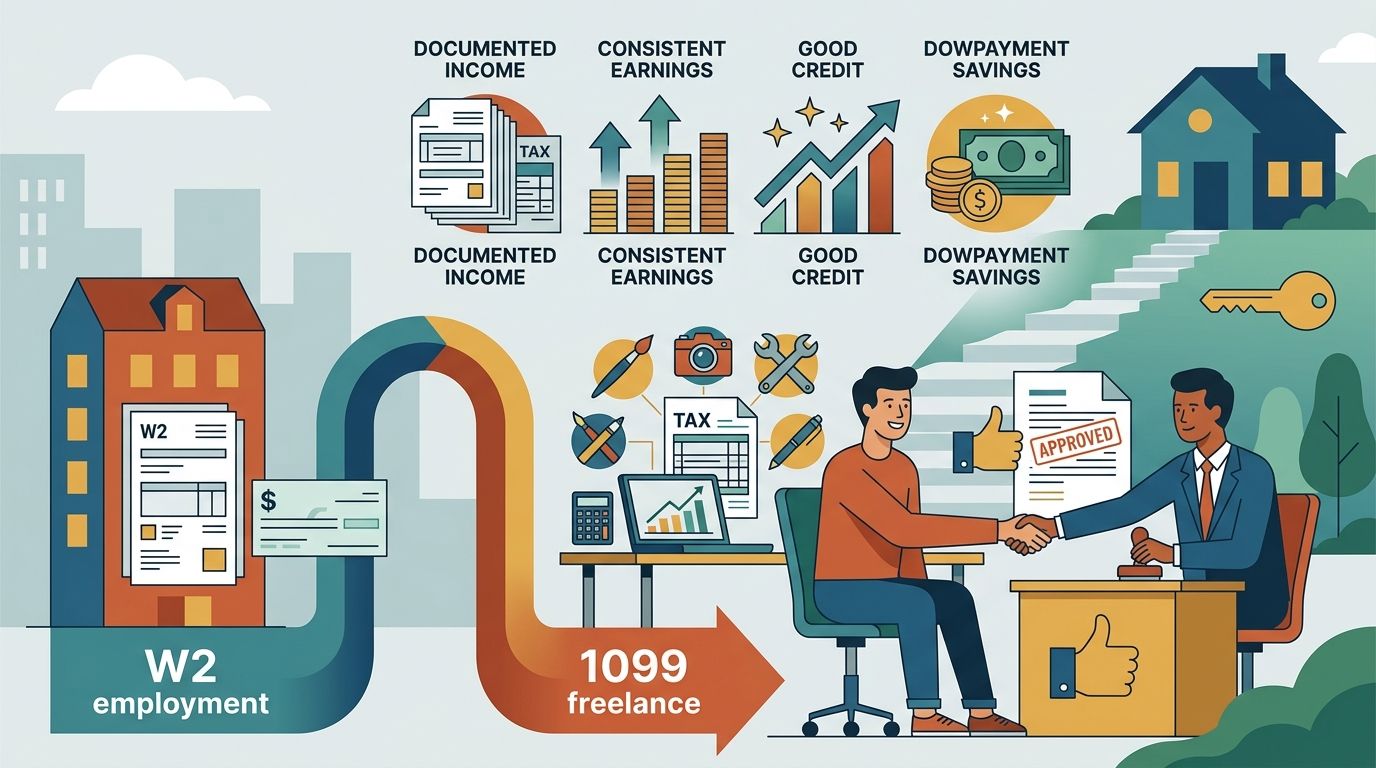
Switching from a W2 paycheck to 1099 income doesn't force you to sit on the sidelines for two years before you can buy a house. Bank statement loans and P&L only programs let you qualify off 12 to 24 months of self-employment income instead of the two full tax years conventional lenders demand. The catch: these non-QM programs typically carry higher rates and larger down payment requirements than a standard Fannie Mae or Freddie Mac loan, so the faster path costs more upfront.
TL;DR
- Conventional lenders want 2 full years of 1099 tax returns before approving a mortgage in 2026.
- Bank statement loans qualify you off 12-24 months of deposits, no tax returns needed.
- P&L only loans can work with as little as 1 year of self-employment history for some borrowers.
- Non-QM programs trade faster approval for higher rates and bigger down payments.
- DSCR loans skip personal income entirely if you're buying a rental instead of a primary home.
Why this matters
Lenders underwrite 1099 income differently than a W2 paycheck because self-employed income is harder to verify and more likely to fluctuate. Fannie Mae and Freddie Mac guidelines built around that assumption still shape most conventional underwriting in 2026, which is why a fresh 1099 filer can get boxed out even with strong bank balances and a solid work history.
The good news: the non-QM market exists specifically to serve people in this gap. If your W2-to-1099 switch happened within the last year or two, you have real options that don't require waiting out a two-year clock.
How to get a mortgage after switching from W2 to 1099 income
The path depends on how long you've been self-employed and what documentation you can produce. Here's how the main routes compare:
Conventional loan
- History required: 2 years
- Documentation: Full tax returns, Schedule C
- Best for: Borrowers with 2+ years of stable 1099 income
Conventional (transition exception)
- History required: 12+ months
- Documentation: Tax returns plus prior W2 history in the same field
- Best for: Borrowers who went 1099 in the same profession
Bank statement loan
- History required: 12-24 months
- Documentation: Personal or business bank statements
- Best for: Self-employed borrowers with strong deposits, thin tax returns
P&L only loan
- History required: As little as 1 year
- Documentation: CPA or self-prepared profit and loss statement
- Best for: Newer 1099 workers without 2 years of returns
DSCR loan
- History required: None on the borrower
- Documentation: Property cash flow only
- Best for: Investment property purchases, not primary residences
Four steps get you from application to approval faster:
- Pull 12-24 months of bank statements (personal or business, depending on the program) before you talk to a lender.
- Get a year-to-date profit and loss statement from your CPA or bookkeeper if your tax returns don't reflect your current income yet.
- Check whether your prior W2 work matches your new 1099 work. Same field, same employer type, or same client roster strengthens a transition-exception case.
- Compare bank statement and non-QM lenders directly — pricing and minimum history requirements vary more here than in the conventional space. A look at the best mortgage lenders for self-employed borrowers is a reasonable starting point before you apply anywhere.
Bank statement loans: qualify off 12-24 months of deposits, not tax returns
Bank statement loans replace tax returns with a lookback at your actual bank deposits, usually 12 to 24 months of personal or business statements. A lender averages your deposits, applies an expense factor, and uses that number as your qualifying income instead of your adjusted gross income on a 1040.
This matters most for someone who just went 1099 because your first year of tax returns often understates real cash flow — write-offs, startup costs, and a partial year of self-employment all shrink the number a conventional underwriter would use. Bank deposits don't have that problem. Loanguys.com runs bank statement loan programs built for 1099 contractors that specifically target this gap. Verdict: Buy — this is the most direct fix for a recent W2-to-1099 switch with healthy deposit activity.
P&L only loans: qualify with as little as 1 year of self-employment history
A P&L only loan drops the bank statement stack entirely and qualifies you off a profit and loss statement your CPA prepares (or, on some programs, one you prepare yourself). This is the shortest history requirement in the non-QM space — some programs will work with a single year of 1099 income if the P&L shows consistent, verifiable profit.
The tradeoff is scrutiny: lenders lean harder on the accuracy of the P&L itself, and a self-prepared statement usually gets less favorable treatment than a CPA-signed one. P&L only mortgage loans for business owners walks through what documentation each version needs. Verdict: Buy for borrowers under 12 months into self-employment with a CPA relationship already in place; Wait if you're relying on a self-prepared P&L with no backup.
Non-QM loans: the broader category that covers both options above
Bank statement and P&L only loans both fall under the non-QM umbrella — loans that don't meet the qualified mortgage rules Fannie Mae and Freddie Mac require. Non-QM underwriting exists precisely because W2-to-1099 transitions, seasonal income, and multi-business owners don't fit conventional boxes cleanly.
How to qualify for a non-QM loan as a self-employed investor covers credit score minimums and reserve requirements that apply across most non-QM programs in 2026. Verdict: Buy if bank statement and P&L programs both feel like a fit — compare rate quotes across a few non-QM lenders before picking one.
Why qualifying timelines vary
- How long you've been 1099 — 3 months of self-employment gets far fewer options than 18 months.
- Whether your new work matches your old W2 field — a transition exception only applies when the fields line up.
- How clean your bank deposits look — irregular, unexplained large deposits slow down or sink bank statement underwriting.
- Credit score and reserves — non-QM lenders lean harder on both when tax return documentation is thin.
- Whether you're buying a primary residence or an investment property — DSCR loans sidestep personal income questions entirely for rental purchases.
- State and property type — condos, multi-unit properties, and certain states carry extra underwriting layers regardless of income documentation type.
Compare 1099 mortgage options now
See which bank statement or non-QM program fits your income history.
How many years of 1099 income do you need for a mortgage?
2 years of 1099 income is the standard conventional requirement, but a documented transition from W2 work in the same field can shorten that to as little as 12 months on some programs. Bank statement and P&L only loans can work with even less history if deposits or profit statements support it.
Can you get a mortgage with only one year of self-employment income?
Yes, one year of self-employment income can qualify you through a P&L only loan or an aggressive bank statement program, though you'll usually need strong credit and reserves to offset the shorter track record. Conventional lenders will almost never approve a straight one-year file without the same-field exception.
Is a bank statement loan better than waiting two years for a conventional mortgage?
A bank statement loan is better if buying now matters more than getting the lowest possible rate, since it trades a higher interest rate and larger down payment for immediate eligibility. If your home purchase timeline is flexible, waiting out the two-year conventional window usually costs less over the life of the loan.
Most buyers in this situation aren't choosing loan types in a vacuum — they're weighing a purchase deadline against a rate difference, and that math changes with every rate environment in 2026.
FAQ
How to get a mortgage after switching from W2 to 1099 income?
You qualify through a bank statement loan (12-24 months of deposits) or a P&L only loan (as little as 1 year of self-employment history) instead of waiting for 2 full years of 1099 tax returns. Conventional loans still require the 2-year history unless your new 1099 work matches your prior W2 field.
What's the best mortgage option for a recent W2 to 1099 switch?
A bank statement loan is the best option for most recent switchers because it uses actual deposits instead of tax returns that may understate a partial first year of income. P&L only loans work better for borrowers under 12 months in with a CPA already producing financial statements.
Is a bank statement loan better than a conventional loan for self-employed borrowers?
A bank statement loan is better for speed and approval odds in the first two years of self-employment, but a conventional loan is usually cheaper once you have 2 full years of tax returns. The choice comes down to whether you need to buy now or can wait.
How much self-employment history do lenders require in 2026?
Most conventional lenders require 2 years of self-employment history documented through tax returns in 2026. Non-QM programs including bank statement and P&L only loans can work with 12 months or less depending on the lender.
Can I use a P&L only loan with less than one year of 1099 income?
Some P&L only programs will consider less than a year of self-employment income, but approval depends heavily on a CPA-prepared statement and strong credit and reserves. Most lenders still prefer at least 12 months of documented income.
Do DSCR loans require 1099 income history at all?
DSCR loans qualify borrowers based on a rental property's cash flow, not personal income, so a W2-to-1099 transition doesn't factor into approval. This only applies to investment property purchases, not a primary residence.
What documents do I need for a bank statement loan?
You need 12 to 24 months of personal or business bank statements, depending on the program, plus standard credit and asset documentation. Tax returns are not required for income qualification on these loans.
Will switching from W2 to 1099 hurt my credit score?
The switch itself doesn't affect your credit score, but income volatility during the transition can make it harder to keep balances low on revolving credit, which does affect your score. Lenders reviewing a 1099 file will weigh both your credit score and your reserves more heavily than a conventional W2 file.
One last thing
The same-field transition exception gets overlooked constantly: if your 1099 work is a continuation of what you did as a W2 employee — same industry, same type of clients, same skill set — some conventional lenders will count your prior W2 years toward the two-year history instead of starting the clock over. Ask about it explicitly before assuming you need a non-QM loan at all.


