


Is a blanket loan worth it for a small rental portfolio?

A blanket loan is worth it for a small rental portfolio in 2026 when you intend to hold the properties together and the written terms justify replacing separate mortgages. The main trade-off is shared collateral: a default can put multiple pledged properties at risk, and selling an individual rental requires satisfying the loan’s release terms. Choose the financing structure that fits your exit plan, not simply the one with fewer payments.
TL;DR
- Is a blanket loan worth it for a small portfolio? Yes, when long-term ownership and written release terms support consolidation.
- A blanket mortgage simplifies debt administration but ties multiple rental properties to the same obligation.
- Separate mortgages suit landlords who want independent sale and refinancing decisions.
- Loanguys is a mortgage broker for investors comparing DSCR, bridge, and other rental financing programs.
Why this matters
For a small landlord, each rental represents a meaningful part of the portfolio. Combining mortgages changes more than your payment schedule: it changes which properties secure the debt and what must happen before you sell one.
Loanguys offers mortgage brokerage services for real estate investors, including DSCR and bridge loan programs. The relevant question for your 2026 financing decision is whether consolidation solves an actual problem without creating an exit restriction you cannot accept.
Is a blanket loan worth it for a small rental portfolio?
A blanket mortgage fits properties you expect to own and finance together; separate mortgages fit properties you expect to manage independently. Neither structure automatically produces better financing. Your existing debt, proposed documents, and ownership plans determine the answer.
Use this comparison for your 2026 review. These are structural differences, not promises about a particular lender’s terms.
Blanket mortgage
- Best for: Landlords holding several rentals under a shared financing plan
- Main advantage: Combines financing under a single loan
- Main drawback: Multiple properties secure the obligation
- What to verify: Release conditions, default provisions, and maturity
Separate mortgages
- Best for: Landlords making property-by-property sale or refinance decisions
- Main advantage: Keeps each mortgage’s collateral separate unless other agreements link it
- Main drawback: Requires managing separate loan schedules and documents
- What to verify: Each loan’s payoff terms and any cross-default provisions
A blanket mortgage consolidates obligations; it does not remove property-level work. You still need to track each rental’s income, expenses, maintenance, insurance, and legal requirements.
Before deciding, write down the problem you want to solve. If your only concern is remembering payment dates, administrative changes avoid replacing otherwise suitable debt. If you need coordinated financing across several properties, a blanket structure deserves a closer review.
When a blanket mortgage fits a small portfolio
Best for: landlords whose rentals share a long-term hold strategy. A blanket mortgage makes structural sense when you expect to keep the pledged properties together and accept the consequences of linking them through the same debt.
That does not mean every property must perform identically. It means the loan’s repayment schedule, collateral requirements, and release provisions must fit the portfolio you actually own.
Look for alignment in these areas:
- Ownership plans: You do not expect an individual sale to fund another essential purchase.
- Debt timing: Replacing existing mortgages serves a defined financing purpose.
- Property condition: Required repairs and operating needs fit your available resources.
- Exit terms: The documents explain how a property leaves the collateral pool.
The benefit is coordinated financing. The drawback is reduced independence: a decision about an individual rental can affect the shared loan.
Recommendation: consider a blanket mortgage only after reviewing the exit provisions alongside the payment terms. A convenient payment arrangement is not sufficient justification for pledging additional properties.
When separate mortgages are the better fit
Best for: landlords who want to sell, refinance, or change individual properties independently. Separate mortgages preserve property-level financing choices, provided no additional agreement links the obligations.
That flexibility matters when your rentals have different futures. You might intend to hold a stable rental indefinitely while selling another after repairs or a lease expiration. Putting both under shared collateral requires reconciling those different plans with the lender’s release conditions.
Existing mortgages also deserve protection from unnecessary replacement. Evaluate what you give up, including the remaining repayment schedule, fixed-rate period, and contractual flexibility. Compare the proposed debt against the loans you have—not against an assumed alternative.
The drawback is administrative work. Separate obligations require separate monitoring, and their maturities do not necessarily align.
Recommendation: keep separate mortgages when independent exits matter more than consolidation. Do not replace debt that already supports your strategy merely to reduce the number of statements you receive.
Why a blanket loan’s value varies
The value of a blanket mortgage varies with the properties and the contract. Focus on these factors rather than searching for a universal portfolio-size cutoff:
- Existing debt: Refinancing changes obligations you already have. Review current payoff terms and the repayment structure you would surrender.
- Collateral exposure: Identify every pledged property and distinguish the mortgage collateral from any personal guarantee.
- Release conditions: Establish the payment, approval, valuation, and documentation requirements for removing a property.
- Rental performance: Review income and expenses by property, then examine the lender’s calculation for the combined portfolio.
- Loan timeline: Compare the amortization schedule with the maturity date and any balloon payment.
- Ownership structure: Confirm that title, borrowing entities, and required guarantees match the proposed transaction.
There is no useful answer based on property count alone. A small portfolio with conflicting sale plans presents a different financing decision from a larger portfolio held under a consistent strategy.
The decisive issue is whether the contract supports your ownership plan without exposing properties unnecessarily.
Check these terms before combining rental mortgages
Partial release
A partial-release provision describes how an individual property can leave the collateral pool while the remaining debt stays in place. Do not assume a sale automatically entitles you to a release.
Ask how the required principal reduction is determined and what conditions apply to the remaining properties. Also establish who approves the release and what documentation the lender requires.
Get the release mechanism in writing before accepting the loan. An informal explanation is not a substitute for the executed documents.
Default and guarantees
Shared collateral exposes the pledged properties to remedies under the same obligation. Review the default provisions, including any cross-default language that connects this loan to another obligation.
A personal guarantee addresses a different issue: the borrower’s or guarantor’s liability beyond the pledged collateral. Have a qualified attorney explain the scope of any guarantee rather than treating an LLC as automatic protection.
Maturity and repayment
Amortization describes how payments reduce principal over time; maturity is the date the remaining debt becomes due. Those schedules are not necessarily identical.
Ask whether the loan ends with a balloon payment, whether the rate changes, and what happens if your planned refinance is unavailable. A smaller scheduled payment does not establish that the overall obligation is easier to repay.
How should you evaluate a blanket loan offer?
Use these 5 steps to evaluate a blanket loan offer in 2026. Work from your property records and the proposed loan documents, not a verbal summary.
- Map existing debt. List each property’s ownership, mortgage balance, payment, maturity, and payoff provisions. Identify which obligations you intend to replace and why.
- Compare structures. Review 2 financing structures side by side: the proposed blanket mortgage and separate property loans. Use consistent assumptions about the properties and your intended holding period.
- Test cash flow. Examine each rental separately before combining the results. Include vacancy, maintenance, insurance, taxes, and other operating obligations in your own planning.
- Test the exit. Walk through selling 1 property while keeping the remaining rentals. Request an explanation of the release process and its effect on the remaining loan.
- Review documents. Reconcile the written terms with your comparison and have legal and tax advisers address the provisions relevant to your situation.
The sequence matters. Comparing payments before identifying collateral and release restrictions leaves the most consequential parts of the decision until last.
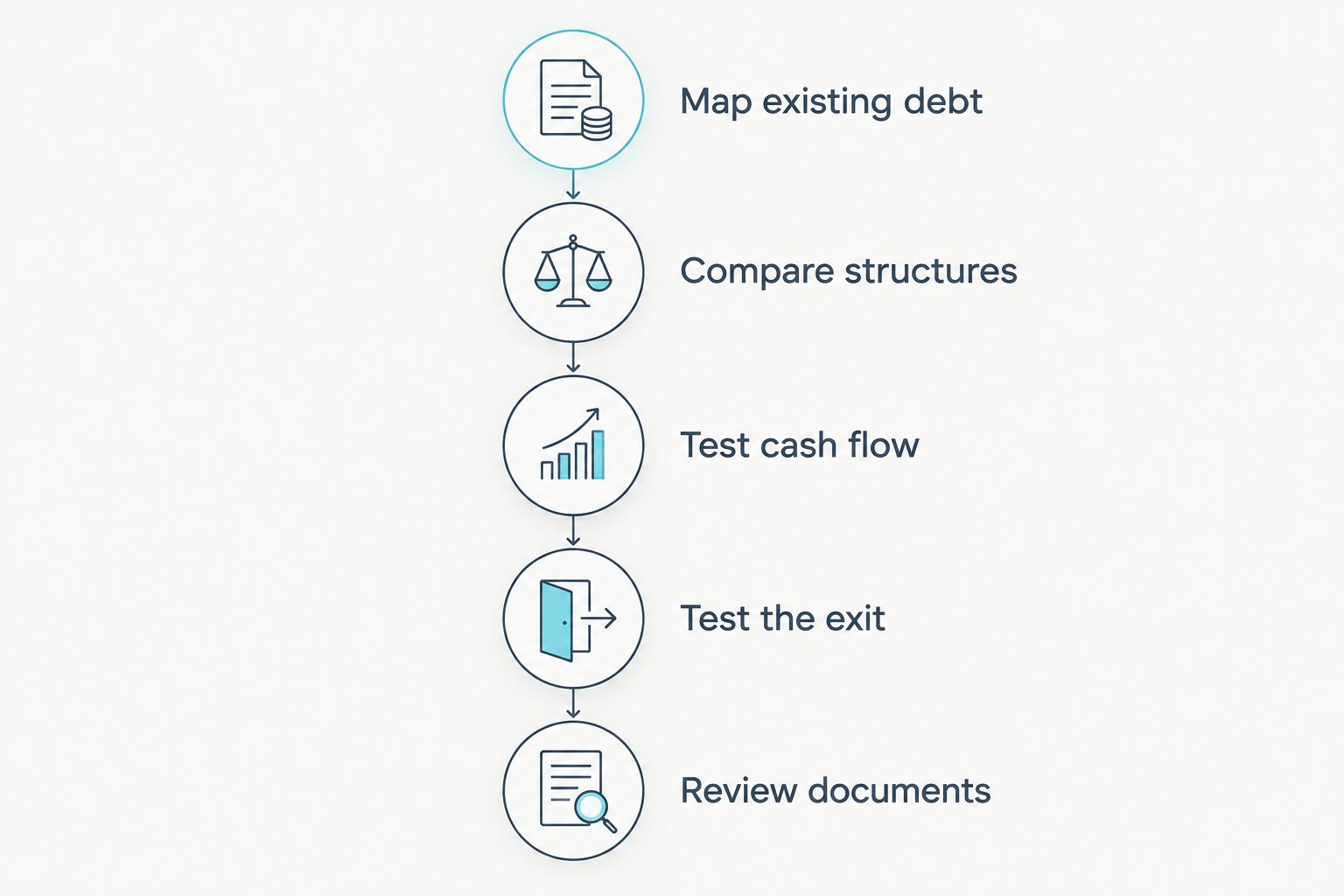
Test the property exit before committing to shared collateral.
For the transaction sequence, see the guide to consolidating multiple rental loans into one blanket mortgage. Keep the decision about whether to consolidate separate from the mechanics of completing it.
Where does a DSCR loan fit in this decision?
A DSCR loan and a blanket mortgage describe different aspects of financing. Debt service coverage ratio, or DSCR, measures income available to cover debt payments; a blanket mortgage describes a loan secured by multiple properties.
The terms are not opposites. Ask whether a proposed rental loan uses property-level or portfolio-level income calculations, and request the lender’s actual formula rather than assuming every DSCR program works alike.
Loanguys is best suited to real estate investors seeking mortgage brokerage services for DSCR, bridge, and other offered loan programs. Loanguys rental financing options include DSCR programs, but that does not establish that a blanket structure is available or appropriate for your properties. Ask which offered programs fit your ownership and financing needs.
Can you sell a rental covered by a blanket mortgage?
Selling 1 property requires resolving the lender’s lien on that property under the loan documents. A partial release provides a contractual route when its conditions are satisfied; without suitable release terms, a sale can require a broader payoff or restructuring.
Review the release conditions before listing the property. The amount you retain from a sale depends on the transaction obligations, not simply the mortgage balance you mentally assign to that rental.
Does a blanket loan eliminate property-level underwriting?
A single loan does not eliminate the need to evaluate its collateral. Expect the lender to specify the property information and supporting documents required for the proposed transaction.
Prepare records for every rental included in the application. A strong combined picture is not a reason to ignore an individual property’s vacancy, condition, title, or operating performance.
FAQ
Is a blanket loan worth it for a small portfolio?
A blanket loan is worth considering when the properties share a long-term ownership plan and the written terms justify shared collateral. Keep separate mortgages when independent sales or refinancing are more important.
What is the biggest disadvantage of a blanket mortgage?
Shared collateral is the central disadvantage of a blanket mortgage. A default can expose multiple pledged properties to enforcement under the same loan.
Can I sell just one property from a blanket mortgage?
You can sell an individual property only after arranging satisfaction or release of the lender’s lien. Review the partial-release requirements before committing to a sale.
Is a blanket mortgage the same as a DSCR loan?
A blanket mortgage is not the same as a DSCR loan. Blanket describes the collateral structure, while DSCR concerns the relationship between income and debt payments.
Will a blanket mortgage automatically lower my payment?
A blanket mortgage does not automatically lower your payment. Compare the actual proposed repayment terms with your existing obligations, including maturity and any balloon payment.
Should I put every rental into a blanket mortgage?
Do not include every rental merely for convenience. Evaluate each property’s existing financing, ownership structure, and intended exit before pledging it.
Can Loanguys help me explore rental property financing?
Loanguys offers mortgage brokerage services for rental financing, including DSCR and bridge loan programs. Ask which offered program matches your properties and ownership plans rather than assuming blanket financing is the right structure.
One last thing
Ask for a written property-exit walkthrough before signing a blanket mortgage in 2026. Pick the rental you are most likely to sell and trace the required approvals, principal reduction, and conditions on the remaining collateral.
That exercise tests the financing against a real ownership decision. If the exit conflicts with your plans, fewer payments will not fix the mismatch. Have qualified legal and tax advisers review the transaction before you commit.


