


Is a cash-out refinance better than a HELOC for rental properties?

A cash-out refinance is better when you need a lump sum and replacing your existing rental mortgage makes financial sense; a HELOC is better when you want staged access to equity while keeping that mortgage. The hidden trade-off is that refinancing changes the financing on your entire mortgage balance, while a HELOC adds another obligation and typically exposes you to variable-rate payments. For 2026, choose based on total debt payments, your borrowing schedule, and your repayment plan—not the amount of equity you can access.
TL;DR
- Cash-out refinance vs HELOC for rental property: choose mortgage replacement for lump-sum needs, staged borrowing for flexibility.
- A cash-out refinance changes the financing on your existing mortgage balance, not just the cash you withdraw.
- A HELOC preserves your existing mortgage but typically adds variable-rate debt and repayment-period risk.
- Loanguys offers DSCR and bank-statement financing; compare qualification methods alongside loan structure.
Why this matters
Your rental property secures the borrowing under either approach. If the investment funded by that borrowing disappoints, the debt still belongs to you—and missed payments put the collateral at risk.
Loanguys is a mortgage broker offering investment-property financing, including DSCR and bank-statement programs. Start with the property’s cash flow and your existing mortgage terms before choosing a financing structure.
The right 2026 decision preserves enough breathing room for vacancies, repairs, taxes, and insurance. Access to equity is not the same as capacity to repay it.
Is a cash-out refinance better than a HELOC for rental properties?
Neither structure wins automatically. A cash-out refinance replaces your existing mortgage with a larger loan and delivers the remaining proceeds after mortgage payoff and applicable closing charges. A home equity line of credit, or HELOC, generally sits alongside your current mortgage and lets you borrow against an approved line under its agreement.
Best for
- Cash-out refinance: A defined lump-sum need when replacing the mortgage works
- HELOC: Staged borrowing when keeping the mortgage matters
Existing mortgage
- Cash-out refinance: Replaced by the new loan
- HELOC: Generally stays in place
Access to funds
- Cash-out refinance: Proceeds delivered through the refinance closing
- HELOC: Draws permitted under the credit agreement
Interest exposure
- Cash-out refinance: Depends on whether the new loan is fixed or adjustable
- HELOC: Typically variable; verify the contract
Principal repayment
- Cash-out refinance: Depends on the mortgage’s amortization terms
- HELOC: Draw-period and repayment-period obligations can differ
Main advantage
- Cash-out refinance: One replacement mortgage with a defined funding event
- HELOC: Borrowing can follow the project’s spending schedule
Main drawback
- Cash-out refinance: Changes financing on the existing balance
- HELOC: Adds debt and potential payment uncertainty
Compare written proposals using the same cash requirement and expected payoff date. Otherwise, a smaller initial payment can hide a longer repayment period or a larger balance remaining when you sell.
Cash-out refinance: best for a defined lump-sum need
A cash-out refinance fits an investor who knows how much capital the project requires and has a sound reason to replace the existing mortgage. Examples include funding another property purchase or completing a renovation with a settled scope.
A fixed-rate cash-out refinance also provides predictable principal-and-interest payments. That does not freeze your total ownership expenses: property taxes, insurance, maintenance, and other costs still change.
Where a cash-out refinance helps
- Defined funding: You receive the refinance proceeds rather than managing repeated draws.
- Mortgage restructuring: The replacement loan can change the term or repayment structure alongside the equity withdrawal.
- Payment planning: Fixed-rate, fully amortizing terms make scheduled debt payments easier to forecast.
Where a cash-out refinance falls short
The new financing applies to the entire replacement mortgage. If your current loan has favorable terms, giving them up can outweigh the benefit of accessing cash.
Extending repayment also deserves scrutiny. A lower scheduled payment does not establish lower lifetime borrowing expense, especially when the new loan restarts amortization over a longer period.
Choose a cash-out refinance when the replacement mortgage works for the property—not merely because the cash proceeds look attractive. For a 2026 comparison, evaluate the outstanding balance at your expected sale or refinance date as well as the monthly payment.
HELOC: best for staged borrowing while keeping your mortgage
A HELOC fits a project in which spending happens in phases and preserving the existing mortgage is a priority. Under the agreement’s draw rules, you access funds as needed rather than taking the entire approved line immediately.
HELOC interest generally applies to the amount drawn, not the entire unused credit limit. Other contractual charges can still apply, so an undrawn line is not automatically free to maintain.
Where a HELOC helps
- Mortgage preservation: Your existing first mortgage generally remains unchanged.
- Staged funding: Draws can follow contractor invoices or other planned expenses.
- Repayment flexibility: Revolving access during the draw period supports repeated borrowing and repayment, subject to the agreement.
Where a HELOC falls short
HELOCs typically carry variable interest rates, so payments can change even without additional borrowing. Payment obligations can also increase when the draw period ends and principal repayment begins.
An approved line is not an unconditional emergency reserve. Agreements can permit freezes or reductions under specified circumstances, including a significant decline in property value.
Choose a HELOC only when the repayment plan survives both rate changes and the transition out of the draw period. Confirm that the proposal specifically permits a non-owner-occupied rental property; owner-occupied terms do not establish investment-property eligibility.
Why the better choice varies
The cash-out refinance vs HELOC for rental property decision turns on these factors, not a universal product ranking:
- Existing mortgage terms: Replacing favorable financing affects the full mortgage balance. A HELOC generally leaves that balance under its current agreement.
- Spending schedule: A defined purchase needs funding at closing; a phased project needs funds over time. Match access to the actual spending plan.
- Repayment source: Identify whether repayment comes from rent, business income, a property sale, or another documented source. Do not treat a hoped-for refinance as a guaranteed exit.
- Equity and liens: Property value, existing secured debt, and lender limits determine borrowing capacity. An estimated market value is not an approval.
- Qualification method: Credit, income documentation, rental income, ownership structure, and property eligibility affect which programs fit.
- Holding period: Your expected sale or payoff date changes the importance of upfront charges, amortization, and contractual prepayment provisions.
Loan-to-value, or LTV, compares a loan balance with the property’s value. Combined loan-to-value, or CLTV, considers multiple secured balances; ask how the lender treats the HELOC limit in that calculation.
How do you compare actual proposals in 2026?
Start with a written borrowing plan. Then require each lender to explain the loan against that same plan, rather than comparing unrelated advertised terms.
- Define the cash need. Separate committed project expenses from contingency funds. Decide whether you need the full amount immediately or in stages.
- Record existing debt. Gather the mortgage statement, rate structure, remaining term, and any prepayment provisions. Obtain a payoff statement when needed for an accurate refinance calculation.
- Match the proceeds. Compare net cash delivered by the refinance with the HELOC draws you actually expect to use. A credit limit and cash received are different things.
- Test repayment. Model scheduled payments, principal reduction, and the balance remaining at your expected exit. Include variable-rate and repayment-period changes where applicable.
- Check restrictions. Confirm rental use, title ownership, draw conditions, lien requirements, and any early-closure or prepayment terms in writing.
Keep the comparison property-specific. A proposal for an individually owned long-term rental does not establish eligibility for an LLC-owned vacation rental.
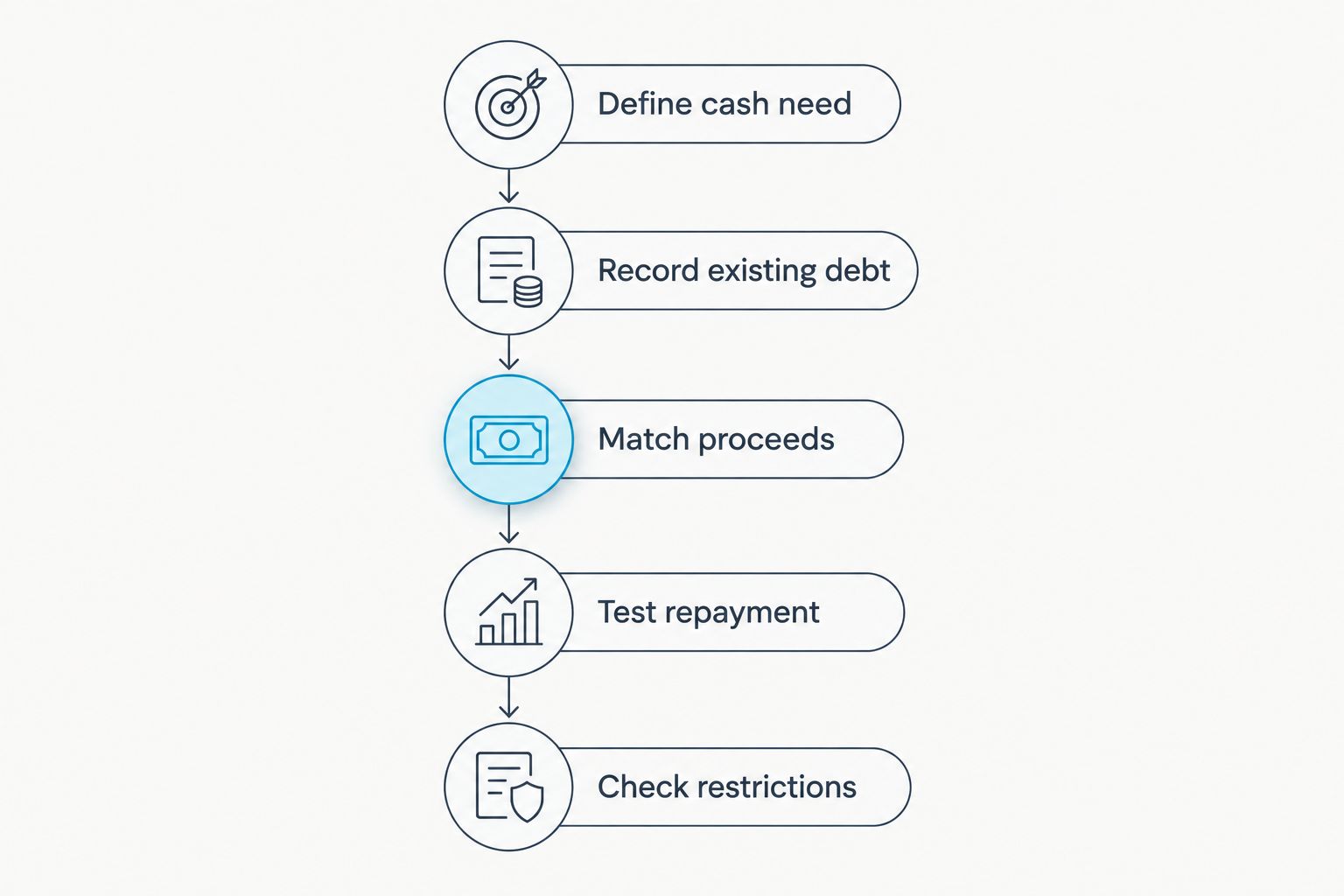
Compare the same cash need and repayment plan before choosing a loan structure.
Can rental income help you qualify for a cash-out refinance?
Rental income can support qualification, but the method depends on the loan program. A conventional investment-property mortgage and a DSCR loan do not use identical underwriting rules.
DSCR means debt service coverage ratio. In rental lending, it compares qualifying property income with the housing payment defined by the program; confirm the income calculation, included expenses, and required coverage with the lender.
Loanguys is best for rental investors seeking a mortgage broker offering DSCR and bank-statement financing. Those programs address different documentation needs, but neither label guarantees approval or makes a weak repayment plan sound.
For an LLC-owned property, confirm title and borrower requirements before paying for transaction expenses. The distinction matters when considering DSCR loans for LLC-owned rental properties, because ownership structure belongs in the initial eligibility discussion—not at closing.
Is a home equity loan better than a HELOC?
A home equity loan is another structure to compare when you want a lump sum without replacing the existing first mortgage. Unlike a revolving HELOC, it generally delivers a single advance with a scheduled repayment obligation.
The distinction among home equity loan options is structural: lump-sum borrowing commits the funds upfront, while revolving borrowing separates the approved limit from the amount drawn. For a U.S. rental property, establish investment-property eligibility and review the actual agreement rather than transferring assumptions from another market.
Home equity loan
- Best for: A known lump-sum need while retaining the first mortgage
- Main benefit: Defined advance and scheduled repayment
- Main drawback: Interest applies to the advanced balance, even before you spend it
HELOC
- Best for: Spending that happens in stages
- Main benefit: Draws can track actual expenses
- Main drawback: Typically variable rates and changing repayment obligations
Cash-out refinance
- Best for: A lump sum plus a justified mortgage replacement
- Main benefit: Restructures the mortgage and releases equity together
- Main drawback: Replaces financing on the existing mortgage balance
Do not choose a home equity loan solely to avoid variable-rate exposure. Compare its full repayment schedule and contractual terms with both alternatives.
What should you check before borrowing against rental equity?
Your borrowing ceiling is not your spending target. In 2026, test the property’s ability to carry the proposed debt without assuming uninterrupted occupancy or a future increase in value.
Build your review around these checks:
- Vacancy: Identify how you will make debt payments when rent stops.
- Repairs: Keep funds available for expenses that do not wait for the next tenant payment.
- Payment changes: Read the HELOC’s rate-adjustment terms and repayment-period provisions.
- Exit timing: Confirm what happens if the planned sale or refinance takes longer than expected.
- Use of proceeds: Keep records showing where borrowed funds went, especially when funding another property.
Tax treatment requires a separate review. Do not assume interest is deductible simply because a rental property secures the debt; the use of proceeds and applicable tax rules matter. Ask your tax adviser to review the intended use before closing.
A Loanguys rental-property financing discussion should start with the current mortgage, intended use of funds, ownership structure, and repayment source. Bring those details so the discussion stays focused on a workable loan rather than the largest possible advance.
FAQ
Is a cash-out refinance better than a HELOC for a rental property?
A cash-out refinance is better when you need a lump sum and replacing your existing mortgage makes financial sense. A HELOC better matches staged spending when preserving the existing mortgage is a priority, provided you can manage its repayment risks.
Can I get a HELOC on a rental property I do not live in?
A rental-property HELOC requires a lender and program that permit non-owner-occupied collateral. Confirm occupancy, property type, ownership, and qualification rules before relying on terms advertised for a primary residence.
Does a cash-out refinance replace my existing mortgage?
A cash-out refinance replaces your existing mortgage with a new loan and releases the remaining proceeds after payoff and applicable closing charges. Evaluate the new terms on the entire replacement balance, not just the cash withdrawn.
Will a HELOC payment stay the same every month?
A HELOC payment is not necessarily fixed because the balance, variable interest rate, and repayment requirements can change. Read both the draw-period and repayment-period terms before borrowing.
Can I use rental income to qualify for a cash-out refinance?
Rental income can support qualification under eligible programs, including DSCR structures that evaluate qualifying property income against a defined housing payment. Documentation and coverage requirements depend on the program.
Can I use rental equity for another property down payment?
Borrowed equity can fund another property purchase when the receiving loan program permits that source of funds. Disclose the borrowing and include the additional debt when evaluating both properties’ repayment capacity.
Does Loanguys offer rental-property financing?
Loanguys offers investment-property financing, including DSCR and bank-statement programs. Confirm the program, documentation, property, and ownership requirements for your proposed transaction.
One last thing
Unused credit is not the same as cash you control. A HELOC limit remains subject to its agreement, while cash-out proceeds create a funded debt obligation whether you spend the money immediately or leave it untouched.
Before signing in 2026, write down exactly how much you need, when you need it, and what repays it. If the repayment answer depends entirely on another lender approving a future refinance, the financing plan is not complete.


