


Is DSCR loan interest higher than a conventional mortgage?

Yes—DSCR loan rates are generally higher than conventional mortgage rates because lenders qualify the rental property primarily through its income rather than your documented personal income. The interest rate also excludes closing costs and any applicable prepayment penalty, so a lower rate does not automatically mean a less expensive loan. For a useful 2026 comparison, request quotes for the same investment property, loan amount, repayment structure, and rate-lock period.
TL;DR
- Are DSCR loan rates higher than conventional? Generally yes; compare investment-property quotes, not owner-occupied mortgage advertisements.
- DSCR loans prioritize rental income; conventional mortgages also assess your qualifying personal income and debts.
- Compare fees, repayment structure, and prepayment terms before choosing a lower interest rate.
- Loanguys offers DSCR financing for real estate investors; approval and loan terms depend on underwriting.
Is DSCR loan interest higher than a conventional mortgage?
DSCR financing generally carries a higher interest rate than comparable conventional investment-property financing, but there is no universal rate gap. Your property, credit profile, down payment, and loan terms determine the actual comparison. An advertised conventional rate for a primary residence is not a valid benchmark for a rental-property loan.
Loanguys is a mortgage broker offering DSCR and other financing programs to real estate investors. Compare the financing route that fits your qualification profile—not just the headline rate.
Best for
- DSCR investment-property loan: Investors seeking qualification centered on rental income
- Conventional investment-property mortgage: Investors whose documented income and debts meet conventional guidelines
Primary qualification approach
- DSCR investment-property loan: Property income relative to its required debt payment
- Conventional investment-property mortgage: Personal income, debts, credit, assets, and eligible rental income
General rate relationship
- DSCR investment-property loan: Often higher than comparable conventional financing
- Conventional investment-property mortgage: Often lower when you qualify for comparable terms
Main advantage
- DSCR investment-property loan: Less reliance on personal-income qualification
- Conventional investment-property mortgage: Potentially lower financing costs
Main limitation
- DSCR investment-property loan: Higher borrowing costs can reduce rental cash flow
- Conventional investment-property mortgage: Personal-income documentation and debt calculations can restrict eligibility
Important check
- DSCR investment-property loan: Rent calculation, prepayment provisions, and repayment structure
- Conventional investment-property mortgage: Rental-income treatment, debt-to-income calculation, and property eligibility
Neither column is an approval promise. A DSCR lender still evaluates credit, property value, available funds, and program eligibility; conventional lenders also apply property and borrower requirements.
Why this matters
A rental property needs financing that both closes and leaves you with a workable operating budget. A conventional mortgage with a lower quoted rate has little practical value if your documented income does not qualify you for the required loan amount.
The reverse matters too. If you qualify for conventional financing, paying more for a different qualification method needs a clear business reason. In 2026, compare executable loan offers rather than choosing a program based on its reputation for flexibility.
Start with eligibility, then compare total borrowing costs. That order prevents you from treating an unavailable mortgage as your cheapest option.
Why DSCR loan rates vary
DSCR lenders do not all evaluate rental income or structure loans identically. Conventional lenders also apply different eligibility requirements and pricing adjustments. These factors explain why your actual quotes matter more than a general statement that one category costs more:
- Rental coverage: Stronger accepted rental income relative to the required payment gives the lender more repayment cushion. Ask exactly which income and payment components enter the calculation.
- Loan-to-value ratio: LTV compares your loan amount with the property's value. A larger down payment reduces LTV, but you must also retain enough cash for closing and property operations.
- Credit profile: Your credit history remains relevant even when personal income is not the primary qualification method. Property cash flow does not replace credit review.
- Property and rental use: A long-term lease, short-term rental, unusual property, or different unit configuration can change eligibility and underwriting requirements.
- Transaction purpose: A purchase, rate-and-term refinance, and cash-out refinance are different transactions. Compare quotes for the same purpose and proceeds.
- Loan structure: Fixed or adjustable rates, amortizing or interest-only payments, lender fees, and prepayment provisions affect the offer. Changing these terms changes the comparison.
Ask the lender to explain the conditions attached to each quote. A verbal rate without its assumptions is not enough to support a financing decision.
How do lenders measure rental coverage?
DSCR means debt service coverage ratio. For residential rental programs, lenders commonly compare accepted rental income with the property's required housing payment, often including principal, interest, taxes, insurance, and applicable association dues. Confirm the program's exact formula because commercial-property calculations and individual lender methods differ.
The ratio describes coverage, not profit:
- 1.00x coverage means accepted income equals the payment used in the calculation.
- 1.25x coverage means accepted income equals 125% of that payment.
- 0.90x coverage means accepted income equals 90% of that payment.
These are mathematical meanings, not approval thresholds. There is no single minimum ratio that applies to every DSCR lender or program.
A property at 1.00x coverage has no cushion within that calculation, but the ratio still does not capture every ownership expense. Maintenance, vacancy, management, and repairs can reduce your actual cash flow beyond the payment components the lender includes.
Use the lender's DSCR calculation for qualification and your own operating budget for the investment decision. Passing underwriting does not establish that a rental is profitable.
Conventional financing: best for documented-income borrowers
Conventional investment-property financing deserves an early comparison when you can document qualifying income and meet the lender's debt-to-income requirements. Debt-to-income, or DTI, compares qualifying monthly debt obligations with qualifying monthly income. Rental income can contribute, subject to applicable documentation and calculation rules.
The advantage is the potential for a lower interest rate and lower overall financing expense. The limitation is that the lender must accept enough income under its guidelines, which is not necessarily the same as the cash moving through your business.
Self-employment does not automatically rule out a conventional mortgage. However, business deductions, income changes, and complex ownership arrangements can affect the income the lender accepts. Ask for an actual qualification review before assuming that a conventional loan is unavailable.
Best for: Investors whose income documentation supports the transaction and who want to compare conventional borrowing costs before considering alternative qualification methods.
DSCR financing: best for rental-income qualification
DSCR financing is relevant when a rental property's income supports the loan but your personal-income documentation makes conventional qualification difficult. The program centers the property income calculation instead of relying primarily on your employment or business income.
That approach has a trade-off. A higher rate increases the required payment, which can weaken both rental coverage and your remaining cash flow. Additional documentation flexibility does not eliminate appraisal, credit, asset, or property requirements.
Loanguys is best suited to investors seeking a mortgage broker offering DSCR financing alongside other investment-property loan programs. The broker's program range is relevant to comparing qualification routes; it does not establish that any particular loan has the lowest rate.
Best for: Investors who need property-income-based qualification and can justify the resulting loan terms through a realistic rental budget.
How do you compare DSCR and conventional quotes fairly?
Use the same written comparison process for every 2026 offer. A useful comparison separates your qualification method from the features that determine borrowing costs.
- Match the property. Identify the same address, rental use, property type, and intended borrower. Do not compare an investment-property DSCR loan with an owner-occupied conventional mortgage.
- Match the loan. Request the same loan amount, transaction purpose, term, and repayment structure. Interest-only and fully amortizing payments are not interchangeable.
- Match the timing. Request quotes close together and confirm the lock period. An unlocked indication and a locked offer do not provide the same protection against rate changes.
- Check the costs. Review lender charges, discount points, third-party expenses, and required cash at closing. Separate prepaid taxes and insurance from charges for obtaining the loan.
- Check the exit. Read the prepayment terms and calculate your expected balance at the time you plan to sell or refinance. Ask which events trigger any penalty.
Keep the assumptions beside each offer. If the lender changes the accepted rent, required down payment, or loan amount during underwriting, update your comparison before making the decision.
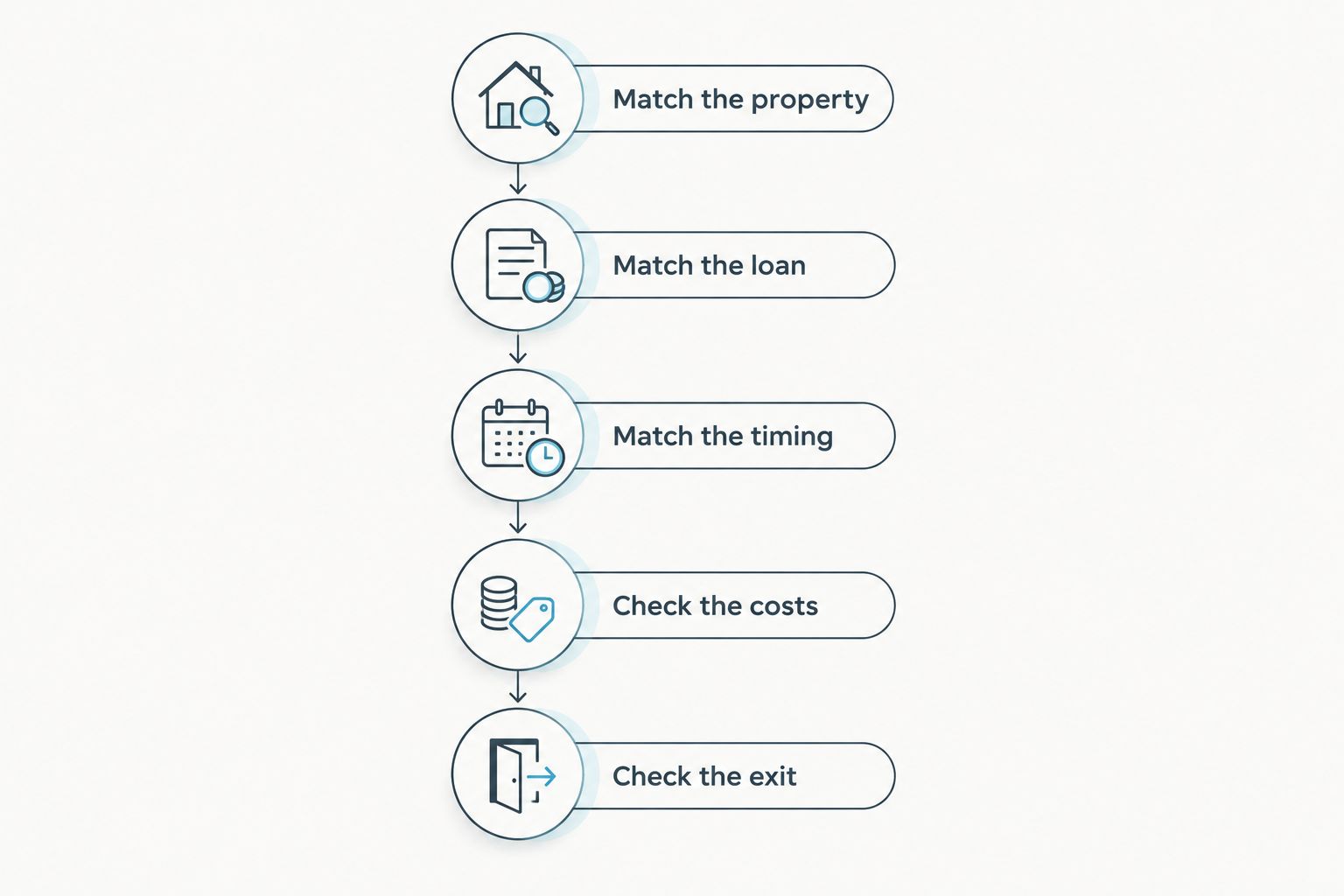
Match the loan assumptions before deciding which offer costs less.
What should you compare besides the interest rate?
Compare the cost of borrowing over your expected ownership period, not just the next payment. Start with lender charges and interest, then account for any applicable exit charges. Review principal reduction separately so you understand how much debt remains.
Discount points are upfront charges paid in exchange for a different rate. A lower rate obtained through points needs enough time to recover the additional upfront expense. If you expect an early sale or refinance, ask for a comparison without points as well.
A prepayment penalty creates a different issue: it can make an early exit more expensive even when the monthly payment looks attractive. Ask for the actual schedule and triggering conditions rather than accepting a summary such as investor-friendly terms.
Review DSCR loan closing costs alongside the lender's written quote. For a 2026 purchase, use current property-tax and insurance information rather than assuming the seller's existing expenses will remain unchanged.
Is a higher-rate DSCR loan worth it?
A higher-rate DSCR loan is worth considering when it supports an eligible rental purchase that conventional qualification does not support and the property's budget still works. Financing access is a benefit, but it is not a substitute for sustainable cash flow.
Test the investment against vacancy, repairs, management expenses, and the payment required under the proposed loan. Keep funds available after closing rather than committing every available dollar to a larger down payment.
Do not justify an unaffordable payment solely by assuming you will refinance later. Your future property value, rental income, credit profile, and available loan terms will determine that opportunity.
Does a larger down payment guarantee a lower DSCR rate?
A larger down payment does not guarantee a lower DSCR rate. It reduces LTV and the loan amount, but the lender's pricing also depends on credit, rental coverage, property characteristics, and the selected terms.
Ask for written alternatives that show the effect on both the loan payment and your remaining cash. The best structure preserves a workable operating reserve rather than pursuing the lowest rate at any cost.
FAQ
Are DSCR loan rates higher than conventional mortgage rates?
DSCR loan rates are generally higher than comparable conventional investment-property mortgage rates. Compare the same property, loan amount, repayment structure, fees, and lock period before deciding.
How much higher are DSCR rates in 2026?
There is no universal DSCR rate premium for 2026. The difference depends on the borrower, property, lender, and loan structure, so use matched written quotes rather than a fixed assumed spread.
Can I get a DSCR loan for the home I live in?
DSCR investment-property loans are intended for investment use, not financing your primary residence. Disclose your intended occupancy and confirm the property's eligibility before applying.
Does a DSCR loan mean no documents are required?
A DSCR loan does not eliminate documentation. Lenders still review items such as credit, assets, property value, and rental income, with exact requirements determined by the program.
Is an interest-only DSCR loan cheaper than a conventional mortgage?
An interest-only payment does not establish that a DSCR loan is cheaper. Principal does not decline through scheduled interest-only payments, and you must also compare fees, future payment obligations, and exit terms.
Can I refinance a DSCR loan into a conventional mortgage later?
Refinancing into a conventional mortgage requires you and the property to meet the applicable guidelines at that time. Check the existing loan's prepayment provisions and do not assume future rates or approval.
Does Loanguys offer DSCR loans for real estate investors?
Loanguys offers DSCR loan programs for real estate investors as a mortgage broker. Request a property-specific review to understand eligibility, documentation, and proposed terms.
One last thing
A lower payment is not the same as a lower borrowing cost. Interest-only payments and longer amortization can reduce the immediate payment while leaving more principal outstanding when you exit.
Before accepting a 2026 loan offer, ask for the projected remaining balance at your intended sale or refinance date. Put that balance beside upfront charges, interest paid, and any prepayment penalty. That comparison reveals trade-offs the headline rate leaves out.


