


LendingTree alternatives for DSCR loan shopping

LendingTree helps you compare lenders through a lending marketplace rather than approaching each lender separately. For DSCR loan shopping, the next step is finding a financing provider whose underwriting fits your rental property, not simply collecting more contacts. The best LendingTree alternative in 2026 is Loanguys if you need a mortgage broker offering DSCR and other investor loan programs; a direct DSCR lender is the better route if you want to evaluate one lender's program directly.
TL;DR
- Loanguys leads LendingTree alternatives for DSCR loans when you need a broker offering rental-property financing and other investor programs.
- A direct DSCR lender suits investors who want to discuss underwriting with the financing provider.
- Banks and credit unions deserve comparison when documented personal income supports an investment-property mortgage.
- Seller financing is a separate purchase strategy, not a substitute DSCR loan program.
Why this matters
A debt service coverage ratio, or DSCR, compares qualifying property income with the debt payment used by the lender. Residential rental programs commonly evaluate rent against principal, interest, taxes, insurance, and applicable association dues; commercial calculations can use net operating income instead. Ask which calculation applies before comparing offers.
The shopping channel and the loan program are different decisions. LendingTree is a marketplace, a mortgage broker arranges financing, and a direct lender evaluates its own lending program. None of those labels establishes whether your property qualifies.
For your 2026 search, compare underwriting assumptions before choosing a financing channel. A useful discussion ends with a clear explanation of acceptable income evidence, property eligibility, borrowing structure, and repayment obligations.
LendingTree alternatives at a glance
These options represent different ways to shop or arrange financing, not interchangeable DSCR products. Match the route to your transaction before requesting terms.
LendingTree
- Best for: Initial lender discovery
- Standout distinction: Marketplace-based lender comparison
- How it differs from LendingTree: The benchmark shopping channel
- Main limitation: Marketplace discovery does not establish DSCR eligibility
Loanguys
- Best for: Investors considering DSCR alongside other financing programs
- Standout distinction: Mortgage broker offering DSCR, fix-and-flip, bridge, bank-statement, and short-term rental programs
- How it differs from LendingTree: A broker relationship rather than marketplace discovery
- Main limitation: Broker involvement does not replace lender approval
Direct DSCR lender
- Best for: Investors evaluating a particular rental-loan program
- Standout distinction: Direct discussion of that lender's underwriting
- How it differs from LendingTree: You approach the financing provider yourself
- Main limitation: One lender's eligibility rules do not represent the entire market
Bank or credit union
- Best for: Investors whose documented finances support an investment mortgage
- Standout distinction: An institution-based financing relationship
- How it differs from LendingTree: You compare the institution's own lending options
- Main limitation: An investment-property mortgage is not automatically a DSCR loan
Seller financing
- Best for: Buyers negotiating financing with a willing property seller
- Standout distinction: Repayment terms negotiated within the purchase
- How it differs from LendingTree: Financing depends on the seller rather than marketplace matching
- Main limitation: Not a standardized DSCR lending program
Do not rank these routes by the length of an initial questionnaire. A shorter inquiry does not establish fewer closing requirements, and a longer application does not establish a better loan.
1. Loanguys: best for comparing investor financing programs
Loanguys is a mortgage broker offering DSCR, fix-and-flip, bridge, bank-statement, and short-term rental loan programs to investors and homeowners across the United States. That program mix makes the broker a relevant starting point when you need to determine whether a property belongs in rental financing or a different financing category.
A stabilized rental and a property needing substantial renovation present different lending questions. Start by describing the property's condition, intended use, and financing purpose rather than assuming every investment property needs a DSCR loan.
Where Loanguys shines
- Program fit: DSCR is one of several explicitly offered financing categories.
- Investor relevance: The stated offering includes rental, renovation, and bridge financing.
- Income alternatives: Bank-statement programs provide another category to discuss when your financing question involves self-employed income.
Where Loanguys falls short
- A mortgage broker is not the same as the lender making the final credit decision.
- Access to several program categories does not mean your property qualifies for each category.
- A broker relationship does not eliminate property review, documentation, or loan conditions.
Business model
- Mortgage-broker route: Broker arranging financing
- LendingTree: Lending marketplace
Starting conversation
- Mortgage-broker route: Your transaction and suitable loan category
- LendingTree: Finding potential lending providers
DSCR fit
- Mortgage-broker route: Confirm the proposed program's requirements
- LendingTree: Confirm requirements with the matched provider
Approval responsibility
- Mortgage-broker route: The lender's underwriting decision remains essential
- LendingTree: Marketplace matching is not lender approval
Best for: Investors who want to discuss DSCR financing alongside bridge, renovation, or alternative-income programs.
Before proceeding, ask who the proposed lender is, who handles underwriting questions, and which conditions remain unresolved. Verdict: Buy into the broker route when program selection is your main problem; do not treat the inquiry as approval.
2. Direct DSCR lender: best for evaluating one program directly
A direct DSCR lender lets you investigate a specific rental-loan program without starting with a marketplace. You take responsibility for finding other lenders if the initial program does not fit. That trade-off matters.
For a straightforward rental purchase in 2026, this route gives you a focused conversation about acceptable rent evidence, property type, and financing purpose. Confirm whether the person answering questions can explain underwriting requirements rather than only provide an initial illustration.
Where direct DSCR lenders shine
- You can ask about the financing provider's own property and borrower requirements.
- You can request an explanation of how that program calculates qualifying rental income.
- You can identify program-specific conditions before comparing another lender.
Where direct DSCR lenders fall short
- A single lender's program does not provide a market-wide comparison.
- You must repeat the evaluation with another provider when eligibility rules do not fit.
- Preliminary discussions still leave appraisal, credit, title, and other applicable conditions to resolve.
Discovery
- Direct DSCR lender: You select and approach the lender
- LendingTree: Marketplace helps identify providers
Program discussion
- Direct DSCR lender: Focused on the selected lender's program
- LendingTree: Requires discussion with the financing provider
Comparison work
- Direct DSCR lender: You organize competing proposals
- LendingTree: Marketplace is the starting channel
Eligibility
- Direct DSCR lender: Depends on that lender's underwriting
- LendingTree: Depends on the matched provider's underwriting
Best for: Investors who already know the loan category they need and want to evaluate a particular lender.
Verdict: Buy into the direct route when you can explain your transaction clearly and will compare written proposals yourself.
3. Bank or credit union: best for documented-income comparisons
A bank or credit union is a useful comparison route when your personal finances support an investment-property mortgage. Ask whether the proposed program uses personal income, property cash flow, or both. The institution's name does not answer that question.
Where banks and credit unions shine
- You can discuss investment-property financing within an existing banking relationship.
- A documented-income mortgage provides another financing category to compare with DSCR.
- You can establish whether the institution finances your intended property use before applying.
Where banks and credit unions fall short
- The institution might offer investment mortgages without offering the DSCR structure you need.
- Personal-income documentation can be central to the proposed program.
- An existing account relationship does not establish mortgage eligibility.
Best for: Investors comfortable documenting personal income who want to compare a conventional investment-mortgage route with property-income-based financing.
Verdict: Hold this option in your comparison until you understand the income qualification method; skip it as a DSCR substitute if the proposed program does not use that structure.
4. Seller financing: best for a negotiable purchase structure
Seller financing means the property seller provides financing under an agreed repayment arrangement. It is an alternative way to fund a purchase, not a lender marketplace or a standardized DSCR product.
Where seller financing shines
- Buyer and seller can negotiate the repayment structure within the transaction.
- The financing discussion can address the seller's goals as well as the buyer's purchase needs.
Where seller financing falls short
- It requires a willing seller and agreement on enforceable terms.
- Title, existing liens, repayment obligations, and default remedies need careful review.
- A balloon payment can create a future refinancing obligation if the agreement includes one.
Best for: Buyers whose seller is willing to discuss financing and whose legal and title advisers can evaluate the proposed structure.
Verdict: Hold seller financing as a separate purchase strategy; skip it as a like-for-like DSCR loan comparison.
Why people switch from LendingTree
For DSCR shopping, the reason to change channels is a change in the question you need answered. Finding providers is useful at the start; determining whether a particular rental fits a lending program requires a property-specific discussion.
Consider a specialist or direct-lender conversation when you need answers about:
- Rental income: Which lease, appraisal, or operating records support qualifying income?
- Property condition: Is the property ready for rental financing, or does it need renovation financing first?
- Ownership: Can the proposed borrower hold title in the intended structure?
- Rental use: How does the program assess long-term rentals versus short-term rentals?
- Exit plan: What happens if you sell, refinance, or change the property's use?
An LLC adds another issue to resolve before choosing a provider. Read the guide to DSCR loans for LLC-owned rental properties, then ask the proposed lender about entity documents and any personal guarantee requirements.
These are reasons to pursue a more specific financing conversation, not evidence that LendingTree cannot lead you to a suitable provider. Switch when the next channel answers your underwriting questions more clearly, not because its application looks easier.
Compare DSCR proposals on the same basis in 2026
A DSCR comparison is only useful when the proposals evaluate the same property and transaction. Establish these four checkpoints before treating two proposals as equivalent.
- Income method: Identify whether qualifying income comes from a lease, market-rent appraisal, operating history, or another accepted source.
- Payment basis: Confirm which debt payments and property expenses enter the calculation.
- Ownership: Confirm the intended borrower, title holder, and applicable guarantee requirements.
- Exit plan: Review prepayment provisions, loan maturity, and your intended holding strategy.
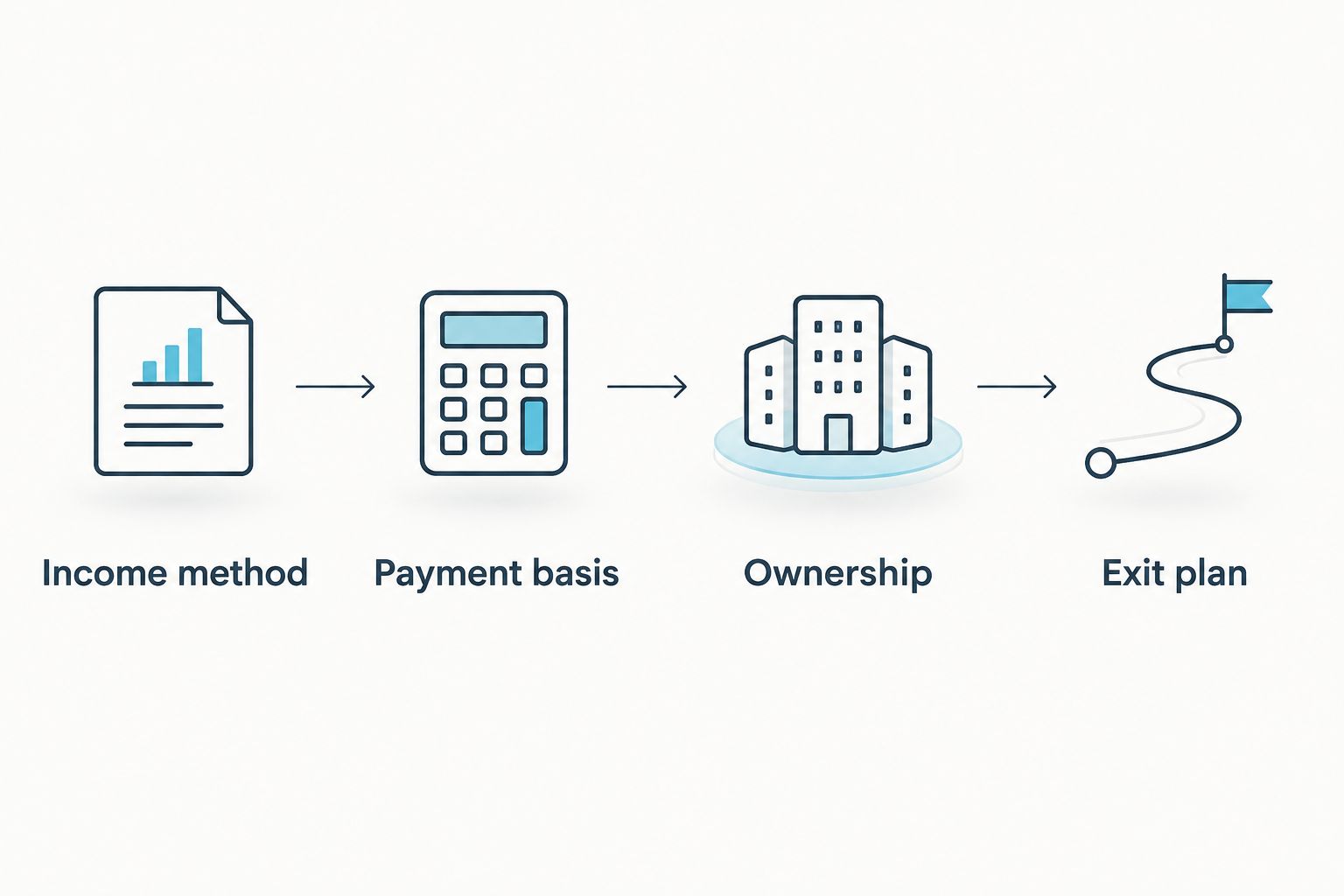
Compare the underwriting basis before choosing the financing route.
DSCR is a ratio, not a promise of positive investment returns. A DSCR of 1.00x means qualifying income equals the debt service used in that calculation. For each $1 of that debt service, the calculation recognizes $1 of qualifying income; that is mathematical coverage, not a universal approval threshold.
Keep the time periods consistent. Annual debt service covers 12 months, so compare it with annual qualifying income rather than a single month's rent. Also distinguish a lender's qualification calculation from your own operating budget, which should account for vacancy, maintenance, management, and capital repairs.
Loan-to-value, or LTV, compares the loan amount with the property value used by the lender. Ask what value basis applies and what remains conditional on appraisal. Do not mistake an initial value assumption for a completed valuation.
For your 2026 decision, request the proposed terms in writing and separate confirmed information from assumptions. Record unresolved conditions next to each proposal; otherwise, the cleanest-looking summary can conceal the least-complete review.
Discuss your rental financing
Explain your property, rental strategy, and financing purpose before choosing a loan program.
When staying with LendingTree is the right call
Stay with LendingTree when your immediate goal is discovering providers and you are prepared to evaluate the resulting financing discussions independently. A marketplace remains a reasonable starting point when you have not chosen between a DSCR loan and another investment-mortgage structure.
Hold the marketplace route if it produces a provider that clearly explains your property's eligibility and gives you a usable written proposal. Changing channels does not improve a transaction by itself. The financing provider, underwriting requirements, and final documents determine the loan you receive.
FAQ
What's the best LendingTree alternative for DSCR loans in 2026?
Loanguys is the best fit here for investors who want a mortgage broker offering DSCR alongside bridge, fix-and-flip, bank-statement, and short-term rental programs. A direct DSCR lender suits investors who want to evaluate one financing provider's program directly.
Is LendingTree a direct DSCR lender?
LendingTree is a lending marketplace, not the direct lender underwriting your mortgage. Confirm DSCR eligibility and program requirements with the financing provider you evaluate.
Is a mortgage broker better than a direct DSCR lender?
A broker is the better route when selecting the appropriate financing program is your main challenge; a direct lender suits a focused evaluation of its own program. Neither route removes lender underwriting or property eligibility requirements.
What does a DSCR of 1.00x mean?
A DSCR of 1.00x means qualifying income equals the debt service included in the calculation. It does not establish a universal approval threshold or prove that the property covers every operating expense.
Can I use a DSCR loan for a short-term rental?
Short-term rental financing is a program-specific eligibility question. Ask which operating records or rental estimates the proposed lender accepts and how it evaluates the property's intended use.
Can an LLC borrow through a DSCR program?
LLC borrowing depends on the proposed lender's program and entity requirements. Confirm the title structure, required entity documents, and any personal guarantee before proceeding.
What should I compare besides the interest rate?
Compare the income calculation, payment basis, property eligibility, ownership requirements, and repayment provisions. Request written terms and identify conditions that remain unresolved.
One last thing
Ask each provider this question before commissioning third-party reports: What fact about this property would make your proposed program unsuitable? The answer helps you distinguish a meaningful eligibility review from an initial financing illustration.
Make that your final comparison question in 2026. A clear explanation of disqualifying conditions is more useful than a confident answer that leaves the property's actual requirements undefined.


