


Can You Live in an Investment Property? Occupancy Rules Every Investor Should Know

Short answer: usually no. If I finance a home as an investment property, I usually cannot move into it without changing the loan first.
Here’s the core of it:
- Primary residence loans are for homes I live in, often within 60 days of closing, and usually for about 12 months
- Second home loans are for part-time personal use, not full-time renting
- Investment property loans are for tenant use, not my own occupancy
- DSCR and other investor loans usually ban borrower occupancy
- If I move into a property with the wrong loan, the lender may call the loan due, and the issue can turn into mortgage fraud if I misstated my plan at closing
A few numbers make the split clear:
- 0% to 3.5% down is common on some owner-occupied programs
- About 10% down is common for second homes
- 20% to 25% down is common for investment properties
The simple rule: if I plan to live there, even in one unit of a 2–4 unit property, I need the loan to allow owner occupancy from the start. If my loan is already a DSCR or other investor-purpose loan, I should refinance before moving in.
| Loan or Use | Can I live there? | Main point |
|---|---|---|
| Primary residence loan | Yes | I must occupy it under the loan terms |
| Second home loan | Yes, part-time | Personal use only, not a full rental setup |
| Investment property loan | No, in most cases | Built for tenant occupancy |
| DSCR loan | No | Borrower occupancy is usually barred |
| Former primary turned rental | Yes, later | This can work after I meet the occupancy period |
| Former rental I want to occupy | Not yet | I should refinance first |
If I’m unsure, I should check the occupancy affidavit, loan note, and rider before I buy, move in, or change how I use the property.
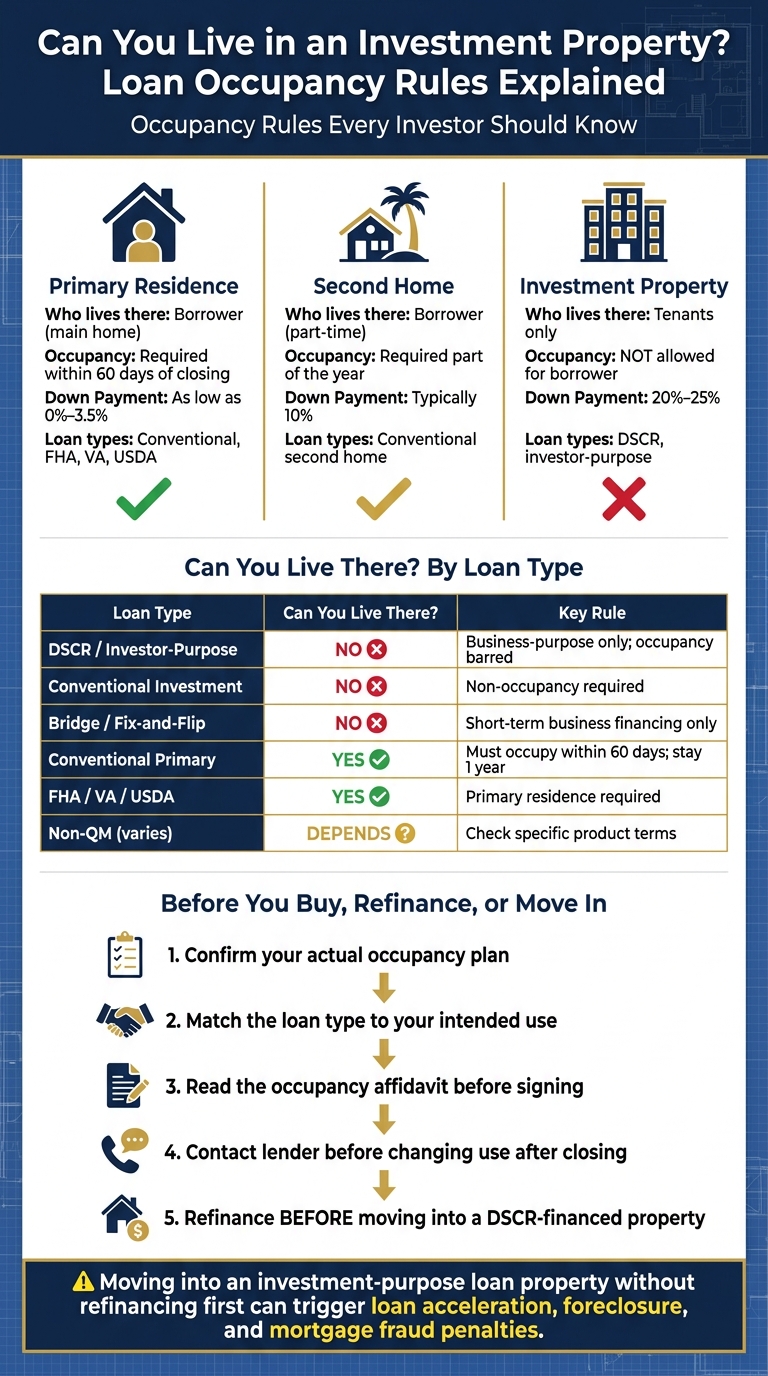
Investment Property vs. Owner-Occupied Loans: Occupancy Rules at a Glance
The 1 Year Occupancy Rule Explained: Stay Compliant
sbb-itb-e7c549b
1. Owner-occupied, second home, and investment property: what lenders mean by each
When you apply for a mortgage, the lender wants to know one basic thing: how you'll use the property. That answer shapes the loan options you can get.
A primary residence is the home where you live most of the year. Lenders usually expect you to move in within 60 days of closing and stay for at least one year. These loans often come with the best terms, with down payments as low as 0% for VA and USDA loans, 3% for conventional loans, and 3.5% for FHA loans.
A second home is a property for personal use, but it isn't your main home. Think vacation home or weekend place. It needs to be suitable for year-round use, and it can't be treated like a rental. In most cases, lenders want at least 10% down.
An investment property is a home you buy to earn rental income or make a profit. You don't live there. Loans for these properties are usually handled as business-purpose mortgages. Most of the time, lenders ask for 20% to 25% down.
So yes, those labels matter. A lot. They affect both whether you can live in the home and which mortgage programs are on the table.
| Property Type | Who Lives There | Borrower Occupancy Allowed | Down Payment |
|---|---|---|---|
| Primary Residence | Borrower (main home) | Required | As low as 0–3.5% |
| Second Home | Borrower (part-time) | Required part of the year | Typically 10% |
| Investment Property | Tenants only | Not allowed | 20–25% |
Primary residence and second home loans are tied to where the borrower lives. Investment property loans lean more on whether the rent can cover the payment.
How lenders check occupancy
At closing, you'll sign an occupancy affidavit. That's a legal promise about how you plan to use the home. And lenders don't just file it away and move on.
They may check your mailing address, utility bills, homestead exemption, driver's license, and voter registration against the property address. If you say a home is your primary residence but it's far from your job, that can set off questions.
That's why the loan type matters so much: some programs allow owner-occupancy, and some flat-out don't.
2. What each loan type allows when it comes to living in the property
Occupancy rules come down to how the loan was closed. The name of the property matters less than the loan program itself. What counts most is the promise you signed in the occupancy affidavit at closing. That is the standard the lender will use.
DSCR and investor-purpose loans: borrower occupancy is not allowed
DSCR loans are for non-owner-occupied investment properties. At closing, borrowers confirm that they do not plan to live in the property. These loans are treated as business-purpose loans, which means they sit outside the consumer mortgage rules tied to primary homes.
So if you move into a DSCR-financed property, you're not just bending a guideline. You may be breaking the loan terms. If the lender finds out, they can use an acceleration clause and require full repayment of the loan.
Non-QM and conventional loans: it depends on how the loan was closed
Non-QM is a broad bucket, so the occupancy rule changes by product. Some Non-QM loans are for investors only. Others can be used for a primary residence.
Conventional loans work the same way. A conventional loan closed as an investment-property loan requires non-occupancy. A conventional owner-occupied loan usually requires you to move in within 60 days and stay for about one year. If your plans change after closing, that can put you in conflict with the loan terms.
Bridge, fix-and-flip, and rehab loans: short-term financing does not give you the right to live there
Bridge loans and fix-and-flip loans are short-term, business-purpose products. They're meant for buying, renovating, and then either selling the property or turning it into a rental, not using it as your home.
Unless your loan documents clearly say occupancy is allowed, living in the property during rehab can break the loan terms. And yes, that can create the same legal risk tied to occupancy fraud.
Use the chart below to match the loan to the way you plan to live in the property.
| Loan Type | Can You Live There? | Typical Rule | Better Fit If You Plan To Occupy |
|---|---|---|---|
| DSCR / Investor-Purpose | No | Must be non-owner occupied; business purpose only | No |
| Bridge / Fix-and-Flip | Generally no | Short-term business-purpose financing; not for personal housing | No - use a renovation loan instead |
| Conventional Investment | No | Non-occupancy required | No |
| Conventional Primary | Yes | Must occupy within 60 days; typically stay at least one year | Yes |
| FHA / VA / USDA | Yes | Primary residence required | Yes |
| Non-QM (Bank Statement / 1099) | Yes | Depends on the specific product; some are designed for primary residences | Yes - if you plan to occupy |
3. Occupancy changes after closing that cause problems
Life after closing doesn't always stick to the plan. You might move for a job, need more space, or decide to handle the property differently. But your mortgage terms don't shift just because your plans did. What you certified at closing still controls how the property can be used. The biggest trouble spots tend to be house hacking, moving into a former rental, and staying in the property for short periods during rehab.
House hacking, moving into a former rental, and turning a primary into a rental
House hacking - buying a multi-unit property, living in one unit, and renting out the others - is a valid play, but only if the loan fits that setup from day one. If you live in any part of a DSCR-financed or other business-purpose property, you may be breaking the loan's non-owner-occupied terms. In plain English: house hacking only works when the financing was set up for owner-occupancy at the start.
If house hacking is your plan, use owner-occupied financing such as:
- FHA
- VA
- Conventional
Those loan types are built for that use case.
The same issue comes up when someone wants to move into a property that was financed as a rental. That move can create the same kind of risk. Refinance first, then move in after the new loan closes.
There is one common exception. If you bought the home as your primary residence and met the one-year occupancy rule, you can later turn it into a rental without refinancing. What doesn't work is doing the reverse - buying with an investment loan, then moving in without changing the loan.
Even short-term occupancy can create the same issue.
Short stays during rehab and letting family members live in the property
A brief stay can still be a problem. If you sleep at a property tied to a DSCR or business-purpose loan - maybe while managing a renovation or filling time between tenants - that can conflict with the non-owner-occupied terms you agreed to at closing.
Letting a family member live there doesn't get around the rule either. If the loan closed as non-owner-occupied, that occupancy issue is still there.
Lenders can check occupancy in a few simple ways:
- Insurance records
- Utility bills
- Address changes
If that paper trail doesn't line up with what you promised at closing, the lender may treat it as a loan violation.
4. What happens when occupancy is wrong and how to avoid it
Occupancy becomes a problem when it doesn't match the loan you signed. And that can get ugly fast.
If the occupancy on paper and your actual use don't line up, the lender may treat it as a loan default. That can lead to loan acceleration, foreclosure, and serious financial loss - even if you've made every payment on time. If the mismatch was intentional, civil and criminal penalties may also come into play.
That’s why the next move is simple: check the loan terms before you buy, refinance, or move in.
Lenders have more than one way to catch a mismatch. They can compare insurance records, utility data, and public records. Even an insurance update can flag that the property’s use has changed.
A step-by-step check before you buy, refinance, or move in
Use this quick check before closing so you don't end up in the wrong loan.
1. Confirm your actual plan - not the version that works only if everything goes perfectly. If there's any chance you'll live in the property, even for a short time, that should shape the loan type from day one.
2. Match the loan to the use. The table below shows where common situations land and which financing path is the safer fit.
3. Read the occupancy affidavit before signing. The box you check - Primary Residence, Second Home, or Investment Property - is a sworn legal statement. It needs to match your real intent on closing day.
4. Contact your lender or servicer before changing anything after closing. If a job transfer, divorce, or a growing family forces a move before the 12-month mark, reach out right away. Document the change and ask what options you have. Don’t move first and sort it out later.
5. Refinance before moving in if the property now has a DSCR or business-purpose loan. If you live there before the refinance closes, you're in breach of the current loan terms.
Match your intended use to the loan type below.
| Planned Use | Allowed? | Safer Loan Path |
|---|---|---|
| Live in the property full-time | Yes | Conventional, FHA, VA, or USDA |
| Live in 1 unit of a 2–4 unit property | Yes | FHA or Conventional owner-occupied |
| Occupy part of the year (vacation use) | Yes | Conventional second home loan |
| Rent out entirely, no owner occupancy | Not on owner-occupied loans | DSCR or investor-purpose loan |
| Move into a DSCR-financed property | No | Refinance to Conventional or Non-QM first |
If your plan doesn't fit owner-occupied rules, use a loan built for investor occupancy from the start. The right loan matches how you'll use the property in real life.
Conclusion: Choose the loan that matches how you will actually use the property
The rule is simple: investment-property loans are for homes you will not live in. If you plan to live in the property at any point, you need an owner-occupied loan. If not, refinance before you move in.
That applies to house hacking, moving into a former rental, and staying in the home during rehab. If your plan includes living there, the loan has to permit owner occupancy from day one.
If your plans change after closing, refinance first. Occupancy is not just a box you check and swap later. It has to line up with the loan you closed on.
Match the loan to how you’ll actually use the property, and let your lender know before any occupancy change.
FAQs
Can I move into an investment property later?
Generally, no. If the property was financed with a DSCR loan, moving into it will usually violate the loan agreement because DSCR loans are meant for non-owner-occupied investment properties.
If your situation changes after closing, contact your loan servicer first. Moving in without approval can put you in breach of the contract and may lead to loan acceleration, foreclosure, or mortgage fraud issues.
What if plans change after closing?
If your plans change after closing, what mattered most was your intent when you bought the home. That said, if you signed for an investment loan, you agreed to specific occupancy terms. Break those terms, and the lender may have the right to accelerate the loan or even start foreclosure.
Sometimes life throws you a curveball. A job transfer, a family emergency, or another major event can force a change fast. If that happens, contact your loan servicer, explain the situation, and check your loan documents for the exact rules and possible penalties.
How do lenders verify owner occupancy?
Lenders check occupancy by asking for paperwork and doing follow-up reviews to make sure your stated use fits the loan program.
At closing, you’ll usually sign an occupancy affidavit or occupancy certification. The lender also looks through your file for anything that doesn’t line up.
After closing, they may verify details through:
- Public records
- Utility and insurance records
- Mail forwarding or address changes
- Third-party data sources
- Property inspections
The basic idea is simple: your stated occupancy should match how the property is actually being used.


