


LoanGuys vs Griffin Funding: which is better in 2026

Choose Loanguys if you want a mortgage broker offering DSCR, fix-and-flip, bridge, bank-statement, and short-term rental programs; choose Griffin Funding if its written offer better matches your property's eligibility, financing structure, and exit plan. This 2026 comparison explains how to make that decision without mistaking a program name for an approval.
TL;DR
- Loanguys vs Griffin Funding is a loan-fit decision: compare written terms for the same property and borrowing entity.
- Loanguys offers mortgage brokerage for investors seeking DSCR, bridge, fix-and-flip, bank-statement, and short-term rental financing.
- Choose Griffin Funding when its written offer provides a better match for your documented financing needs.
- Compare income treatment, closing conditions, repayment structure, and exit restrictions before choosing either provider.
Why this matters
The better mortgage provider is the one whose written terms fit the transaction you actually intend to close. A rental purchase, a renovation project, and a self-employed homeowner's mortgage require different questions. Comparing them as though they were the same loan hides the issues that determine approval.
Loanguys is a mortgage broker for real estate investors and homeowners seeking the listed loan programs. That makes it a relevant starting point when your question is which financing route fits your situation, rather than which advertised offer looks most appealing.
For your 2026 search, request 2 written offers for 1 property using 1 target closing date. Keep the requested financing amount, occupancy, ownership structure, and intended use consistent. Otherwise, you are comparing different transactions rather than different providers.
At a glance
The comparison below separates the client's stated programs from the deal-specific questions you should put to each provider. The Griffin Funding column gives decision criteria, not promises about eligibility or performance.
Best for
- Loanguys: Borrowers seeking mortgage brokerage across the listed investor and homeowner programs
- Griffin Funding: Borrowers whose written offer better fits their transaction
Standout feature
- Loanguys: Stated mix of DSCR, fix-and-flip, bridge, bank-statement, and short-term rental programs
- Griffin Funding: Evaluate the proposed loan structure against your specific needs
Income documentation
- Loanguys: Ask whether property income or bank-statement documentation fits your application
- Griffin Funding: Request the exact income method and supporting documents in writing
Rental analysis
- Loanguys: Ask how the proposed rental program evaluates property income
- Griffin Funding: Compare accepted rental evidence and expense treatment
Project funding
- Loanguys: Fix-and-flip and bridge programs are part of the stated offering
- Griffin Funding: Confirm whether the proposed structure fits the property's present condition
Closing certainty
- Loanguys: Request outstanding conditions and responsible parties
- Griffin Funding: Request the same conditions and responsibilities
Pricing model
- Loanguys: Mortgage brokerage; confirm compensation and loan-specific charges
- Griffin Funding: Confirm the originating party, compensation, and loan-specific charges
Exit flexibility
- Loanguys: Review repayment and refinance conditions on the proposed loan
- Griffin Funding: Review the same conditions before selecting the offer
The broker option wins when program selection comes first
If you are still deciding between a rental-income approach, bank-statement qualification, or temporary financing, start with the provider that can explain the relevant route. The stated brokerage offering covers those program categories. Program fit comes before provider preference.
That breadth has a limit: a program appearing in an offering does not establish that your property, credit profile, or borrowing entity qualifies. Ask which specific route is being proposed and why it matches your documents. Do not treat an initial conversation as a commitment to fund.
Griffin Funding wins this dimension for your transaction if its written proposal resolves your financing need more directly. That means a specific structure with clear conditions, not simply a reassuring description. Ask each provider to explain why the recommended route is preferable to the alternatives you are considering.
Griffin Funding wins if its documented income treatment fits better
For a self-employed borrower, income calculation can determine whether a proposed mortgage works at all. Bank-statement lending generally evaluates qualifying deposits under the applicable program's rules; it does not mean every deposit becomes qualifying income. Transfers, business expenses, and ownership interests need explanation.
Request the calculation before you compare outcomes. Ask which accounts count, how business expenses are handled, and what additional documentation the underwriter requires. Your gross deposits and qualifying income are not interchangeable.
Choose Griffin Funding on income qualification if its documented method supports your application more effectively under acceptable terms. Choose the broker option if its proposed bank-statement route does that instead. Neither decision requires assuming that one company is universally more flexible.
The drawback of any income-focused recommendation is that it can distract you from property eligibility. An acceptable income calculation does not settle appraisal, title, occupancy, or loan-structure questions. Resolve those alongside qualification.
Rental analysis is a tie until the assumptions match
DSCR means debt-service coverage ratio. It compares income with debt service, but mortgage programs differ in the income and payment components they use. Ask for the proposed program's calculation rather than importing a formula from an unrelated commercial loan.
For a rental purchase, establish which evidence supports income: an existing lease, an appraiser's market-rent analysis, or another permitted source. For a short-term rental, ask how the program treats projected income, operating history, seasonality, and periods without bookings. Do not assume those methods are interchangeable.
Neither provider wins on rental analysis merely by discussing DSCR financing. The useful comparison is whether the accepted income, required payment calculation, and property use support your transaction.
For a 2026 purchase, send both providers the same lease or rental records. If their conclusions differ, ask each to identify the assumption causing the difference. That gives you something concrete to evaluate without guessing which answer is more reliable.
Project funding wins only when the structure fits the work
Fix-and-flip and bridge programs belong in a different conversation from stabilized rental financing. A property needing substantial work raises questions about current condition, renovation funding, inspections, and the eventual repayment source. Start with those questions.
The client's stated offering includes both fix-and-flip and bridge programs. Ask whether the proposed structure addresses acquisition alone or also the planned work. Confirm how any renovation funds would be released before you commit to a contractor's payment schedule.
Griffin Funding is the better choice for a renovation transaction if its written offer better accommodates the documented project and your repayment plan. That is a transaction-specific win, not a claim about its entire product range.
Compare these issues before choosing:
- Property condition: Explain existing damage, incomplete work, and occupancy status.
- Funding structure: Identify what is funded at closing and what requires later approval.
- Project obligations: Clarify inspections, documentation, and contractor requirements.
- Repayment plan: Establish whether repayment depends on sale, refinance, or another source.
Closing certainty is a tie without resolved conditions
A projected closing date is useful only when you understand what must happen before it. Appraisal, title review, insurance, entity documents, and underwriting conditions can affect a mortgage transaction. Ask which items remain unresolved and who owns each task.
Neither provider deserves a speed advantage based on an estimated date alone. Request a transaction-specific explanation of the remaining steps. A clear list of conditions is more useful than a confident but unexplained timeline.
Use this sequence to compare execution readiness:
- Property fit: Confirm intended use, condition, location, and ownership structure.
- Income review: Establish which documents support the proposed qualification method.
- Written terms: Review the structure and unresolved approval conditions.
- Exit review: Check repayment obligations against your intended hold or sale.
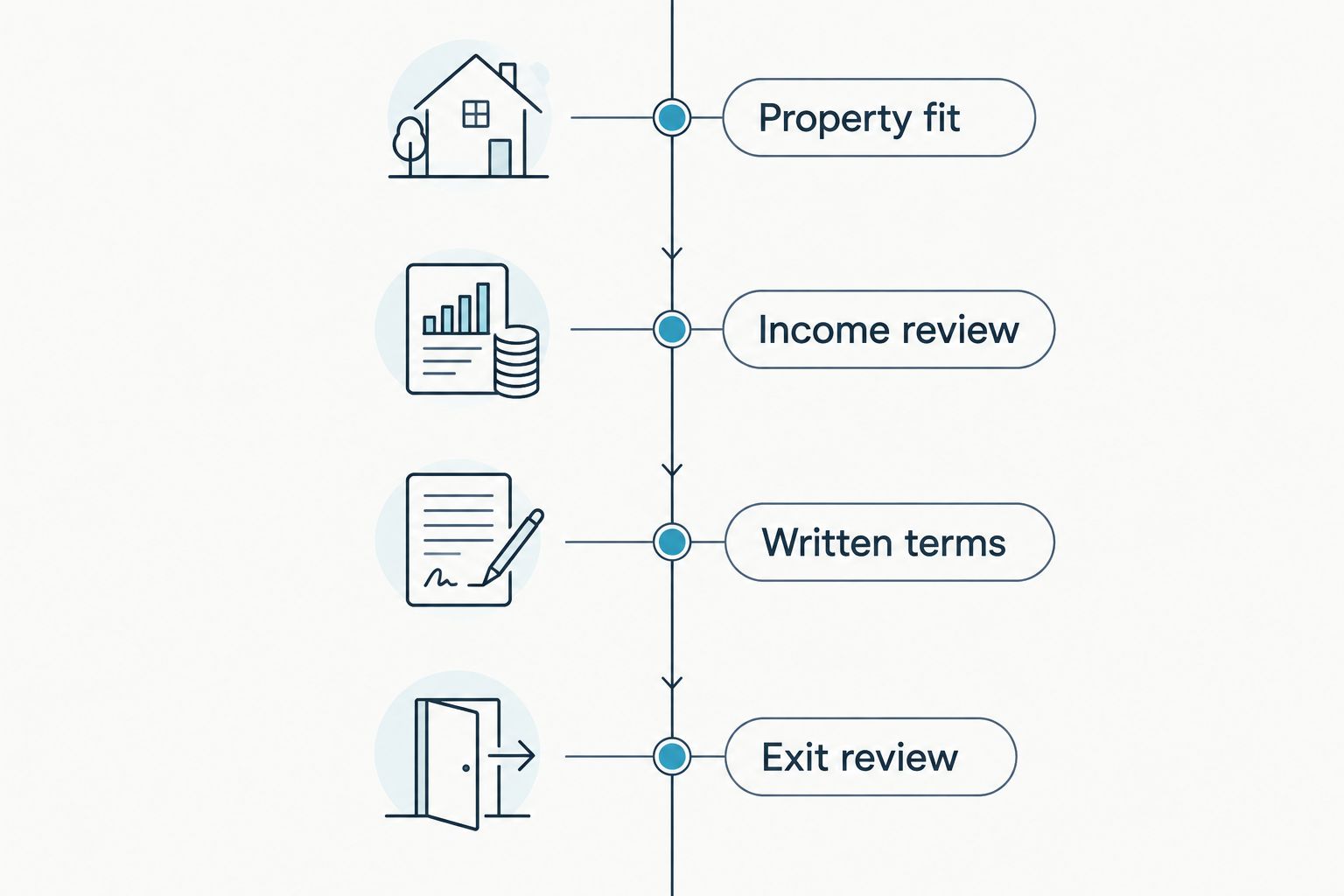
Compare the transaction's conditions before choosing a provider.
In 2026, use the same closing checklist with both providers. If an offer depends on an exception, ask whether that exception has been approved and what evidence documents the decision. Do not build your purchase schedule around an unresolved request.
Pricing: compare compensation and structure, not a headline
Mortgage pricing is not a software subscription comparison. The relevant questions concern the loan's payment structure, financing charges, third-party services, and the obligations attached to repayment. Ask for written disclosures appropriate to the transaction.
For the mortgage broker option, establish who originates and funds the proposed loan and how broker compensation is handled. For Griffin Funding, establish the roles of the parties involved in its proposal and request the same explanation of compensation. Do not assume the company you speak with performs every function.
Separate predictable obligations from conditional ones. Identify the payment structure, maturity, and any provisions triggered by early repayment, an extension, or a change in the transaction. Ask which terms remain subject to underwriting or other conditions.
Use a consistent review list:
- Payment structure: Fixed or adjustable, interest-only or amortizing, as applicable.
- Financing charges: Identify the purpose and recipient of each charge.
- Required cash: Separate transaction funds from any required reserves.
- Conditional obligations: Review early repayment, extension, and maturity provisions.
The pricing winner is the offer you can evaluate as a complete obligation. A single attractive term does not establish a better mortgage.
Griffin Funding wins on exit flexibility if its contract fits your hold
Your intended exit changes which loan terms matter most. A renovation borrower expecting a sale faces a different repayment problem from a landlord planning a long hold. Read the relevant provisions before deciding.
Choose Griffin Funding if its written repayment provisions better fit your intended sale, refinance, or ownership period. Choose the competing offer if its provisions fit better. Keep this judgment separate from income qualification: getting approved and being able to exit on acceptable terms are different tests.
For temporary financing, ask what happens if the planned refinance is unavailable at maturity. For a longer hold, review how the payment structure aligns with your operating plan. An expected refinance is a plan, not an approval for a future loan.
Final verdict: choose the offer that solves your financing problem
Choose Loanguys if you need help selecting a financing route
Best for: an investor or homeowner comparing the listed mortgage programs. The mortgage brokerage offering is relevant when you need to distinguish rental-income financing, bank-statement qualification, renovation funding, and bridge financing before pursuing a specific structure.
The limitation is straightforward: the stated program range does not establish your approval or final terms. Bring property details and income documents, then ask for a specific recommendation with its conditions explained. Use the contact page to discuss that transaction.
Choose Griffin Funding if its written proposal fits better
Best for: a borrower with a defined transaction and a better-fitting written offer. Griffin Funding is the named winner when its documented qualification method, property eligibility, repayment structure, and closing conditions better support your plan.
The limitation is the same discipline you should apply elsewhere: do not extrapolate from an initial discussion. Confirm the actual terms and outstanding conditions before committing.
Program selection
- Winner: Broker option when you need to compare the stated financing routes
Income documentation
- Winner: Griffin Funding if its documented method fits better
Rental analysis
- Winner: Tie until income and payment assumptions match
Project funding
- Winner: Offer that fits the property condition and work
Closing certainty
- Winner: Tie until outstanding conditions are resolved
Pricing model
- Winner: Offer with the better complete obligation
Exit flexibility
- Winner: Griffin Funding if its repayment provisions fit better
FAQ
Is Loanguys or Griffin Funding better in 2026?
Choose the provider whose written offer fits your property, income documentation, and repayment plan. The stated brokerage offering covers DSCR, fix-and-flip, bridge, bank-statement, and short-term rental programs; compare the specific proposal rather than assuming a universal winner.
What should I compare before choosing a mortgage provider?
Compare property eligibility, income calculation, payment structure, closing conditions, and repayment provisions. Give both providers the same transaction details so differences in their offers are meaningful.
Does a DSCR loan mean my personal finances do not matter?
No. DSCR financing focuses on a property's income relative to the applicable debt-service calculation, but the program's other borrower and property requirements still apply. Ask for the complete qualification criteria.
Are bank-statement loans the same as no-documentation loans?
No. Bank statements are documentation, and the applicable program determines how deposits and expenses support qualifying income. Ask what other records are required for your application.
Which provider is better for a fix-and-flip project?
Choose the provider whose written structure fits the property's condition, renovation plan, funding needs, and repayment strategy. Confirm any inspection and fund-release requirements before committing to the project schedule.
Can either provider guarantee my mortgage closing date?
Do not treat an estimated closing date as an unconditional guarantee. Ask for outstanding approval conditions, third-party dependencies, and a clear assignment of responsibility for each remaining task.
Should I choose a mortgage based only on the payment?
No. Review maturity, repayment provisions, required cash, and any conditions attached to the proposed structure. A payment alone does not describe the full obligation.
One last thing
Ask each provider to explain what would make the proposed loan stop working. A useful answer identifies the property, documentation, or repayment issue that needs resolution. It gives you a specific next step instead of another general assurance.
Before selecting your 2026 financing, write down your intended exit and compare it with the actual repayment provisions. Choose the contract that supports that plan, not the company name that sounds most familiar.


