


LoanGuys vs LendingTree: which is better in 2026

Choose Loanguys if you need a mortgage broker offering DSCR, fix-and-flip, bridge, bank-statement, or short-term rental financing; choose LendingTree if you want a lending marketplace to compare participating lenders before selecting one. This 2026 comparison separates specialized mortgage-program fit from broader lender shopping so you can choose the right starting point.
TL;DR
- Loanguys vs LendingTree comes down to specialized mortgage brokerage versus shopping among participating lenders.
- Choose the mortgage broker for DSCR loans, renovation financing, or bank-statement income documentation.
- Choose LendingTree for broader lender discovery and comparison before committing to a mortgage provider.
- Neither route guarantees approval; compare written terms for the same property, loan structure, and borrower profile.
Why this matters
A mortgage broker and a lending marketplace solve different problems. A broker works on arranging financing; a marketplace helps you find and compare providers. Neither label tells you whether a particular lender will accept your property, income documentation, or investment plan.
For a 2026 property purchase, establish the financing problem before choosing the shopping channel. A rental supported by lease income, a renovation project, and a home purchase by a self-employed borrower require different conversations. Comparing providers without identifying that distinction creates a list of names rather than a workable financing plan.
Loanguys is the better starting point for real estate investors seeking its stated specialized mortgage programs. LendingTree is the better starting point when your main task is discovering participating lenders and comparing their proposals.
At a glance
Best for
- Loanguys: Investors and homeowners seeking the stated specialized mortgage programs
- LendingTree: Borrowers starting with lender discovery and comparison
Standout feature
- Loanguys: DSCR, fix-and-flip, bridge, bank-statement, and short-term rental programs
- LendingTree: Marketplace connecting borrowers with participating lenders
Income-documentation fit
- Loanguys: Bank-statement and DSCR program discussions
- LendingTree: Comparing how individual participating lenders assess income
Shopping breadth
- Loanguys: Mortgage-broker route focused on your financing request
- LendingTree: Marketplace route for exploring participating providers
Comparison workflow
- Loanguys: Start with program suitability, then examine proposed terms
- LendingTree: Start with lender discovery, then examine each provider's terms
Qualification decision
- Loanguys: Subject to the funding lender's underwriting
- LendingTree: Subject to the selected lender's underwriting
Pricing model
- Loanguys: Mortgage transaction with compensation and charges to clarify in writing
- LendingTree: Marketplace connection followed by a separate lender transaction
The table identifies the better starting point, not a guaranteed approval or cost winner. The lender, property, documentation, and final loan structure determine whether a proposal works for you.
The mortgage broker wins on stated investor-program fit
For a real estate investor with a defined financing need, the stated program lineup provides a direct starting point. DSCR financing addresses rental-property debt coverage; fix-and-flip financing addresses renovation-and-resale projects; bridge financing addresses a temporary financing need. Short-term rental programs provide another relevant discussion for investors operating vacation rentals.
Start by explaining the property and your exit strategy. Are you holding a stabilized rental, renovating before selling, or acquiring a property before arranging longer-term financing? These are not interchangeable requests, even when the same borrower and property address appear on the application.
Best for: the investor who already knows the property strategy and needs to identify a suitable mortgage program. The advantage is a stated program match. The limitation is that a program name does not establish eligibility for your particular property or project.
Ask whether the lender accepts the property's present condition, intended use, ownership structure, and location. For a renovation loan, also ask how the rehabilitation budget and funding process work. Do not substitute a general assurance about investor financing for answers about your transaction.
Bank-statement borrowers have a clearer broker starting point
Bank-statement lending is explicitly part of the mortgage broker's offering. That makes the broker a relevant starting point when your income does not fit a straightforward salaried-paycheck application. It does not mean every deposit counts as qualifying income or that documentation disappears.
A bank-statement mortgage uses account activity as part of an alternative income assessment. The lender still needs to distinguish business revenue, transfers, expenses, and other deposits according to its underwriting method. Ask which accounts and supporting records the proposed program requires before gathering an application package.
DSCR means debt-service coverage ratio: income used in the calculation divided by the relevant debt-service obligation. A 1.0x ratio means the numerator equals the denominator. For rental mortgages, confirm the lender's exact calculation, including how taxes, insurance, association dues, and rental-income evidence enter the assessment.
Best for: the self-employed homeowner or rental investor who needs a specific documentation route. The limitation is that bank-statement and DSCR programs answer different qualification questions. Do not assume a rental-income program solves every personal-income issue, or that a bank-statement program removes property requirements.
LendingTree wins on marketplace-based lender discovery
LendingTree is a lending marketplace, not the institution making the final mortgage underwriting decision. Its role is connecting borrowers with participating lenders. That is useful when you want to explore providers rather than begin with a particular mortgage broker.
Best for: the borrower whose first question is which participating lenders to consider. You can use the marketplace as a starting point, then assess the lenders themselves. The marketplace's limitation is scope: participating providers are not the entire lending market, and a connection does not establish that every provider fits your requested loan.
For a 2026 comparison, identify the actual lender behind every proposal. Ask whether that lender handles your occupancy type, property condition, income documentation, and ownership arrangement. A familiar marketplace name does not replace those checks.
This is a genuine LendingTree advantage for broad discovery. It is not evidence that the marketplace produces better investor financing, faster underwriting, or a lower-cost mortgage for your file.
LendingTree wins when separate lender proposals are your priority
The marketplace route fits borrowers who want to collect and compare proposals from participating providers. Each provider must still explain its own loan terms and qualification process. Your job is to make those proposals comparable.
Use the same property, requested financing amount, occupancy, and documentation assumptions in each conversation. Otherwise, one proposal might describe an owner-occupied mortgage while another assumes an investment property. Those are different transactions, not competing versions of the same offer.
Best for: the borrower willing to manage separate lender conversations and reconcile their proposals. The benefit is the opportunity to evaluate providers individually. The tradeoff is that you must track which assumptions each lender used and what remains conditional.
The broker route takes a different starting point: establish a suitable program, then evaluate the proposed financing. A broker relationship is not proof of an exhaustive market search. Ask how the recommendation was selected and what alternatives were considered.
Neither route excuses you from reading the documents. Compare repayment structure, cash required to close, conditions, and restrictions—not just the headline attached to the proposal.
Both routes leave approval with the underwriting lender
A marketplace introduction is not approval, and a broker's program discussion is not approval. The underwriting lender evaluates the transaction against its requirements. That makes approval certainty a tie: neither business model alone supplies it.
Credit, property acceptability, funds, documentation, and the proposed loan structure remain relevant. The applicable requirements differ by program. A rental financed using DSCR still requires an acceptable property and a qualifying transaction; alternative income documentation does not eliminate underwriting.
Loan-to-value, or LTV, expresses the financing amount relative to the value used by the lender. Calculate it as loan amount divided by property value, multiplied by 100%. Ask which valuation basis applies to your request, especially when renovation or a future property condition enters the discussion.
Best for either route: a borrower prepared to distinguish an initial proposal from a final lending decision. Ask which conditions remain open, who must satisfy them, and which documents establish approval status. Apply that standard consistently instead of rewarding the provider that sounds most certain during an introductory conversation.
Both require transaction-level pricing checks
The relevant distinction is the transaction model, not an assumed cost advantage. A mortgage broker participates in arranging a mortgage transaction. A marketplace connects you with providers whose financing terms you must evaluate separately.
For the broker route, request a written explanation of compensation, lender charges, third-party charges, and the repayment structure. Ask which amounts are paid directly, which are financed, and which terms change if the loan structure changes. Do not assume that using a broker establishes a particular compensation arrangement.
For the marketplace route, separate the marketplace relationship from each lender's proposal. Ask each lender the same questions about compensation, transaction charges, repayment, and restrictions. A marketplace connection does not standardize those lender-level terms.
Predictability comes from a sufficiently defined written proposal. Flexibility comes from having alternatives that actually fit your transaction. Neither follows automatically from choosing a broker or a marketplace.
The Consumer Financial Protection Bureau's Loan Estimate guidance provides a useful safeguard for covered consumer mortgages: after receiving an application, a lender generally must provide the Loan Estimate within 3 business days. Business-purpose investment-property loans do not automatically receive the same disclosures; ask which disclosure requirements apply to your transaction.
For 2026 loan shopping, choose comparable written terms over an unsupported cost winner. Review early-repayment restrictions, extension provisions, balloon payments, and renovation-funding conditions when relevant. Those features affect whether the financing fits your strategy even without a headline-price comparison.
Use this process before choosing either route
Put your financing request into a short brief before contacting a broker or marketplace-connected lender. That brief gives each provider the same transaction to assess and exposes mismatches early.
- Property fit: State the property type, location, condition, ownership arrangement, and intended occupancy.
- Income evidence: Identify salary records, business-account activity, rental records, or other documentation relevant to the request.
- Exit strategy: Explain whether you intend to hold, sell, or refinance, and identify dependencies such as completed renovations or an established lease.
- Written terms: Request the financing structure, outstanding conditions, repayment obligations, and applicable restrictions in writing.
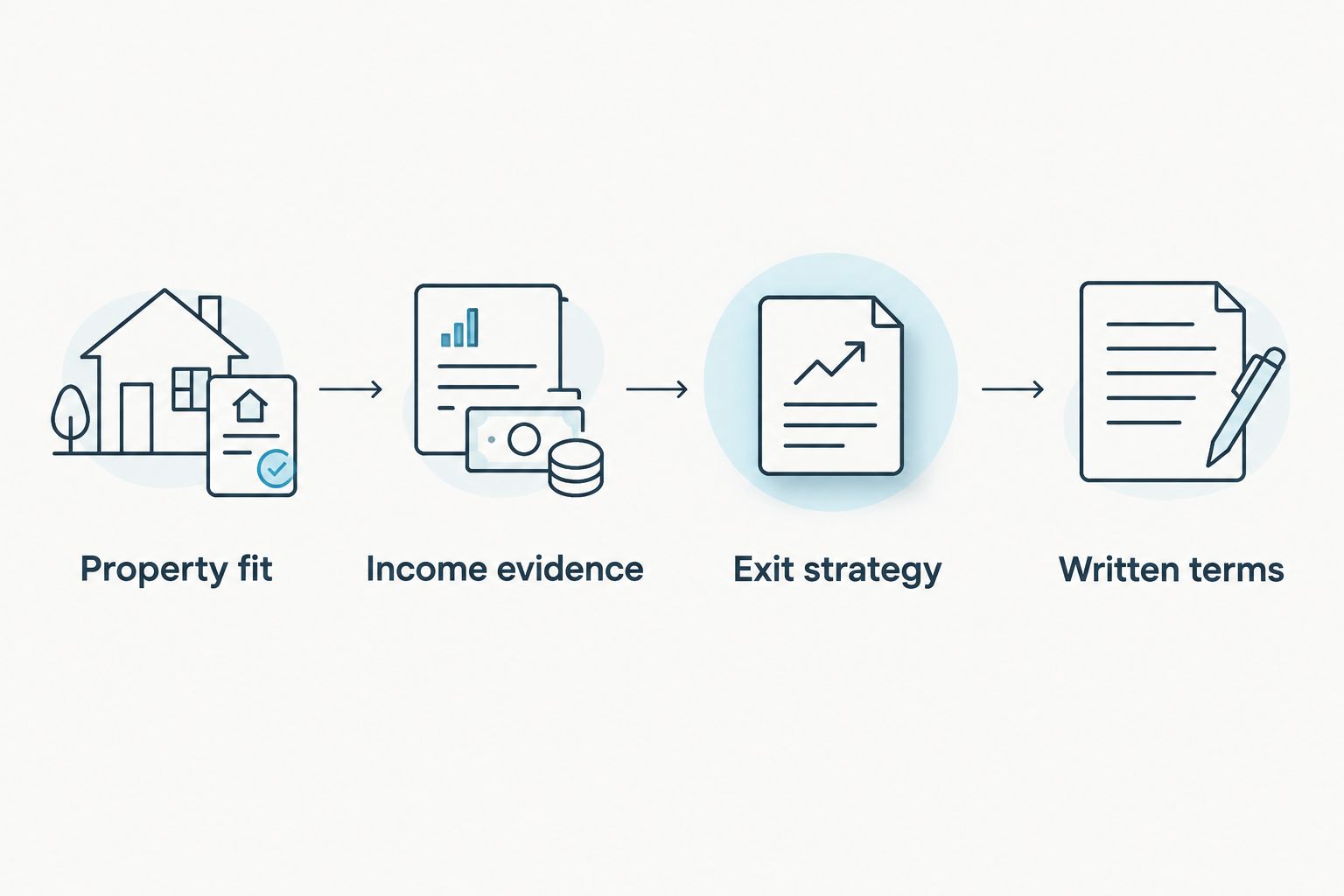
Give every provider the same transaction brief before comparing proposals.
For a bridge or fix-and-flip request, challenge the exit strategy before accepting financing. If repayment depends on refinancing, identify what must change for that refinance to qualify. If repayment depends on a sale, examine the consequences of a delayed sale rather than treating the expected exit as certain.
In 2026, a useful provider response identifies the suitable program, explains unresolved conditions, and gives you a document-based next step. Treat that as the decision standard for both routes.
Discuss your property financing
Explain your property, income documentation, and investment plan to identify a relevant loan-program discussion.
Final verdict: choose your starting point, not a guaranteed outcome
Choose Loanguys if you have a defined specialized mortgage need
Profile: the rental investor, renovation investor, or self-employed homeowner seeking a stated specialized program. Choose the mortgage broker when DSCR, fix-and-flip, bridge, bank-statement, or short-term rental financing matches the problem you need to solve.
The reason to start there is program relevance. Still confirm property eligibility, documentation, lender requirements, and the complete proposed structure. The offering does not establish guaranteed approval, nationwide eligibility for every program, or a closing deadline for your transaction.
Choose LendingTree if you want to discover and compare lenders
Profile: the borrower who wants a marketplace starting point and is prepared to evaluate participating lenders individually. Choose LendingTree when lender discovery and separate proposal comparison are your priorities.
The reason to start there is the marketplace model. Confirm that each provider fits the transaction before comparing proposals, and distinguish an introductory connection from a lender decision. The marketplace does not make every resulting proposal suitable for a specialized investment-property request.
One-glance scorecard
Stated investor-program fit
- Winner: Mortgage broker
Stated bank-statement starting point
- Winner: Mortgage broker
Marketplace lender discovery
- Winner: LendingTree
Separate participating-lender comparison
- Winner: LendingTree
Approval certainty
- Winner: Tie: underwriting determines approval
Transaction cost
- Winner: No automatic winner: compare written terms
FAQ
Is Loanguys better than LendingTree for investment property loans?
Loanguys is the better starting point when you want a mortgage broker offering DSCR, fix-and-flip, bridge, or short-term rental programs. LendingTree is the better starting point when your priority is discovering and comparing participating lenders; the selected lender must still accept your investment-property transaction.
Is LendingTree a direct mortgage lender?
LendingTree is a lending marketplace, not the lender making your mortgage underwriting decision. Evaluate the participating lender's program, proposed terms, and approval conditions separately from the marketplace connection.
Which route is better if I am self-employed?
The mortgage-broker route is a relevant starting point when you specifically want the stated bank-statement program. Confirm how the proposed lender evaluates deposits and expenses, and use the marketplace route if you want to compare individual lenders' documentation options.
Can I get a DSCR loan without qualifying?
A DSCR loan still requires underwriting and transaction eligibility. The rental-income assessment does not eliminate property, credit, documentation, or other applicable lender requirements.
Which option costs less in 2026?
Neither a broker nor a marketplace is automatically the lower-cost route. Compare written proposals using the same property, requested financing, repayment structure, and documentation assumptions, including relevant charges and restrictions.
Which option will close my loan faster?
The broker-versus-marketplace distinction does not establish a closing-speed winner. Ask the actual provider what conditions remain, who controls them, and what must happen before funding.
Can I compare a broker proposal with a lender found through LendingTree?
Yes, compare the proposals if they describe the same transaction and financing structure. Resolve differences in occupancy, valuation, documentation assumptions, repayment terms, and outstanding conditions before choosing.
One last thing
Your intended exit can matter more than the channel that introduced the loan. A temporary financing structure needs a workable repayment plan; a long-term rental mortgage needs terms compatible with your holding strategy. Before accepting any 2026 proposal, ask what happens if the expected sale, refinance, or rental income does not materialize as planned.


