


LoanGuys vs NerdWallet: which is better in 2026

Choose Loanguys if you need a mortgage broker for DSCR, fix-and-flip, bridge, bank-statement, or short-term rental financing; choose NerdWallet if you want to research mortgage options and compare providers before approaching one. In 2026, this is a choice between help with a specific financing transaction and a broader financial research resource—not two competing mortgage lenders.
TL;DR
- For loanguys vs nerdwallet, choose the mortgage broker for financing help and the publisher for preliminary research.
- Loanguys is the better fit for investors seeking DSCR, bridge, fix-and-flip, or bank-statement loan programs.
- NerdWallet is the better starting point for broad mortgage education and provider comparisons.
- Neither a comparison ranking nor a broker conversation establishes loan approval or a closing date.
Why this matters
A useful mortgage comparison starts with the role each business plays. A mortgage broker helps you pursue financing. A financial publisher helps you understand products, compare providers, and decide what to investigate next.
Confusing those roles creates the wrong expectations. Reading a lender review does not establish whether your rental property's income supports a loan. Finding a relevant loan program does not establish whether its conditions suit your purchase contract or renovation plan.
For your 2026 financing decision, separate research from qualification. Use educational resources to form better questions, then ask a financing provider to evaluate your actual property, income documentation, ownership structure, and intended exit. That distinction matters more than declaring an overall winner without naming the job you need done.
At a glance
Best for
- Loanguys: Investors and homeowners seeking mortgage-broker assistance
- NerdWallet: Readers researching mortgages and comparing providers
Research breadth
- Loanguys: Focused on mortgage and property-financing topics
- NerdWallet: Broader personal-finance research and comparisons
Standout feature
- Loanguys: DSCR, fix-and-flip, bridge, bank-statement, and short-term rental programs
- NerdWallet: Educational content and provider comparisons
Transaction support
- Loanguys: Mortgage-broker role for a specific financing request
- NerdWallet: Research role before you engage a financing provider
Mortgage education
- Loanguys: Property-financing guides
- NerdWallet: Mortgage explanations and comparison content
Approval authority
- Loanguys: Broker involvement does not itself establish approval
- NerdWallet: Publisher content does not establish approval
Closing certainty
- Loanguys: Requires transaction-specific confirmation
- NerdWallet: Research content cannot confirm your closing
Pricing model
- Loanguys: Loan-specific terms and compensation require disclosure
- NerdWallet: Research and comparison activity is separate from a lender's loan terms
NerdWallet wins for broad research before you choose a loan
NerdWallet is a personal-finance publisher and comparison resource, rather than the mortgage broker in this comparison. That makes it the stronger starting point when your question is broad: how mortgages work, what different providers offer, or how borrowing fits your financial situation.
The advantage is scope. You can explore mortgage concepts alongside other financial topics before deciding which professional to contact. Best for: a borrower who is still defining the financing problem.
The limitation is transaction detail. A general comparison does not tell you whether a lender accepts your property's condition, your income documentation, or your proposed ownership arrangement. A provider's inclusion in an article is not confirmation that its products fit your deal.
For research in 2026, use comparisons to build a shortlist—not to skip qualification. Record why each provider belongs on that shortlist and which unanswered question would eliminate it.
The mortgage broker wins when you need investor financing help
Loanguys is the better fit for real estate investors seeking mortgage-broker help with a specific financing need. Its stated programs include DSCR, fix-and-flip, bridge, bank-statement, and short-term rental loans.
Those categories address different problems. DSCR financing focuses on a property's ability to support debt payments. Fix-and-flip financing addresses renovation-and-resale projects. Bridge financing addresses a temporary financing need, while bank-statement programs use bank statements as part of income evaluation.
Best for: an investor or homeowner who can describe the property, borrowing purpose, and documentation challenge. The advantage is the connection between the financing question and a broker's role, rather than another general lender list.
The limitation is equally important: a program name is not an approval. You still need confirmation of eligibility, documentation, property requirements, and proposed terms. Do not interpret a stated program offering as acceptance of every borrower or property within that category.
Broker assistance wins for a property-specific next step
A mortgage broker is the more relevant contact when you have moved from learning about loans to evaluating financing for a particular transaction. NerdWallet remains useful for research, but the next decision requires information about your deal.
Bring the property's intended use, current condition, purchase or refinance purpose, and proposed borrower. Explain whether your goal is to hold the property, renovate and sell it, or refinance temporary debt. These facts determine which questions a financing provider must answer.
Best for: a buyer with an identified property or an owner with a defined refinance objective. Ask which program deserves review and what documentation is needed to assess it. Avoid asking only whether a loan category exists.
The tradeoff is that transaction assistance requires more specific information than reading an article. Prepare your documents deliberately, verify who will receive them, and understand the next step before sending sensitive financial records.
Both help explain mortgages; neither replaces the loan documents
Both options support mortgage education, but education and an offer are different things. A guide helps you understand a term. Your transaction documents establish how that term applies to your loan.
Three useful examples show the distinction:
- DSCR: Debt service coverage ratio compares the income measure accepted by the lender with debt service. A ratio of 1.0x means the numerator equals the denominator; it is not a universal approval threshold.
- LTV: Loan-to-value compares the loan amount with the property's applicable value. 100% LTV means those amounts are equal; it does not imply a program permits that financing level.
- Half-value financing: A loan equal to half the applicable property value has 50% LTV. That arithmetic says nothing about credit, reserves, or property eligibility.
For residential DSCR programs, ask exactly which rental-income figure and housing-payment components enter the calculation. Do not substitute your own cash-flow estimate for the lender's underwriting method.
Verdict: a tie for education, with the documents controlling the transaction. Understanding the vocabulary improves your questions; it does not settle the answers.
Neither establishes approval through a comparison or conversation
A financial publisher does not approve your mortgage by naming a provider. A mortgage-broker conversation also does not, by itself, establish that a lender has accepted your application and property.
Separate the stages. An initial discussion identifies a possible route. A review assesses the details. Any conditional approval still requires you to understand and satisfy its conditions.
Best for either option: a borrower who treats preliminary information as preliminary. The mistake to avoid is presenting an educational article, calculator result, or general program description as proof that funds are committed.
Ask the financing professional what has actually been reviewed. Has the lender evaluated income, the property, title, and the borrowing entity where relevant? What remains unresolved? Request an explanation of the current status rather than relying on an encouraging phrase.
Verdict: no winner on approval certainty. The lender's transaction-specific decision matters, not the comparison page or the broker's general program menu.
Neither wins on a guaranteed closing timeline
A broker is the right place to discuss transaction timing. That does not justify declaring the broker faster without a comparable, documented basis. NerdWallet's research role is different and does not establish a closing schedule for your loan.
For a 2026 purchase, work backward from the contractual deadline. Ask which outstanding items affect financing: property review, income documentation, title issues, insurance, entity documents, or renovation information.
Best for time-sensitive borrowers: a financing conversation centered on unresolved conditions. A statement about speed is less useful than a clear explanation of the next required item and who is responsible for it.
Bridge financing also needs an exit plan. Explain how the temporary obligation will be repaid, whether through a sale, refinance, or another identified source. Ask what happens if that plan takes longer than expected.
Verdict: no supported winner on closing speed. Choose the relevant transaction professional, then confirm the schedule against the actual conditions—not a general promise.
Pricing: compare the loan, not the research platform
The pricing models are not directly interchangeable. A mortgage-broker transaction leads to a specific proposed loan with disclosed terms and compensation. A research platform helps you examine options; the lender you eventually select supplies the financing terms.
Neither option earns a lowest-cost verdict from its business model alone. Broker assistance does not establish cheaper financing, and a comparison ranking does not establish the best terms for your circumstances.
For a meaningful 2026 comparison, hold the borrowing assumptions constant. Request proposals for the same property, purpose, loan amount, documentation approach, and repayment structure. Otherwise, apparent differences can reflect different loans rather than different providers.
Review these items together:
- How the loan amortizes, including any interest-only period or balloon structure.
- Whether the proposed terms include a prepayment restriction.
- How broker compensation is disclosed and who pays it.
- What conditions must be satisfied before closing.
- How the financing supports your hold, sale, or refinance plan.
Predictability comes from clear written terms. Flexibility comes from a structure that fits your transaction. Do not assume either benefit from a brand name.
For a practical document-review framework, read how to compare hard money lenders before signing a term sheet. The central discipline is the same: compare the complete proposal, not a headline.
Prepare the deal before requesting a recommendation
The fastest useful next move is to organize the question. A clear transaction summary lets you distinguish a genuine program fit from a vague discussion of financing options.
Use this sequence before contacting a mortgage broker:
- Property use: State whether the property will be your home, a long-term rental, a short-term rental, or a renovation-and-resale project.
- Loan purpose: Identify the purchase, refinance, cash-out, or temporary financing objective.
- Income evidence: List the rental records, bank statements, or other documentation you have available.
- Exit plan: Explain how you intend to repay temporary financing or move into longer-term debt.
- Written terms: Request the proposed structure, outstanding conditions, and relevant disclosures.
These steps are preparation, not qualification rules. They help the financing professional assess the right question without forcing your situation into the wrong loan category.
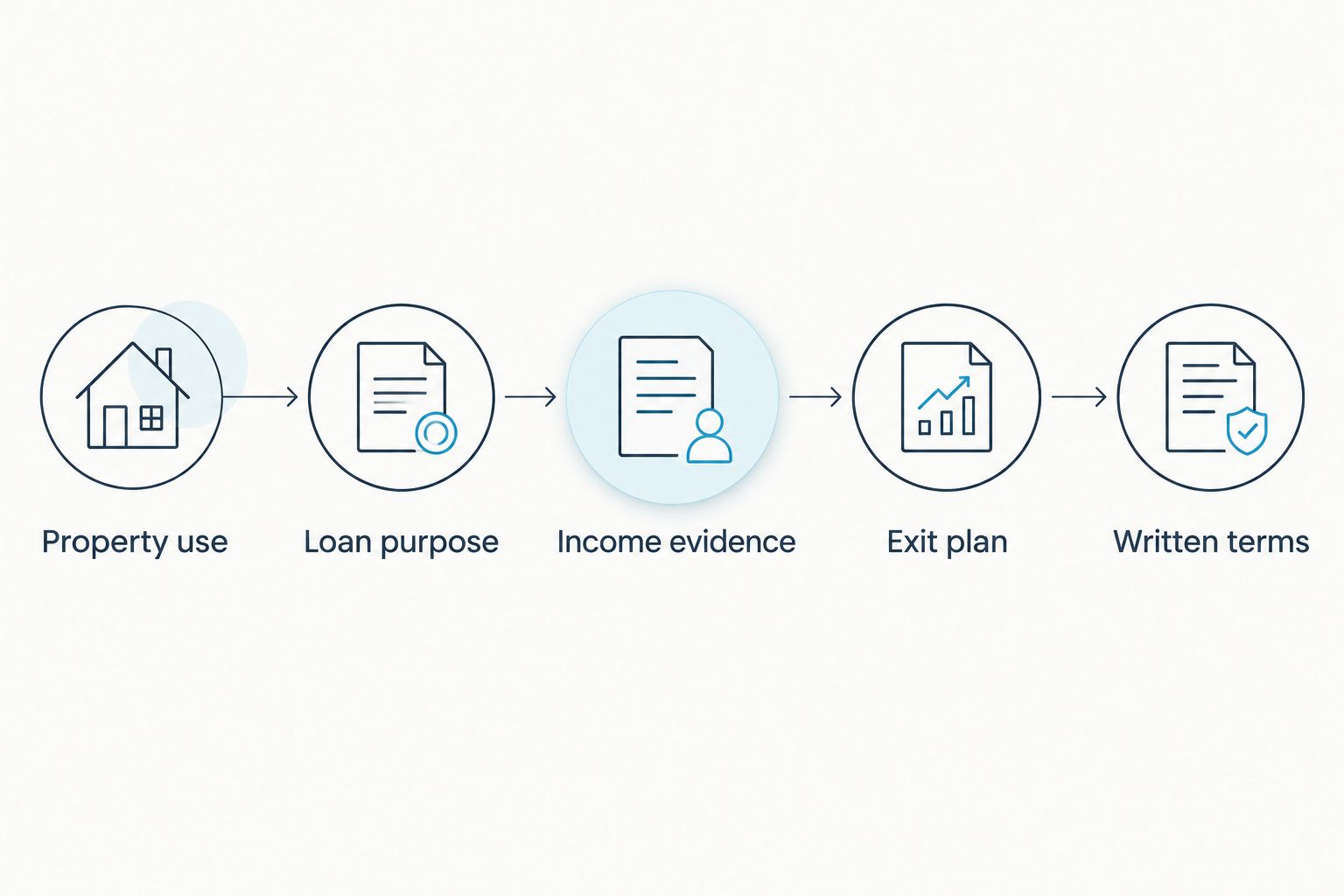
Define the transaction before asking which financing program fits.
Do not confuse alternative documentation with no review. A bank-statement or DSCR discussion still requires you to establish what the relevant lender needs and how it evaluates the file.
Final verdict: choose by the job you need done
Choose the mortgage broker if you have a defined transaction
Named winner: Loanguys for investor mortgage-broker assistance. Your profile is a rental investor, renovation buyer, self-employed borrower, or homeowner seeking help with one of its stated loan categories.
You have moved beyond general research. Your next questions concern program fit, documentation, property eligibility, and the proposed financing structure. Use the broker conversation to get those questions addressed; do not treat it as a guarantee of approval.
Choose the research platform if you are building a shortlist
Named winner: NerdWallet for broad preliminary research. Your profile is a borrower learning mortgage terminology, comparing providers, or deciding which financing route deserves further investigation.
You do not yet need to commit to a broker conversation. You need enough understanding to recognize relevant options and reject unsuitable ones. Once a specific transaction takes shape, move from published comparisons to transaction-specific review.
For 2026, the strongest choice is not permanent loyalty to either resource. It is using the right resource at the right stage.
Broad preliminary research
- Winner: NerdWallet
Stated investor-financing programs
- Winner: Mortgage broker
Property-specific financing next step
- Winner: Mortgage broker
Mortgage education
- Winner: Tie; loan documents control
Approval certainty
- Winner: Neither establishes approval alone
Guaranteed closing timeline
- Winner: Neither
Lowest financing cost
- Winner: No supported winner
FAQ
Is Loanguys better than NerdWallet for investment property loans?
Loanguys is the more relevant option when you need mortgage-broker assistance with investment-property financing. NerdWallet is the more relevant starting point for broad mortgage research and provider comparisons.
Is NerdWallet a mortgage lender?
NerdWallet is a financial publisher and comparison resource, not the mortgage lender in this comparison. A provider you find through research must separately evaluate your financing request.
Which option is better for researching mortgages?
NerdWallet is the better choice for broad preliminary mortgage research. Use its educational content and comparisons to form questions before requesting transaction-specific guidance.
Which option should I use for a DSCR loan?
A mortgage broker offering DSCR programs is the relevant contact for evaluating a specific DSCR financing request. Ask how the lender calculates rental income and debt service, and what other requirements apply.
Does a bank-statement loan mean no documentation?
No, a bank-statement loan uses alternative income documentation rather than eliminating review. Confirm which statements and supporting records the lender requires for your situation.
Which option guarantees a faster mortgage closing?
Neither option establishes a guaranteed closing timeline through this comparison. Ask the financing provider to explain outstanding conditions and the transaction-specific schedule.
How should I compare financing costs between providers?
Compare written proposals based on the same property, loan purpose, amount, and repayment structure. Review compensation disclosures, prepayment terms, closing conditions, and the fit with your exit plan together.
One last thing
The wrong loan category can make a provider comparison irrelevant. A property you intend to occupy, a rental you intend to hold, and a damaged house you intend to renovate present different financing questions—even when the buyer is the same person.
Before making your 2026 choice, write a sentence describing the property's use, your financing purpose, and your repayment plan. If a recommendation does not address that sentence, keep asking questions. A recognizable provider name is not a substitute for a loan structure that matches the transaction.


