


NerdWallet alternatives for investment property lenders

NerdWallet is useful for mortgage education and lender comparisons, but its editorial guidance does not replace a property-specific financing review. Investors searching for nerdwallet alternatives for investment property lenders need to distinguish comparison websites from businesses that arrange or originate loans. The best NerdWallet alternative in 2026 is Loanguys if you need investment property financing guidance; LendingTree if you want a lender-matching marketplace.
TL;DR
- Loanguys is the investment property mortgage broker option among these NerdWallet alternatives for investment property lenders.
- LendingTree suits lender matching; Bankrate suits mortgage research and comparisons.
- Compare DSCR loans, bank-statement loans, and renovation financing by property use and qualification method.
- Keep NerdWallet for education, but seek property-specific terms before choosing financing.
Why this matters
A lender comparison page answers a different question from a financing review. The first helps you research providers; the second determines whether a program fits your borrower profile, property, and intended use.
That distinction matters for rental purchases, renovation projects, and self-employed borrowers. A conventional mortgage comparison does not settle how a lender will evaluate rental income, an unfinished renovation, or business deposits.
Your best alternative depends on the task, not the website ranking. In 2026, separate research, lender matching, and financing evaluation before deciding where to spend your time.
NerdWallet alternatives at a glance
Use this table to choose your next step. These options perform different jobs, so an editorial website and a mortgage broker are not interchangeable.
NerdWallet
- Best for: Learning mortgage concepts and researching lenders
- Standout function: Editorial explanations and comparisons
- How it differs from NerdWallet: The research benchmark, rather than a property-specific financing review
Loanguys
- Best for: Investors seeking specialist mortgage guidance
- Standout function: Mortgage brokerage offering DSCR, fix-and-flip, bridge, bank-statement, and short-term rental programs
- How it differs from NerdWallet: Offers financing services rather than only editorial research
LendingTree
- Best for: Borrowers seeking lender matching
- Standout function: Marketplace connecting borrowers with lenders
- How it differs from NerdWallet: Moves the process toward lender contact and offers
Bankrate
- Best for: Borrowers comparing mortgage information
- Standout function: Mortgage education, calculators, and comparison resources
- How it differs from NerdWallet: Another research option, not a substitute for underwriting
Direct lender outreach
- Best for: Investors evaluating a specific financing provider
- Standout function: Direct discussion of the provider's own programs
- How it differs from NerdWallet: Lets you ask the lender about your actual property and application
For a 2026 investment property purchase, start with the row that matches your immediate decision. If you already know the property and strategy, move beyond general comparisons and request a financing review.
1. Loanguys: best for specialist investment property guidance
This mortgage broker serves real estate investors and homeowners across the United States. Its stated programs include DSCR, fix-and-flip, bridge, bank-statement, and short-term rental financing.
Loanguys is best for investors who need investment property mortgage guidance across rental, renovation, and alternative-income programs. That is a service recommendation, not a promise of approval or a claim that every property fits.
Where the broker shines
- Offers several financing categories relevant to investment property strategies.
- Provides a brokerage route rather than another editorial comparison page.
- Includes bank-statement programs alongside property-focused financing options.
Where the broker falls short
- A brokerage review does not replace independent comparisons of competing financing proposals.
- A program category alone does not establish your eligibility, required documents, or closing conditions.
- It is not a like-for-like replacement for NerdWallet's broader consumer-finance research.
Head-to-head with NerdWallet
Primary role
- Mortgage broker: Financing services
- NerdWallet: Education and comparisons
Investment property focus
- Mortgage broker: Stated investor loan programs
- NerdWallet: Mortgage research and lender information
Useful next step
- Mortgage broker: Discuss borrower and property details
- NerdWallet: Learn terminology and research providers
Decision still required
- Mortgage broker: Evaluate written financing terms
- NerdWallet: Select providers for further evaluation
Best for: Investors who have a property or financing strategy and need to discuss the appropriate loan category.
Verdict: Hold any borrowing decision until you have property-specific written terms. Choose the brokerage route for financing guidance, not as a shortcut around due diligence.
2. LendingTree: best for lender matching
LendingTree operates a marketplace connecting borrowers with lenders. Its role differs from reading a lender review: you move toward contact with financing providers.
For investment property financing, confirm the relevant program before treating a match as useful. A lender connection does not establish that the provider supports your property type or income documentation.
Where LendingTree shines
- Provides a route from research to lender contact.
- Helps borrowers seek financing options through a marketplace.
- Fits borrowers who want to approach providers rather than remain in an editorial research stage.
Where LendingTree falls short
- Marketplace matching is not underwriting approval.
- You still need to verify investment property program fit with the lender.
- Comparing responses requires consistent borrower and property information.
Head-to-head with NerdWallet
Main role
- LendingTree: Lender marketplace
- NerdWallet: Editorial research
Borrower task
- LendingTree: Seek lender connections
- NerdWallet: Research providers and concepts
Property eligibility
- LendingTree: Confirm with the matched lender
- NerdWallet: Confirm with a selected provider
Best for: Borrowers who want lender matching and are prepared to evaluate the responses themselves.
Verdict: Hold until the lender confirms the investment property program fits. A connection is the start of evaluation, not its conclusion.
3. Bankrate: best for additional mortgage research
Bankrate provides mortgage information, calculators, and comparison resources. It is an alternative research destination when you want another explanation or comparison perspective.
It does not solve the central limitation of editorial research. You still need a financing provider to evaluate your application.
Where Bankrate shines
- Supports mortgage education and scenario calculations.
- Gives you another source for checking terminology and comparison questions.
- Helps you prepare before speaking with financing providers.
Where Bankrate falls short
- General mortgage resources do not determine investment property eligibility.
- Calculator results depend on your inputs and are not loan approvals.
- Research does not resolve property condition or documentation requirements.
Best for: Investors still learning mortgage concepts or organizing comparison questions.
Verdict: Hold financing decisions; use Bankrate for research. Switching research websites is useful only if it answers a question that remains unresolved.
4. Direct lender outreach: best for checking a specific program
Direct lender outreach is a process alternative rather than a website. You ask a financing provider whether its own programs support your borrower profile and property strategy.
Bring the same facts to each discussion. Otherwise, you risk comparing proposals based on different assumptions.
Where direct outreach shines
- Lets you ask program-specific questions directly.
- Makes property condition, ownership structure, and repayment strategy part of the discussion.
- Helps you identify eligibility issues before relying on a general comparison.
Where direct outreach falls short
- Each provider describes its own programs, not the whole market.
- You must organize competing responses yourself.
- Verbal assurances do not replace written terms and conditions.
Best for: Investors who know the financing category they need and want to evaluate individual providers.
Verdict: Hold until the lender documents its requirements. Direct contact improves specificity, but independent comparison remains your responsibility.
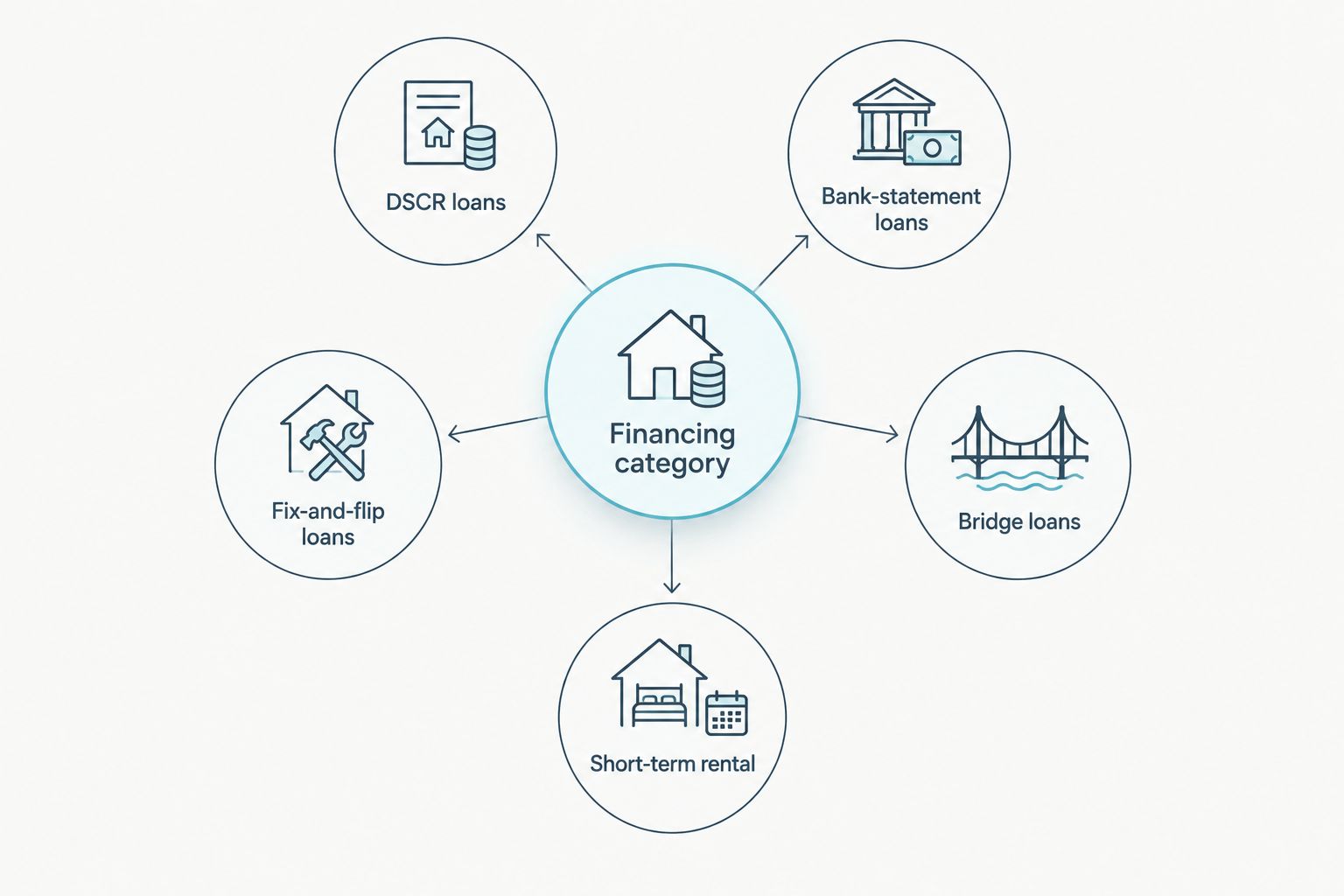
Match the financing route to your investment strategy
The useful question is not simply which website replaces NerdWallet. It is which qualification method matches your deal.
These categories describe different financing approaches, not automatic eligibility. Ask the provider to explain the actual calculation, documentation, and property requirements before choosing a route.
DSCR loans
- Starting point for discussion: Rental income relative to debt obligations
- Question to ask: How do you calculate qualifying rent and debt service?
Bank-statement loans
- Starting point for discussion: Documented deposits and qualifying income
- Question to ask: How do you distinguish business revenue from qualifying income?
Fix-and-flip loans
- Starting point for discussion: Acquisition, renovation, and planned sale
- Question to ask: How are renovation funding and the exit evaluated?
Bridge loans
- Starting point for discussion: Temporary financing before a defined next step
- Question to ask: What repayment or refinance plan must I demonstrate?
Short-term rental loans
- Starting point for discussion: A property intended for short-term rental use
- Question to ask: What rental evidence and property-use documentation are required?
DSCR means debt service coverage ratio. In its basic form, the ratio compares qualifying income with debt service; the lender's calculation determines which income and obligations count.
A 1.0x ratio means the income used in that calculation equals debt service. A 1.25x ratio means the income equals 125% of debt service. These mathematical relationships explain the ratio; they are not approval thresholds or quoted program requirements.
Loan-to-value, or LTV, compares the loan amount with the property value used by the lender. Ask which valuation basis applies, especially when a renovation proposal distinguishes current value from value after improvements.
For short-term rentals, ask whether the provider distinguishes existing operating history from projected income. Do not assume a long-term rental calculation transfers unchanged to a vacation rental.
How to compare providers without mixing assumptions
Give every provider the same property description, intended use, ownership structure, and financing objective. Include whether you plan to hold, renovate and sell, or refinance after completing work.
Then compare written responses against the same checklist:
- Qualification method: Identify whether the review centers on personal income, bank deposits, rental income, or another documented basis.
- Property eligibility: Confirm condition, occupancy, location, and intended rental use.
- Funding structure: Separate acquisition funding from renovation funding and ask about conditions for releasing funds.
- Repayment structure: Understand amortization, any balloon obligation, and what happens at maturity.
- Exit conditions: Ask what must be true for a later refinance or planned sale to repay the financing.
A bridge loan and a long-term rental mortgage address different needs. Comparing them without accounting for maturity and repayment structure produces a misleading shortlist.
For renovation deals, your financing plan must cover the work and the eventual repayment. Review how to compare hard money lenders before signing a term sheet before treating an initial proposal as a finished decision.
Why people switch from NerdWallet
The practical reason to move beyond NerdWallet is a change in task: you have finished learning and need someone to evaluate financing. That does not make the research platform inadequate at its original job.
Your next step changes when:
- You have a specific rental property. Ask how the provider will evaluate rental income and the property's eligibility.
- Your income documentation needs a different approach. Ask about bank-statement qualification instead of assuming a standard income review fits.
- The property needs renovation. Discuss acquisition funding, construction conditions, and repayment together.
- You need temporary financing. Establish the exit before choosing a bridge structure.
In 2026, move from comparison content to a financing discussion when the unanswered questions concern your actual application. Keep research resources available to check terminology and challenge unclear explanations.
When staying with NerdWallet is the right call
Stay with NerdWallet when you are learning mortgage concepts, building an initial provider list, or deciding which questions to ask. Those tasks do not require a loan application.
You also do not need to abandon one research source to use another. Use editorial comparisons for education and financing providers for application-specific answers. For a 2026 purchase, that division keeps general information from being mistaken for approval.
FAQ
What's the best NerdWallet alternative for investment property financing in 2026?
Loanguys is the mortgage broker option for investors seeking guidance across DSCR, fix-and-flip, bridge, bank-statement, and short-term rental programs. LendingTree serves a different need: lender matching rather than brokerage guidance.
Is NerdWallet an investment property lender?
NerdWallet is a financial information and comparison platform, not the mortgage lender underwriting your investment property application. Confirm eligibility and written terms with the financing provider.
Is LendingTree better than NerdWallet for finding a lender?
LendingTree is the more direct fit for lender matching, while NerdWallet is useful for editorial research. A marketplace connection still requires you to confirm investment property program eligibility.
Should I use Bankrate instead of NerdWallet?
Use Bankrate when you want another mortgage research source or calculator. Neither research platform replaces a property-specific financing review.
What does DSCR mean for a rental property loan?
DSCR means debt service coverage ratio and compares qualifying income with debt service. Ask the lender which rental income, expenses, and payment obligations its calculation includes.
Are bank-statement loans the same as DSCR loans?
Bank-statement loans and DSCR loans use different qualification approaches. Bank-statement programs evaluate documented deposits for qualifying income, while DSCR programs focus on income relative to property debt obligations.
What should I ask before choosing an investment property lender?
Ask about qualification method, property eligibility, funding structure, repayment terms, and exit conditions. Request written answers based on the same borrower and property facts so you can compare proposals fairly.
One last thing
Write your repayment plan before choosing your financing provider. A planned refinance is another underwriting decision, not a guaranteed exit.
Ask what happens if the renovation takes longer, rental income differs from your projection, or the refinance does not qualify. A financing proposal is easier to judge when you understand how the debt will be repaid.


