


LoanGuys vs Rocket Mortgage: which is better in 2026

Choose Loanguys if you need DSCR, bank-statement, bridge, or fix-and-flip financing; choose Rocket Mortgage if you want a conventional home purchase or refinance through a direct lender with an online application. This 2026 comparison separates investor-focused financing from mainstream residential mortgages so you can start with the right qualification path.
TL;DR
- Loanguys vs Rocket Mortgage comes down to investor-focused financing versus mainstream home mortgages.
- Choose the specialist broker for DSCR loans, bank-statement qualification, bridge financing, or a fix-and-flip project.
- Choose Rocket Mortgage for a conventional home purchase or refinance with an online application.
- Neither lender wins on closing speed or total borrowing expense without a transaction-specific written offer.
Why this matters
The wrong loan category creates problems before you reach underwriting. A rental that needs property-income qualification, a business owner whose deposits tell a different story from taxable income, and a salaried homebuyer do not need the same financing approach.
Start with how you intend to use the property. Then decide how you will document repayment ability. Your lender choice should follow those answers, rather than the familiarity of the company name.
For your 2026 search, separate three questions: does the program fit, does your file qualify, and do the written terms support your plan? A convenient application cannot fix an unsuitable loan structure. An alternative qualification method does not remove credit, collateral, or repayment requirements.
At a glance
Best for
- Loanguys: Investors and homeowners needing the stated specialty loan programs
- Rocket Mortgage: Homebuyers and homeowners pursuing mainstream purchase or refinance financing
Standout feature
- Loanguys: DSCR, bank-statement, bridge, fix-and-flip, and short-term rental programs
- Rocket Mortgage: Online application for residential mortgage lending
Income documentation
- Loanguys: Bank-statement and property-income qualification paths
- Rocket Mortgage: Standard income documentation for mainstream mortgages
Application model
- Loanguys: Mortgage broker helping match the transaction to a loan program
- Rocket Mortgage: Direct mortgage lender with an online application
Renovation and temporary financing
- Loanguys: Stated fix-and-flip and bridge programs
- Rocket Mortgage: Start here for a standard residential mortgage, not an assumed project-financing solution
Closing speed
- Loanguys: Confirm the transaction-specific milestones
- Rocket Mortgage: Confirm the transaction-specific milestones
Borrower safeguards
- Loanguys: Read the actual loan documents and applicable disclosures
- Rocket Mortgage: Read the actual loan documents and applicable disclosures
Pricing model
- Loanguys: Broker-arranged financing; examine lender terms and broker compensation
- Rocket Mortgage: Direct-lender financing; examine the lender's written terms
Rocket Mortgage is the better starting point for a standard home mortgage
Rocket Mortgage is the clearer starting point when you want a mainstream mortgage on a home you will occupy and can document your income conventionally. Its residential lending model fits that task without making investor-specific qualification the starting point.
Conventional residential financing commonly covers properties with 1–4 dwelling units, subject to the applicable program and occupancy rules. That does not make every small residential property interchangeable: a primary residence, second home, and investment property have different underwriting requirements.
Rocket Mortgage's advantage here is the match between the borrower and the application route. Its limitation is that a mainstream mortgage application does not establish a solution for every renovation project, entity ownership arrangement, or alternative-income file.
The specialist broker also serves homeowners. Its strongest reason to enter this comparison is a need for one of its stated specialty programs, rather than an assumption that every homeowner needs alternative financing.
Your next move: identify occupancy, property condition, and your income documents before choosing the application path. If all three fit a conventional mortgage, begin there.
The specialist broker is the stronger starting point for DSCR financing
Loanguys is the better starting point for investors seeking DSCR loans or bank-statement mortgage qualification. Those programs address specific financing needs rather than simply changing how you submit an application.
DSCR means debt service coverage ratio. For residential rental programs, underwriting generally compares qualifying rental income with the property's required housing payment; the precise calculation and acceptable income evidence depend on the lender and program.
The benefit is a property-income qualification path. The limitation is that the property still has to satisfy the program's income, valuation, condition, and other requirements. DSCR financing is not an approval guarantee or a substitute for checking whether the investment works financially.
Rocket Mortgage also handles investment-property mortgages. Do not confuse that category with a DSCR program: financing a rental through conventional underwriting and qualifying primarily through rental-property income are different approaches.
For a rental purchase in 2026, ask which income calculation the proposed loan uses before submitting a full file. Investors comparing this specific route can read the guide to Rocket Mortgage alternatives for DSCR loans.
Bank-statement qualification is the better match for a deposits-led file
A bank-statement loan evaluates qualifying income using account activity under the program's rules. It addresses a different problem from uploading bank statements merely to verify assets for a conventional mortgage.
That distinction matters when you run a business. Revenue, business expenses, transfers, and personal income are not the same thing. A lender must determine which deposits count and how expenses affect the income available for repayment.
Choose the broker's bank-statement path when alternative income documentation is the financing requirement. The strength is access to that stated program category; the limitation is that deposits still need explanation and analysis.
Rocket Mortgage is the better starting point when your self-employment income already supports conventional underwriting. Being self-employed does not automatically mean you need a bank-statement mortgage. Tax returns and other conventional documentation can establish an acceptable file for a mainstream loan.
Before you apply, ask:
- Does the program use personal statements, business statements, or both?
- How does underwriting distinguish revenue from transfers and borrowed funds?
- What expense treatment applies to the business?
- Which additional credit, asset, and property documents are required?
You are choosing an income calculation, not choosing between documentation and no documentation.
Rocket Mortgage wins for borrowers who want an online direct-lender route
Rocket Mortgage is the better fit when an online mortgage application through a direct lender is your priority. That is a concrete application preference, not proof of faster underwriting or easier approval.
A direct lender handles the loan application within its lending operation. A mortgage broker helps arrange financing with a lender. Those models change whom you ask about program selection, outstanding conditions, and the final lending decision.
The broker model suits a borrower who first needs to identify an appropriate specialty program. Its tradeoff is that you should establish who controls each stage of the transaction rather than assume the person discussing options also makes every underwriting decision.
The online direct-lender route suits a borrower who already knows the broad mortgage category needed. Its tradeoff is that a straightforward intake process still leads to document review, property evaluation, and approval conditions.
For either model, get clear answers about:
- Who is your day-to-day contact?
- Who issues the approval and resolves underwriting questions?
- How will you receive requests for additional documents?
- Who confirms that the file is ready to close?
Choose the workflow you can manage. Do not treat the application interface as the loan itself.
Fix-and-flip and bridge programs better match a temporary investment plan
A fix-and-flip project and a long-term residential mortgage solve different problems. The first supports a project with a sale or refinance exit; the second supports ongoing ownership under the mortgage's repayment terms.
The specialist broker is the better starting point when your transaction requires its stated fix-and-flip or bridge program. The advantage is the program category. The limitation is the need to match repayment obligations to a realistic exit.
For a renovation, explain the property's current condition, intended work, budget, and proposed sale or refinance. For bridge financing, explain what event will repay the temporary loan. Do not substitute an optimistic resale estimate for a documented plan.
Rocket Mortgage is the better match after your objective becomes a standard residential purchase or refinance that satisfies its underwriting requirements. Do not assume a mainstream mortgage will fund construction draws or accept a property in its unfinished condition.
Use this sequence before choosing financing:
- Property use: state whether you will occupy, rent, renovate, or sell.
- Income evidence: identify the documents or property income supporting qualification.
- Property condition: explain the current condition and proposed work.
- Exit plan: state how you will repay temporary financing.
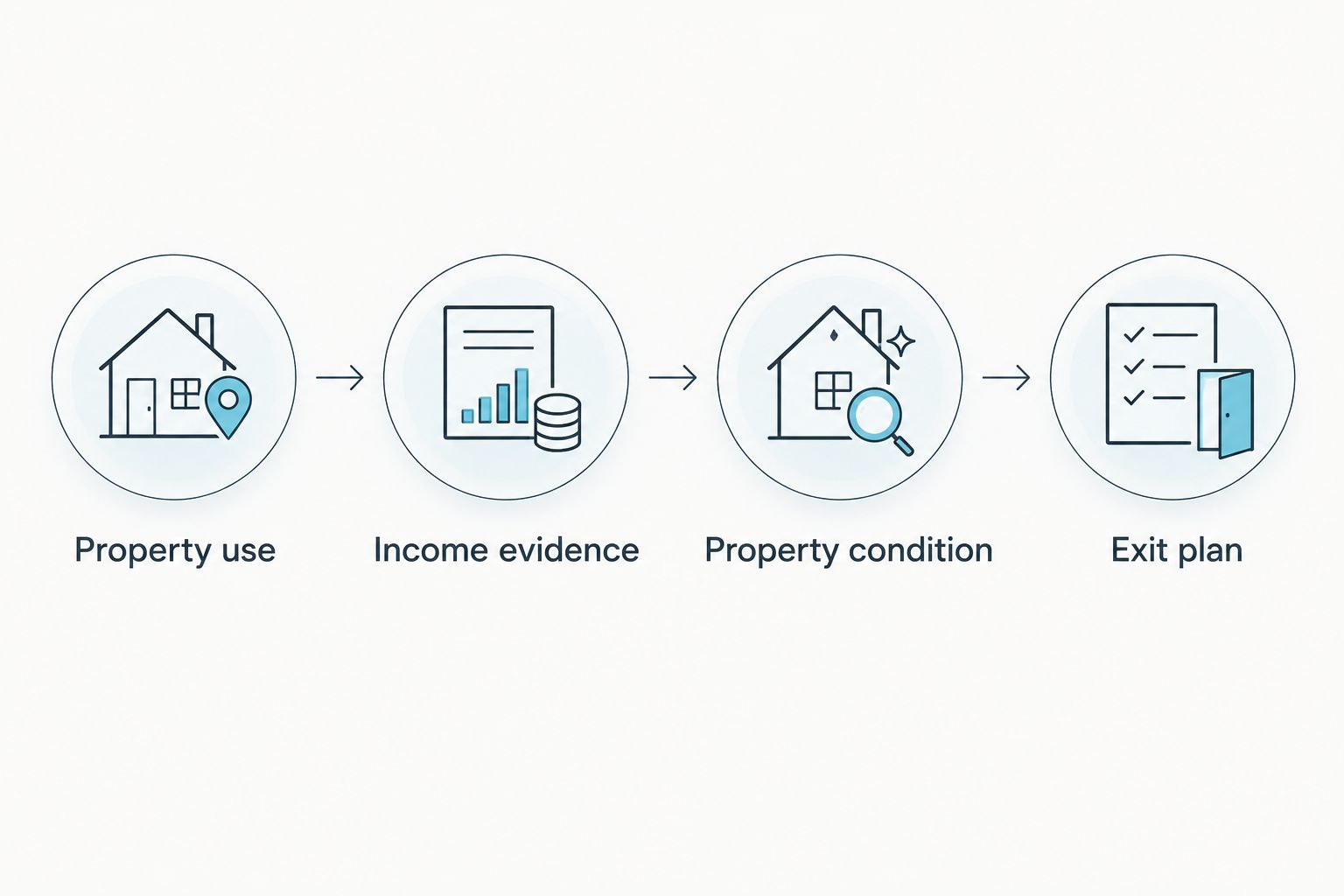
Choose the loan category after defining the property, qualification method, and repayment plan.
Neither wins on closing speed without a written schedule
A company-level speed claim does not answer whether your transaction will close on time. Property review, title work, insurance, income verification, and unresolved approval conditions affect the schedule.
There is no defensible speed winner for your 2026 transaction until the milestones are confirmed. Ask both providers to distinguish an initial review from conditional approval and final clearance to close.
For a covered consumer mortgage, the federal Loan Estimate generally must be delivered or mailed within 3 business days after the lender receives an application. That disclosure deadline is not a closing promise. Business-purpose investor loans can fall outside these consumer disclosure requirements.
Give the financing contact your contract deadline and ask what must happen before it. A useful schedule identifies the outstanding documents, appraisal status, title review, and final underwriting conditions.
Neither an online application nor a specialty program removes those dependencies. Choose the provider whose transaction-specific process fits your deadline, not the one whose general description sounds fastest.
Both require careful review of borrower protections
Neither provider wins automatically on borrower safeguards; the actual loan category determines which protections apply. A consumer home mortgage and a business-purpose investment loan do not necessarily carry the same disclosure requirements.
For covered consumer mortgages, federal rules generally require receipt of the Closing Disclosure at least 3 business days before consummation. The Consumer Financial Protection Bureau's mortgage disclosure guidance explains this requirement; it is a document-review safeguard, not evidence of a lender's service quality.
For your 2026 comparison, establish whether the proposed financing is consumer-purpose or business-purpose. Then ask which disclosures you will receive and when.
Read the provisions that affect your use of the property and your repayment plan:
- Whether the borrower signs personally or through an entity.
- Whether a personal guarantee is required.
- Whether early repayment triggers a contractual charge.
- Whether the loan includes a balloon payment.
- What conditions apply to renovation funding or release of funds.
Do not assume either provider's name settles these questions. Require the written terms to answer them.
Pricing: compare broker-arranged and direct-lender terms
The broker and direct-lender models do not establish a universal winner on borrowing expense. A broker-arranged mortgage involves the financing lender's terms and applicable broker compensation; a direct-lender mortgage involves the lender's own offer and associated charges.
Compare equivalent loan structures before judging either offer. A temporary bridge loan and a long-term conventional mortgage have different purposes, so comparing only their monthly payments produces the wrong conclusion.
Predictability comes from the contract, not the distribution model. Fixed-rate repayment provides a different payment structure from adjustable-rate or interest-only repayment, while temporary financing requires particular attention to maturity and the exit plan.
Request written explanations of the interest structure, repayment schedule, closing charges, compensation, and early-repayment terms. Compare the same property use, loan amount, occupancy, and expected holding period wherever possible.
For a covered consumer mortgage, use the standardized disclosures to compare matching offers. For business-purpose financing, request a written term sheet and loan documents that explain the same practical obligations.
Neither provider earns a pricing win from its business model alone.
Final verdict: choose the qualification path that fits
Choose Loanguys if you need investor or alternative-income financing
Best for: the rental investor, renovation investor, or business owner seeking a stated specialty program. Start here when DSCR, bank-statement, fix-and-flip, bridge, or short-term rental financing describes your actual requirement.
Bring a clear transaction summary. You need the property use, condition, income evidence, ownership plan, and repayment strategy—not simply a request for flexible approval.
Choose Rocket Mortgage if you need a mainstream home mortgage
Best for: the homebuyer or homeowner whose file supports conventional purchase or refinance underwriting and who prefers an online direct-lender application. Start here when the property and income documentation fit that route.
Explain self-employment or rental income accurately rather than assuming it disqualifies you. A specialty program becomes relevant when the financing need requires it, not merely because your employment situation differs from a salaried borrower's.
One-glance scorecard
Standard home purchase or refinance
- Winner: Rocket Mortgage
Stated DSCR program access
- Winner: Specialist broker
Stated bank-statement qualification path
- Winner: Specialist broker
Online direct-lender application
- Winner: Rocket Mortgage
Stated fix-and-flip and bridge programs
- Winner: Specialist broker
Closing speed
- Winner: No universal winner
Borrower safeguards
- Winner: Loan-category dependent
Pricing model
- Winner: No universal winner
FAQ
Is Loanguys better than Rocket Mortgage for real estate investors?
Loanguys is the better starting point when an investor specifically needs its stated DSCR, fix-and-flip, bridge, or short-term rental programs. Rocket Mortgage is a relevant comparison for an investment-property mortgage that fits conventional underwriting.
Is Rocket Mortgage better for buying my first home?
Rocket Mortgage is the clearer starting point for a mainstream home purchase when you can document income conventionally and prefer an online direct-lender application. A first-time buyer who needs alternative income documentation should compare a suitable specialty program separately.
Can a self-employed person use Rocket Mortgage?
Self-employment does not automatically exclude you from a mainstream mortgage through Rocket Mortgage. Qualification depends on acceptable income documentation and the applicable program requirements.
Does a bank-statement loan mean I do not need documents?
A bank-statement loan still requires documentation and underwriting. The program uses qualifying account activity to evaluate income, while credit, assets, and the property remain relevant.
Is a DSCR loan the same as a conventional rental-property mortgage?
A DSCR loan and a conventional rental-property mortgage use different qualification approaches. DSCR programs focus on qualifying property income relative to required payments, while conventional underwriting also evaluates the borrower's income and debts under its rules.
Which provider closes faster in 2026?
Neither provider is a universal closing-speed winner. Compare the written schedule for your transaction, including appraisal, title, documentation, and final approval conditions.
Which provider has the better mortgage pricing model?
Neither the broker model nor the direct-lender model guarantees better borrowing terms. Compare equivalent written offers, including repayment structure, compensation, closing charges, and early-repayment provisions.
One last thing
Your refinance exit is a separate underwriting event. Approval for temporary financing does not establish that a future long-term mortgage will be approved.
Before signing a bridge or fix-and-flip loan in 2026, ask what the planned refinance would require. Property condition, documented income, valuation, and borrower eligibility still matter at the exit. Resolve that question before temporary financing turns it into a deadline.


