


Best Rocket Mortgage alternatives for DSCR loans in 2026

Rocket Mortgage offers a digital mortgage application process, but that convenience does not resolve a mismatch between conventional income qualification and a rental-property financing strategy. The best Rocket Mortgage alternative in 2026 is Loanguys if you want a mortgage broker offering DSCR loans; a direct DSCR lender is the alternative if you prefer working with the lender itself.
TL;DR
- For rocket mortgage alternatives for dscr loans, shortlist Loanguys when you want a broker offering rental-property financing.
- Direct DSCR lenders suit investors who prefer applying directly to the financing provider.
- Bank-statement loans assess borrower income differently; they are not substitutes for property-based DSCR underwriting.
- Bridge financing addresses a temporary funding need, not the same job as a long-term rental mortgage.
Why this matters
Your mortgage search should start with how you need to qualify, not which lender has the easiest application. A rental investor with strong property income and complicated personal income has a different financing problem from a salaried buyer purchasing a home.
DSCR means debt-service coverage ratio. It measures income against debt obligations, although the exact calculation depends on the loan program. Conventional mortgage underwriting instead evaluates your personal income and debts, with qualifying rental income considered under the applicable rules.
Choose the underwriting approach before choosing the provider. This 2026 guide compares a broker, direct DSCR lending, portfolio lending, bank-statement financing, and bridge financing rather than treating every mortgage company as interchangeable.
Rocket Mortgage alternatives at a glance
The options below represent different financing routes, not a claim that every provider accepts every property. Confirm the actual program, ownership structure, and rental-income calculation before authorizing an appraisal.
Rocket Mortgage
- Best for: Borrowers seeking a digital application for a conventional mortgage
- Standout characteristic: Online mortgage application process
- Difference from Rocket Mortgage: Benchmark for a borrower-income-based mortgage route
Loanguys
- Best for: Investors seeking a broker offering DSCR and other investor loan programs
- Standout characteristic: DSCR, fix-and-flip, bridge, bank-statement, and short-term rental programs
- Difference from Rocket Mortgage: A broker option for discussing investor-specific financing
Direct DSCR lender
- Best for: Investors who want to apply directly for property-income-based financing
- Standout characteristic: Direct relationship with the financing provider
- Difference from Rocket Mortgage: Focuses the search on DSCR underwriting rather than a general mortgage application
Portfolio lender
- Best for: Investors seeking a lender that retains loans on its own books
- Standout characteristic: Institution-specific underwriting
- Difference from Rocket Mortgage: Eligibility depends on that institution's lending policy
Bank-statement financing
- Best for: Self-employed borrowers whose deposits better explain their income
- Standout characteristic: Alternative documentation of borrower income
- Difference from Rocket Mortgage: Changes income documentation rather than relying solely on rental coverage
Bridge financing
- Best for: Investors with a temporary financing need and a defined exit
- Standout characteristic: Interim funding structure
- Difference from Rocket Mortgage: Addresses a transition rather than a permanent rental mortgage
A bank-statement loan or bridge loan is not automatically a DSCR loan. Keep that distinction clear when comparing proposals in 2026: a different provider does not necessarily mean a different qualification method.
1. Loanguys: best for broker-led DSCR financing
Loanguys is a mortgage broker offering DSCR, fix-and-flip, bridge, bank-statement, and short-term rental loan programs across the United States. That makes the broker a relevant starting point when you need to discuss both a rental mortgage and the financing route that fits your property's current condition.
Bring the investment plan, not just the purchase address. Explain whether you intend to hold the property, renovate it, operate a short-term rental, or refinance existing debt.
Where the broker shines
- Offers DSCR financing as an explicit program category.
- Offers other investor loan categories for situations that are not ready for long-term rental financing.
- Serves real estate investors and homeowners across the United States.
Where the broker falls short
- A mortgage broker is not the same as the lender making the credit decision.
- A listed program does not establish your eligibility or the property's eligibility.
- DSCR qualification does not remove the need to assess credit, collateral, and available funds.
Best for: Investors who want a broker offering DSCR loans and related financing programs.
Starting discussion
- Broker-led DSCR route: Rental strategy and requested loan program
- Rocket Mortgage conventional route: Borrower qualification for a conventional mortgage
Income focus
- Broker-led DSCR route: Property coverage under the selected DSCR program
- Rocket Mortgage conventional route: Personal income and debts, plus eligible rental income
Provider relationship
- Broker-led DSCR route: Broker coordinates the financing process
- Rocket Mortgage conventional route: Borrower applies through the mortgage lender
Decision point
- Broker-led DSCR route: Confirm the selected lender's requirements
- Rocket Mortgage conventional route: Confirm conventional mortgage eligibility
Verdict: Buy into the broker-led route when DSCR underwriting fits your rental strategy; do not treat the program list as an approval.
2. Direct DSCR lender: best for a direct lending relationship
A direct DSCR lender is the clearest alternative when you already know you want property-income-based underwriting. You discuss eligibility and submit your application to the financing provider rather than starting with a broker.
The trade-off is scope. Your property must fit that lender's program, and a direct relationship does not make its guidelines more flexible by itself.
Where direct DSCR lending shines
- Keeps the application conversation focused on rental-property coverage.
- Gives you a direct relationship with the financing provider.
- Lets you request a specific explanation of accepted rent evidence and debt-service calculations.
Where direct DSCR lending falls short
- One lender's rejection does not establish that every DSCR program will reject the deal.
- A strong rental forecast does not override property or credit requirements.
- Short-term rental assumptions need explicit acceptance, not an informal assurance.
Best for: Investors with a defined rental strategy who prefer working directly with a DSCR lender.
Qualification focus
- Direct DSCR route: Property income relative to debt service
- Conventional mortgage route: Borrower income and debt obligations
Rent evidence
- Direct DSCR route: Selected DSCR program's requirements
- Conventional mortgage route: Applicable conventional rental-income rules
Key screening question
- Direct DSCR route: Does the property satisfy this program?
- Conventional mortgage route: Does the borrower and property satisfy conventional rules?
Verdict: Buy into direct DSCR lending when you understand the program and want a direct lender relationship.
3. Portfolio lender: best for institution-specific underwriting
A portfolio lender retains loans on its own books rather than relying exclusively on selling them into the secondary mortgage market. Its lending policy determines which borrowers, properties, and structures it accepts.
That distinction is useful, but it is not a promise of lenient underwriting. Ask how the institution evaluates rental income and whether personal income remains part of qualification.
Where portfolio lending shines
- Provides an institution-specific route for evaluating a rental transaction.
- Allows you to discuss the property's business case with the lender retaining the loan.
Where portfolio lending falls short
- A portfolio mortgage is not automatically a DSCR mortgage.
- Retaining the loan does not guarantee acceptance of your ownership structure or property type.
Best for: Investors whose transaction needs an institution-specific review rather than a standard product assumption.
Verdict: Hold portfolio lending on your shortlist until the lender explains its actual underwriting method.
4. Bank-statement financing: best for self-employed income
Bank-statement financing addresses how you document personal income. The lender reviews bank activity under its program rules rather than treating the rental property's coverage ratio as the sole income qualification method.
Choose this route when your business income is central to the application. Do not choose it merely because the property is a rental.
Where bank-statement financing shines
- Gives self-employed borrowers an alternative income-documentation route.
- Separates a personal-income documentation problem from a property cash-flow problem.
Where bank-statement financing falls short
- Deposits are not automatically qualifying income; the lender must evaluate them.
- Personal debt obligations still matter under the selected program.
Best for: Self-employed investors whose borrower-income documentation is the main obstacle.
Verdict: Buy into bank-statement financing for an income-documentation problem; skip it as a presumed DSCR equivalent.
5. Bridge financing: best for a temporary funding gap
Bridge financing serves a transition. It deserves consideration when the property or transaction needs an interim structure before a sale or longer-term refinance.
The exit matters as much as the initial approval. Establish what must happen before permanent financing becomes realistic.
Where bridge financing shines
- Matches a temporary funding need to an interim loan structure.
- Keeps the purchase or transition discussion separate from long-term rental underwriting.
Where bridge financing falls short
- Does not guarantee that a later DSCR refinance will qualify.
- Creates an exit obligation that depends on the loan's actual terms.
Best for: Investors with a temporary financing need and a documented repayment or refinance plan.
Verdict: Hold bridge financing until the exit is credible; skip it as a substitute for permanent financing without a plan.
Why investors look beyond Rocket Mortgage
The practical reasons to compare alternatives are underwriting and transaction fit, not an assumption that Rocket Mortgage is a poor lender. Your application can be easy to complete and still be aimed at the wrong loan structure.
Consider another route when:
- Property income: You want qualification centered on rental income relative to debt service.
- Borrower income: Your self-employment income needs an alternative documentation method.
- Property condition: The asset needs work before it fits a long-term mortgage program.
- Ownership structure: You need explicit confirmation about an LLC or other borrowing entity.
- Loan exit: You need temporary financing with a defined path to repayment.
These are reasons to compare programs, not claims about a particular lender's rejection policy. In 2026, ask Rocket Mortgage which program applies to your transaction before assuming its conventional route is your only option.
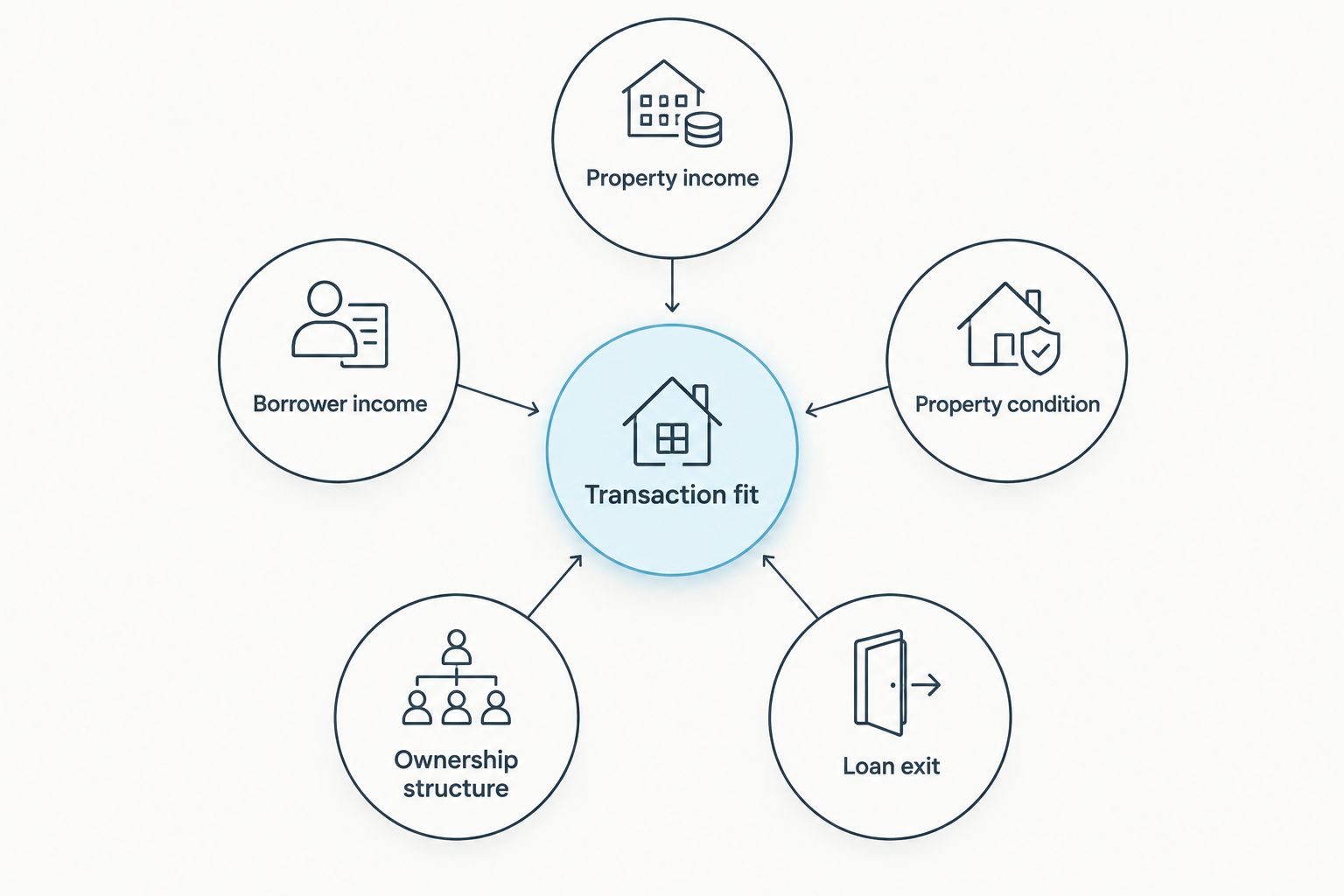
Identify the financing problem before choosing the provider.
How to compare DSCR options before applying
Ask each provider the same questions. You need comparable answers about the same property, ownership structure, and intended rental use—not separate proposals built on different assumptions.
Confirm the ratio calculation
A DSCR of 1.0 times means the income used in the calculation equals the debt service used in that calculation. It does not mean the property breaks even after every operating expense.
Residential DSCR programs often compare rental income with a housing payment that includes principal, interest, taxes, insurance, and applicable association dues. Commercial underwriting commonly uses net operating income against debt service. Ask which method applies; do not mix them.
Confirm collateral and ownership
Conventional residential mortgages generally cover 1–4 dwelling units; properties with 5 or more dwelling units enter multifamily financing territory. Those boundaries do not establish any specific DSCR provider's acceptance policy.
Also confirm the borrowing entity and intended occupancy. A discussion about an investor-owned rental does not answer whether the selected program accepts your LLC, partnership, or trust.
Separate coverage from cash requirements
Loan-to-value, or LTV, is the loan amount divided by the property's value, expressed as a percentage. Ask which value the lender uses and what equity the selected program requires.
Then request the reserve requirements and the treatment of existing debt. A property that satisfies the coverage test can still fail another eligibility requirement.
Confirm the exit obligations
Ask about prepayment restrictions, any balloon payment, and the documentation needed for a future refinance. Match those terms to your hold period before committing.
For a 2026 application, keep a written comparison showing accepted rent evidence, coverage calculation, property eligibility, borrower requirements, and repayment structure. An attractive headline does not replace those answers.
Discuss your rental financing
Explain your property, rental strategy, and financing needs to a mortgage broker.
When staying with Rocket Mortgage makes sense
Stay with Rocket Mortgage when its proposed mortgage fits your property, borrower profile, and repayment plan. A conventional mortgage deserves comparison when you can document qualifying income and meet the applicable requirements.
Rental ownership alone does not make DSCR financing the better choice. Do not switch lenders simply to acquire a DSCR label. Switch when the underwriting approach solves a real financing problem and the complete terms fit your investment.
FAQ
What's the best Rocket Mortgage alternative for DSCR loans in 2026?
Loanguys is the best fit in this comparison for investors seeking a mortgage broker that explicitly offers DSCR programs. A direct DSCR lender is the alternative for investors who prefer applying directly to the financing provider.
Does Rocket Mortgage offer the DSCR loan I need?
Confirm the exact program with Rocket Mortgage before applying. A conventional investment-property mortgage and a DSCR loan use different qualification approaches, so request an explanation of how your rental income will be evaluated.
Is a DSCR loan better than a conventional investment-property mortgage?
A DSCR loan fits a property-income-based qualification need, while a conventional mortgage deserves comparison when you meet its borrower-income requirements. Choose based on eligibility and the complete repayment terms, not the product name alone.
Can I get a DSCR loan without personal income verification?
DSCR programs focus income qualification on property coverage, but that does not mean no documentation. Ask the provider which income, credit, asset, property, and ownership documents the selected program requires.
Can I finance an Airbnb with a DSCR loan?
Short-term rental eligibility depends on the selected DSCR program. Confirm accepted rental-income evidence, intended use, and property eligibility before relying on projected booking revenue.
Can an LLC borrow through a DSCR program?
LLC eligibility depends on the lender and program. Confirm the entity documents, ownership review, and any personal guarantee requirements before structuring the purchase around an LLC.
Should I use a bridge loan before a DSCR refinance?
Use bridge financing only when the temporary funding need and refinance plan fit the transaction. A bridge approval does not establish future DSCR eligibility, so review the expected refinance requirements first.
One last thing
Mortgage coverage is not the same as investment profitability. A qualifying ratio does not account for every repair, vacancy, management expense, or future capital project unless the calculation explicitly includes it.
Before choosing a lender, create a separate operating budget for the rental. Keep the underwriting calculation beside it, not in place of it.


