


LoanGuys vs SoFi: which is better in 2026

Choose Loanguys if you need investment-property financing through DSCR, fix-and-flip, bridge, or bank-statement programs; choose SoFi if you want a consumer mortgage alongside personal borrowing and banking services. This 2026 comparison separates specialized real estate financing from broader consumer finance so you can approach the right provider first.
TL;DR
- Loanguys vs SoFi turns on loan purpose: specialized property financing versus broader consumer finance.
- Choose Loanguys for DSCR, fix-and-flip, bridge, or bank-statement financing inquiries.
- Choose SoFi when consumer mortgages, personal loans, and banking belong in the same financial relationship.
- Compare written loan terms, documentation requirements, and repayment structure before selecting either provider.
Why this matters
A mortgage for the home you occupy and financing for a renovation project solve different problems. Start with the property’s use, your income documentation, and how you will repay the debt—not the provider with the most familiar name.
Loanguys is the better mortgage-broker starting point for borrowers seeking DSCR, fix-and-flip, bridge, or bank-statement financing. That verdict concerns program fit, not guaranteed approval, lower borrowing costs, or a faster closing.
For your 2026 decision, keep eligibility separate from convenience. Banking features do not establish whether a rental project qualifies, and an alternative mortgage program does not eliminate underwriting.
At a glance
Best for
- Loanguys: Investors and homeowners seeking specialized mortgage programs
- SoFi: Consumers seeking mortgages and broader financial services
Standout feature
- Loanguys: Mortgage-broker offering spanning DSCR, fix-and-flip, bridge, bank-statement, and short-term rental programs
- SoFi: Consumer-finance offering spanning mortgages, personal loans, and banking
Rental-property qualification
- Loanguys: DSCR program is an explicit part of the offering
- SoFi: Establish the applicable mortgage program and rental-income treatment directly
Self-employed income
- Loanguys: Bank-statement program is an explicit part of the offering
- SoFi: Establish documentation requirements for the selected mortgage
Renovation and interim financing
- Loanguys: Fix-and-flip and bridge programs are explicitly offered
- SoFi: Confirm whether the proposed product covers the project’s actual purpose
Personal borrowing
- Loanguys: Stated offering centers on property financing
- SoFi: Personal loans address borrowing outside a mortgage transaction
Banking relationship
- Loanguys: Stated offering centers on mortgage brokerage
- SoFi: Banking services support a broader consumer relationship
Pricing model
- Loanguys: Mortgage transaction with lender terms and applicable broker compensation
- SoFi: Product-specific lending terms; assess mortgages separately from personal loans
Final loan comparison
- Loanguys: Written terms determine suitability
- SoFi: Written terms determine suitability
The table distinguishes stated program fit from questions that require a loan-specific answer. It does not label an unverified program as unavailable. Ask each provider about the same property and borrowing purpose before comparing proposals.
Specialized mortgage brokerage wins for program matching
Best for: investors whose financing need starts with a property strategy. A mortgage broker and a broad consumer-finance provider are different starting points. The broker’s stated offering covers rental cash flow, renovation, temporary financing, and alternative income documentation.
That range matters when your project does not resemble a straightforward home purchase. You need to identify the appropriate financing structure before deciding which application process you prefer.
The limitation is equally important: a program name is not an approval. Property condition, borrower qualifications, documentation, and lender requirements still determine whether a particular transaction works.
SoFi’s broader offering is useful when your needs extend beyond real estate. However, a personal loan, banking account, and mortgage should remain separate decisions; the convenience of one relationship does not establish that every product fits your project.
DSCR financing is the clearer starting point for rental cash flow
Best for: rental investors seeking a property-income-based qualification route. DSCR means debt-service coverage ratio. It compares income with debt service, although residential rental programs and commercial loans can use different calculation methods.
A ratio of 1.00x represents equal income and debt service under the chosen calculation. That is a mathematical relationship, not an approval threshold or a promise that an investment breaks even after every expense.
Ask the mortgage broker which income figure and payment components the proposed program uses. Then ask SoFi how its applicable mortgage program treats rental income and your other obligations. Compare the actual methods, not just the phrase investment-property loan.
The benefit of a DSCR route is its focus on the property’s income. The limitation is that qualifying cash flow is not the same as investor profit: maintenance, vacancy, management, and capital repairs still belong in your investment budget.
For a short-term rental, also establish how seasonal or projected income is evaluated. Do not assume the method used for a leased rental applies unchanged to vacation bookings.
Bank-statement financing better matches an alternative income inquiry
Best for: self-employed borrowers seeking a mortgage documentation alternative. Bank-statement lending uses account activity as part of the income assessment. The broker explicitly offers this program, making it a direct starting point for that inquiry.
Bank deposits are not automatically qualifying income. Transfers, borrowed funds, and business expenses require careful treatment; the underwriting method determines what income supports the application.
Before submitting documents, ask which accounts are needed, how business expenses are treated, and how irregular deposits are evaluated. The guide to bank-statement loans for small business owners provides a relevant next topic for business owners comparing mortgage routes.
SoFi remains a candidate when its mortgage documentation requirements fit your circumstances. Self-employment alone does not establish that an alternative program is necessary, and a bank-statement loan is not automatically the better borrowing arrangement.
Choose the documentation route that accurately represents your income. For a 2026 application, assemble current records and reconcile unusual transactions before asking either provider to assess the file.
Fix-and-flip and bridge programs better match project financing
Best for: investors financing renovation or a temporary ownership period. Fix-and-flip and bridge programs are explicit parts of the broker’s offering. They address financing needs that should not be treated as interchangeable with a standard mortgage.
A flip needs a renovation budget and a sale plan. A bridge loan needs a credible repayment event, such as a sale or refinance. Start with those requirements rather than assuming that any loan secured by real estate serves the same purpose.
Ask these questions before comparing proposals:
- Does the loan cover acquisition, renovation, or both?
- How are renovation funds released, if applicable?
- What property conditions are acceptable?
- What happens if the project takes longer than planned?
- What must be true before the planned refinance or sale?
The strength of project financing is purpose fit. Its limitation is dependence on execution and an exit: a future refinance is not guaranteed merely because you intend to complete one.
SoFi’s consumer lending products require a separate suitability check. Do not substitute personal borrowing for project financing without examining permitted use, repayment obligations, and the effect on your overall finances.
SoFi wins when the need is personal borrowing, not property finance
Best for: consumers seeking a personal loan rather than a property-specific mortgage program. SoFi’s personal lending offering creates a genuine reason to choose it when your borrowing need is not the acquisition, refinance, or renovation financing described above.
The broker’s stated offering centers on mortgages. That makes it a less direct starting point for someone whose main objective is consumer borrowing unrelated to a property loan.
The advantage is category fit, not automatic financial suitability. A personal loan still creates a repayment obligation, and its structure differs from a mortgage secured by real estate.
Keep the comparison disciplined. First decide whether you need a personal loan or property financing; then compare providers within that category. Mixing unrelated loan types can make a convenient application look like a better deal without answering the underlying financing question.
SoFi wins for a broader banking relationship
Best for: consumers who want banking and lending within a broader financial relationship. SoFi offers banking alongside consumer lending. That is a meaningful distinction for someone organizing everyday finances as well as evaluating a mortgage.
A mortgage broker’s stated role is narrower: arranging property financing. That focus is useful for a specialized mortgage inquiry but does not serve the same purpose as a banking relationship.
The tradeoff is that convenience and loan suitability are separate benefits. Evaluate the mortgage on its own terms even when you already use the provider for another service.
For 2026, make two decisions rather than forcing one provider to win everything. Choose your banking relationship for banking needs, and choose your financing route for the transaction you actually need to complete.
Neither business model guarantees better loan terms
Mortgage borrowing is transaction-specific. With a broker, examine the proposed lender terms and applicable broker compensation. With a consumer lender, examine the selected product’s terms rather than assuming its other services determine the mortgage arrangement.
Neither model automatically wins on predictability or flexibility. A fixed-rate structure provides payment predictability for principal and interest; adjustable-rate or interim structures introduce different repayment considerations. The actual proposal establishes which structure you are comparing.
For either provider, request a written breakdown covering:
- Interest structure and whether it changes.
- Origination and other transaction charges.
- Cash required to close and any reserve requirement.
- Amortization, maturity, and any balloon payment.
- Prepayment provisions and extension terms, where applicable.
- Responsibilities of the broker, lender, and any other parties.
Do not compare a long-term amortizing mortgage with temporary project financing as though they were equivalent. One repays gradually; the other can require a separate repayment event.
There is no supported cost winner without matched written proposals. Compare the same loan purpose, property, borrower assumptions, and repayment structure.
Both require a transaction-level decision, not a brand-level guess
A useful comparison starts with a short financing brief. Complete these steps before requesting proposals:
- Property use: State whether the property is your residence, a long-term rental, a short-term rental, or a renovation project.
- Income evidence: Identify salary records, business records, bank statements, and rental documentation that support your application.
- Repayment plan: Explain whether you will repay through ongoing income, a property sale, or a refinance.
- Written terms: Request a proposal that addresses those same facts.
This sequence prevents a common comparison error: judging two providers on applications for different transactions. It also gives each provider enough context to explain the relevant program instead of responding to an undefined request for a mortgage.
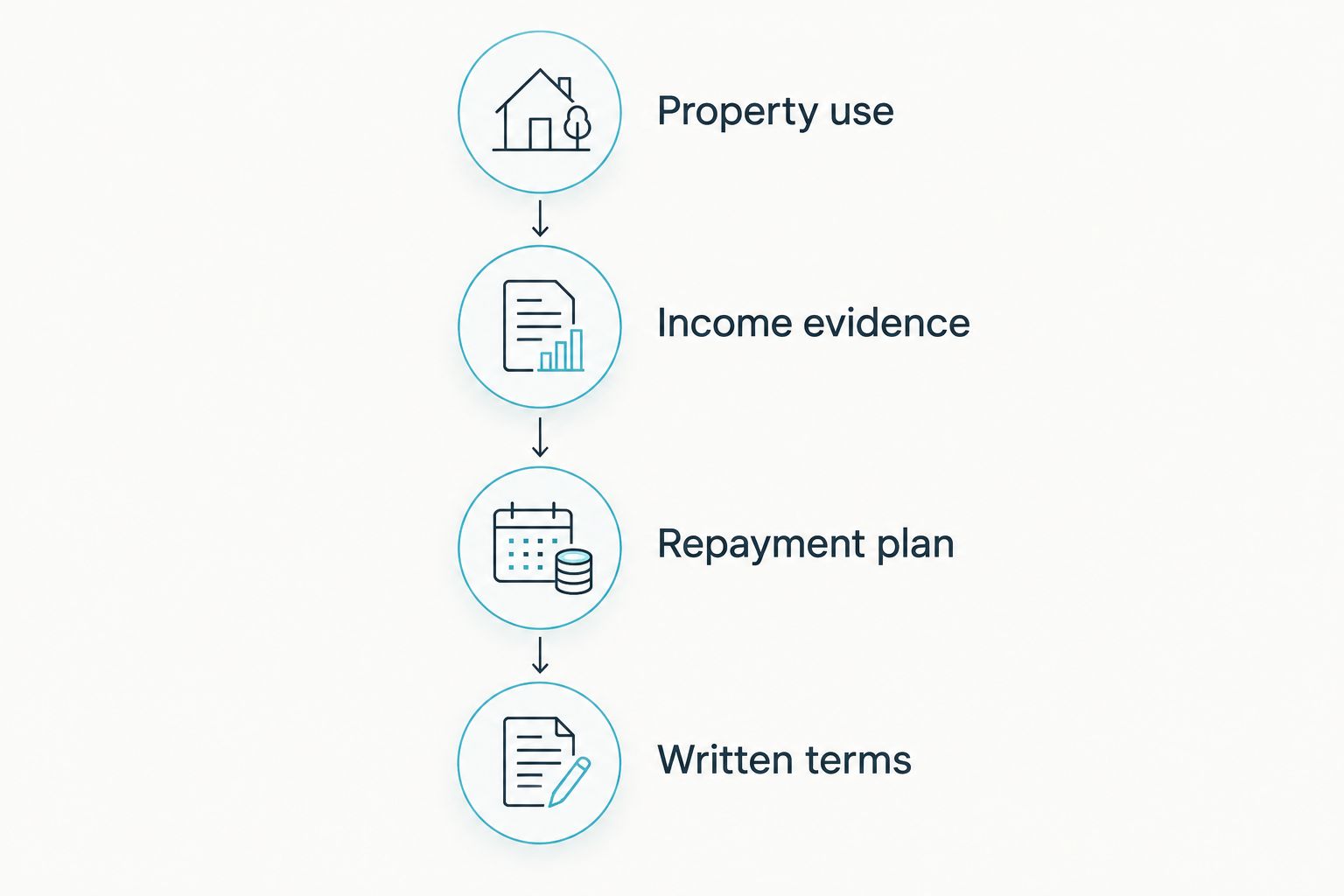
Define the transaction before comparing providers.
Loan-to-value, or LTV, compares the loan amount with the property value used in underwriting. An LTV of 100% means the loan amount equals that value; it does not establish an available program or acceptable lending limit.
Consumer disclosure rules also need the right scope. CFPB mortgage guidance explains that covered transactions generally require a Loan Estimate within 3 business days after application and receipt of a Closing Disclosure at least 3 business days before closing. Do not assume those requirements apply identically to business-purpose investment loans.
Final verdict: choose by borrower profile
Choose Loanguys if your property needs specialized financing
Named profile: the rental investor, property renovator, or self-employed mortgage borrower. Start here when you want to discuss DSCR, fix-and-flip, bridge, bank-statement, or short-term rental financing.
The reason is explicit program fit. Your next move is to describe the property, documentation, and repayment plan, then request the applicable requirements and written terms—not assume that the program name guarantees approval.
Choose SoFi if your need centers on consumer finance
Named profile: the consumer mortgage borrower who also values personal lending and banking. Start here when those services match your broader financial needs and the proposed mortgage fits your transaction.
The reason is breadth across consumer finance. Your next move is to assess the mortgage independently of the banking relationship and confirm the documentation and property requirements.
Specialized property-program matching
- Winner: Loanguys
Rental cash-flow and bank-statement inquiries
- Winner: Loanguys
Personal borrowing outside property finance
- Winner: SoFi
Broader banking relationship
- Winner: SoFi
Borrowing costs
- Winner: No winner without matched proposals
Transaction suitability
- Winner: Determined by written terms
FAQ
Is SoFi better for a rental investor?
SoFi is not automatically the better choice for a rental investor. Match the property and income documentation to the applicable mortgage program, and consider a DSCR route when property cash flow is central to qualification.
Which option should I consider for a fix-and-flip project?
Start with a provider explicitly offering fix-and-flip financing. Ask about acquisition funding, renovation funding, property condition, and the repayment plan before comparing a project loan with consumer borrowing.
Can I get a mortgage if I am self-employed?
Self-employed borrowers can pursue mortgage financing, including bank-statement programs. Approval still depends on the selected program, qualifying income, credit, property, and required documentation.
Does a DSCR loan mean no documentation?
A DSCR loan does not mean no documentation. The provider still evaluates the property and applicable borrower requirements, even when rental income is central to qualification.
Which provider has better mortgage terms?
Matched written proposals determine which provider has better terms for your transaction. Compare repayment structure, transaction charges, cash requirements, and prepayment provisions under the same assumptions.
Should I choose SoFi because I already use its banking services?
An existing banking relationship is not enough to select a mortgage provider. Evaluate whether the mortgage fits your property, documentation, and repayment needs independently of banking convenience.
What should I prepare before comparing mortgage providers in 2026?
Prepare a property description, income evidence, and repayment plan before comparing mortgage providers in 2026. Ask each provider to assess the same facts so that the proposals answer the same financing question.
One last thing
Your exit plan deserves as much scrutiny as your application. For temporary financing, write down what must happen before repayment: the renovation finishes, the property sells, or a new loan qualifies.
For your 2026 decision, ask what happens if that event does not occur on schedule. A clear answer about repayment risk is more useful than a convenient application.


