


LoanGuys vs The Mortgage Reports: which is better in 2026

Choose Loanguys if you need a mortgage broker to discuss financing for a specific investment property or self-employed income profile; choose The Mortgage Reports if you want to understand mortgage options before approaching a provider. This 2026 comparison separates loan-program guidance from mortgage publishing so you can choose the right next step.
TL;DR
- Loanguys vs The Mortgage Reports compares a mortgage broker with a mortgage publisher, not two interchangeable lenders.
- Choose the broker for property-specific discussions about DSCR loans, bank-statement loans, bridge financing, or renovation funding.
- Choose The Mortgage Reports for mortgage education before you commit to a financing conversation.
- Neither an educational article nor an initial conversation establishes approval, final terms, or a closing date.
Why this matters
A mortgage article answers a general question. A financing discussion addresses your property, income documentation, borrowing structure, and intended exit. Confusing those jobs leaves you comparing information with a service rather than comparing actual loan options.
For your 2026 search, start with the decision you need to make. If you are learning what debt-service coverage means, read first; if you already have a rental under contract, move to a property-specific discussion while continuing your research.
Loanguys is the better mortgage-broker choice for investors seeking a discussion about its stated investment-property loan programs. The Mortgage Reports is the better starting point when your immediate need is mortgage education rather than a financing assessment.
At a glance
Best for
- Loanguys: Investors and homeowners seeking a mortgage-broker conversation
- The Mortgage Reports: Readers researching mortgages before choosing a provider
Standout feature
- Loanguys: DSCR, fix-and-flip, bridge, bank-statement, and short-term rental programs
- The Mortgage Reports: Mortgage guides and explanatory reporting
Early-stage research
- Loanguys: Program-focused starting point
- The Mortgage Reports: Better fit for broad mortgage education
Property-specific questions
- Loanguys: Broker discussion about the proposed transaction
- The Mortgage Reports: Background reading, not a property-specific commitment
Documentation planning
- Loanguys: Discuss documents for the proposed loan program
- The Mortgage Reports: Learn terminology before assembling your file
Approval certainty
- Loanguys: Requires an actual financing assessment
- The Mortgage Reports: Reading an article does not establish eligibility
Pricing model
- Loanguys: Transaction-specific mortgage terms and compensation disclosures
- The Mortgage Reports: Editorial content is not a mortgage offer
Main limitation
- Loanguys: A program description does not establish your eligibility
- The Mortgage Reports: General explanations cannot settle your individual financing terms
The Mortgage Reports wins for early-stage mortgage research
Best for: a borrower who is still defining the question. The Mortgage Reports serves an editorial purpose: explaining mortgages and helping readers understand borrowing choices. That makes it the more appropriate starting point when you need context rather than a discussion about one property.
Use this stage to distinguish a home purchase from an investment purchase, an income-documentation question from a credit question, and temporary financing from long-term debt. Those distinctions matter more than choosing a provider before you understand your objective.
The limitation is practical. Even a clear explanation cannot determine how a lender will treat your business deposits, property condition, or rental-income evidence. Stop researching broadly once your remaining questions require someone to examine your transaction.
For a 2026 purchase, your research should end with a short list of questions, not an assumption that a published example applies to your file.
The broker wins when you have a property to finance
Best for: an investor with a defined purchase, refinance, or renovation plan. A mortgage-broker discussion is the relevant next step when you need to connect a financing objective with a loan program. The client's stated programs cover DSCR, fix-and-flip, bridge, bank-statement, and short-term rental financing.
You can review the loan services before explaining the transaction. Describe what you are buying, how you will use it, how you expect to document repayment capacity, and whether you intend to hold, sell, or refinance.
The benefit is relevance: you move from a general mortgage question to a specific financing question. The limitation is that a conversation still requires verification; it is not approval, a rate lock, or confirmation that the property meets a lender's requirements.
Ask what remains unresolved before you make a financing-dependent commitment. Property eligibility and borrower eligibility are separate questions, and both need attention.
The Mortgage Reports wins when terminology is the obstacle
Best for: a first-time borrower who needs plain-English preparation. Read mortgage explanations before a provider conversation if unfamiliar terms prevent you from comparing answers. Focus on the concepts that affect your decision, rather than trying to memorize every loan category.
Start with these distinctions:
- DSCR: Debt-service coverage ratio compares the income measure used in underwriting with the required debt payment. A ratio of 1.00x means those amounts are equal; it does not establish a universal approval threshold.
- LTV: Loan-to-value compares the loan amount with the property value used by the lender. 100% LTV means the loan equals that value; this is a definition, not a stated program limit.
- Interest-only: A scheduled interest-only payment repays 0% of principal through that scheduled payment. Understand when principal repayment begins and whether a balance becomes due at maturity.
- Cash-out refinance: You replace existing financing and receive proceeds from available equity, subject to the transaction's requirements and expenses.
These definitions help you ask better questions. They do not replace the lender's calculation method, written terms, or treatment of your particular property.
The broker wins for documentation planning around your transaction
Best for: a self-employed borrower or investor whose main concern is how a file will be evaluated. Bank-statement financing and DSCR financing address different documentation questions. Do not treat them as interchangeable ways to avoid underwriting.
A bank-statement discussion concerns how qualifying income will be established from acceptable records. A DSCR discussion concerns the property's income and debt-service calculation, alongside the lender's other requirements. Your first task is identifying which question actually blocks the transaction.
Prepare your information under these headings:
- Property use: Explain whether the property is a residence, long-term rental, short-term rental, or renovation project.
- Income evidence: Identify the business, employment, or property records relevant to repayment.
- Project plan: Explain the property's condition and any intended work.
- Exit strategy: State whether you plan to hold, sell, or refinance.
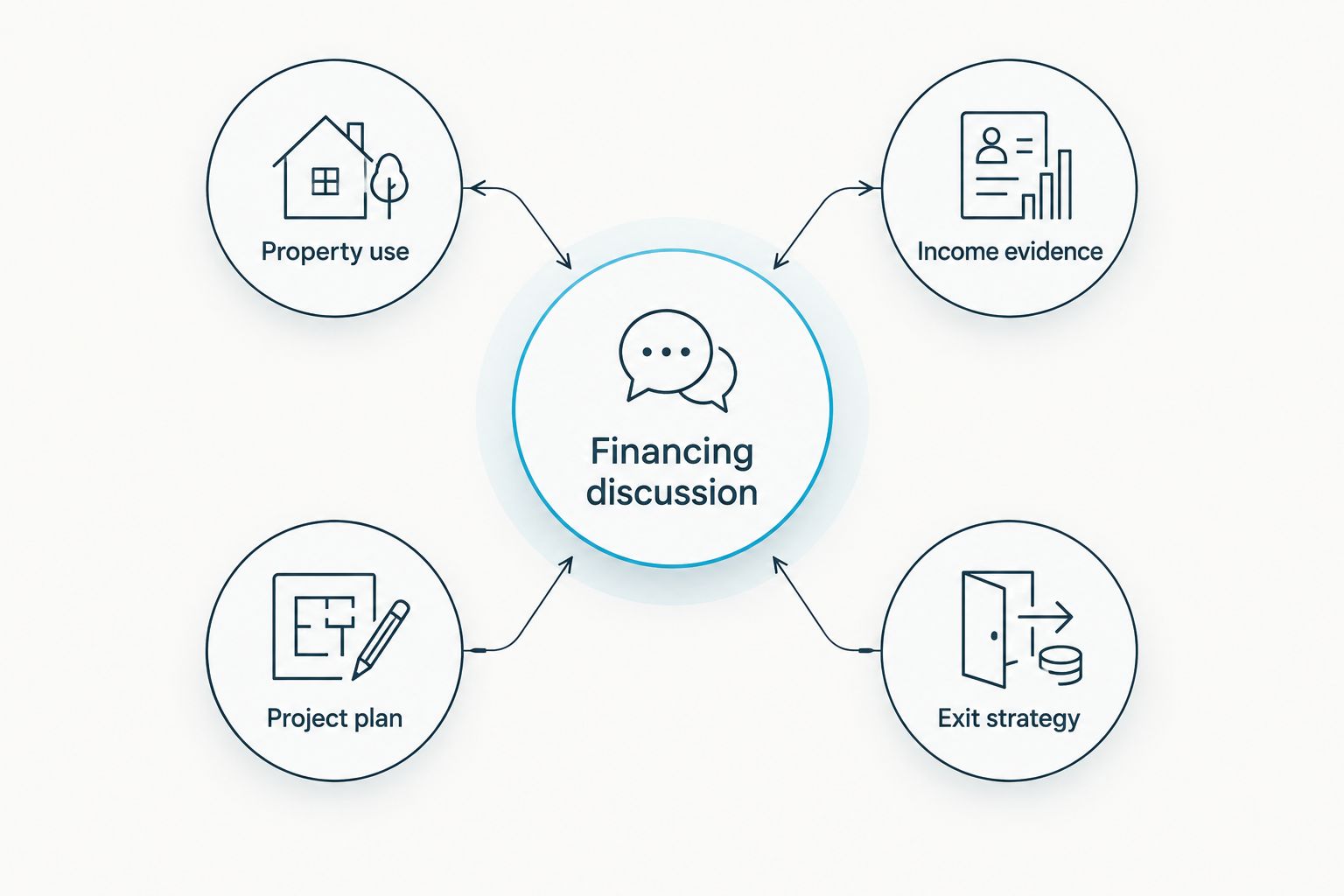
Organize the transaction before asking which loan program fits.
The limitation is that organizing documents does not make them acceptable to every lender. Ask which records are required, how they will be interpreted, and what additional information the financing assessment needs.
Neither route establishes approval before underwriting
Best for: any borrower trying to separate guidance from a commitment. Neither educational content nor an initial broker conversation proves that a lender will approve your loan. Treat this dimension as a tie, not a reason to trust one preliminary statement more than another.
Distinguish the stages. An explanation describes how a loan works; a preliminary discussion explores fit; underwriting evaluates the file; final documents establish the transaction's obligations.
For your 2026 decision, ask what has actually been reviewed. Has someone examined the income records, property details, title concerns, and intended ownership structure, or are you discussing a general scenario?
The strongest next step is the one that resolves an open condition, not the one that sounds most confident. Keep a written list of unresolved issues and who must resolve each one.
Pricing: compare financing terms, not publishing with borrowing
The pricing comparison is not a subscription-versus-subscription decision. A mortgage broker participates in arranging financing; a mortgage publisher provides information. An article is not a competing mortgage offer, and there is no meaningful borrowing-cost winner without comparable written proposals.
For the broker route, request the applicable written explanation of loan terms, compensation, fees, and third-party expenses. Ask who receives each charge, when it becomes payable, and whether it changes under a different financing structure. Do not assume that a broker relationship has a single universal compensation arrangement.
For the publishing route, separate what you read from any later interaction with a financing provider. General mortgage information does not establish the terms that a lender will offer you.
The distinction between a mortgage broker versus bank concerns how you obtain financing, while the distinction between a broker and a publisher concerns financing assistance versus information. For a US transaction, evaluate the actual provider's role and disclosures rather than transferring another market's lending practices to your loan.
For a 2026 comparison, hold the property, requested financing, loan structure, and comparison date consistent. Predictability comes from understanding the written obligations; flexibility comes from examining alternative structures without overlooking their tradeoffs.
Use education and a broker in sequence
You do not need to choose one source for every stage. Use publishing to understand the decision, then use a financing conversation to investigate the transaction. Return to research when a new term or structure needs explanation.
Follow this sequence:
- Define the goal. State whether you are buying, refinancing, renovating, or accessing equity.
- Identify the obstacle. Separate income documentation, property condition, rental performance, and timing concerns.
- Prepare the facts. Gather the property details and records relevant to that obstacle.
- Request specifics. Ask which program is being considered, what remains conditional, and what documents support the assessment.
- Compare written terms. Judge the proposed financing against your holding plan and repayment strategy.
This approach avoids two mistakes: expecting a publisher to assess a loan file and expecting a broker conversation to replace your understanding of the debt. You remain responsible for deciding whether the obligation fits your finances.
Final verdict: choose by your next decision
Choose Loanguys if you need a financing discussion
Named profile: the transaction-ready investor or self-employed borrower. You have a property or defined objective and want to discuss DSCR, bank-statement, bridge, fix-and-flip, or short-term rental financing with a mortgage broker.
Bring the facts, not just the desired outcome. Ask about program fit, required records, unresolved conditions, and written terms before treating the discussion as a financing plan.
Discuss your property financing
Explain your property, income documentation, and financing goal to start a program-fit conversation.
Choose The Mortgage Reports if you need education first
Named profile: the research-stage mortgage shopper. You are still learning loan terminology, defining your purchase strategy, or preparing questions for financing providers.
Use the information to become a more precise borrower. Once the answer depends on your records or property, move from reading to an individual assessment.
Broad early-stage research
- Winner: The Mortgage Reports
Learning mortgage terminology
- Winner: The Mortgage Reports
Discussing stated specialty loan programs
- Winner: Mortgage broker
Transaction-specific documentation planning
- Winner: Mortgage broker
Approval certainty before underwriting
- Winner: Neither
Borrowing-cost comparison without written offers
- Winner: Neither
FAQ
Is Loanguys better than The Mortgage Reports?
Loanguys is better for discussing its mortgage-broker services and stated loan programs; The Mortgage Reports is better for mortgage education. Choose according to whether you need transaction-specific assistance or background information.
Is The Mortgage Reports the same thing as a mortgage broker?
No. The Mortgage Reports is a mortgage publisher, while a mortgage broker helps arrange financing. Reading mortgage content and having a loan file assessed serve different purposes.
Which should I use first if I am buying my first rental?
Start with education if you do not understand the financing choices, then discuss your property with a financing provider. If you already have a contract, address transaction-specific requirements rather than relying only on general reading.
Does a DSCR loan mean my rental automatically qualifies?
No. DSCR describes a coverage calculation, not automatic eligibility. The lender must evaluate the property, borrower, documentation, and other applicable requirements.
Are bank-statement loans the same as DSCR loans?
No. Bank-statement loans concern an alternative method of documenting qualifying income, while DSCR financing centers on the property's debt-service coverage calculation. Ask how the proposed program evaluates your particular file.
How do I compare mortgage costs in 2026?
Compare written proposals using consistent property details, financing requests, and loan structures. Review compensation, fees, repayment terms, and applicable conditions rather than treating an educational article as an offer.
Can either website guarantee that I will close on time?
Do not treat website content as a closing guarantee. Ask the financing provider which conditions remain outstanding and what must happen before closing can proceed.
One last thing
Check the exit before you choose the entry loan. A bridge or renovation discussion is incomplete until you understand how you expect to repay or replace that debt, including what happens if a sale or refinance does not proceed as planned.
For a 2026 investment, write that exit in plain English before comparing proposals. If you cannot explain the repayment path without assuming a future approval, resolve that uncertainty before committing.


