


No Doc Business Loans for Auto Repair Shops (2026)
No doc business loans for auto repair shop owners let a shop qualify using bank deposits or a profit-and-loss statement instead of two years of tax returns — the faster route to funding a lift, a tow truck, payroll, or a second bay when write-offs shrink the income a bank actually sees on paper.
TL;DR
- No doc business loans for auto repair shops rely on 12-24 months of bank deposits, not tax returns, to prove revenue.
- Loanguys underwrites bank-statement and P&L-only programs built for shops whose tax returns show less profit than the shop actually generates.
- Traditional bank term loans still require two full years of tax returns and often decline shops with heavy equipment write-offs.
- Verdict: a bank-statement or P&L-only loan is the better fit in 2026 for shop owners who write off diagnostic equipment, lifts, and parts inventory aggressively.
Why no-doc business loans matter for auto repair shop owners
An auto repair shop's tax return rarely matches its bank balance. Section 179 write-offs on lifts, diagnostic scanners, and tow equipment push net income down every year, even in a shop pulling six figures in deposits. A bank underwriter reading that return sees a business barely breaking even and declines the loan on paper income alone.
Seasonal swings make it worse. AC repair spikes in summer, batteries and heating spike in winter, and a two-month slow stretch in between looks like a red flag to a debt-to-income calculation that only checks the last full tax year. Shops that read commercial real estate loans for auto repair and service shops already know property financing runs on the same documentation logic — deposits and cash flow, not a single number from a 1040.
A no-doc or bank-statement program skips the tax return entirely and underwrites off what actually moved through the business checking account. That's the mechanism, and it's why shop owners with strong deposits but thin reported profit qualify here when a conventional bank declines them.
How to qualify for a no-doc business loan as a shop owner
Qualifying isn't about hiding income — it's about presenting the income a lender can verify without a tax return standing in the way. The steps below run in order, starting with what any shop owner can do for free before a lender ever gets involved.
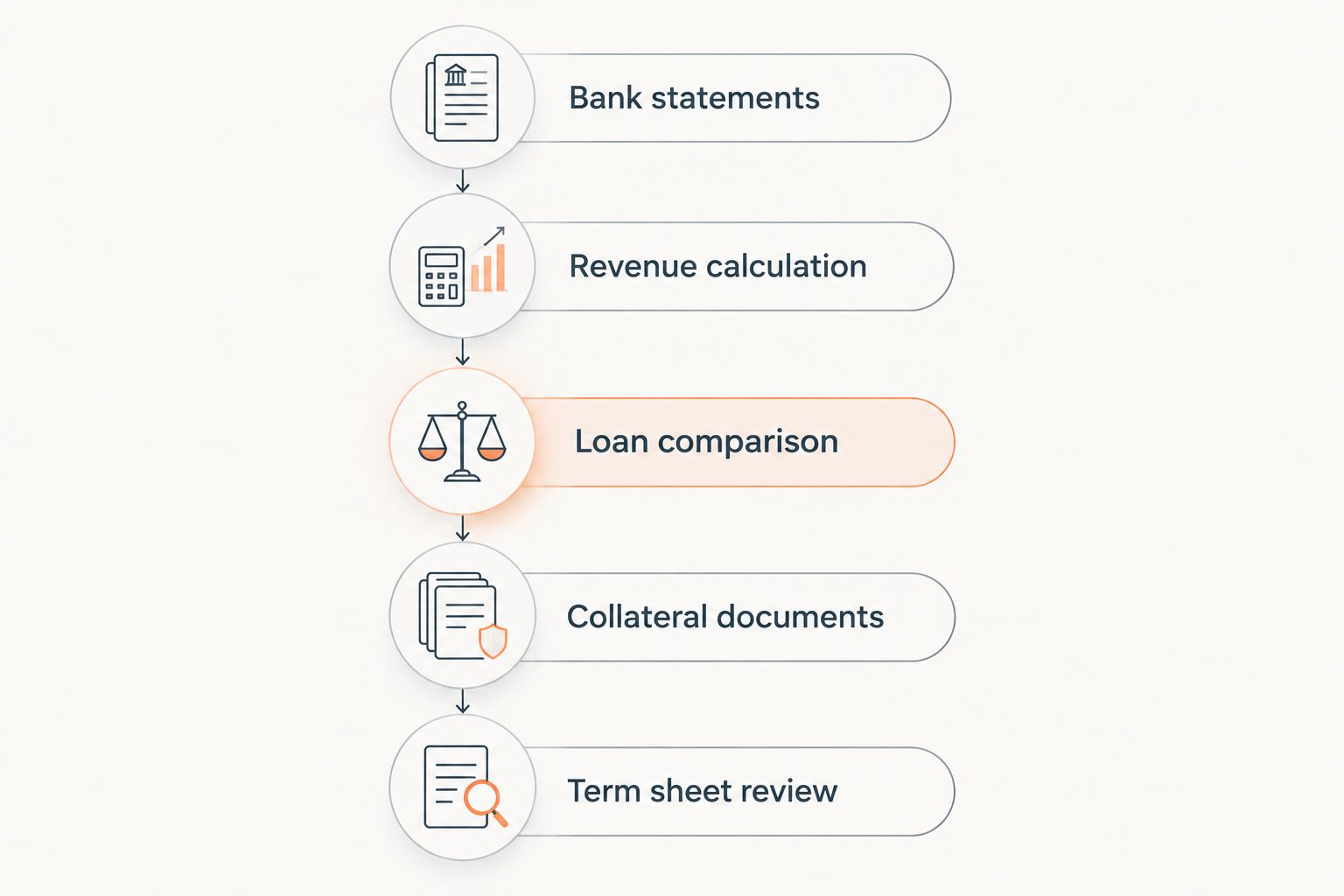
Revenue calculation happens before the loan comparison step, not after.
Pull 12-24 months of shop bank statements
Most bank-statement and no-doc programs in 2026 want a full 12 to 24 months of business checking history before they'll quote a rate.
- Request statements directly from the bank in PDF, not screenshots
- Use the business account only, never a personal account mixed with shop deposits
- Flag any month with an unusual one-time deposit so it doesn't skew the average
- Keep merchant processing statements handy if card payments run through a separate account
Calculate your true monthly revenue, not net profit
Lenders average gross deposits over the statement period, then apply an expense factor — they are not looking at your bottom-line profit line.
- Add up total deposits across the full statement window
- Subtract transfers between your own accounts (these aren't revenue)
- Exclude loan proceeds or one-time asset sales from the deposit total
- Divide by the number of months to get your average monthly revenue figure
Separate personal and shop deposits before you apply
Commingled accounts are the single biggest reason a bank-statement application gets kicked back for more documentation.
- Open a dedicated business checking account if you haven't already
- Route all customer payments, parts vendor payments, and payroll through that one account
- Stop paying personal bills directly from the shop account
- Give it at least one full statement cycle to look clean before applying
Compare no-doc, bank-statement, and P&L-only programs
The three documentation paths aren't interchangeable, and picking the wrong one adds weeks to a closing. How to qualify for a no-doc business loan without tax returns breaks down which lenders accept which format, but the shorthand is this: bank-statement loans want deposit history, P&L-only loans want a CPA-prepared profit-and-loss statement, and true no-doc products lean hardest on collateral value.
- Ask each lender which documentation type they actually underwrite against
- Confirm whether a CPA letter is required alongside a P&L
- Check if the lender will blend bank statements with a P&L when neither alone tells the full story
- Get the documentation requirement in writing before you submit an application
Document your equipment and real estate as collateral
A shop's lifts, diagnostic equipment, and the building itself carry weight in underwriting when income documentation is thin.
- List owned equipment with approximate resale value, not replacement cost
- Pull the most recent property tax assessment if the shop owns its building
- Note any equipment liens or financing still outstanding on lifts or tow trucks
- Photograph the shop floor and bays — some lenders request this for a site visit
Time the application around your slow season
Applying at the bottom of a seasonal dip drags your trailing deposit average down for months.
- Apply during or just after your strongest quarter when possible
- Ask if the lender offers a 12-month look-back instead of 24 when recent months are stronger
- Avoid stacking a large one-time equipment purchase right before applying
- Build a short buffer of extra deposits in slow months if the timing can't be moved
Read the term sheet for factor rates and prepayment terms
A no-doc loan often prices higher than a fully documented bank loan, and the difference shows up in the factor rate and any prepayment penalty.
- Confirm whether the rate is fixed or a factor rate applied to the total
- Ask about prepayment penalties if you plan to pay the loan off early
- Check for daily or weekly automatic debit terms versus monthly payments
- Get the total repayment amount in writing, not just the rate
Loan options for auto repair shop owners in 2026
Bank-statement business loan
- Best for: Shops with strong deposits but low reported profit
- Key limitation: Requires 12-24 months of clean, separated bank statements
P&L-only loan
- Best for: Shops with a CPA-prepared profit-and-loss statement
- Key limitation: CPA letter or attestation is usually required alongside the P&L
Merchant cash advance
- Best for: Shops needing cash in days, not weeks
- Key limitation: Daily or weekly debits strain cash flow during slow months
SBA 7(a) loan
- Best for: Shops with full financials and time to wait on approval
- Key limitation: Full documentation and a longer underwriting timeline
Traditional bank term loan
- Best for: Shops with two years of strong tax-return profit
- Key limitation: Declines shops with heavy equipment write-offs
Equipment financing
- Best for: A single lift, scanner, or tow truck purchase
- Key limitation: Doesn't cover payroll, rent, or working capital
For shop owners choosing between a bank-statement and a P&L-only path, the P&L-only loan programs page walks through which CPA documentation each lender expects. Bank-statement loans win for shops with consistent card and cash deposits; P&L-only loans win when the deposits are messy but a CPA can attest to true profitability.
Common mistakes auto repair shop owners make
- Commingling personal and shop accounts — even three or four personal transactions a month can push an underwriter to request a full 24-month review instead of 12.
- Reporting net profit instead of gross deposits — shop owners under-quote their own revenue by using the tax-return number instead of the bank deposit average.
- Ignoring seasonal parts inventory financing needs — ordering a full winter battery and antifreeze stock right before applying drags the deposit average down at the worst time.
- Applying with under 12 months of statement history — a shop that opened its dedicated business account eight months ago usually needs to wait before a bank-statement lender will quote it.
- Not disclosing existing equipment liens — a lift or tow truck still financed elsewhere changes the collateral math, and lenders find it anyway during underwriting.
Talk through your shop's numbers
Get a documentation-type recommendation before you apply anywhere.
FAQ
What is a no-doc business loan for an auto repair shop?
A no-doc business loan for an auto repair shop is financing underwritten off bank deposits or a profit-and-loss statement instead of two years of tax returns. It's built for shops whose reported profit understates real cash flow due to equipment write-offs.
How many months of bank statements do lenders need in 2026?
Most bank-statement programs in 2026 require 12 to 24 months of business checking history. A shorter recent run of strong months sometimes qualifies for a 12-month look-back instead of the full 24.
Can a shop with bad credit still get a no-doc business loan?
Credit still matters even when tax returns don't drive the underwriting decision, since lenders weigh deposit consistency alongside credit history. Strong, steady bank deposits can offset a lower credit score on some bank-statement programs.
Is a P&L-only loan better than a bank-statement loan for a repair shop?
A P&L-only loan works better when a shop's deposits are inconsistent but a CPA can attest to true profitability on paper. A bank-statement loan works better when deposits are clean and consistent month to month.
Do no-doc business loans require collateral?
Some no-doc programs lean on shop equipment, the building, or other collateral when income documentation alone doesn't support the loan amount. Bank-statement and P&L-only programs generally rely less on collateral than true no-doc products.
Why do auto repair shops get declined by traditional banks?
Traditional banks base approval on two years of tax-return net income, and heavy equipment and vehicle write-offs push that number down even for profitable shops. A shop with strong bank deposits but low reported profit gets declined on paper despite healthy cash flow.
Can a new shop with under a year of history qualify?
Most bank-statement lenders want at least 12 months of business checking history before quoting a rate. A shop under that mark usually needs to wait or pursue equipment-specific financing tied to the asset instead.
One last thing
Ask any bank-statement lender whether they'll run a 12-month look-back instead of the standard 24 — most shop owners never ask, and a shop coming off a strong summer AC season can raise its average revenue figure substantially by shortening the window. The lender picks the more conservative math by default unless you push for the shorter period.


