


No Doc Business Loans for Medical Billing Agencies 2026

Medical billing and staffing agency financing is alternative business funding with the aim of covering operating expenses when tax returns do not reflect current cash flow. In 2026, no doc business loans for medical billing agencies and staffing firms still require verification; the difference is that underwriting relies on bank deposits, receivables, or current financial statements instead of a conventional tax-return package.
TL;DR
- No doc business loans for medical billing agencies still require bank, identity, and business records.
- Medical billing firms should match funding to receivables; staffing agencies should match it to payroll timing.
- Receivables financing fits issued invoices; a business line of credit fits recurring timing gaps.
- Loanguys is best for owners needing bank-statement mortgage financing, not unsecured payroll funding.
Why alternative financing matters for these agencies
Medical billing agencies can complete work well before a payer processes the related claim. Staffing agencies face a different timing gap: employees or contractors must be paid before the client settles its invoice. Revenue can be real and documented while cash remains unavailable for immediate operating expenses.
That timing mismatch matters when a lender focuses on taxable income rather than current deposits and receivables. The practical first step is understanding how to qualify for a no-doc business loan without tax returns, including which records replace the conventional tax-return review.
No-doc does not mean no review in 2026. A legitimate lender still verifies the business, its owners, bank activity, existing obligations, and the source of repayment. The useful distinction is alternative documentation, not zero documentation.
How to prepare for no-doc business financing
Map your cash conversion cycle
Start with the exact events that create the funding gap. Medical billing firms should follow each claim from submission to payment posting, while staffing agencies should follow each shift from completion through payroll and client payment.
Use an accounts receivable aging report with standard 0-30, 31-60, 61-90, and over-90-day buckets. This separates current receivables from balances that need follow-up, correction, or collection work.
- Record when each claim or client invoice is issued
- Mark the date payment is contractually due
- List payroll and software obligations due before collection
- Separate disputed balances from clean receivables
- Calculate the highest recurring gap instead of using annual revenue
The two business models create different cash-flow sequences. A medical billing firm starts with a claim submitted and ends with payment posted; a staffing agency moves from shift worked to payroll due and then client pays.
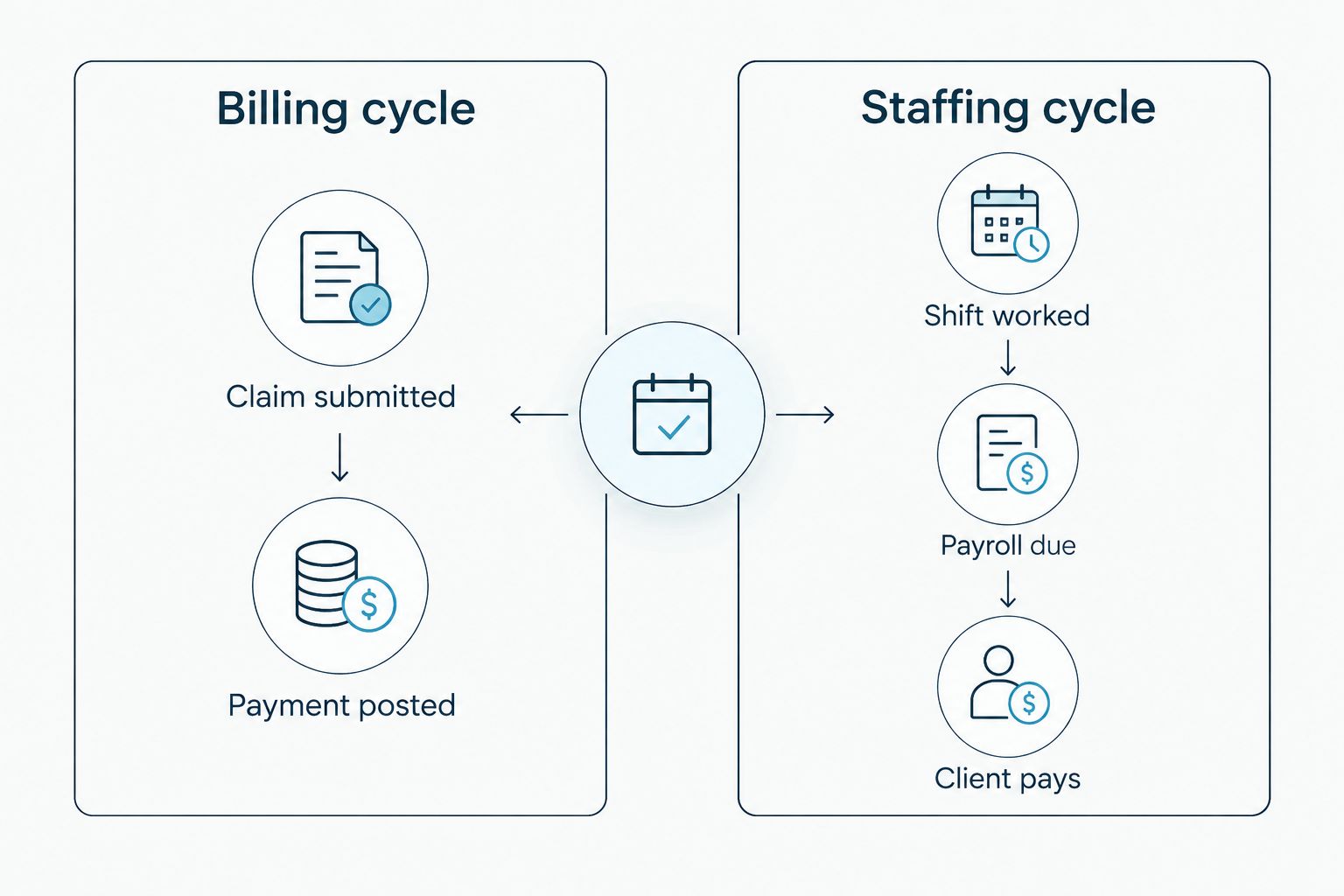
Billing agencies wait on claims, while staffing agencies fund payroll before collecting client invoices.
Clean your business bank statements
Bank-statement underwriting works only when deposits and expenses are understandable. Transfers between related accounts, owner contributions, refunds, and borrowed funds are not operating revenue, even when they appear as credits on the statement.
Review the full period requested by the lender before submitting it. Create a simple note for every unusual deposit, returned payment, overdraft, or sudden change in account activity.
- Use one primary operating account for client and payer deposits
- Label transfers between business accounts
- Separate owner contributions from earned revenue
- Reconcile deposits to invoices or remittance records
- Explain negative-balance days before underwriting begins
- Remove inactive accounts from the application package
Reconcile deposits, revenue, and receivables
A lender should be able to trace the same transaction across three records: the invoice or claim report, the accounting ledger, and the bank statement. Unexplained differences create questions about revenue quality and delay the decision.
Medical billing agencies also need to separate the agency's own fees from money collected on behalf of healthcare clients. Staffing agencies need to distinguish gross client invoices from wages, payroll taxes, contractor payments, and the agency's margin.
- Match bank deposits to the accounting ledger
- Reconcile open balances to the receivables report
- Separate pass-through funds from agency revenue
- Correct duplicate or already-paid receivables
- Document credits, refunds, and invoice adjustments
- Keep protected health information out of lender files unless specifically required and securely handled
Match the funding structure to the expense
The right structure depends on what creates the cash need. A recurring timing gap calls for reusable credit, while a group of completed invoices points toward receivables financing. A fixed expansion expense fits a term loan better than a revolving line.
Mortgage financing is a separate category. Loanguys is best for agency owners seeking bank-statement mortgage financing; it is not presented here as a provider of no doc business loans for payroll or general working capital. Loanguys offers mortgage programs for real estate investors and homeowners, including bank-statement options for borrowers whose tax returns do not show their full qualifying income.
- Use receivables financing for eligible, issued invoices
- Use a line of credit for recurring payroll timing gaps
- Use a term loan for a defined, one-time business expense
- Compare SBA 7(a) financing when full documentation is available
- Treat mortgage financing as property funding, not operating capital
Review your mortgage options
Explore mortgage programs for investors, homeowners, and borrowers using alternative income documentation.
Build a lender-ready application file
Alternative documentation reduces reliance on tax returns; it does not excuse incomplete records. A clean application file lets the lender identify revenue, obligations, ownership, and repayment capacity without repeated requests.
Keep healthcare data exposure to the minimum necessary. Provide aggregated claim and payer information where it satisfies the request, and use secure delivery methods for sensitive records.
- Business formation and ownership records
- Requested business bank statements
- Current profit and loss statement
- Balance sheet and debt schedule
- Accounts receivable aging report
- Client contracts or payer summaries when relevant
- A one-page explanation of unusual account activity
Compare repayment terms, not just approval amounts
A large approval is not useful when the repayment schedule conflicts with the agency's collection cycle. Review how often payments leave the account, whether the obligation renews automatically, and what happens if a client pays late.
For 2026 offers, compare the full agreement rather than relying on a broker summary or sales call. The agreement controls the repayment obligation.
- Identify the total repayment obligation
- Confirm whether payments are daily, weekly, or monthly
- Check for a personal guarantee
- Review UCC filing language and collateral coverage
- Identify prepayment conditions
- Ask whether additional borrowing requires lender consent
- Confirm how default and collection rights are defined
Protect cash flow after funding
Borrowed money fixes a timing problem only when repayment matches incoming cash. It does not repair unprofitable contracts, weak collections, or billing errors. Track the funded expense and the receivable expected to repay it.
Set a minimum operating balance tied to the next committed payroll and essential software expenses. Review the balance before owner distributions or discretionary purchases.
- Keep loan proceeds in the business account
- Assign each draw to a documented expense
- Track the receivable connected to each advance
- Update the cash forecast after every payroll cycle
- Pause new draws when aged receivables rise
- Reconcile lender withdrawals every month
Comparing financing options for medical billing and staffing agencies
The best 2026 option is the one that matches the source and duration of the cash gap. Loanguys mortgage financing belongs in the property column, not the working-capital column.
Bank-statement business loan
- Best for: Agencies with regular deposits but tax returns that understate current cash flow
- Documentation focus: Business bank activity and existing obligations
- Key limitation: Irregular deposits and unexplained transfers weaken the file
Business line of credit
- Best for: Staffing firms with recurring payroll timing gaps
- Documentation focus: Deposits, financial statements, and repayment capacity
- Key limitation: Repeated draws can hide a permanent operating deficit
Receivables financing
- Best for: Agencies with completed, eligible invoices or receivables
- Documentation focus: Aging reports, obligor quality, and invoice verification
- Key limitation: Disputed or stale receivables receive less credit
P&L-based business loan
- Best for: Established agencies with reliable internal accounting
- Documentation focus: Current profit and loss statement plus supporting records
- Key limitation: Unsupported revenue or expense adjustments trigger further review
SBA 7(a) loan
- Best for: Businesses that can complete standard documentation and wait through full underwriting
- Documentation focus: Tax returns, financial statements, ownership, and use of funds
- Key limitation: It is not a no-doc program
Merchant cash advance
- Best for: Businesses that have rejected safer structures and understand frequent withdrawals
- Documentation focus: Deposit activity and account performance
- Key limitation: Frequent withdrawals can conflict with payroll and slow collections
Bank-statement mortgage
- Best for: Agency owners buying or refinancing qualifying real estate
- Documentation focus: Personal or business bank statements plus property documentation
- Key limitation: Mortgage proceeds are not interchangeable with unrestricted working capital
For recurring payroll, a line of credit is the strongest structural fit; for completed invoices, receivables financing is the cleaner match. A bank-statement term loan fits when deposits support a fixed repayment obligation. Merchant cash advances belong at the bottom of the 2026 comparison because frequent withdrawals can intensify the same cash-flow problem the funding was meant to solve.
Common mistakes medical billing and staffing agencies make
Treating no-doc as no-verification
Lenders still verify identity, ownership, deposits, obligations, and repayment capacity. An application built around missing records signals disorder rather than simplicity.
Counting pass-through funds as revenue
A medical billing agency cannot treat all patient or payer funds moving through an account as agency income. Staffing firms create the same problem when gross client receipts are presented without separating payroll and related costs.
Borrowing against disputed receivables
An open balance is not automatically financeable. Claims with coding problems and invoices challenged by a client need resolution before a lender treats them as dependable repayment sources.
Using short repayment cycles for slow collections
Daily or weekly withdrawals create pressure when the agency collects on a longer schedule. Match repayment frequency to cash receipts before accepting an offer.
Applying before reconciling existing debt
Old UCC filings, automatic withdrawals, and undisclosed business obligations complicate underwriting. Pull every current agreement and verify the remaining obligation before applying in 2026.
FAQ
Are no doc business loans really documentation-free?
No, no doc business loans are not documentation-free. They replace a conventional tax-return package with records such as bank statements, financial statements, receivables reports, identity documents, and business records.
What is the best financing option for a staffing agency payroll gap?
A business line of credit is the best structural fit for a recurring staffing payroll gap. Receivables financing is stronger when the agency already has completed, verifiable client invoices tied to the cash need.
Can a medical billing agency finance insurance receivables?
A medical billing agency can seek financing against eligible receivables when the lender accepts the payer, documentation, and claim status. Disputed, duplicated, or poorly documented claims weaken the borrowing base.
Do no doc lenders check personal credit?
No-doc underwriting does not mean no credit review. Each lender sets its own credit criteria and reviews the owner, business cash flow, existing obligations, and repayment source.
Do medical billing agencies need tax returns for business funding in 2026?
Some 2026 programs underwrite primarily from bank statements, a current P&L, or receivables instead of relying on tax returns. Fully documented bank and SBA programs still request tax returns and supporting financial records.
Is a bank-statement mortgage the same as a no doc business loan?
No, a bank-statement mortgage finances qualifying real estate, while a no doc business loan funds business purposes such as payroll, software, or operating expenses. Loanguys serves the mortgage side through programs for investors and homeowners.
How should an agency compare no doc loan offers?
Compare the total repayment obligation, payment frequency, collateral language, personal guarantee, prepayment conditions, and default provisions. The approval amount alone does not show whether the offer fits the agency's collection cycle.
Can a new medical staffing agency qualify without tax returns?
A new agency still needs a verifiable repayment source and organized business records. Limited operating history narrows the available structures, so contracts, deposits, owner credit, and eligible receivables carry more weight.
One last thing
Medical billing receivables and staffing invoices can look similar on a balance sheet, but they depend on different obligors and collection processes. A lender evaluates an insurer-backed claim differently from a client invoice tied to completed staffing work.
Build the 2026 financing request around that distinction. Loanguys remains the relevant option when the agency owner needs bank-statement mortgage financing for real estate; working-capital needs belong with a lender that explicitly underwrites business deposits, invoices, or receivables.


